William Eggleston: The Last Dyes at Zwirner
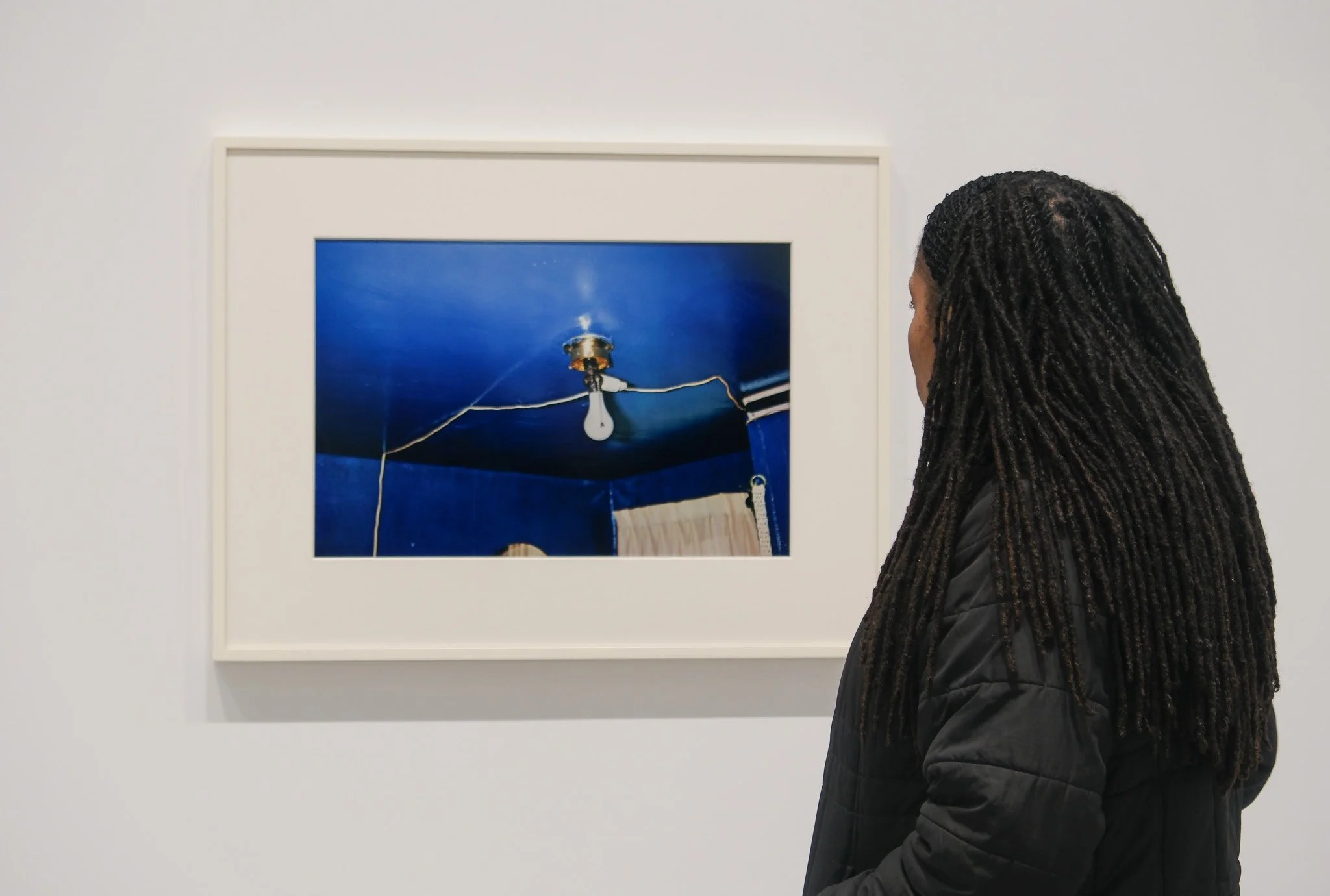
A viewer considers Untitled (1970), an Egglestong photograph known as the blue ceiling. Photo by Jamie Lubetkin
A bare lightbulb hangs from a blue ceiling, its wires stretched taut across saturated cobalt like power lines against a limitless sky. William Eggleston shot this in 1973, at the same time he made his more famous red ceiling—same angle, same fixture, different universe. Where the red version feels claustrophobic and fevered, this blue chamber opens upward into something cooler, more expansive. The color doesn't just fill the frame; it creates atmospheric depth, turning a cheap residential ceiling into infinite space. That's the dye-transfer process doing what it does best: making pigment so dense it acquires dimension, transforming flat surfaces into portals.
This is Eggleston in the early 1970s, shooting Kodachrome slides of the American South and discovering that ordinary moments could detonate with chromatic intensity if you knew how to print them. What he knew was dye-transfer, the same process Hollywood used for The Wizard of Oz and Gone With the Wind. What Kodak developed for selling lipstick and cigarettes, Eggleston hijacked for art.
The Last Dyes at David Zwirner marks the final group of photographs ever produced using this vanished process. When Kodak discontinued the dyes, paper, and matrix film in the early 1990s, Eggleston and his master printers Guy Stricherz and Irene Malli began hoarding materials. For the past 25 years, they've been rationing the last reserves. Now they're gone. These prints represent the extinction of a medium made relevant in the fine art realm by Eggleston, now 85 and still working.
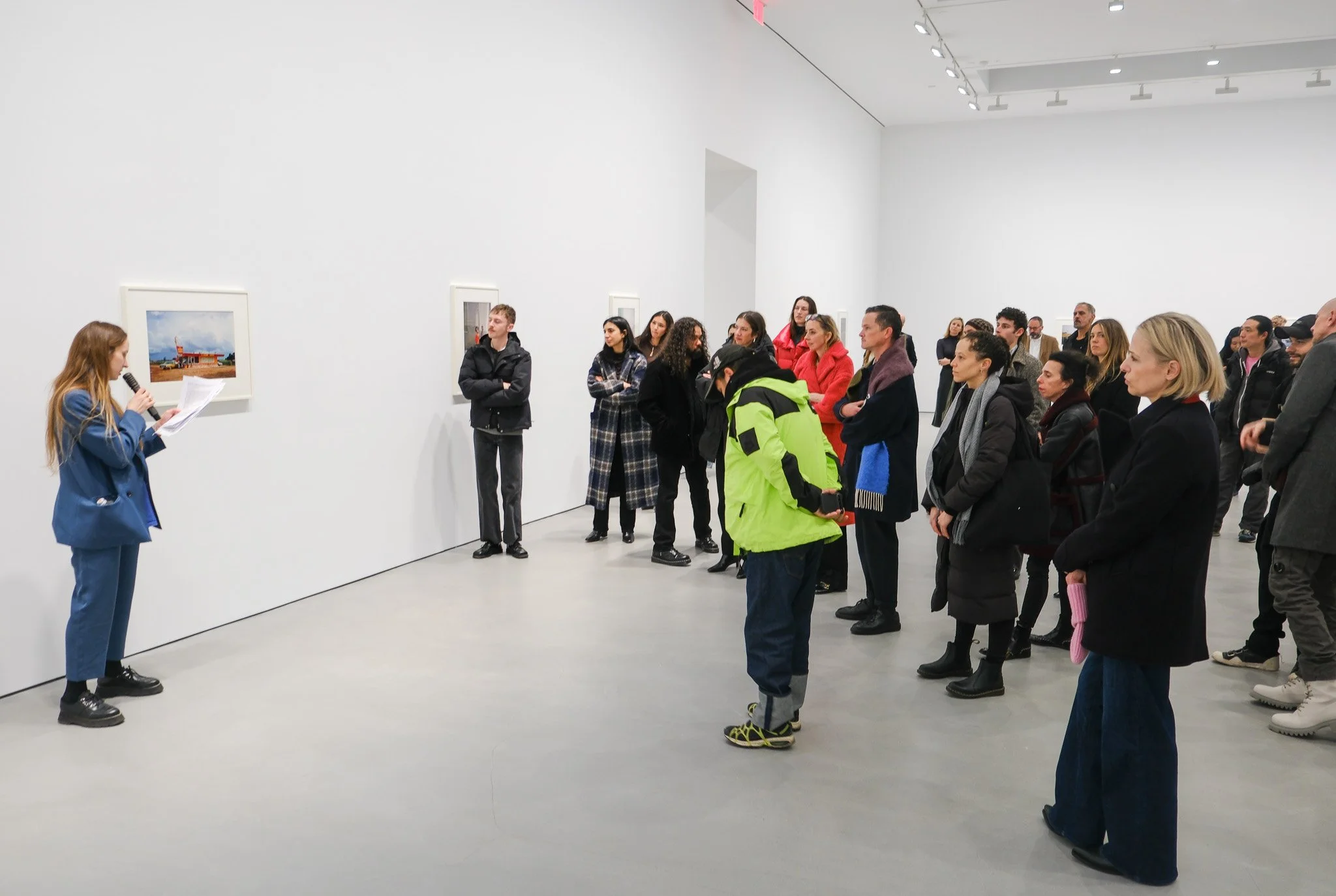
Brooklyn-based artist Sara Cwynar leads a press walkthrough of The Last Dyes at David Zwirner. Photo by Jamie Lubetkin
Brooklyn-based artist Sara Cwynar, who led a press walk through of The Last Dyes prior to the exhibition’s public opening, called Eggleston’s work “one of the most perfect combinations of medium and subject in the entire history of art.”
“I think there's something powerful about the use of these commercial, printing techniques…for these kinds of everyday subjects, which often include faded advertisements, discarded commodities, lonely or tired looking people, old cars, things that kind of show us how the promise of advertising doesn't always work out or live up to its promise. I think there's something very moving about that,” said Cwynar, whose practice includes photograph collage, installation and book-making.
Standing before the blue ceiling photograph, Cwynar compared the lesser-known work with The Red Ceiling, which gained cultural currency when it was featured on the cover of seminal 70s pop band Big Star’s 1973 record Radio City. “I think about…the difference between the sort of blood, saturated, creepy red of the original and this more serene version. And also the fact that we know this house is no longer there. I think for a lot of these photos, it's very much about looking at these things that you know are gone and Eggleston photographing things as they were about to disappear and photographing this kind of way of life that was being replaced by a new one, even in his own time.”
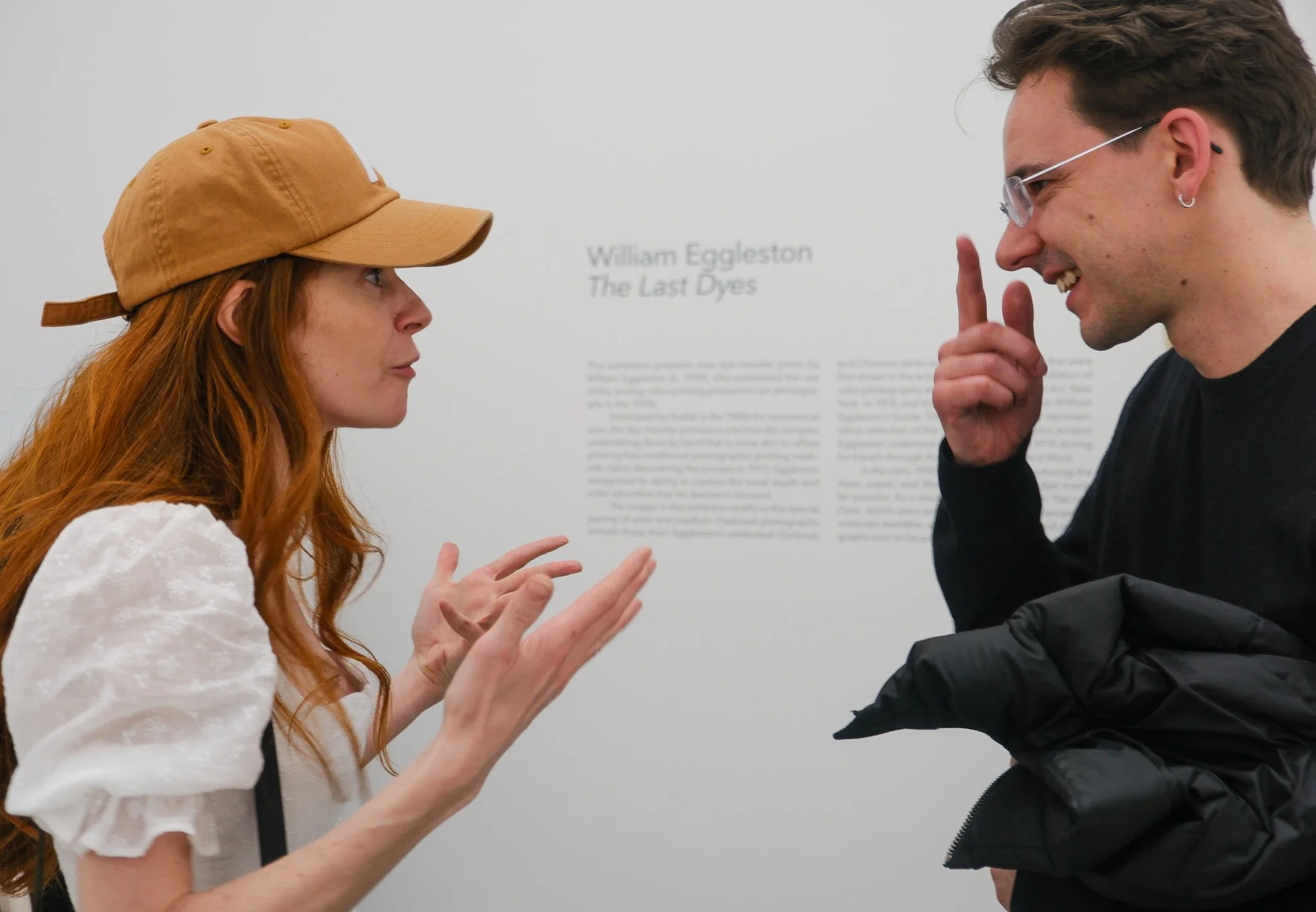
Attendees discuss the work of William Eggleston at Zwiner. Photo by Jamie Lubetkin
The dye-transfer process itself was complex and unforgiving. Eggleston's Kodachrome slides were split into three separation negatives, then enlarged onto three transparent film matrices coated with light-sensitive emulsion. Each matrix bathed in cyan, magenta, or yellow dye, the gelatin holding color like a sponge. Then one at a time, the matrices were pressed and rolled onto special fiber paper, building up layers of pigment until the image emerged with a physical surface that almost resembles painting.
It's expensive. It's slow. It's labor-intensive. And the results—as photographer and printer Richard Benson once said—"were, like Marilyn Monroe, better than anything else around."
The work on view spans 1969 to 1974, Eggleston's road trip years through the South and West. Like the untitled photograph of the blue ceiling, Zwirner chose to exhibit several other photographs that have gained less acclaim than their close relatives.
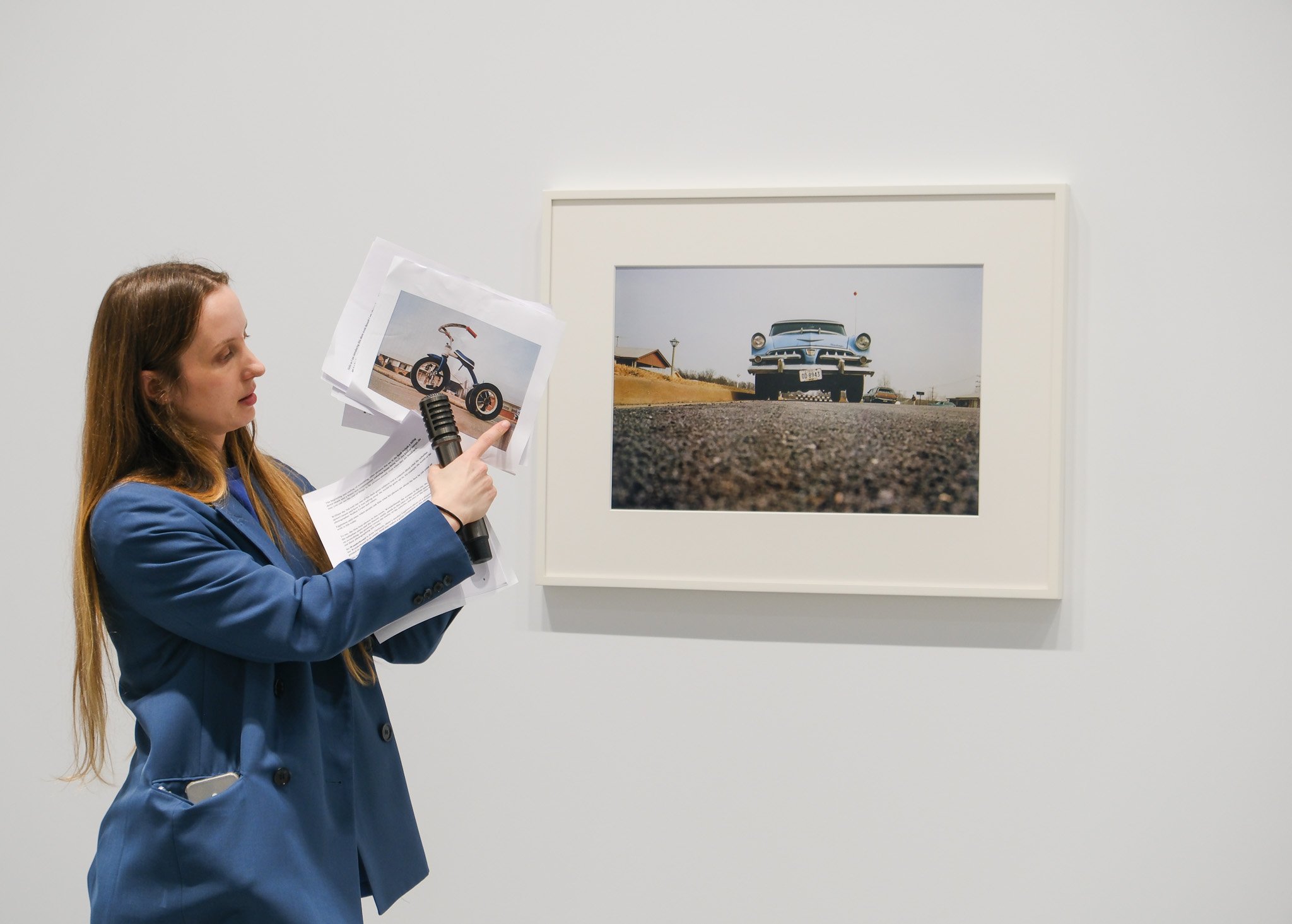
Cwynar holds up a copy of Eggston’s famous tricycle stands before a photograph of a 1956 Dodge taken at the same time. Photograph by Jamie Lubetkin
During the walkthrough, Cwynar held up a copy of Eggston’s famous tricycle photograph—the one that became iconic after appearing on the cover of William Eggleston's Guide—noting that you can just glimpse the bumper of a car on the right edge of the frame. That 1956 Dodge was captured moments later in a shot that is part of the Zwirner exhibition. Eggleston shot the tricycle low and close, giving a child's toy the monumental presence of sculpture, while the car photograph pulls back to show the full chassis looming against gray sky, asphalt texture sharp in the foreground. Both use the same strategy: ground-level perspective that transforms ordinary objects into totems. But the tricycle became famous while the car remained in the archive.
Some of the other images included in the show appeared in Eggleston’s explosive 1976 MoMA debut, the first major exhibition of color photography at the museum. John Szarkowski curated that show, and critics were anything but kind.
“As color is now one of the ‘hot’ problems in this medium long dominated by black and white images, it would be news indeed if Mr. Eggleston's pictures were the masterpieces they are claimed to be. In my opinion, they are not,” wrote New York Times art critic Hilton Kramer in his review of the MoMa show. He went on to slam Szarkowski for referring to Eggleston's images as perfect. “Perfect? Perfectly banal, perhaps. Perfectly boring, certainly,” the critic wrote.
The fury had two sources. First, color photography in 1976 belonged to advertising and fashion magazines, not museum walls. Stephen Shore had mounted a color show at the Metropolitan Museum in 1971 and critics were appalled then too. "Serious" photographers worked in black and white. Color was considered vulgar, garish, trashy—the domain of selling things, not making art.
Second, Eggleston's subjects seemed aggressively mundane. Gas stations. Grocery stores. A tricycle in a driveway. The interior of a kitchen stove. The contents of a freezer. Kramer saw only "dismal figures inhabiting a commonplace world of little visual interest"
When he first began experimenting with dye transfer, Eggleston said, “The color saturation and the quality of the ink was overwhelming. I couldn't wait to see what a plain Eggleston picture would look like with the same process. Every photograph I subsequently printed with the process seemed ... better than the previous one."
"Plain Eggleston picture" undersells the transcendent achievement documented at Zwirner. Southern skies manifest within the confines of the rectangular frame—verdant expanses, run-down structures, cirrus and cumulus clouds streaking overhead. Signs and cars become blocks of saturated color against tonal gradations shot at different times of day. People transform into visual components, emblems of specific places and moments.
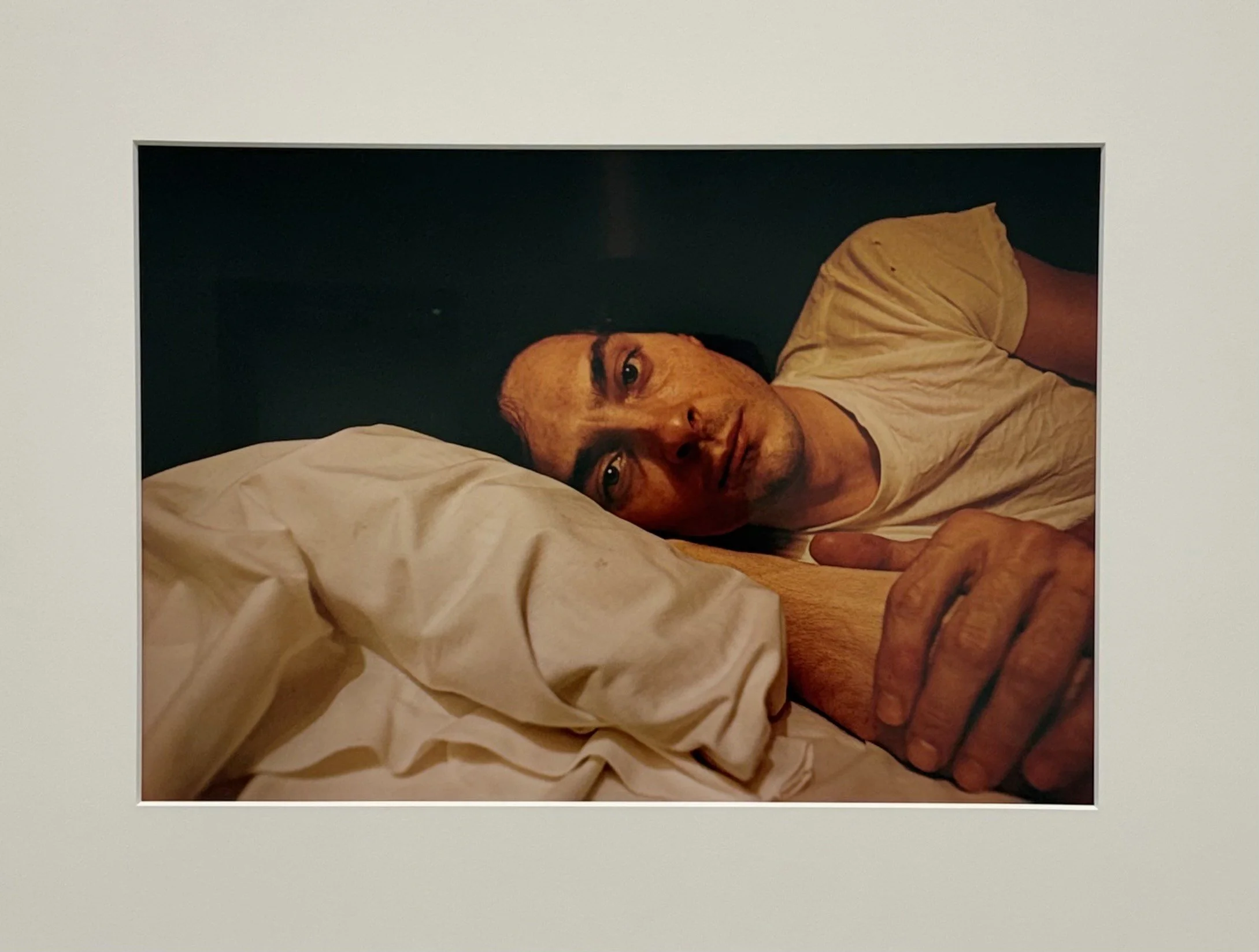
An Eggleston self-portrait. Photo by Jamie Lubetkin.
Then there are the interiors, where baroque tenebrism meets motel America. Deep blacks with brightly lit figures suspended within them. In one self-portrait, Eggleston lies in darkness, his head on a white pillow whose folds resemble carved marble. His face and oversized hand rest close to the lens, sculptural and strange. The scene evokes sacral light—a church interior relocated to some roadside room where Eggleston stopped for the night.
Jeffrey Kastner, writing in the accompanying book published by David Zwirner, identifies the tension that makes Eggleston's work endure: "The complicated dynamic between what [Eggleston] was interested in and how he expressed those interests in his images would turn out to be its own kind of advertisement—for a new way of thinking about, and photographically representing, the world around us, one that would come to mark his oeuvre as among the most indelible in the history of the medium."
There's finality here, but not mourning. The dye-transfer process is gone. The materials are exhausted. But the images—these specific images, printed this specific way—achieve what Eggleston always pursued: color so rich it transcends representation and becomes its own reality. As Kastner writes in the book, these aren't just pictures of the South. They're "among the most indelible in the history of the medium."
When Kodak killed dye-transfer, they killed more than a printing process. They killed a particular kind of seeing, a way of making the everyday luminous through sheer chromatic force. These prints are fossils of that vision, but fossils that still burn.
William Eggleston: The Last Dyes, is on view at David Zwirner, 533 West 19th Street, through March 7.