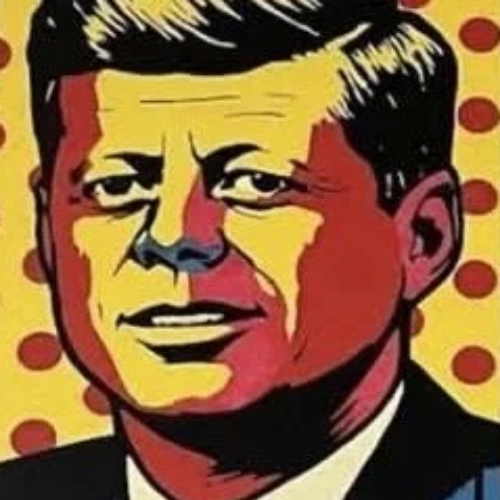
The AI generated “Warhol” portrait of JFK as seen on the wall at the Midtown Hotel in Boston.
Andy Warhol's 1964 portrait of John F. Kennedy is a neat distillation of the pop art progenitor’s genius: confident color blocks, that signature economy of line, a reduction of the president to his most iconic elements. It's a meditation on fame, mortality, and the way images flatten public figures into symbols.
By comparison, the Midtown Hotel's AI-generated JFK is risible. Put the real Warhol next to the hotel's algorithmic interpretation and the differences jump out like a bad photocopy. The AI version drowns in polka dots, excessive halftone patterns and the worst kind of comic book kitsch. Where Warhol's restraint creates tension, the AI fills every gap with decorative noise. One's a cultural artifact; the other's a screensaver, and not a good one.
As first reported by Artnet, Boston's Midtown Hotel reopened after five years as Northeastern dorm housing, and instead of hiring from the city's deep pool of actual artists, management chose the cheaper and easier AI route to decorate its walls. And it appears to be proud of that decision. Wall signs gleefully announce that "Art throughout this hotel was entirely created by Artificial Intelligence." It notes that these sterile masterpieces resulted when AI was asked: "What if Andy Warhol painted Boston luminaries?" According to reporting by Artnet's Sarah Cascone, the results have ignited social media fury and tanked the hotel's Yelp ratings to 2.6 stars.
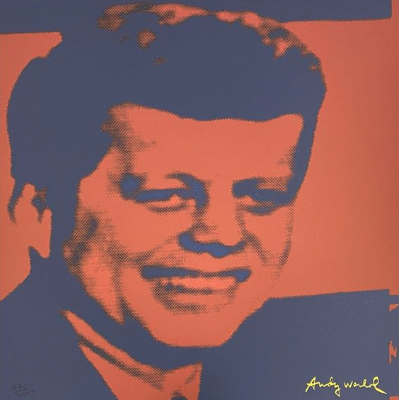
Warhol’s JFK portrait.
Unlike the other Boston luminaries the hotel sacrificed to AI pop art fakery—Larry Bird, Barbara Walters, David Ortiz, Donna Summer, Bill Russell, Arthur Fiedler, Thomas Menino—we actually have Warhol's real JFK portrait for direct comparison. And that comparison is not flattering. AI can mimic surface-level aesthetics, but it fundamentally misunderstands what made Warhol revolutionary. The algorithm just regurgitates visual clichés.
Guest Alex Steed, a photographer and publisher who stayed at the hotel during a friend's funeral, captured the mood perfectly: "I know we have bigger fish to fry but this sucks so fucking bad," he wrote on Instagram. His post drew thousands of views and hundreds of comments, with one observer noting, "In a city with world-renowned art museums and world famous art schools, someone missed a real opportunity."
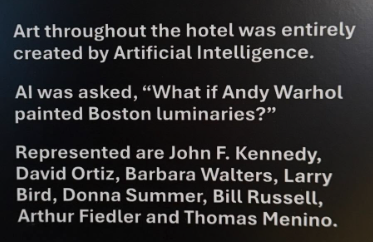
A sign on the wall of the Midtown proudly announcing its use of AI to create portraits to decorate its walls.
Boston's art scene is, of course, legendary—Mass Art, the School of the Museum of Fine Arts, the Isabella Stewart Gardner Museum—yet the Midtown opted for algorithmic slop over human creativity. The hotel's sign reads like a celebration of cost-cutting dressed up as innovation, proudly advertising the elimination of artists from art-making. As Steed told Artnet: "You can throw a rock and hit an artist. It's easy to source someone who's local."
The Warhol Foundation declined Artnet’s request for comment, but the real Andy—who understood that repetition, appropriation, and mechanical reproduction were tools in service of ideas about fame and capitalism—would probably find this whole situation grimly amusing. His work questioned authenticity. This hotel just fakes it.
Source: Artnet News, "Boston Hotel Roasted for Using A.I.-Generated 'Warhol' Portraits as Decor," January 7, 2026