London’s Nightmarish Christmas Mural Shows What Happens When AI Replaces Artists
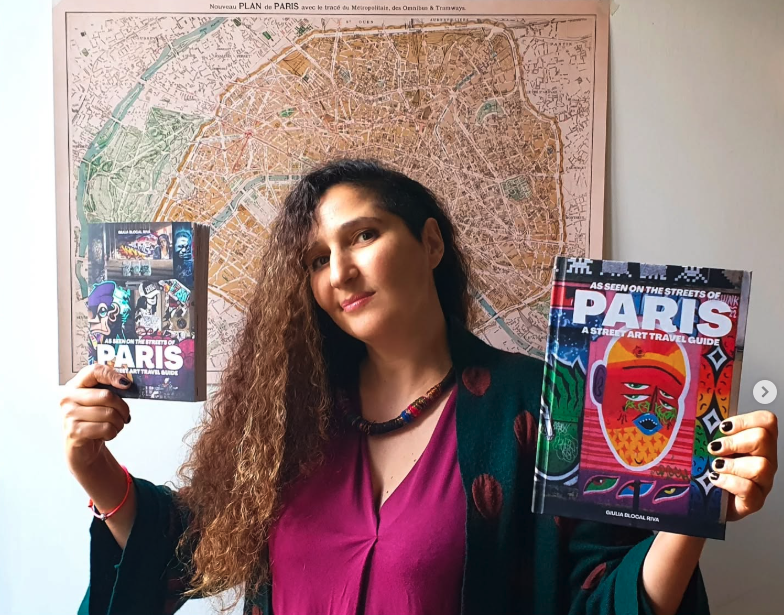
After we published our piece When AI Meets Pop Art: A Boston Hotel's Warhol Fail, we heard from, Giulia Blocal, the Rome-based street art writer and author who has been running the independent blog BLocal Travel since 2011. Giulia had just included an essay in her substack Beyond the Walls about the role of AI in public art.
“In street art, the role of the artist extends beyond producing an image: it involves research, intention, dialogue with the community, analysis of the context, vision, and accountability. Street art is not just a visual outcome but a human practice rooted in decision-making, context and lived experience. With AI-generated works, instead, the result feels disconnected, hollow or careless, reinforcing the perception that speed and cost have been prioritised over meaning and craft,” she told B Scene Zine.
Giulia served as Communication & Content Manager at Amsterdam's STRAAT Museum and writes the monthly newsletter Beyond the Walls. Her independent book series As Seen on the Streets of... combines personal experience with local artist insights to document the cities shaping global street art culture. The series has so far looked at London and Paris. Her work has appeared in The New York Times, The Sunday Times, Brooklyn Street Art, and Sky TG24.
Here is her essay on AI and pubic art:
👋 Ciao, I’m Giulia Blocal, your street art insider. This is Beyond the Walls, a monthly deep dive into street art, graffiti, off-the-beaten-path travel, and a bit of my life in between.
A large Christmas mural generated using artificial intelligence was installed in southwest London. Intended to evoke a festive winter scene inspired by the work of Pieter Brueghel the Elder, the image instead unsettled viewers with its distorted figures and surreal inconsistencies.
From a distance, it appeared to depict a frozen Thames animated by crowds and winter activity.
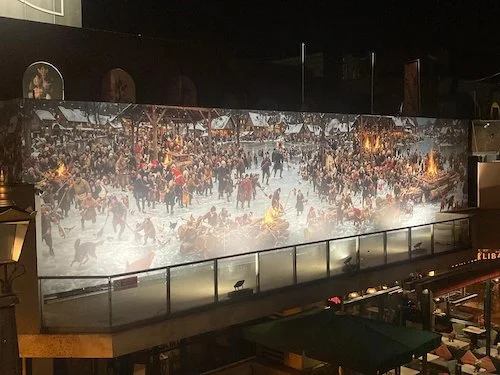
Up close, the image revealed an unsettling accumulation of visual anomalies: grotesquely contorted faces, warped Santa Clauses and snowmen, animals bleeding into one another, and figures with misshapen bodies struggling to skate across shallow, foamy water, while elsewhere crowds packed into an improbably oversized wooden boat.
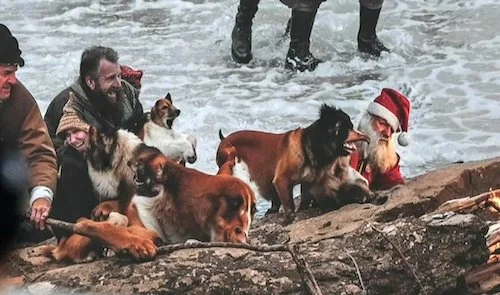
Detail of the London mural generated by AI.
As photos circulated widely on social media, public reaction ranged from mockery to concern, with many questioning how such a visibly flawed and unsettling image was approved for display in a shared urban space.
The Chicago Mural Controversy
Sadly, this AI-generated mural isn’t an isolated case. Earlier this year in Chicago, a public mural sparked significant backlash after it emerged that the artwork was generated by artificial intelligence rather than created by a local artist or through community collaboration.
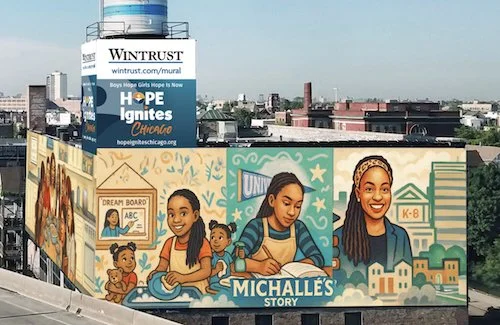
What had been expected to be a celebration of community and culture instead drew criticism as it lacked the authenticity, nuance and human voice typical of murals in the city’s long public-art tradition, while at the same time bypassing opportunities for real artists to contribute to public narrative and place-making.
AI in Public Art: A Question of Representation and Responsibility
Both episodes have sparked broader conversation about the role of AI in public art, authenticity in representation, and how decisions about mural production should involve community voices rather than defaulting to automated tools.
I found images online of the slogan “Hire real artists” spray-painted over other examples of AI-generated urban art, an understandable and legitimate reaction that speaks to a deeper unease about how generative AI is being deployed in public contexts.
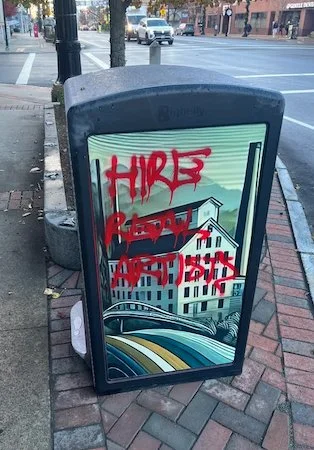
The criticism is not simply a rejection of technology, but a response to processes that replace human labour, authorship, and community work with automated image production. In street art, the role of the artist extends beyond producing an image: it involves research, intention, dialogue with the community, analysis of the context, vision, and accountability.
Street art is not just a visual outcome but a human practice rooted in decision-making, context and lived experience.
With AI-generated works, instead, the result feels disconnected, hollow or careless, reinforcing the perception that speed and cost have been prioritised over meaning and craft.
🤔 But What If the Distorted Christmas Mural Was Intentional?
Today’s AI is far too advanced to produce such blatant hallucinations by accident, and that is what makes those bizarre visuals feel to me intentional rather than careless. I read the accumulation of errors, distortions and surreal mismatches less like a technical failure and more like a provocation, one designed to force viewers to confront the role of the artist, or the absence of one.
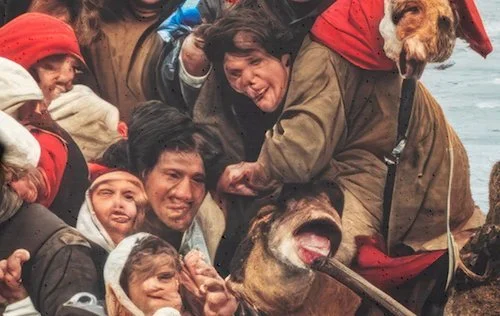
Detail of the London mural generated by AI.
While researching, I came across a persistent rumour attributing the mural to Mat Collishaw, a YBA artist known for his long-standing interest in provocation and, more recently, for his extensive use of AI as an artistic tool. That connection is what fuelled the speculation in the first place. Although no confirmation ever arrived and the artist did not respond to multiple requests for comment, the idea remains compelling. At the very least, it suggests the possibility that an artist deliberately amplified AI’s visual hallucinations to trigger a debate about authorship, intention and responsibility in public space.
This reading feels to me more convincing than the alternative explanation of an unsupervised intern, a rushed approval process and a 100-foot image installed without anyone noticing that something was fundamentally off.
What remains difficult to understand for me is why no one has stepped forward to explain that the mural may have been made on purpose, a silence that ultimately weakens its potential to be read as a deliberate artistic gesture rather than a simple oversight.
If that were the case, then the outrage, confusion and discussion it generated, culminating in the mural being torn down shortly after installation, should be seen not as failures but as outcomes.
After all, this is exactly what meaningful art has always done: unsettle, provoke, invite interpretation, and push us to question how images are made, who makes them, and why.