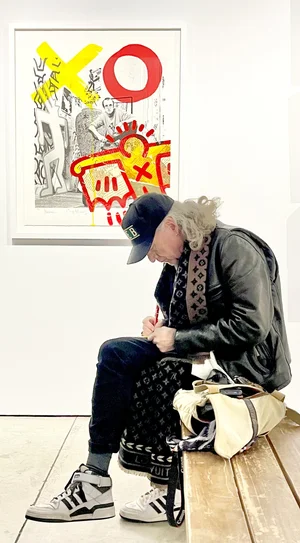
Before the Whitney: Gagosian Visits Roy Lichtenstein's Brushstrokes
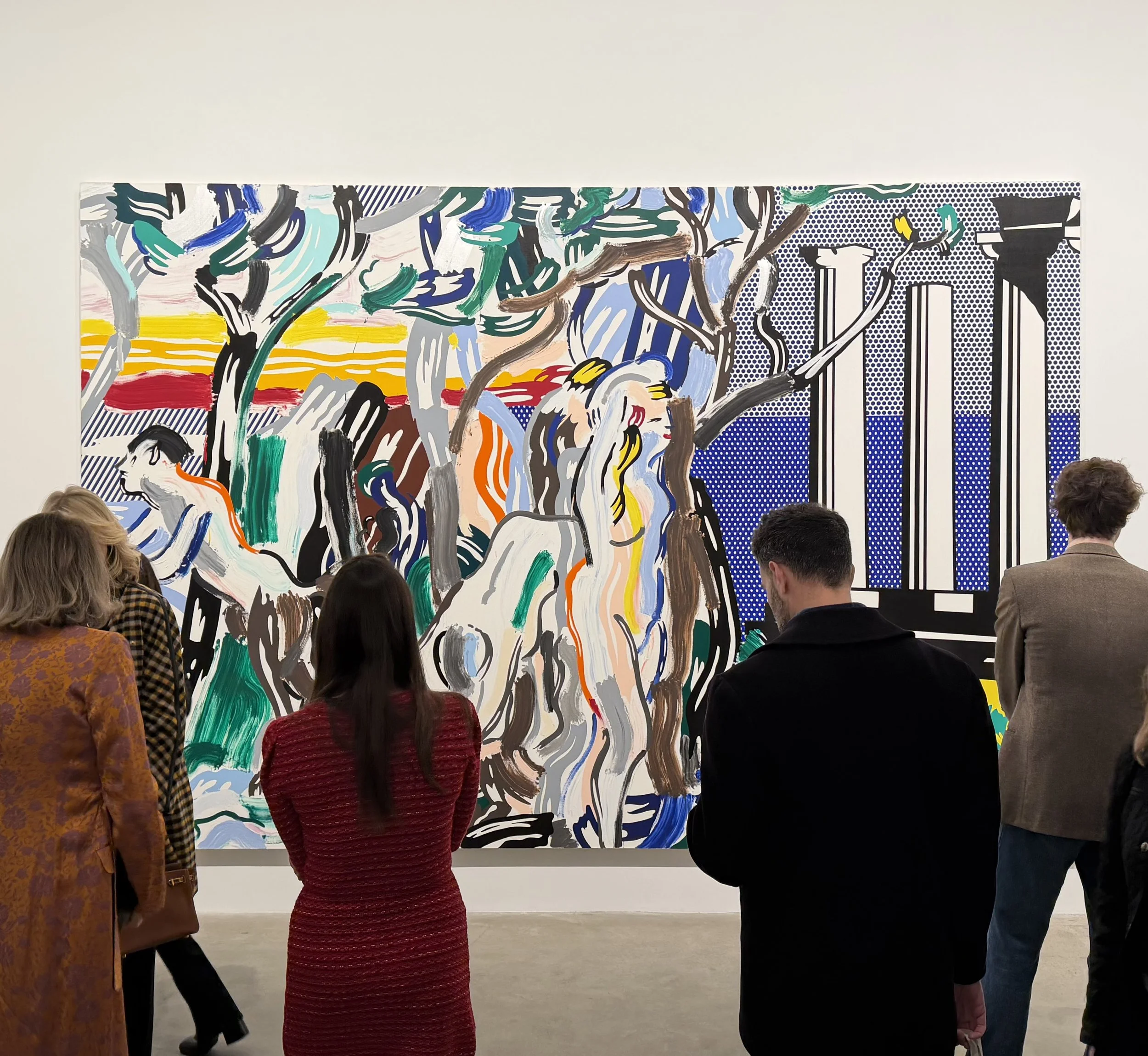
Viewers examine Roy Lichtenstein's Forest Scene with Temple (1986) at Gagosian in Chelsea. Photo by Lisa Freeman
The left side of Roy Lichtenstein's Forest Scene with Temple (1986) is a tangle of unruly brushstrokes that don't seem capable of the kind of rational, organized behavior normally associated with pop art compositions. Gray and green marks are assembled into something approaching a forest with restive figures flitting about the surface, never becoming fully distinct from the lines that make them. To the right, though, a crisp, comic-book temple holds its ground, all black outline and Benday logic.
Lichtenstein spent decades considering the duality of committing art with traditional brushstrokes, versus his signature devotion to concise lines and Benday dots. One is the abstract expressionist ethos of painting as gesture with improvisation and emotion dispensed by the artist's hand. The other bows to pop art's painting as system, leveraging code, reproduction and control. In Forest Scene, Lichtenstein refuses to make a choice, forcing the two styles into coexistence.
Later this year the Whitney will open a major retrospective of work by Roy Lichtenstein, the first comprehensive survey of the pop art legend there in more than two decades. And it's safe to assume the place will be awash in Benday dots. But before that institutional main event arrives in October, Gagosian is offering a toothsome preview that focuses on Lichtenstein's brushstroke work as a reminder that he often strayed from comic book stylings and whiz-bang word play.
Open March 19 at Gagosian's Chelsea space, Painting with Scattered Brushstrokes revisits one of Lichtenstein's most persistent ideas: the brushstroke itself. Drawn largely from the Roy and Dorothy Lichtenstein family collection, the exhibition assembles paintings, sculpture, watercolors and works on paper tracing how a single pictorial device became one of the artist's most enduring departures from pop art sensibilities.
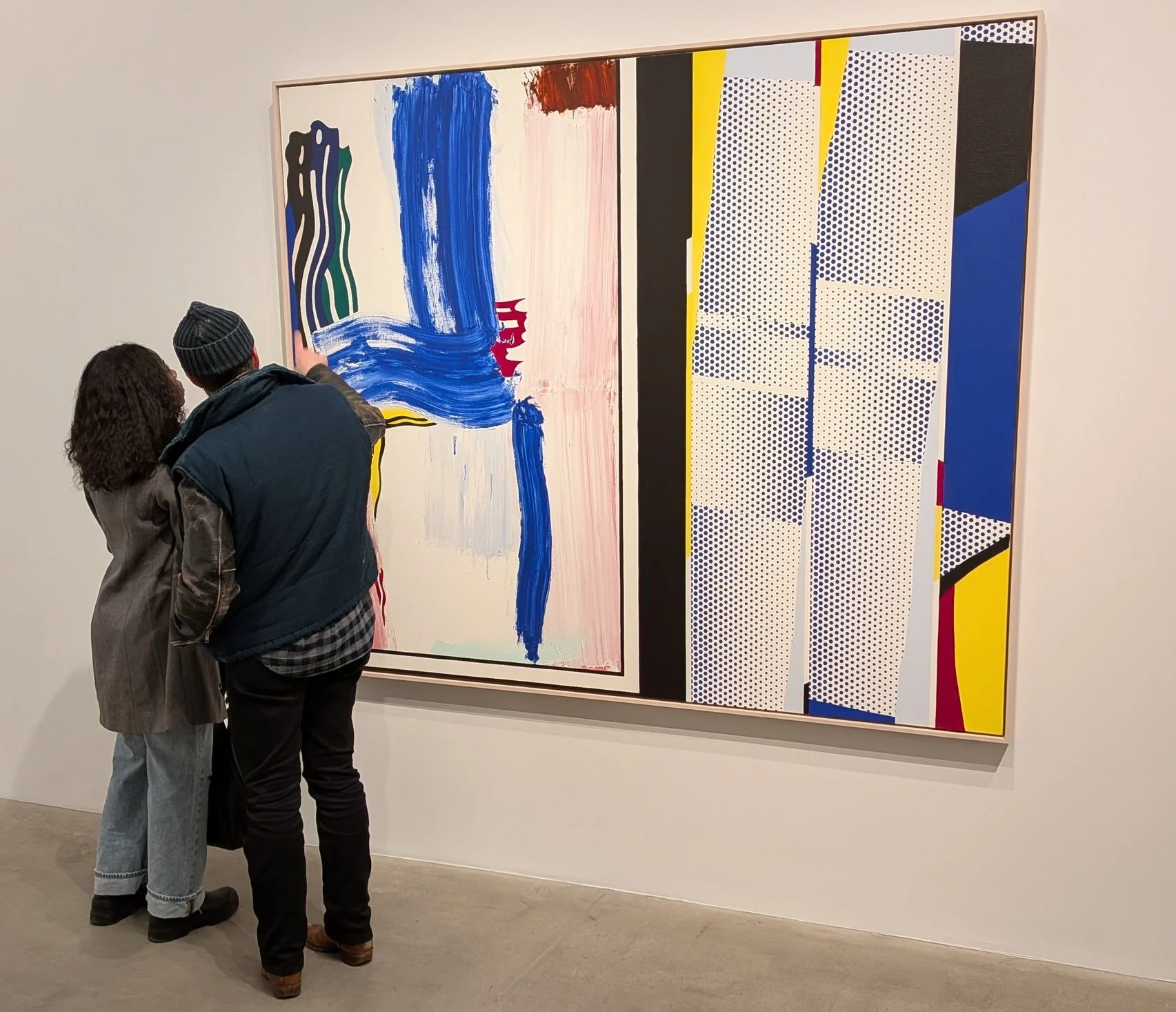
A couple considers Lichtenstein's Painting: Mirror (1984) at Gagosian. Photo by Lisa Freeman
In fact, despite his association with pop art cleanliness, Lichtenstein spent decades dismantling the brushstroke. He sought to translate the swaggering mark of abstract expressionism into something oddly mechanical: flat bands of color edged in thick black outlines. The heroic smear of paint became an image of a brushstroke rather than the thing itself. Lichtenstein once described the device as "a depiction of the object—a kind of crystallized symbol of it," reducing the expressive rhetoric of modernist painting to a graphic sign. (Quote source: exhibition context/artist statement — see flag below.)
The Gagosian exhibition comes at a moment of renewed interest in Lichtenstein's work, including 2025 auction results that highlighted the demand for his work in the run-up to the Whitney retrospective. Last year, Sotheby's presented a dedicated single-owner sale of more than 90 works from the Dorothy and Roy Lichtenstein Collection as part of a broader series of auctions that collectively realized over $150 million.
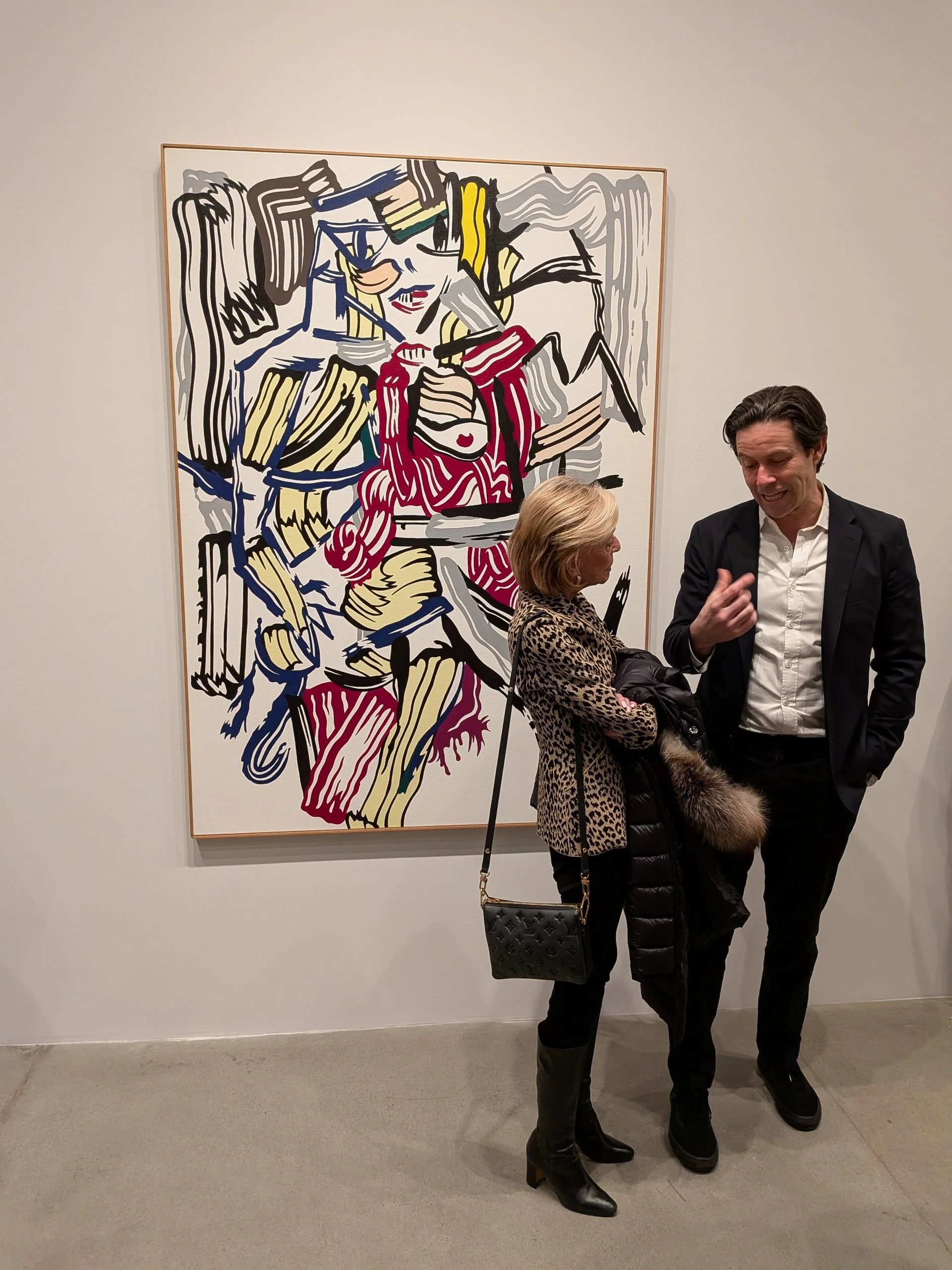
Two visitors share a moment in front of Lichtenstein's Woman (1981) at Gagosian.
The current show focuses largely on works from the 1970s and '80s, when Lichtenstein returned to the brushstroke. Instead of isolating a single stroke against a blank field—as he often had in the 1960s—he began embedding brushstrokes within landscapes, figures and fragments of classical architecture. The marks might stand in for foliage, waterfalls or anatomy. What began as parody gradually evolved into a compositional system.
Forest Scene is a monumental example of this, with its suggestion of a forest on one side and a Greco-Roman temple on the other. Within the forest are barely legible figures: a dark-haired nude at left and a blonde figure near the center, their limbs dissolving into the surrounding brushwork. The same strokes that define tree limbs also describe bodies, making it difficult to determine where landscape ends and anatomy begins.
Behind them the background fractures into competing visual codes: diagonal blue hatching on one side, wavy yellow-and-red bands suggesting sunset at center and the precise dot pattern behind the temple at right.

Roy Lichtenstein working on Forest Scene with Temple (1986) in his Southampton studio, New York, c. 1986. Artwork © Estate of Roy Lichtenstein. Photo: © Bob Adelman
Photographs of Lichtenstein working on the canvas in his Southampton studio reveal how carefully the effect was constructed. The studio—designed by the artist in the 1970s with skylights and high ceilings—was built specifically to accommodate works of this scale. In one image Lichtenstein stands before the unfinished painting, aggressively applying a diagonal brushstroke that would become a tree limb in front of one of the temple's columns. The photographs clarify what the finished painting disguises: the gestural marks and the precise geometry were not opposing impulses, but deliberate choices deployed at different moments by the same hand.
Painting with Scattered Brushstrokes is less a market event than a focused argument about how one idea shaped decades of Lichtenstein's work. Across the work on view, the brushstroke emerges not merely as a recurring motif but as a conceptual device—a way of translating the expressive rhetoric of modernist painting into a language of images.

Painting with Scattered Brushstrokes drew an ample crowd to its opening at Gagosian, Chelsea. Photo by Lisa Freeman
Lichtenstein was born in New York on October 27, 1923, and died here on September 29, 1997, at the age of 73. He painted his first Brushstroke canvas at 41 and continued returning to the motif for the rest of his career.
The Whitney retrospective will revisit that trajectory on an institutional scale this fall. For now, Gagosian offers a concentrated preview—one brushstroke at a time.
Roy Lichtenstein: Painting with Scattered Brushstrokes runs March 19–April 25 at Gagosian, 541 West 24th Street, New York.