From Room 828 to West 19th Street: Elizabeth Peyton Is Still Paying Attention

A woman considers Elizabeth Peyton’s 2026 painting, “The Death of Sarpedon (after Henri-Leopold Levy, 1874).” Photo by Jamie Lubetkin
A small painting hangs on the white wall of David Zwirner's Chelsea gallery. A figure—pale, nearly weightless—is being lifted and carried away. The colors bleed into each other: rose, lavender, a wash of blue. The body is surrendered. The people holding it are barely there. The painting is The Death of Sarpedon (after Henri-Léopold Lévy, 1874), Elizabeth Peyton's response to a 19th-century work and the story from Homer's Iliad of how Zeus, unable to save his son’s life, weeps and lets him go.
Across the gallery, Peyton is speaking to a pre-opening gathering hosted by David Zwirner. She has been thinking about this myth for a while. Someone close to her died. She returned to the story of Sarpedon and found something in Zeus's surrender—not defeat, but acceptance. "Instead of fighting against nature," she said, "he rained down tears of blood, and he lets it happen." She described it as "quite heartbreaking, but soothing at the same time."
On March 19, mountains in my heart (the death of Sarpedon), Peyton's latest solo show in New York, opened at Zwirner’s Chelsea gallery. It follows solo presentations at his gallery in London in 2023 and Paris in 2025, and arrives after her work appeared in Zwirner's 2025 group survey Circa 1995: New Figuration in New York alongside John Currin, Peter Doig, Marlene Dumas, and Lisa Yuskavage.
Zwirner, introducing Peyton at the opening, traced his relationship with her work back to the early days of both their careers. "I've been a fan of Elizabeth Peyton's for as long as I had a gallery," he said. "I opened my gallery in 1993 on Greene Street and in 1994 I walked around the corner to Broome Street and there was a brand new gallery, Gavin Brown, and I think his opening show was Elizabeth Peyton. I bought a painting. I still have the painting. And so to have Elizabeth in the gallery is just spectacular."

David Zwirner discusses his relationship with Elizabeth Peyton during the opening of her show, mountains in my heart (the death of Sarpedon). Photo by Jamie Lubetkin
Peyton's New York story started before that. Born in Danbury, Connecticut in 1965, she studied at the School of Visual Arts from 1984 to 1987, during the years when Jean-Michel Basquiat, Keith Haring, and Kenny Scharf were pulling downtown into a new art era. Her first solo show was at Althea Viafora Gallery in 1987. In 1993, Gavin Brown organized a two-week exhibition of her drawings in Room 828 at the Hotel Chelsea—visitors collected a key at the front desk and entered an unattended installation of small portrait drawings of historical figures, viewable around the clock. Fewer than 50 people came. It became one of those quietly mythic downtown moments. Today, her New York story continues with work in MoMA, the Guggenheim, and the Whitney.
Looking at the Sarpedon painting, what strikes you is how little force it uses. Peyton has taken a scene of mythological weight and rendered it almost fragile. The lifted figure is barely articulated—form implied rather than stated, flesh rendered in transparent layers that seem to evaporate as you look. The violence of the battlefield wounds is gone leaving tenderness in its place. It is, as Peyton suggested, soothing. A painting about how we handle loss.
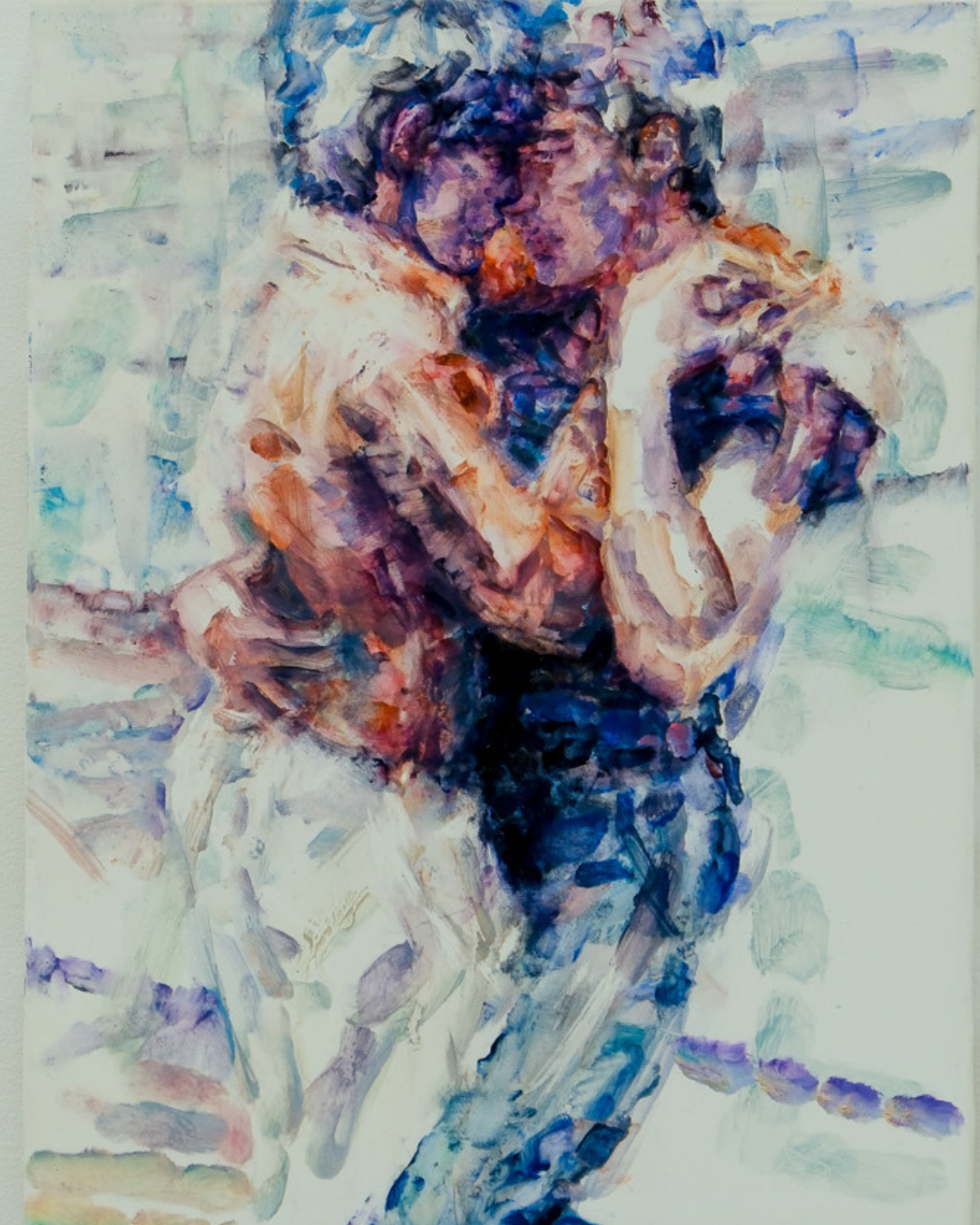
Elizabeth Peyton’s “Happy Together” (2022–2024). Photo by Jamie Lubetkin
A man looks at Elizabeth Peyton’s “Happy Together” (2022–2024). Photo by Jamie Lubetkin
Happy Together (2022–2024) operates differently but from the same emotional territory. Two figures embrace their bodies rendered with rapid, dense strokes of copper, cobalt, and lavender against a cool pale ground marked with loose horizontal dashes. Where the Sarpedon painting is quiet and open, Happy Together is compressed and urgent. Peyton doesn't resolve the forms; you read the embrace through color and pressure rather than anatomy.
"I trust what catches my eye, and I follow it, and feel it," Peyton said at the opening. "And trust that what is holding my attention is important."
In Thus Love, Echo (2023) the face emerges from a field of violet, lavender, and pale rose, the features built from loose, directional strokes that cohere just enough to read as a portrait before dissolving back into paint. Like all of the paintings in the show, Thus Love, Echo is of modest scale. But from any distance, it is indisputably beautiful. And across her oeuvre, Peyton has made the pursuit of beauty a principle mission. "I didn't want to give up on beauty. Beauty was a very powerful thing in my life,” she said.
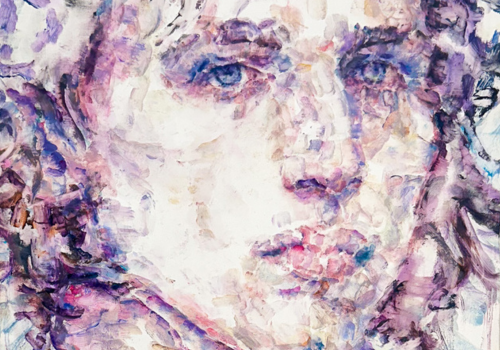
Detail, Elizabeth Peyton’s “In Thus Love (Echo),” 2023, at Zwirner. Photo by Jamie Lubetkin
Elizabeth Peyton’s “In Thus Love (Echo),” 2023, at Zwirner. Photo by Jamie Lubetkin
That method of paying attention and trusting in her own perception of beauty is what connects Peyton’s portraiture of Napoleon Bonaparte and Kurt Cobain to the dying son of Zeus. Peyton is often grouped with Marlene Dumas as part of the 1990s return to figuration. The comparison holds up to a point. But where Dumas leans toward confrontation, Peyton stays quieter, granting her subjects respect and admiration regardless of whether they are ancient heroes or rock stars or friends.
The critic Peter Schjeldahl observed in 1997 that what mattered in Peyton's work was not who she painted but how—"with rigor that has ethical bite," he wrote in the Village Voice. Nearly three decades later, the rigor is still there, and so is the bite—just held very lightly, in very careful hands.
Elizabeth Peyton: mountains in my heart (the death of Sarpedon) runs March 19 – May 2, 2026 at David Zwirner, 533 West 19th Street, Chelsea, New York.