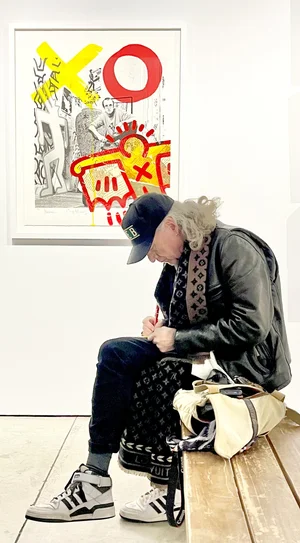
Graffiti Legend RAMS, In His Own Words
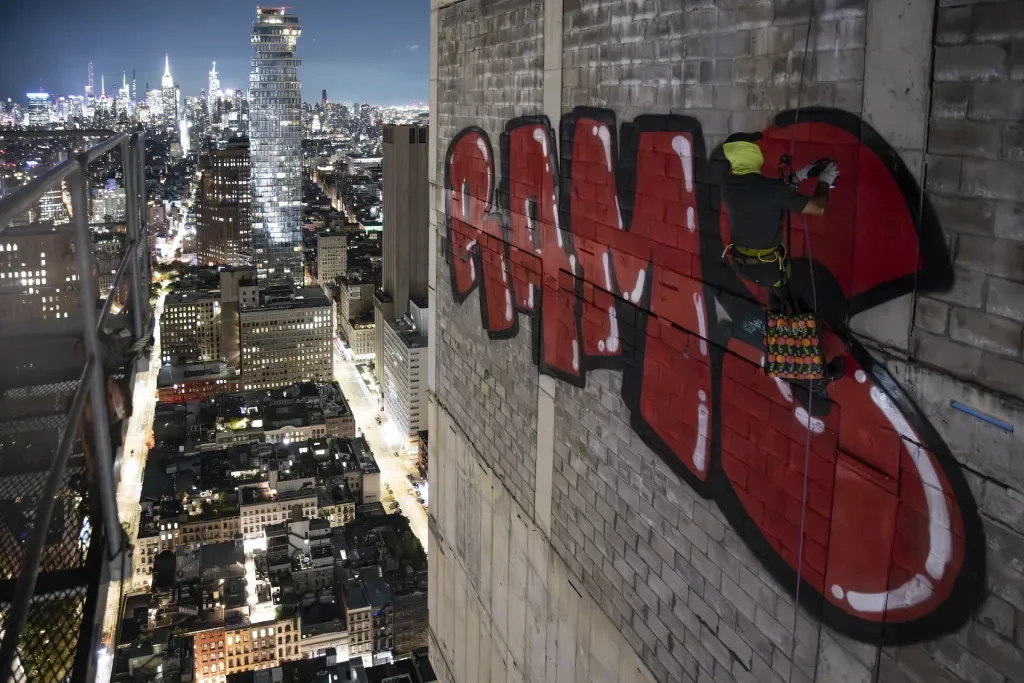
RAMS tagging 45 Park Place. Photo by driftershoots via RAMS.
In preparing a piece for OBSERVER about rappel graffiti, I reached out to a number of artists, including the legendary RAMS. In the process of answering questions about the global phenomenon in which artists use mountaineering gear to rappel down the sides of buildings to create monumental tags, RAMS composed a brilliant essay in which he discussed the history of rappel graffiti, his inspirations, how he got started, what motivates him and the inside story of how he tagged a building near the Egyptian pyramids.
In recent years, RAMS has created some of the most spectacular tags ever. Last year, for example, he scaled 161 Maiden Lane, the stalled 700-foot-tall residential project known as The Leaning Tower of New York, to complete the highest rappel tag ever. He also made international headlines when he rappelled down a skyscraper under construction at 45 Park Place to leave his mark hundreds of feet above the streets of Lower Manhattan.
And more recently, he risked international incident to complete a tag in the shadow of Egypt’s pyramids. Here is RAMS story in his own words:
By RAMS
I’m not exactly sure what the history of rappelling in graffiti is. What I remember as a kid, though, was seeing New Jersey writers PK and KID hitting impossible spots. I assumed ropes were involved, but they never publicly spoke about how they were getting into those positions. Years later I met PK, and it was a privilege hearing about his life and that era firsthand.
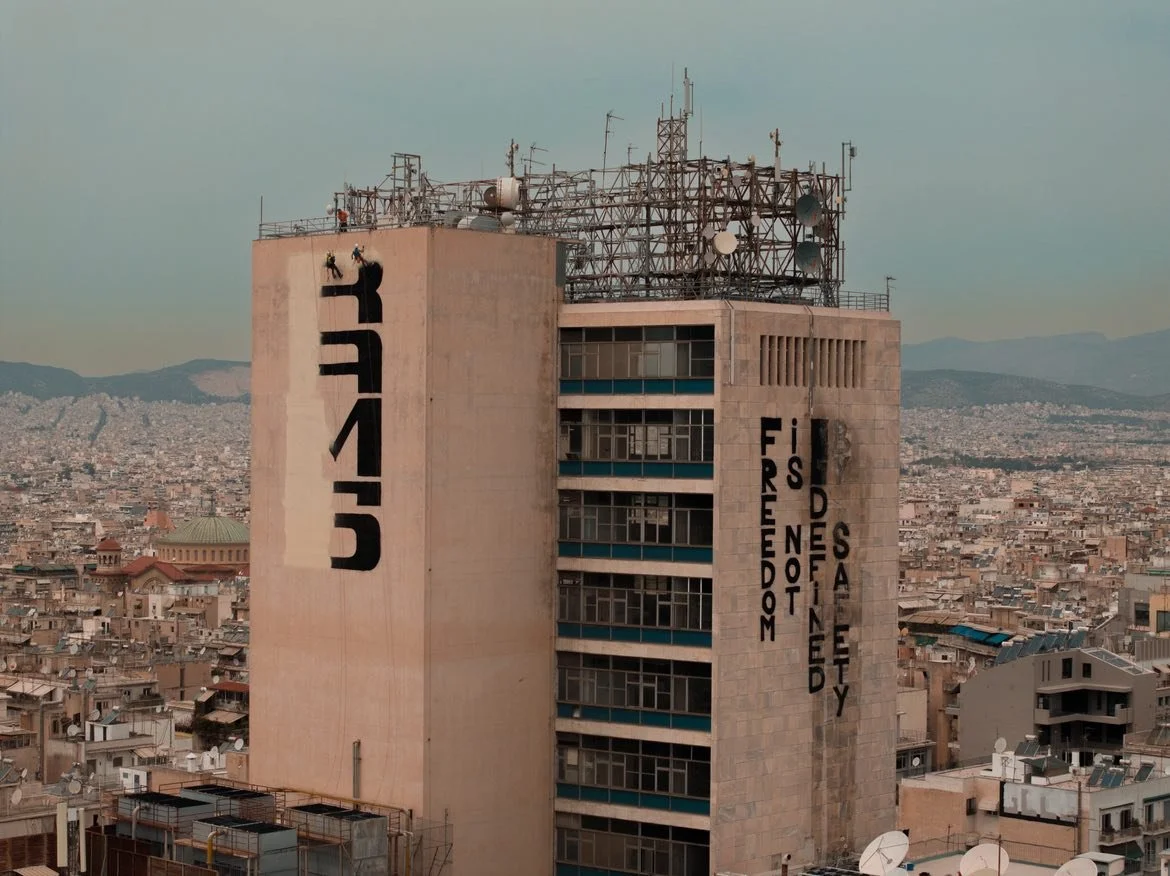
RAMS and others working on a piece in Athens. Photo courtesy RAMS
I first tried rappelling in Philadelphia while traveling through the States. At the time I was highly motivated to make a name for myself, especially since most Americans had never heard of me. I was shown the gear on a hotel roof we accessed by casually walking in like we were staying there. With some patience and bolt cutters, we got to the roof.
I put the harness on, the guy I was with tied the knots, and off I went. The moment my weight went over the edge, I was terrified. I had no real understanding of the gear. There was no backup line if the rope failed. I slowly lowered myself past the hotel sign, trying not to snag the rope on the steel frame of the neon sign.
Fear and second thoughts flooded in — why am I doing this? When it came time to ascend back up the rope, I couldn’t. I didn’t know how. I’d had a 20-second explanation about 30 minutes earlier. I was trying to yell and whisper at the same time, asking the guy on the roof for advice without attracting attention from the street below, which felt just as close as he was.

RAMS at work on a piece 700 feet atop 161 Maiden Lane in Lower Manhattan. Photo courtesy RAMS
It was extremely stressful. After a long struggle, I managed to ascend (incorrectly) using brute force. When I finally got back onto the roof, I’d never been happier to feel solid ground under my feet. My legs were numb; the harness had cut off circulation for so long it took a while before I could feel them again.
Over the next few months, I got a little better through practice. What really reduced the fear and the physical effort was binge-watching rock climbers and rope-access workers on YouTube. Understanding the mechanics changed everything. Since then, I’ve minimized the amount of gear I carry, partly because it usually involves climbing endless stairs with a bag full of paint, and partly because traveling internationally demands that everything packs down as small as possible.

RAMS tag, toward the left, along with many others on a building in New York’s Chinatown. Photo by J. Scott Orr
As for the motivation, it’s the same as painting graffiti on the street or on trains. I love it. I love it so much I almost hate it. I wish I were passionate about something that actually made money, but instead this takes every cent and all my time.
It’s a combination of things: growing up when graffiti was everywhere and every kid had a tag, being encouraged to pursue art because I could draw, instability at home, and the need to get outside and feel seen and appreciated by my peers. Some of those motivations have faded, but I think the 13-year-old version of me would be hyped to see where I am now.
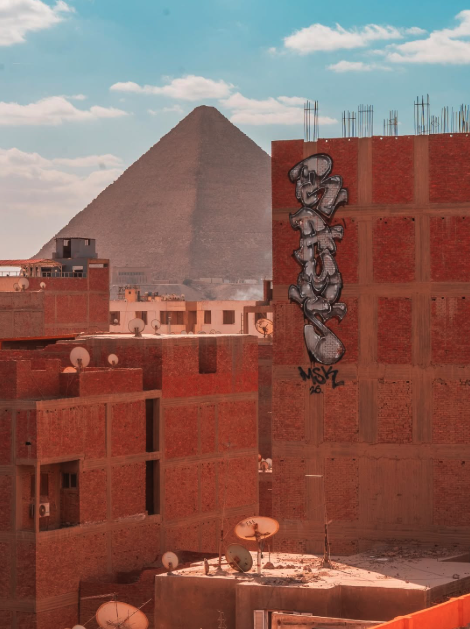
Rams rappel graffiti in the shadow of the pyramids in Giza, Egypt. Photo courtesy RAMS
Right now I’m focused on the Middle East. The risk is high, but so is the potential. Every country is different, but many haven’t had much exposure to this Western art movement. Graffiti has appeared there before, often politically — especially during the Arab Spring in 2010, which makes things dangerous. Police or military can assume political intent, and that can lead to serious consequences and painting the metro is always treated as a crime against the state.
Giza was difficult. Most rooftops are occupied by apartments or huts with people living up there. The city is run down, but the architecture is beautiful, and the people are kind if you can pass as local. Every building I wanted to access was locked at night, with steel gates at street level. Breaking into one on a busy street wasn’t an option in a city saturated with police and military.
I spent a week scouting buildings and access points. Each building I attempted I would have to wait around 12 hours in the building before I could exit again. On the final building, I built a makeshift ladder to get over an unfinished brick wall. The rooftop was covered in dust, sand, and broken wood, so over a few hours I gathered scraps and stacked them to be able to reach the top to rappel the building.
I waited until 3:30 a.m., hoping the area would calm down. It didn’t. People were still walking past constantly, and at least 20 surrounding buildings overlooked the spot, with residents regularly stepping onto their balconies. I was running out of time that night, and in Egypt.

Another view of Rams tag in the shadow of the pyramids in Giza, Egypt. Photo courtesy RAMS
I climbed over and started rolling the crude wall with light blue bucket paint. Within five minutes, a woman across the street spotted me from her window. I was already committed and locked into the building so I kept painting. I waved to see if she was calm. No response.
Fifteen minutes passed. She stayed at the window. No police arrived. More people noticed, but everyone seemed to continue their night. Eventually I finished the piece. Even if things went wrong now, I’d done it: the first rappel in Egypt, and on a building close to the pyramids. I was happy but still stressed.
I climbed back over and packed up. People across the street were still watching, probably out of curiosity. From their angle they couldn’t see the painting — just someone hanging on a rope with a bucket of paint and spray cans.
I descended the broken stairwell, full of dust and trash. The top three floors were abandoned — the only reason this building worked — but the lower floors were occupied. I was locked inside until morning. I waited under the stairs for someone to leave for work.
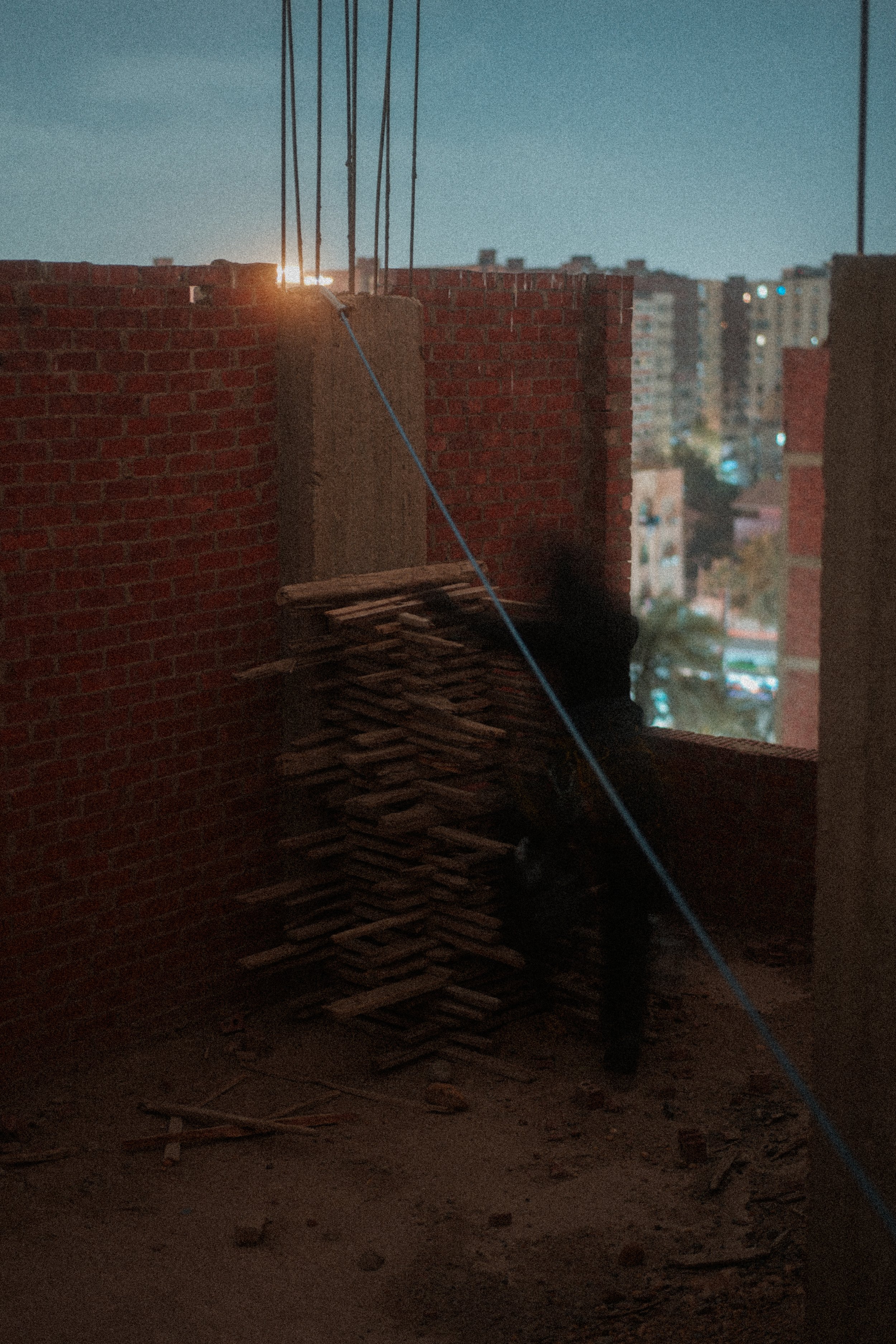
RAMS’ makeshift ladder on the rooftop in Giza, Egypt. Photo courtesy RAMS
After a couple of hours, a man approached the gate from outside. I tried to exit before he locked it, but he blocked me, speaking Arabic. He was clearly asking what the fuck I was doing there. I was covered in blue paint and dust, carrying a black bag stuffed with rappel gear.
I tried to play dumb. He grew aggressive and called out to others. When he stepped away toward an apartment, I bolted. If he locked that gate again, I was completely trapped.
He grabbed me outside. At least I was out. Another man joined him. I pulled out my phone and camera, translating, claiming I was a photographer who’d been locked inside after shooting from the roof. They didn’t believe me. Soon four men surrounded me, trying to force me into their car.
Adrenaline kicked in. I remember thinking it was almost funny — there was no chance I was getting into that car.
After more shouting, two men left. The remaining two said they were taking me to the police station. I walked with them, knowing I’d run when the moment came. A few blocks later, I took a sharp left and sprinted.
I made it.
I finished the piece. I had my gear. I was heading back to the hotel.
The next day I flew out of Egypt and into Jordan. Sitting in that plane seat as it lifted off, exhausted, I couldn’t stop thinking about how different things could’ve been if they’d gotten me into that car — or to the police.