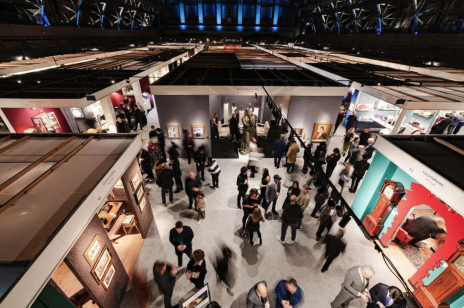
Something is happening at America's most buttoned-up fair. The Winter Show—that bastion of Queen Anne highboys and Chippendale gilt mirrors held annually at the Park Avenue Armory—has been quietly evolving, no doubt prompting pearl clutching among the antique world’s old guard. What began in 1955 as a strictly antiques affair that refused pieces less than 100 years old has morphed into something more ambitious and way more interesting.
As the 2026 edition unfolds this weekend, it’s clear that the Winter Show’s evolution is continuing with an increasing focus on art and an updated definition of “antique.” And, if last year’s closing numbers and the statements of the show’s leaders are accurate, The Winter Show’s retool is keeping it relevant and successful in the face of shifting collector appetites.
At the pre-opening press walkthrough, the Armory was abuzz with optimistic dealers eager for the doors to open to collectors and, hopefully, buyers. While there are still booths focusing on brown wood furniture and Americana, these dealers are hardly the dominant players they once were. Today, right down the way from the medieval armor was a booth featuring 20th-century woven works by Alexander Calder.
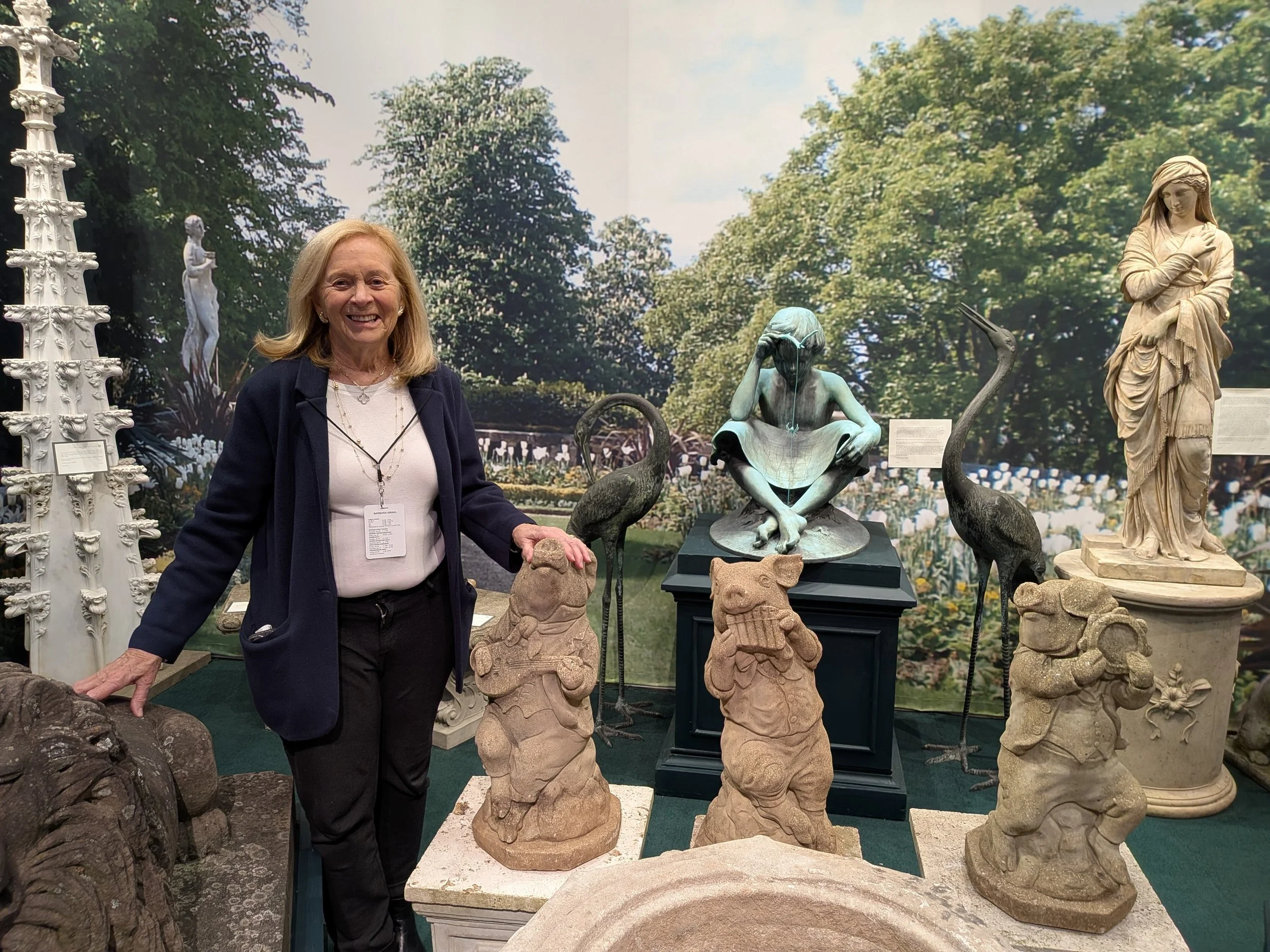
Barbara Israel, of Barbara Israel Garden Antiques, has witnessed the show’s evolution from her booth over more than three decades. Photo by Lisa Freeman
Barbara Israel, who has been selling monumental stone garden ornaments at The Winter Show for over three decades, said she has witnessed the show’s evolution firsthand.
“I have not changed that much, but the surrounding pieces certainly have,” she said. ”It used to be mostly Americana. And then it branched out into a lot of English dealers, a lot of European dealers. And then, you know, print and design. There’s a lot more art now than in the old days and some of it is contemporary art,” she said.
On the evening before the show opens, those charged with vetting the dealers’ offerings conduct an informal poll to select their top five favorite pieces. One of this year’s selections was an earthenware sculpture of a polar bear called This Land is Our Land by Georgina Warne. The piece was created last year, 99 years short of the show’s old age standard.
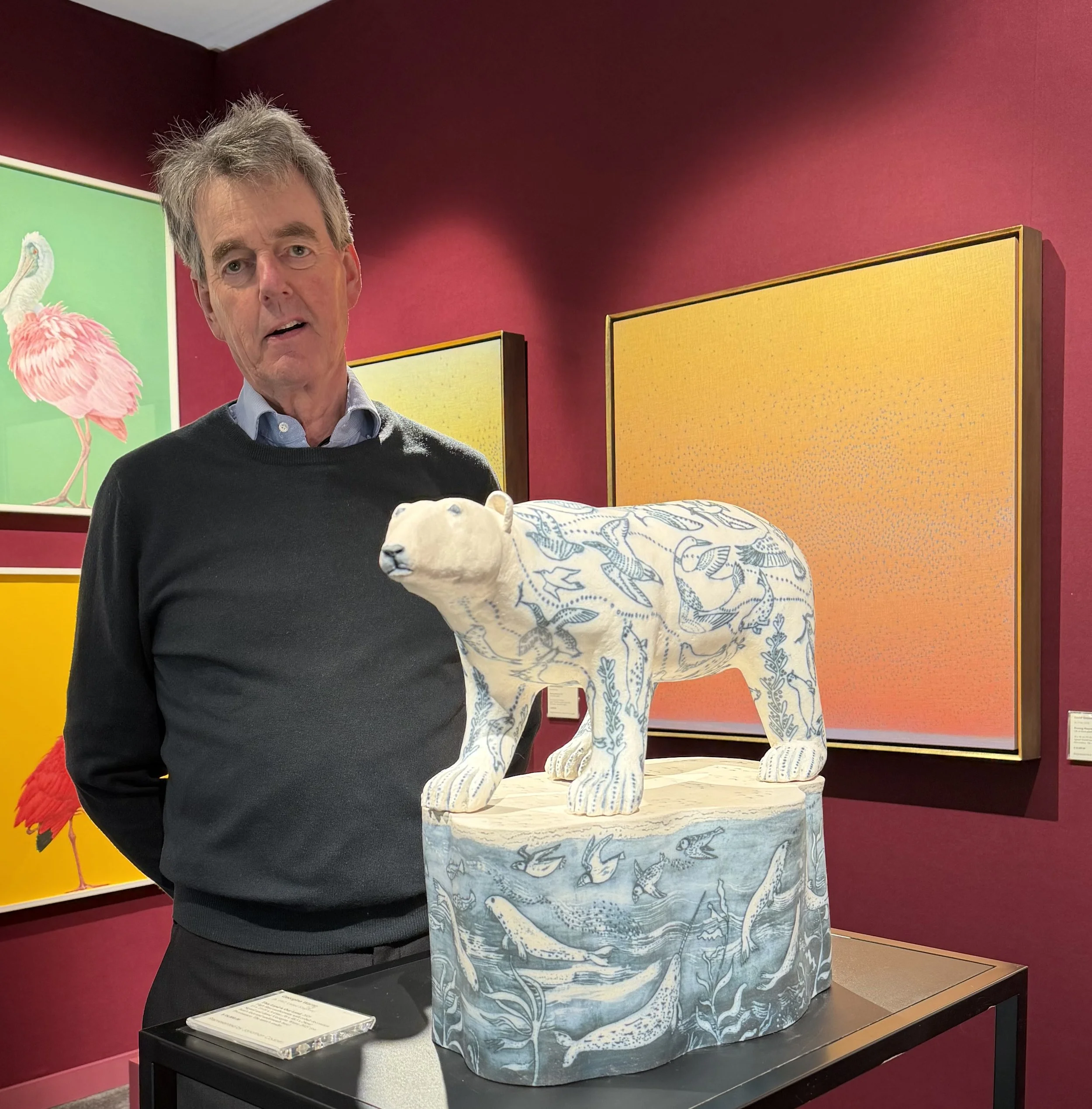
Jonathan Cooper, whose booth features contemporary art, with the 2025 piece “This Land is Our Land.” Photo by Lisa Freeman
Jonathan Cooper, who brought the piece from his London gallery, said he had long sought a spot in the show, but only got in four years ago. “I've seen it evolve. But, as a contemporary dealer, I didn't realize that I could actually get into the fair. I wanted to, desperately. So as soon as I learned they were relaxing the rules a bit, I applied and was accepted. That was four years ago,” he said.
Standing out as a clear manifestation of the show’s relaxed rules is the booth of Hollis Taggart. The well-known Chelsea gallery arrived at this year’s show with work by Alexander Calder, Willem de Kooning, Helen Frankenthaler, Franz Kline, and others. “The market for a lot of antiques has largely collapsed and so they needed to reach out to new audiences,” said Severin Delfs, the gallery’s director of development. “This is actually our second year, and it's funny you ask, because last year, we were specifically invited to be part of this growing narrative of The Winter Show,” he said.
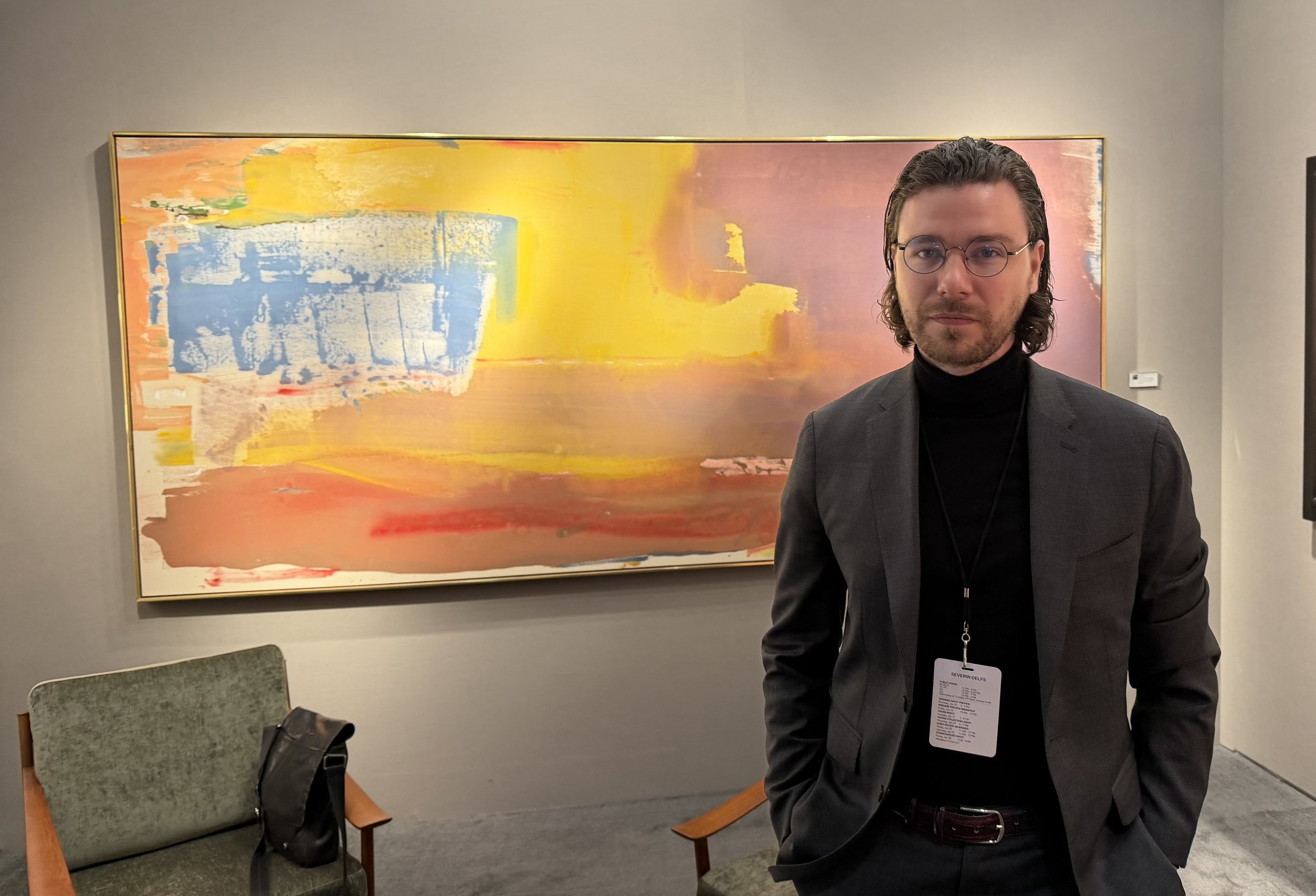
Severin Delfs, director of development at Hollis Taggart Gallery, stands before a painting by Helen Frankenthaler that until recently would not have been welcome at The Winter Show. Photo by Lisa Freeman
A critical moment in the show's evolution came in 2018, when the fair dropped "Antiques" from its name entirely. No longer "The Winter Antiques Show," it simply became "The Winter Show"—a move designed "to recognize and embrace the long-standing breadth and diversity of its exhibitors." The 2019 edition was the first to bear this streamlined moniker, a subtle but significant pivot that reflected a recognition of the decline of the traditional antiques market.
Market indicators tell a brutal story. Antique furniture values have plummeted 45 percent over the past 15 years, with some pieces seeing much larger drops. The high end has collapsed by 70 percent from peak values. Baby Boomers are downsizing, flooding the market with mahogany dining furniture nobody wants. Their millennial children prefer Ikea's disposability or the clean lines of mid-century modern—anything but grandmother's carved mahogany sideboard.
The Winter Show’s current self-description—"America's leading art, antiques, and design fair"—puts art first, a semantic choice that would have been unthinkable when the show launched. Now the fair showcases "works spanning 5,000 years," from Egyptian antiquities to contemporary ceramics by living Japanese artists.
The 2025 edition's sales report reads like a manifesto for this new direction. Yes, dealers moved traditional Americana—a Chippendale slab table, a Federal slant-front desk. But the buzzy sales were contemporary: Joan B Mirviss LTD reported "record sales" including contemporary stoneware works by Inaba Chikako ($15,000) and Fujikasa Satoko ($80,000). Maison Gerard sold a 2024 Guy Bareff wall sculpture at the Opening Night Party. Milord Antiquités moved mid-century pieces by Jules Leleu from the 1940s-50s and a Philip & Kelvin Laverne table from the 1970s—works that wouldn't have qualified as "antiques" under the fair's original century-old rule.
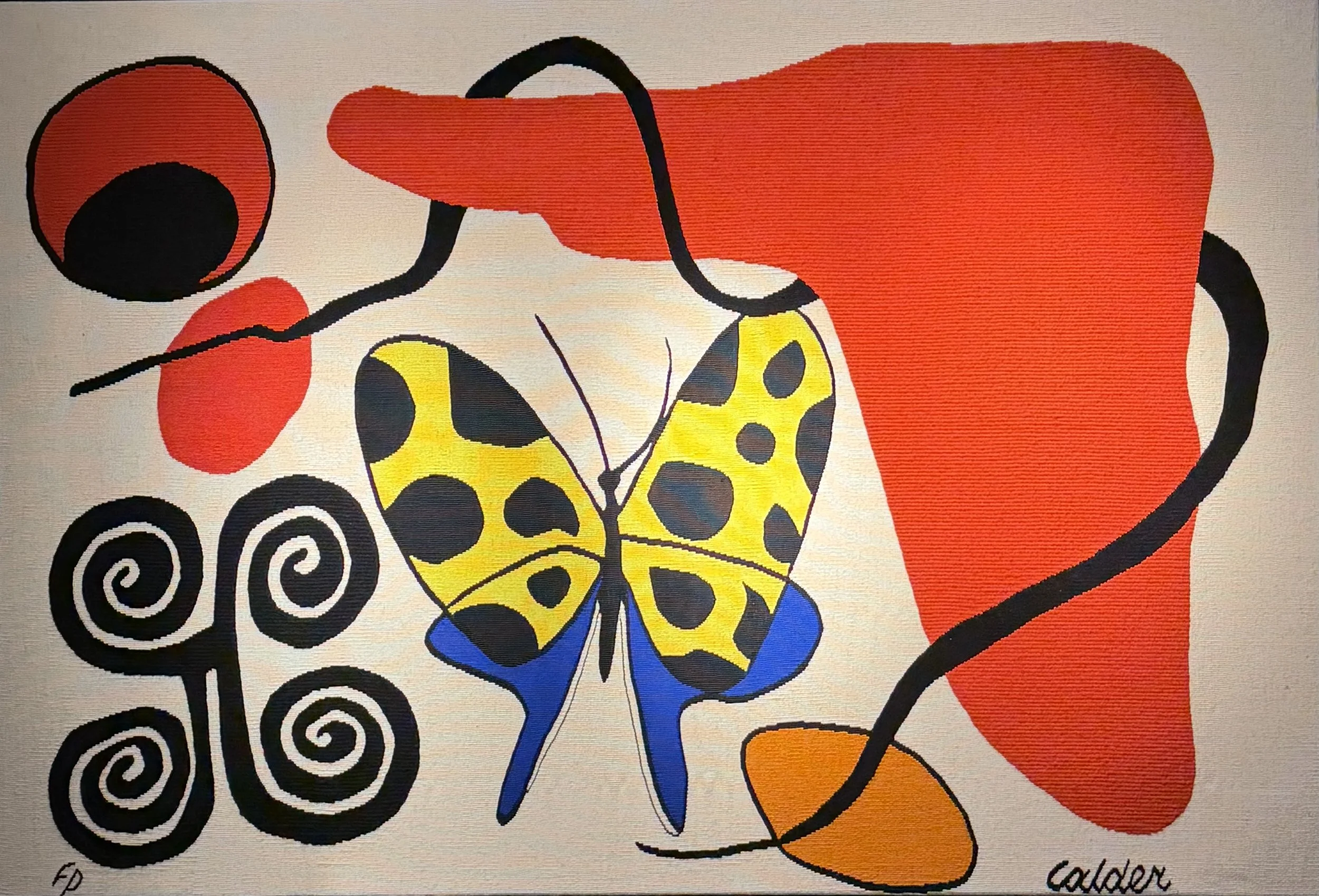
Butterfly, a woven tapestry by Alexander Calder in the booth of Boccara Gallery. Photo by Lisa Freeman
Despite the collapsing antiques market, The Winter Show isn't dying. It's thriving. The 2025 edition reported "strong sales and critical acclaim" with sales "across a diverse set of dealers and markets," and "raised record-setting funds" for East Side House, the Bronx nonprofit that's benefited from the fair since its inception.
This isn't a fair in decline. It's a fair in transition, one that's managed what so many antiques dealers couldn't: adapting without sacrificing standards. The rigorous vetting process—120 experts across 30 disciplines examining every piece—remains unchanged. The Park Avenue Armory location, the white-glove service, the museum-quality presentations—all intact. What's changed is the willingness to acknowledge that "art, antiques, and design" isn't a hierarchy but a continuum.
The Winter Show's evolution mirrors larger shifts in collecting culture. As Yankee magazine noted in 2020, many fairs "are running from the word antique." The Winter Show has made its bet: that collectors care more about quality and narrative than arbitrary age requirements. Based on the latest numbers and the enthusiasm on the floor of this year’s show, it seems to be working.