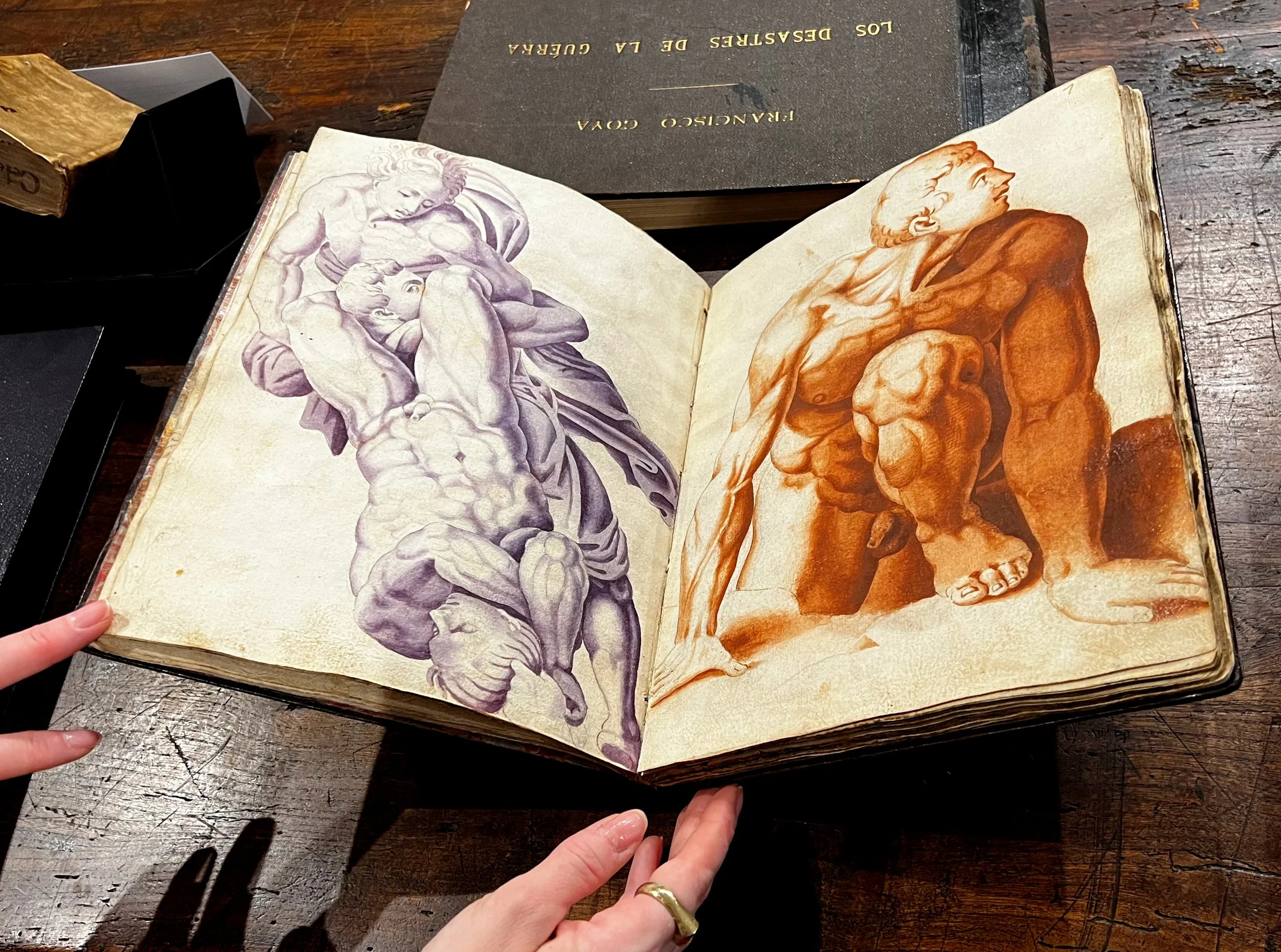
Sketchbook by an unknown contemporary of Michelangelo, photo by Michael Wolf
Master Drawings New York (MDNY) is an art fair dedicated to works on paper and is celebrating its 20th anniversary this year. Hearing the words “master drawings” brings to mind old master works on yellowed paper in darkened museum rooms. Master Drawings New York has some of that, but also so much more. The fair includes works ranging from 16th century drawings to Polaroids from the 1970s, from a large double portrait by contemporary artist Kiki Smith to drawings created by a British soldier imprisoned in Dachau during World War Two. MDNY is held in galleries throughout the city, mostly concentrated on the Upper East Side. The fair is complemented by a program of talks, tours, and workshops organized in partnership with The Drawing Foundation.
A great place to start: HS Rare Books
Visiting HS Rare Books sets the mood for MDNY. It’s located in a beautiful townhouse on East 73rd Street, less than a block from Central Park. One enters through a limestone Beaux-Arts doorway and, if you’re up for it, takes the stunning elliptical staircase to the fourth floor. There is also a small elevator, but be sure to look down the dramatic stairwell as you go up. Stepping into the HS Rare Books showroom feels like traveling back in time. With its antique furnishings and shelves filled with historic books and prints, the space feels somewhere between a medieval scriptorium and an aristocrat’s private library. You’ll be greeted by Erin Mae Black, the manager of the HS location, who is friendly, knowledgeable, and eager to share her deep expertise in antique books. She and owner Sebastian Hidalgo Sola envisioned a “wunderkammer- like space” for rare books on the Upper East Side, opening HS in its current location last year.
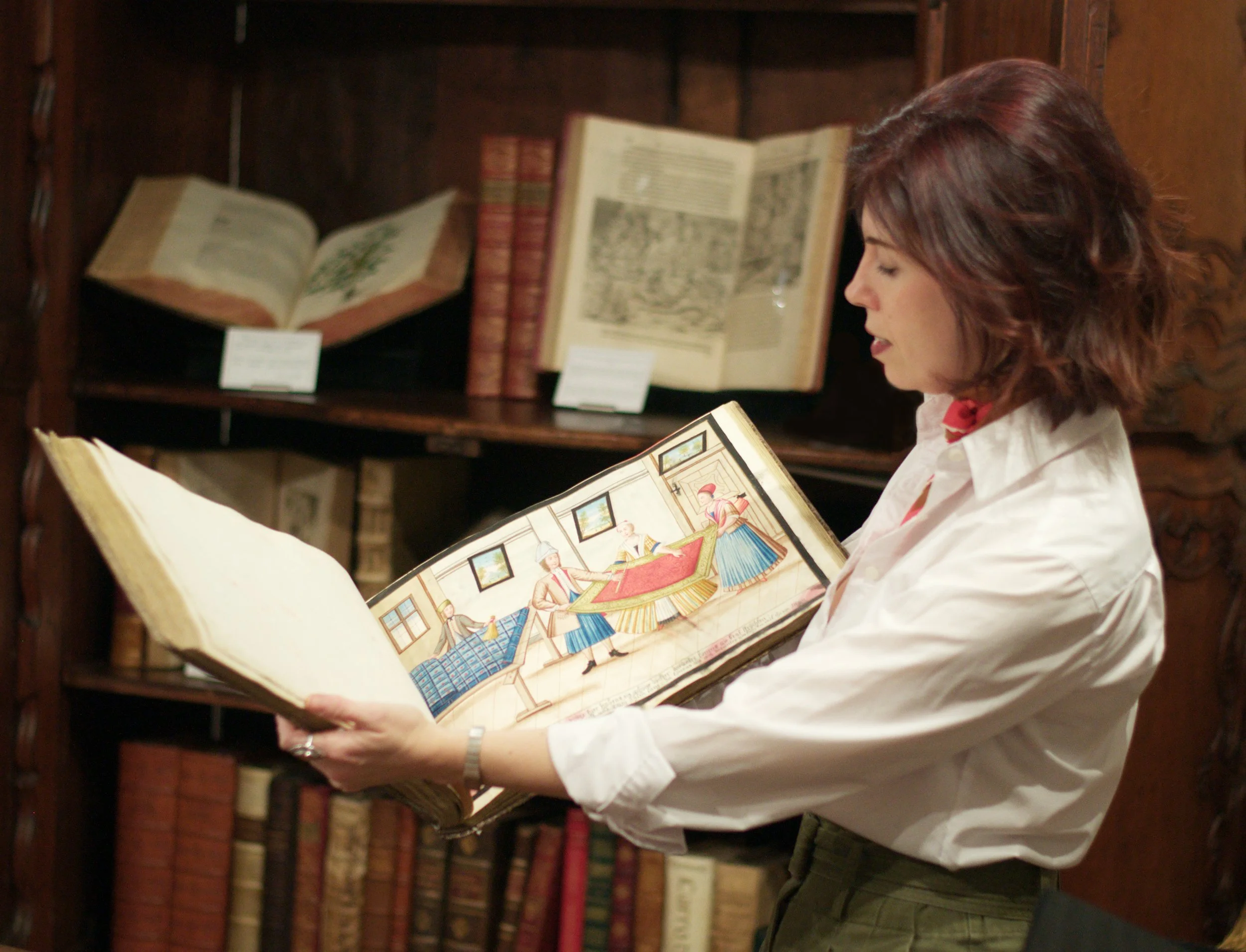
Erin Mae Black Gallery Manager of HS Rare Books, photo by Michael Wolf
For MDNY, HS Rare Books is featuring a bound volume of 16th-century drawings after Michelangelo’s The Last Judgment in the Sistine Chapel. These stunning ink and wash drawings by an unknown artist were made before the figures’ genitalia were painted over with loincloths by the painter Daniele da Volterra, an act that earned him the nickname Il Braghettone, or “the breeches maker.” The additions were made shortly after Michelangelo’s death, underscoring how brief the period was in which the masterpiece existed in its original, unaltered state. As a result, images of the untainted figures from that time are rare. One can easily imagine the artist seated in a candlelit chapel, gazing upward at the fresco while producing these drawings. Another highlight of the HS exhibition is a leather-bound volume of drawings by Marco Vericci, produced for Marino Grimani in the year he was appointed Doge of the City and Republic of Venice. The volume contains 50 full-page pen-and-ink drawings of imaginary fortified island cities, along with 50 ornate cartouches. The drawings are rendered with such precision and fine linework that they closely resemble etchings.
HS Rare Books stocks scores of historically important books many of those of interest to an artistic eye will be on display for MDNY.
The Road to Abstraction: Jill Newhouse Gallery
A short walk uptown, directly across from the Metropolitan Museum of Art, brings you to Jill Newhouse Gallery on 81st Street. Newhouse is a fourth-generation art dealer. Her great-grandfather was a gallerist and bookseller in St. Louis. Jill Newhouse founded her eponymous gallery in New York in 1980. Newhouse is presenting two concurrent exhibitions: MDNY 2026: 19th and 20th Century Works on Paper from Thomas Jones to Pablo Picasso: The Shift to Abstraction and An Incessant Ardor: Drawings by Stephanie de Virieu. Newhouse is sharing her gallery space with Mireille Mosler, Ltd., which is presenting The Spiritual in Art: Abstract Drawing 1915–1918 in the downstairs space.
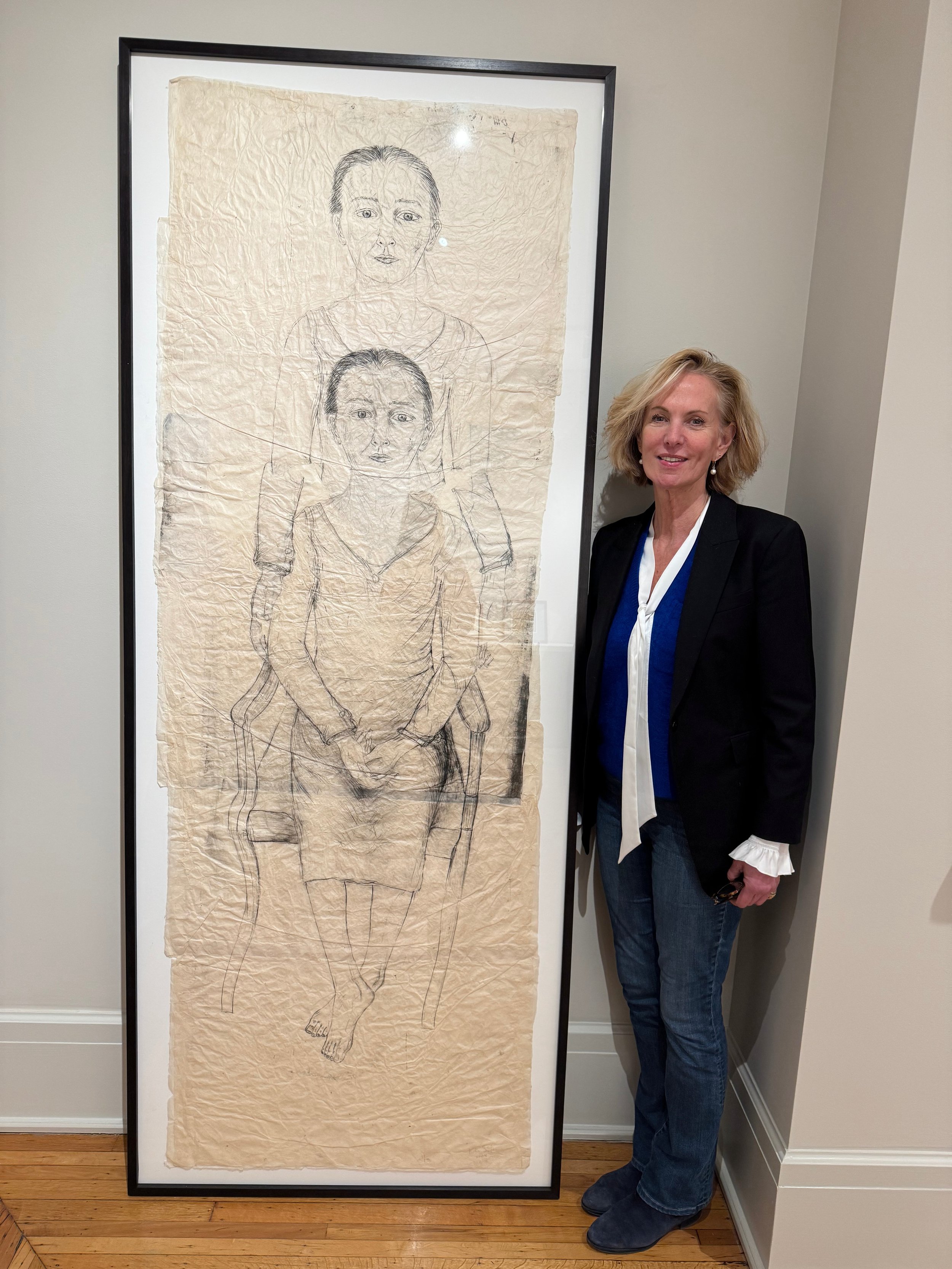
Jill Newhouse with a double-portrait by Kiki Smith. Courtesy of Jill Newhouse Gallery
The Shift to Abstraction traces the move toward abstraction by artists from the late 19th century into the 20th century. Exhibition highlights include an 18th-century landscape by Thomas Jones, a rare early watercolor landscape by Gauguin, and an abstract portrait by Picasso of his lover, Dora Maar. It also features two double portraits of women by contemporary artists Kiki Smith and Philip Pearlstein, rendered in radically different stylistic approaches. Kiki Smith’s large work Standing and Seated Girl, 2004, is drawn in her characteristically naive style and has an almost Victorian formality, with one girl standing upright behind another seated in a chair, both looking straight ahead toward the viewer. By contrast, Pearlstein’s figures in Study for Two Models With Large Whirlygig I, 2006, are more relaxed and seem unaware of being observed. The watercolor study comes from a series of double portraits depicting models posing with folk art whirlygigs. The whirlygig shown in this and other of his works is a caricature of a Black male figure cranking a device that fans the white female figures. Pearlstein, who is not generally known for overt political commentary, here appears to be addressing issues of white privilege.
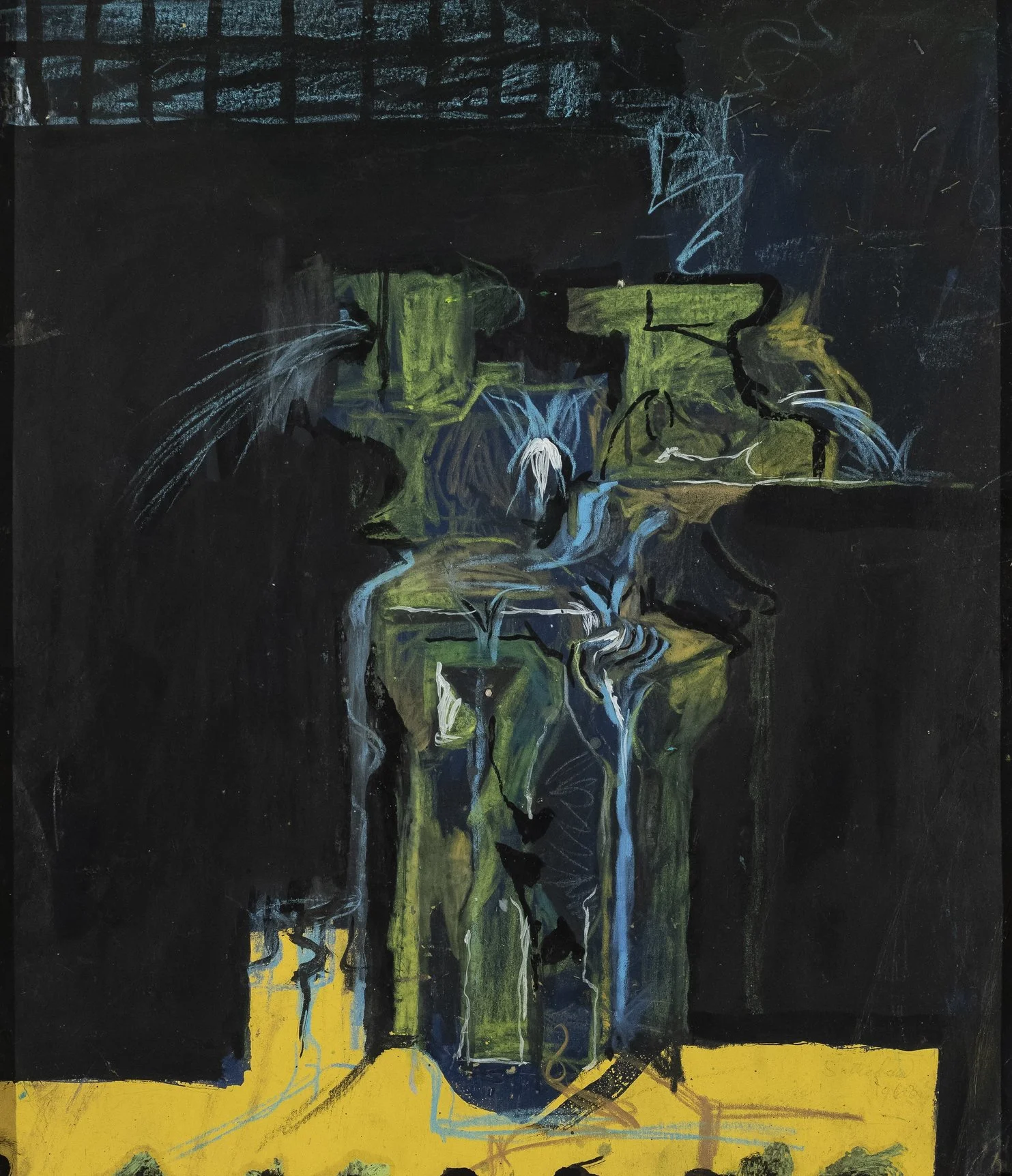
Graham Sutherland, Study for The Fountain, 1963 Courtesy of Jill Newhouse Gallery
Other highlights of the exhibition include a stunning small gouache and crayon drawing by Graham Sutherland, Study for The Fountain. Vibrant yellows, greens, and blues, accented with white highlights, are set against a black background. The lines are spontaneous and confident, giving the work a mysterious and intriguing quality. A small nude by Édouard Vuillard from 1890 is notable for its simple, bold composition and is paired nicely with a similarly sized drawing by Rodin. The second exhibition presented by Newhouse, An Incessant Ardor: Drawings by Stephanie de Virieu, features work by an artist little known outside of France. De Virieuwas a sculptor and draughtswoman whose life spanned the 18th and 19th centuries. The exhibition includes a delicately and subtly rendered portrait of the Marquis de Murinais, along with allegorical drawings such as the dramatic Death Unmasked and the Maiden and The Dream (Le Songe). For MDNY, Newhouse is sharing her space with Mireille Mosler, Ltd., who is presenting The Spiritual in Art: Abstract Drawing 1915–1918. The exhibition pairs nicely with Newhouse’s The Shift to Abstraction. It features abstract drawings by two Dutch women artists, Elisabeth Stoffers (1881–1971) and Paulina Wijnman (1889–1930). The majority of the works are by Stoffers, with two drawings by Wijnman.
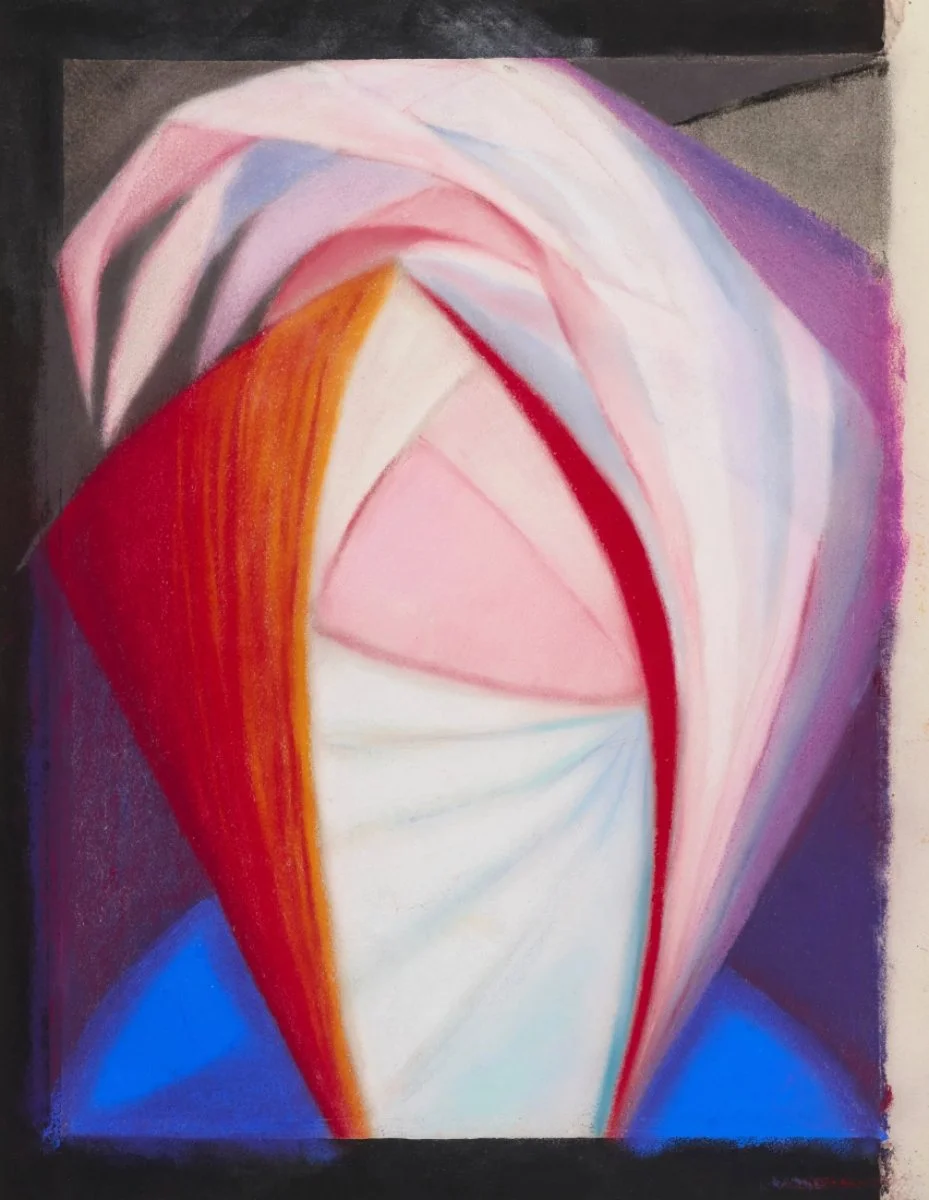
Paulina Wijnman, Untitled, 1917, Pastel on paper, Courtesy of Mireille Mosler, Ltd.
Stoffers’s pastel drawings parallel the work of Georgia O’Keeffe from the same period. Most feature organic forms rendered in smoothly blended, saturated color, with a few reading as abstract landscapes. Wijnman’s drawings have a more overtly spiritual dimension. Both drawings are untitled and date from 1917. One appears to depict an abstracted Madonna and Child, with a simplified head and torso. A glowing yellow, rounded triangular shape emanates from near the woman’s heart. Like Hilma af Klint,\ both artists were overshadowed by the dominance of their male counterparts. This exhibition offers an important opportunity to recognize their participation in the development of abstract art.
Witness to History: Abbott and Holder
London gallery Abbott and Holder, currently headed by Tom Edwards, will bring British drawings spanning the 17th to 20th centuries to the Kate Oh Gallery on 72nd Street.
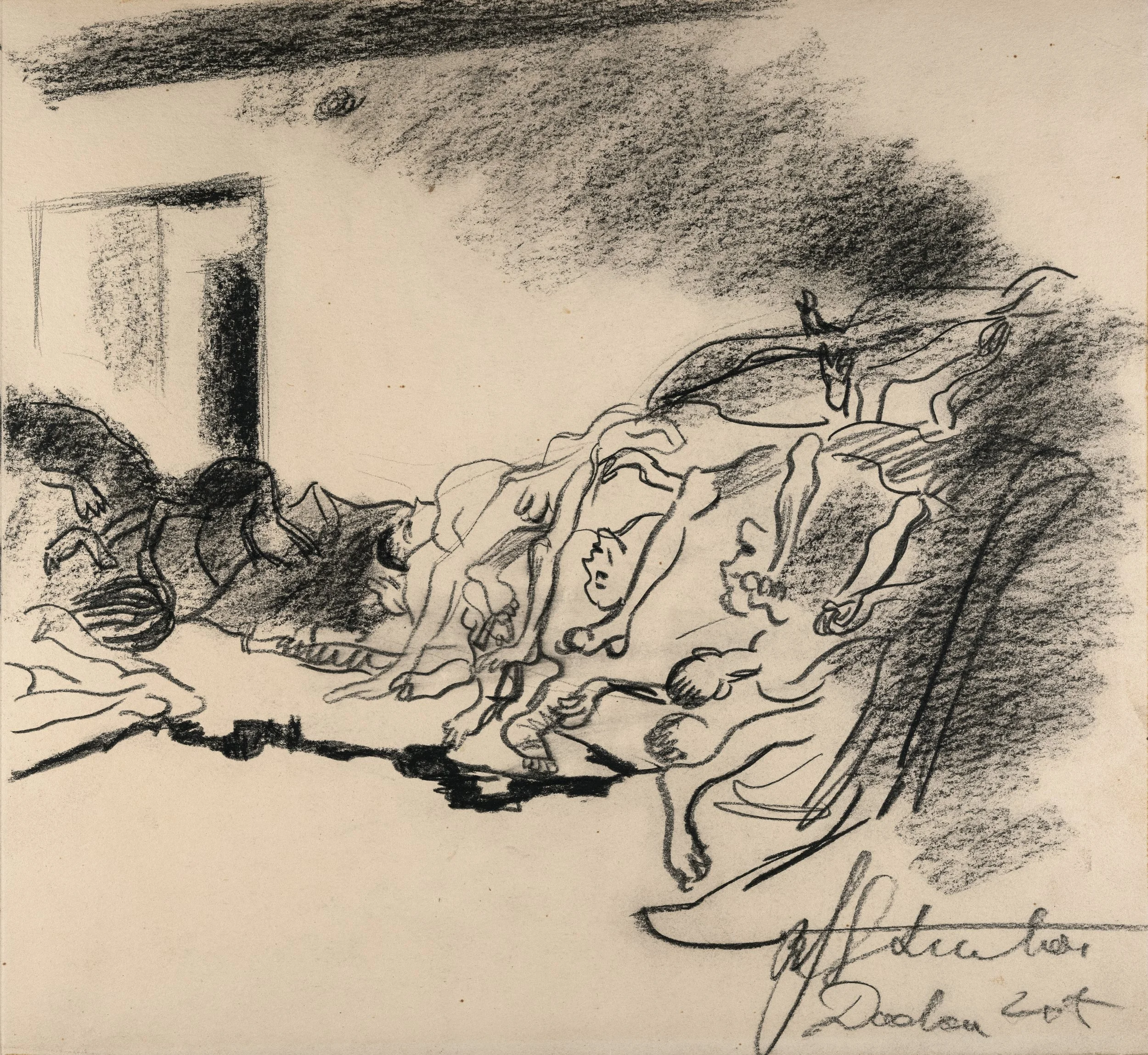
Dachau Concentration Camp; Corpses in the Mortuary, Brian Stonehouse, Courtesy of Abbott and Holder
Among the most dramatic and powerful works are drawings by British soldier Brian Stonehouse (1918–1998). In 1942, Stonehouse was recruited by the Special Operations Executive and parachuted into occupied France, disguised as an art student and concealing a radio in his artist’s box. In France, he aided the Resistance by transmitting intelligence to the Allies from behind enemy lines, but was able to do so for only a few months before being captured by the Gestapo. He was subjected to long periods of interrogation and solitary confinement, eventually ending up in the notorious Dachau concentration camp. Dachau was liberated by American forces on April 29, 1945. On April 30, the day after his liberation, Stonehouse toured the crematorium, mortuary, and gas chamber and recorded the atrocities he witnessed. He made five drawings, working quickly, as he later wrote: “I visited and made sketches of piles of corpses at the Krematorium. Not much time to sketch, as the place had been mined by the SS before they left, and the building was expected to blow up at any minute.” This exhibition includes these historically significant drawings.
Downtown in Chelsea: Bruce Silverstein Gallery
Only two galleries in Chelsea are participating in MDNY: C.G. Boerner and Bruce Silverstein Gallery. C.G. Boerner is presenting German Romantic Drawings, while Bruce Silverstein Gallery is showing Between Order and Chaos: André Kertész and M. C. Escher.
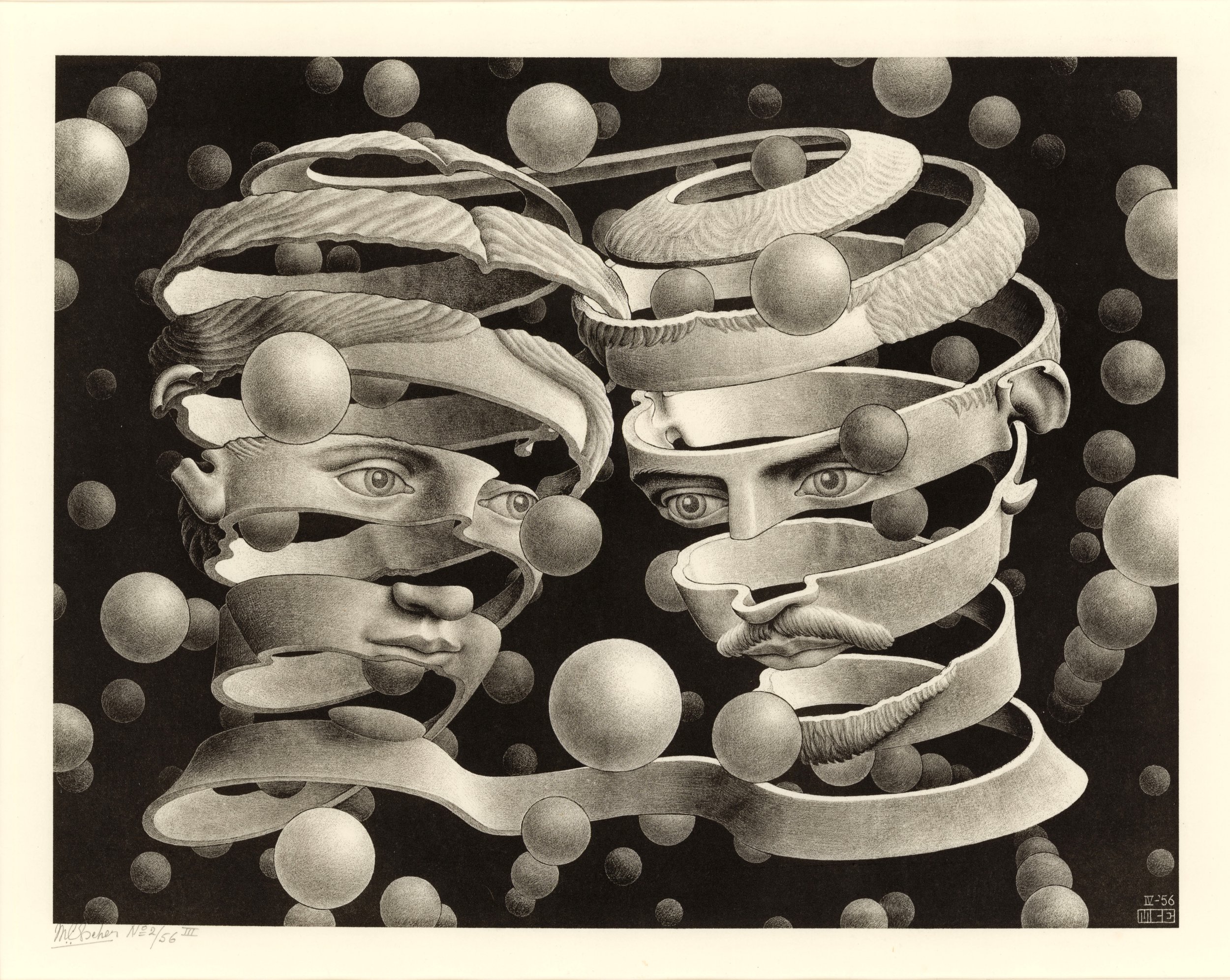
M.C. Escher, Bond of Union, 1956, Courtesy Bruce Silverstein Gallery
Between Order and Chaos features instantly recognizable works by Escher, including Day and Night, Bond of Union, and experiments with distortion such as Print Gallery. Escher’s prints are juxtaposed with photographs by André Kertész. Some of the pairings are so strikingly similar that it almost feels as though the two artists were working side by side, much like Picasso and Braque during the development of Analytical Cubism. Born just four years apart, Kertész and Escher appear to have influenced one another or to have independently investigated the same visual and perceptual concerns. For example, Kertész’s photograph Fortune Teller (1930), which depicts a figure distorted through a mirrored ball, closely parallels Escher’s Self-Portrait in Spherical Mirror (1935). Escher’s woodcut Puddle (1952) also finds a clear counterpart in Kertész’s photograph Puddle, Empire State Building (1967), in which the iconic structure appears inverted in a puddle, destabilizing spatial perception. Kertész’s photographs of Manhattan buildings, such as Chimney, MacDougal Alley, April 1, 1965 and 23rd Street, New York, September 11, 1970, reduce the cityscape to abstract arrangements of geometric forms that echo Escher’s earlier architectural constructions like Convex and Concave and Up and Down.
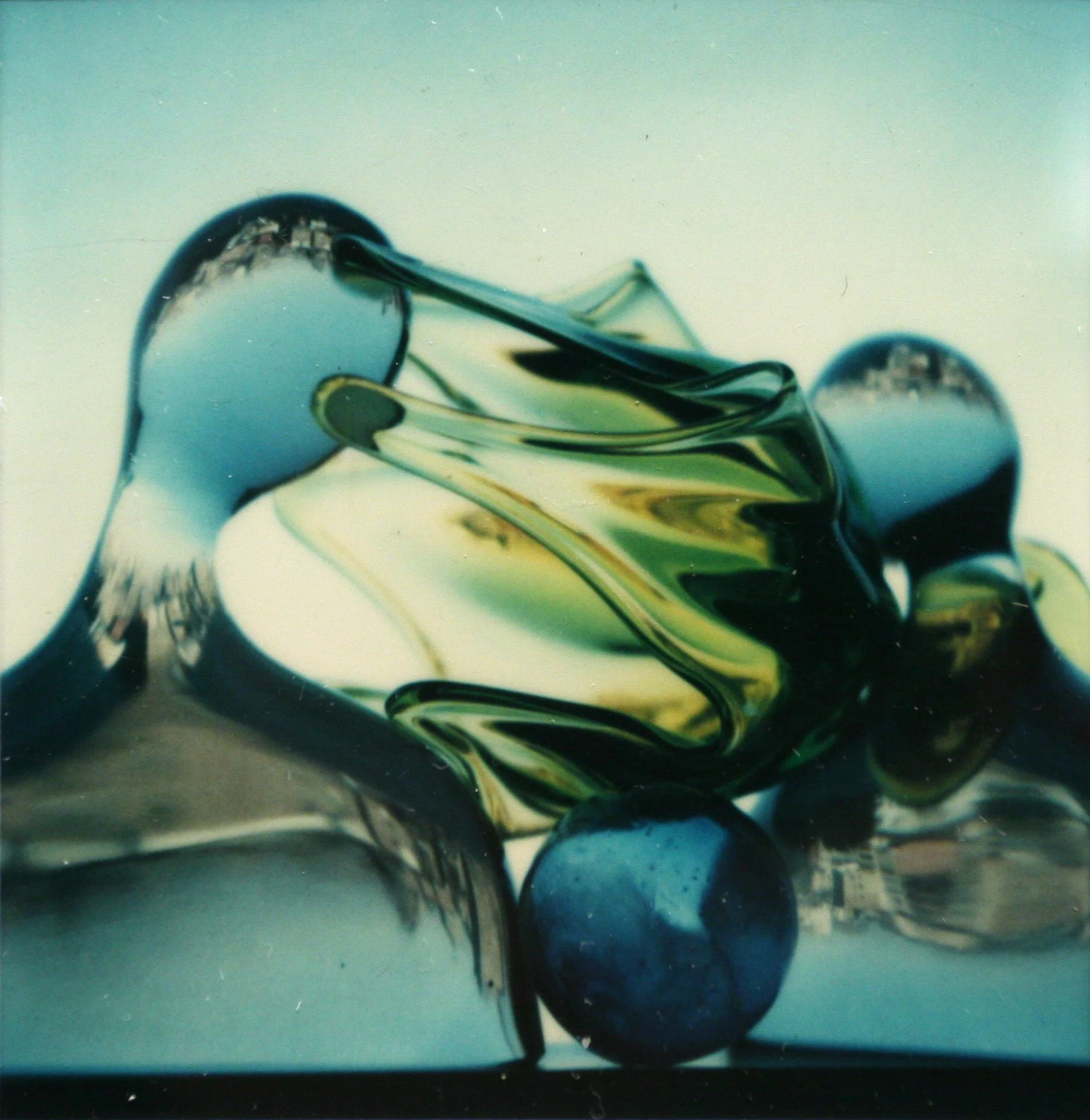
André Kertész, December 15, 1979, Courtesy Bruce Silverstein Gallery
Especially interesting in the context of MDNY are Kertész’s experiments with the Polaroid SX-70 camera, including images from the 1970s and early 1980s, particularly the photo December 15, 1979, which moves toward near-pure abstraction. Seen together, the works highlight the surprising dialogue between Kertész and Escher, underscoring how each artist pushed their medium toward perceptual ambiguity. For newcomers and seasoned viewers alike, MDNY offers a rare opportunity to move across centuries, geographies, and mediums while tracing how drawing remains a vital and enduring form of expression. Master Drawings New York galleries are free and open to the public no tickets are required. MDNY’s 20th edition runs from January 30 to February 7, 2026, with opening hours of 3–8 pm on opening Friday, 11 am–6 pm most days, and 1–5 pm on Sunday, February 1. Check the website for further details.
MDNY also presents a weeklong series of events, including behind-the-scenes tours, lectures, and workshops. While MDNY gallery entry is free, many of the events have limited capacity and require advance ticket reservations check the MDNY Partners and Events page for more information.