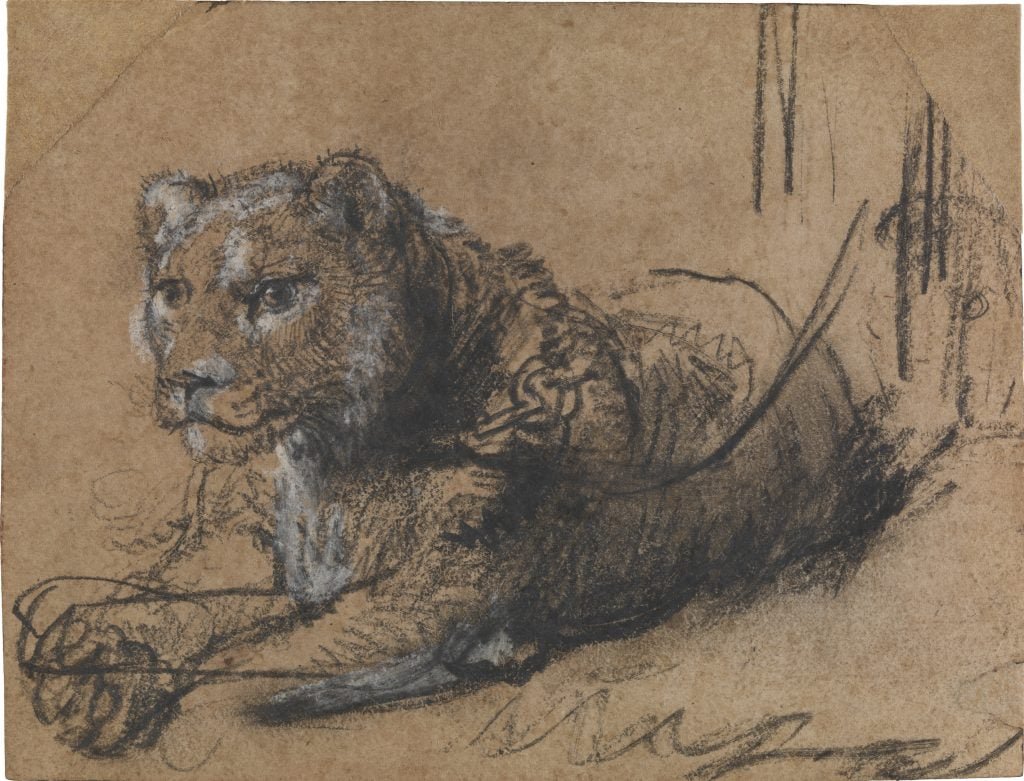
Rembrandt van Rijn, Young Lion Resting, (ca. 1638–42). Black chalk, white chalk heightening, and gray wash, on brown laid paper, 11.5 x 15 cm. Image courtesy of The Leiden Collection.
UPDATE: Young Lion Resting, a masterwork by Rembrandt van Rijn, has sold at Sotheby’s in New York for $17,860,000, placing it among the most valuable Old Master Drawings to be sold at auction. The price realised today establishes the work as the most valuable drawing by Rembrandt ever sold at auction. The proceeds of the auction will benefit Panthera, a charity devoted to the conservation of the world’s 40 species of wild cats, founded by Dr. Thomas S. Kaplan, his wife Daphne Recanati Kaplan and the late Dr. Alan Rabinowitz, and now chaired by the drawing’s co-owner, Jon Ayers.
“To see this masterpiece, which began our journey with collecting Rembrandt some twenty years ago, now provide the resources to protect big cats around the world is a deeply moving moment of symmetry for us. Uniting art and wildlife, this sale marking the 20th Anniversary of Panthera was meant to transform cultural heritage into conservation action. Its incredibly successful outcome evinces both the enduring power of the Master and the crucial importance of safeguarding biodiversity for future generations,” Kaplan said.
Picture Rembrandt van Rijn in his early thirties, already established in Amsterdam with a reputation for dramatic portraits and innovative history paintings, walking the cobblestone streets in search of something specific: a live lion to draw.
In 17th-century Amsterdam, tracking down a lion most likely would have meant visiting a traveling exhibit or navigating the city's network of private menageries—some operated by aristocrats who collected exotic, others run as commercial enterprises where the curious paid admission to gawk at creatures they would never otherwise encounter.
Next month, that hunt culminates in an unexpected way. Sotheby's will auction Rembrandt’s drawing Young Lion Resting during its Masters Week sales in New York, with all proceeds benefiting Panthera, the world's leading wild cat conservation organization working to protect 40 species across 34 countries. It's a sale that transforms the drawing's provenance from mere ownership history into active conservation work—a 380-year-old artwork funding the survival of the very species that inspired it.
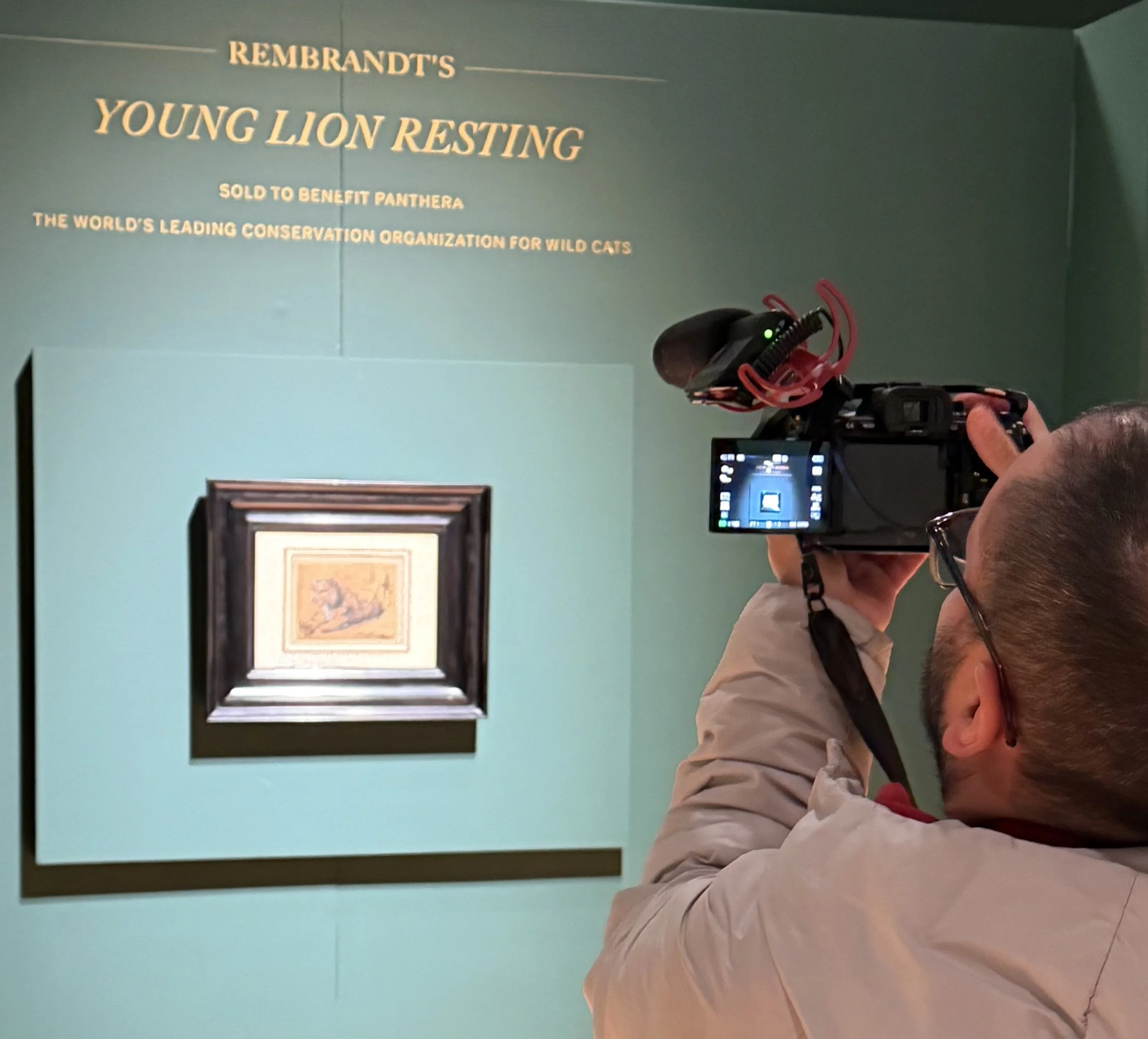
A photography at the opening of the Sotheby’s auction preview. Photo by Lisa Freeman
For over two decades, Young Lion Resting has resided in the Leiden Collection, that heavyweight private assembly of Dutch Golden Age art housing 17 Rembrandt paintings plus the only privately held work by Vermeer. Mega-collector and philanthropist Thomas S. Kaplan, founder of both the Leiden Collection and Panthera, acquired the drawing in 2005 as his very first Rembrandt purchase, with Jon Ayers, Panthera's Board Chair, later becoming co-owner.
Rembrandt sketched the young lion's left paw twice, adjusting its position in real time, chasing some elusive perfection in how the creature held itself. The animal wears a leash, rendered in three-quarter view with pen, ink, and wash on toned paper. Its gaze is that of a self-possessed apex predator, penetrating, intelligent, and calm, but with no effort to disguise a simmering potential for lethality.
This wasn't copied from bestiaries or imagined. Rembrandt got close enough to the real, living thing to see the texture of its fur, the tension in its muscle, the uneasy quiet of a predator's attention when it's watching you back.
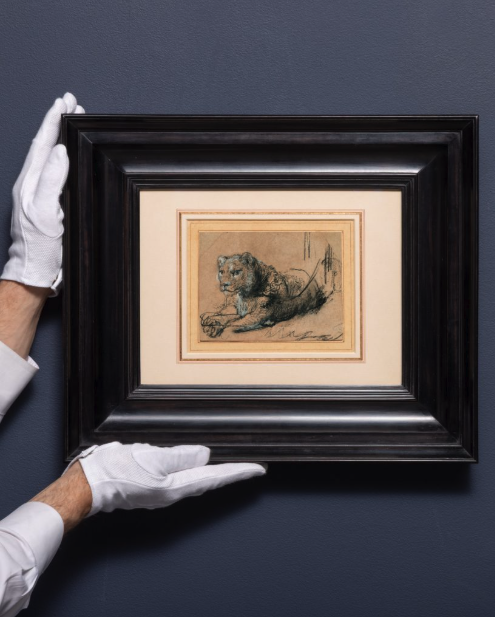
Rembrandt Harmensz. van Rijn, Young Lion Resting (ca. 1638–42). Courtesy of Sotheby’s.
Only six lion drawings by Rembrandt are currently known to exist, making Young Lion Resting exceptionally rare—and it's the only animal drawing by the master still in private hands. Two related works depicting what's believed to be the same lion live at the British Museum, with three additional lion studies scattered between the Louvre, Rotterdam's Boijmans Van Beuningen Museum, and the Rijksmuseum.
While the travels of an elephant Rembrandt drew around the same period are well-documented, the specific lion in this drawing remains historically anonymous. We know Rembrandt was an avid collector of curiosities and exotica—his home inventories prove it—assembling objects he could study and incorporate into his work. But somewhere in that methodical cataloging of the exotic, lions clearly struck a deeper chord.
No one knows for sure how Rembrandt encountered this particular lion, but Sotheby’s has one theory. “Some of the most unusual animals were toured around fairs and festivals….The annual fair in Amsterdam was held on what is now the Waterlooplein, just a two-minute walk from Rembrandt's house (now the Rembrandthuis museum),” the auction house said in documents presented along with the work.
“We can't be sure that that was where Rembrandt saw his young lion, but contemporary records show that one was shown at the Amsterdam fair in both 1644 and 1645. Stylistically, the Young Lion Resting could well date from that time, or a few years earlier,” Sotheby’s said.
Before the February sale, the drawing toured Paris, London, Abu Dhabi, Hong Kong, and Saudi Arabia—a global farewell lap for a work Gregory Rubinstein, Sotheby's Head of Old Master Drawings, calls "one of the most significant Old Master drawings to appear at auction in decades."
Three hundred and eighty years after Rembrandt found his lion, the drawing will fund the survival of its living descendants. The young artist who scoured Amsterdam's menageries with pen and ink would probably appreciate the symmetry.