Inside the Christie's Irsay Auction: When Guitars Ate the Room
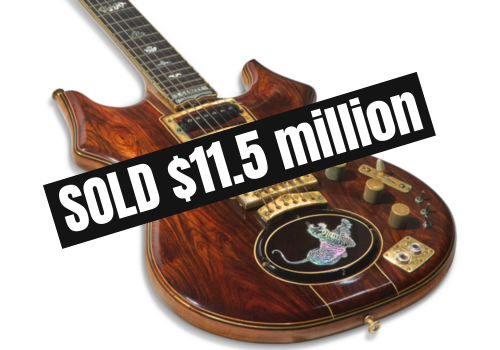
$11.5 million for a Jerry Garcia guitar. $14.5 million for a Stratocaster. And a very old question: what makes anything worth anything at all?
Thursday night at Christie's New York, a guitar changed hands for $11.5 million. Not a Picasso. Not a Basquiat. A guitar. Six strings, a body built from wood and wire, hand-crafted by luthier Doug Irwin over six years and finished in 1979. The guitar is called "Tiger," and it was Jerry Garcia's primary instrument through most of the 1980s—which in Grateful Dead mythology is roughly equivalent to saying it was the Holy Grail.
Tiger had belonged to Jim Irsay, the late Indianapolis Colts owner who died in 2025 at 65, and who spent decades assembling one of the most extraordinary private collections of American cultural artifacts in existence. Irsay paid $957,500 for Tiger in 2002. Thursday's buyer paid more than twelve times that. The pre-sale estimate was $1 to $2 million. The hammer fell at $9.5 million—$11.5 million with fees—obliterating every projection.
A video circulating on social media appears to show the winning bidder as Bobby Tseitlin of Timeless Gem and Family Guitars, with guitarist Derek Trucks seated beside him as the hammer dropped. Christie's declined to confirm the buyer's identity. For Deadheads who feared Tiger would vanish behind velvet rope, it's a reassuring result: Family Guitars describes itself as a living collection of instruments that "continue to be played, heard, and experienced the way they were meant to be." They already steward Garcia's 1976 Travis Bean TB500 #11 and Bob Weir's 1983 Modulus Blackknife "No Fun" guitar.
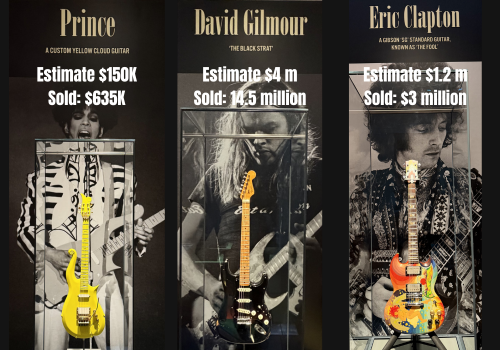
Guitars once owned by Prince, David Gilmore and Eric Clapton realized prices well in excess of estimates at Christies. Graphic by J. Scott Orr
Tiger wasn't even the night's most expensive instrument. That went to David Gilmour's "Black Strat," the 1969 Fender Stratocaster most closely associated with Pink Floyd's defining recordings, which sold for $14.5 million including fees—a new world record for a guitar at auction, shattering the previous mark of $6 million set in 2020 when Kurt Cobain's Martin D-18E went under the hammer. Cobain's 1969 Fender Competition Mustang—played in the "Smells Like Teen Spirit" video—added another $6.9 million to the evening's guitar tab.
The full sale brought in a cool $84 million, with a portion designated for charity. Beyond the guitars: Eric Clapton's MTV Unplugged Martin 000-42 fetched $4 million. Clapton's psychedelic "The Fool" Gibson SG brought $3 million. George Harrison's Gibson SG Standard—his main instrument from 1966 to 1968—went for $2.2 million. John Lennon's Broadwood upright piano, on which he composed "Lucy in the Sky with Diamonds," "A Day in the Life," and "Being for the Benefit of Mr. Kite!", sold for $3.2 million. The logo drum head from the Beatles' 1964 Ed Sullivan debut: $2.9. Paul McCartney's handwritten "Hey Jude" lyrics: $1 million. And Jack Kerouac's original 120-foot typescript scroll of On the Road—the night's second-highest lot—cleared $12.1 million.
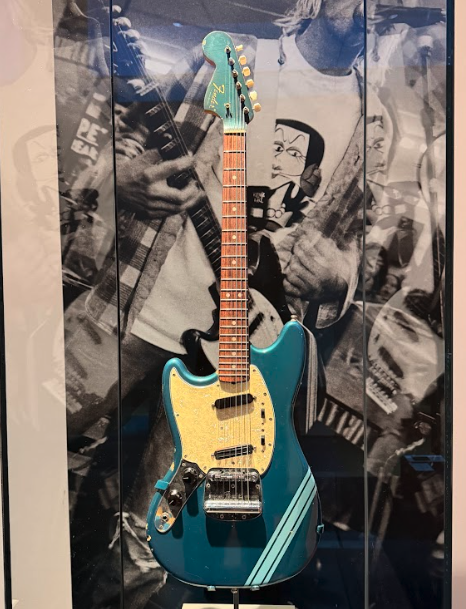
Curt Cobain's Fender Mustang. Photo by J. Scott Orr
To understand how a guitar built in a California workshop becomes the centerpiece of a Christie's evening sale, it helps to understand what auction houses have always actually been: platforms for converting private objects into public prices. Sotheby's started in 1744 selling rare books. Phillips, founded in 1796, built its early reputation dispersing aristocratic estates. The formula never changed. Only the objects did.
The acceleration has been fast and deliberate. In 2019, Sotheby's formally split its business into fine art and a second division called "Luxury, Art & Objects"—acknowledging that Rolex watches and Nike Air Jordans had graduated from side hustle to growth engine. Christie's launched a dedicated department for sneakers, streetwear and collectibles. Phillips now moves more than $200 million in watches annually. Sotheby's reported its luxury division generated $2.7 billion in 2025, out of roughly $7 billion in total sales. Christie's says luxury objects are the primary entry point for new buyers—about 38 percent of first-time clients—most of them bidding online, never setting foot in a salesroom.
The sneakers, the watched and the guitars are, in this context, recruitment tools. And they seem to be working.

Guitars once owned by Eddie Van Halen, George Harrison and Neal Schon with others from the Irsay Collection. Photo by J. Scott Orr
The Irsay sale presents a philosophical question: is paying $11.5 million for Tiger any crazier than paying $110.5 million for a Basquiat? Is a watch worth $31 million? Is Jane Birkin's Hermès bag — which Sotheby's sold for $10.1 million in 2025, a record for a handbag — worth more than a house?
The answer is always the same combination: scarcity, mythology, and competition among people with enough money to chase objects that carry outsized cultural meaning. A canvas by Basquiat and a guitar built by Irwin for Garcia operate on identical logic. One hung on a gallery wall. The other was played at shows that devoted followers traded bootleg tapes of for decades. Provenance and story are what the auction houses sell, whether it's painted on canvas or built from mahogany and wire.
The line between "fine art" and "cultural artifact" was always more artificial than the art world liked to admit. The same institutional machinery that once handled Rembrandts now applies equal rigor to a 1969 Stratocaster—provenance research, scholarly catalogue notes, global online bidding, white gloves, the whole deal. The Irsay collection proved, again, that the theater works just as well for a guitar.
Full results at christies.com.