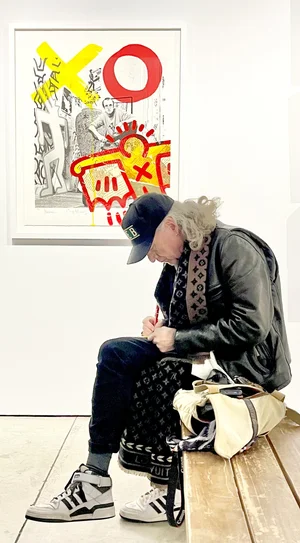
A man considers Jean-Michel Basquiat’s 1983 Museum Security (Broadway Meltdown) at Sotheby's. Photo by J. Scott Orr
When Jean-Michel Basquiat painted Museum Security (Broadway Meltdown) in 1983, he was 22 years old and newly vaulted from downtown graffiti prodigy to art-world obsession. The painting, an imposing 84-by-84-inch square of acrylic, oil stick, and paper collage, now returns to the market with an estimate above $45 million at Sotheby's Contemporary Evening Auction this May—more than four decades after it first appeared in Basquiat’s landmark Los Angeles debut at Larry Gagosian Gallery.
The canvas is an archive of Basquiat icons and themes. Words scatter across its black background in Basquiat’s signature stream-of-consciousness script: “ESSO,” “ASBESTOS,” “ROME,” “400 YEN,” “PRICELESS ART,” “FIVE CENTS.” His crown appears. So does a skeletal head with hollow red eyes. An African mask. A pointing hand. References to “Hooverville” and “Papa Doc.” Bureaucratic terms—“SECURITY,” “LAW,” “FBI,” “COMICS CODE”—close in from every direction, as if the language of institutions itself were forming a perimeter.
Basquiat often crossed out words not to erase them but to emphasize them, forcing viewers to read more closely. In Museum Security, that tactic turns the painting into something like a visual essay on power: who gets to define culture, who gets priced out of it, and who gets paid minimum wage to guard the door.
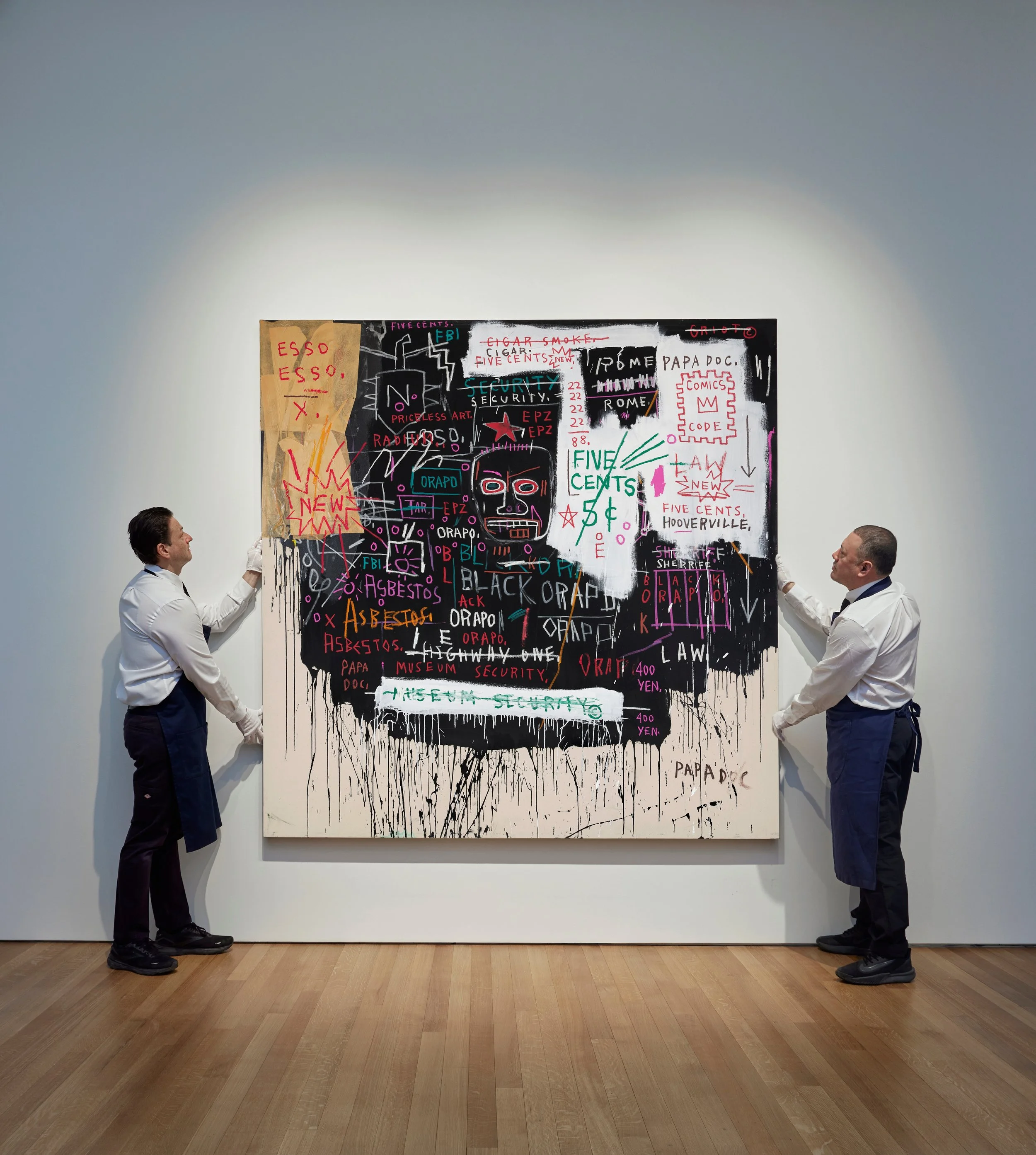
Jean-Michel Basquiat’s 1983 Museum Security (Broadway Meltdown) at Sotheby's. Photo courtesy Sotheby’s
“Jean-Michel Basquiat’s Museum Security (Broadway Meltdown) embodies the qualities that define the artist at his very best: executed at the height of his career, on an impressive scale, and charged with the imagery and language that made his work instantly recognizable,” said Grégoire Billault, the chairman of contemporary art at Sotheby’s New York.
The work belongs to a group of roughly a dozen monumental paintings Basquiat created in the spring of 1983, widely considered the moment when his visual language reached full complexity—braiding references to anatomy, music, Black history, sports, and economics into dense pictorial systems (see the monograph published by Hirmer Publishers). Another painting from that moment, Hollywood Africans, now hangs in the collection of the Whitney Museum of American Art in New York.
Museum Security (Broadway Meltdown) has since become a regular on the institutional circuit, appearing in exhibitions at venues including Fondation Beyeler in Switzerland and the major Basquiat retrospective at Fondation Louis Vuitton in Paris, as well as a 2019 presentation at the Brant Foundation (Sotheby’s; Brant Foundation). Most recently, it appeared in the exhibition Signs: Connecting Past and Future at Seoul’s Dongdaemun Design Plaza.
The painting’s provenance is almost as dramatic as the canvas itself. In 2011, British collector Edward Spencer-Churchill reportedly rejected a $5.5 million offer from Basquiat mega-collector Alberto Mugrabi, instructing his dealer to sell the work to virtually anyone else—a decision that sparked legal wrangling and a withdrawn auction before the painting ultimately sold privately for about $15 million. Two years later it resurfaced at Christie's in London, where it sold for roughly $14.5 million in a Post-War and Contemporary evening sale.
Since then, Basquiat’s market has only escalated. In 2017, his 1982 skull painting Untitled sold for $110.5 million at Sotheby’s, setting a record for an American artist at auction (Sotheby’s). Against that backdrop, the estimated $45 million price for Museum Security feels less like a ceiling than a checkpoint.
Which brings the painting’s central irony back into focus. Basquiat filled the canvas with the phrase “PRICLESS ART,” only to surround it with the words “FIVE CENTS.”
Forty-three years later, the guard is still on duty. The art is still priceless. And the price keeps climbing.