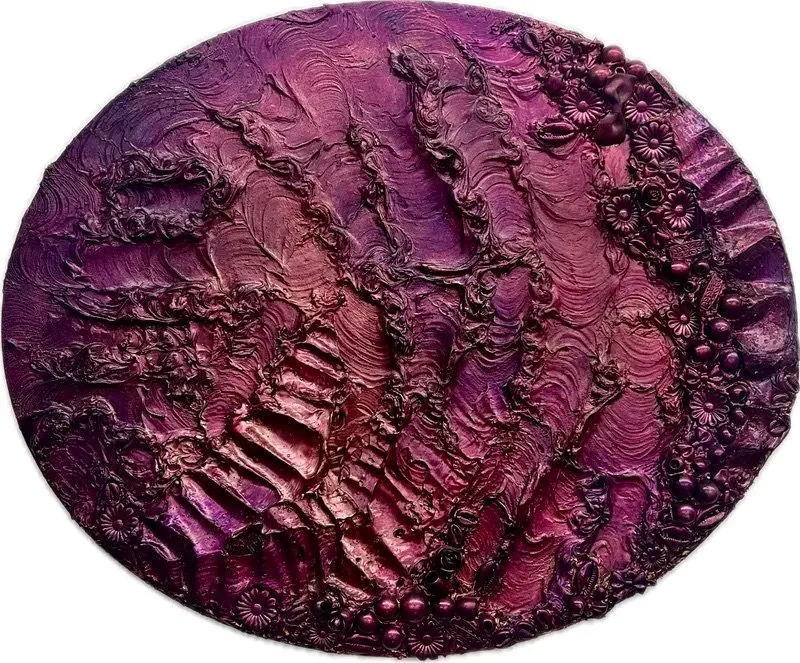
Ashanté Kindle, So Glad I Made It (Ellipsed Elegance 5), 2024. Hair knockers, barrettes, beads, cowrie shells, and acrylic on canvas. 18 × 24 in. (45.7 × 61 cm). Courtesy of Hollis Taggart Downtown.
Material Memory
Megan Baker, Edward Holland, Ashanté Kindle, Hans Neleman, Cordy Ryman,
Kelly Wang and Michael Wolf
Memory is often understood as an act of recollection—a return to something already known. The work in Material Memory, a recent group show at Hollis Taggart Downtown, proposes something more expansive. Across painting, sculpture, assemblage, and installation, the artists in this exhibition treat memory less as a repository of the past than as an active process of construction. Their works accumulate, carve, layer, fragment, repeat, and reorganize experience into new visual structures.
What makes the exhibition particularly compelling is not simply its shared theme, but the different manifestations of memory through which each artist arrives. Rather than illustrating memory or depicting nostalgia, the artists develop distinct methodologies for producing it. The exhibition suggests that memory is not only something artists represent; it is one of their primary creative instruments. By the time the brush touches a surface or a miter saw parts wood, intention has already become memory. What follows is another kind of remembering: the artist’s material intelligence developed through years of practice that anticipates how pigments, tools, and surfaces will respond.
Memory stores visual knowledge, preserves technical traditions, carries symbolic systems, and allows inherited forms to be recognized, transformed, and returned to the present. In this sense, memory is less a subject than a method of thinking. Material Memory and its artists ask not simply what artists remember, but how memory becomes visible through process, material, and form.
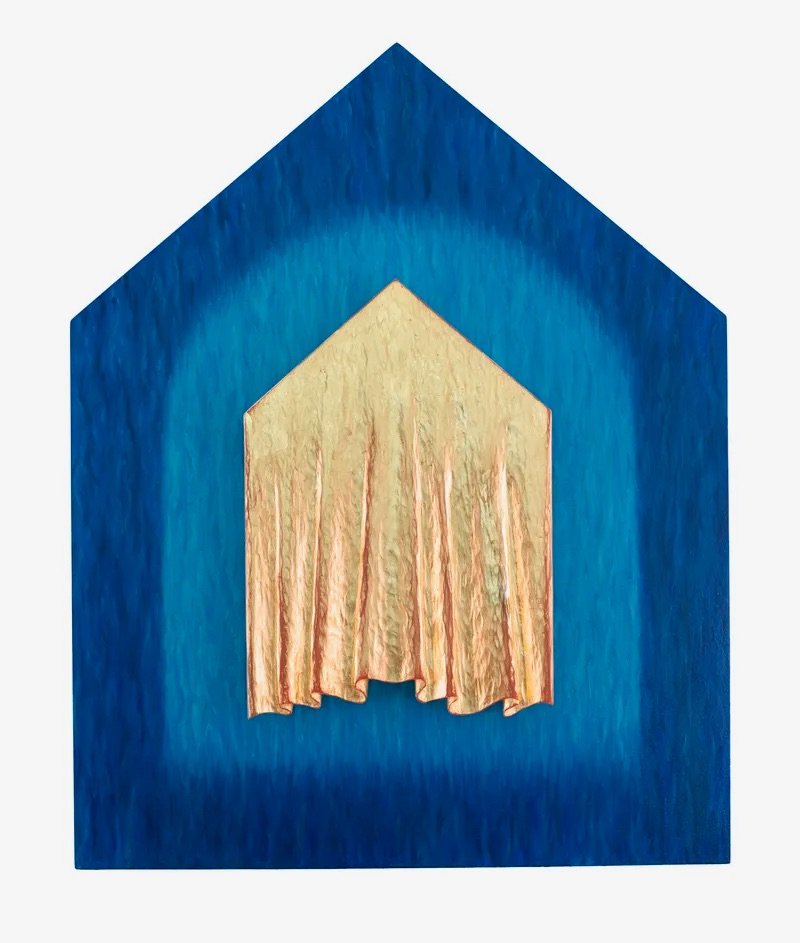
Michael Wolf, The Thin Veil Between, 2022. Wood (Baltic birch plywood and poplar), oil paint, and 24K gold leaf. 30 × 24 × 2¼ in. (76.2 × 61 × 5.7 cm). Courtesy of Hollis Taggart Downtown.
Michael Wolf’s The Thin Veil Between (2022) offers one of the exhibition’s clearest demonstrations of this idea. Developed following a fellowship at Winterthur, where he studied carved ornament on historic American furniture, and inspired by the exuberant shell forms of a Portuguese Baroque tabernacle at the Philadelphia Museum of Art, his sculpture transforms historical research into contemporary making. Five months of carving, painting, and gilding are visible not simply as labor, but as practiced knowledge. Rather than reproducing historical forms, Wolf absorbs them into his own visual language, demonstrating how memory can function as a living material within artistic practice.
Cordy Ryman approaches memory through an entirely different logic. His painted wooden constructions privilege relationships over individual objects. In Box Mountain (2023–2024), Ryman’s work speaks to the memory of a growing—and sublimating—repository, almost ritualistic, as if each box has a memory to be buried under the mountain. Repetition, variation, modular construction, and accumulated decisions create an installation that rewards movement as much as observation. As viewers circulate through the gallery, attention shifts continually between individual forms and the larger field they collectively produce. Meaning develops through return. The work encourages sustained looking, revealing how repetition itself becomes a structure through which memory is built.
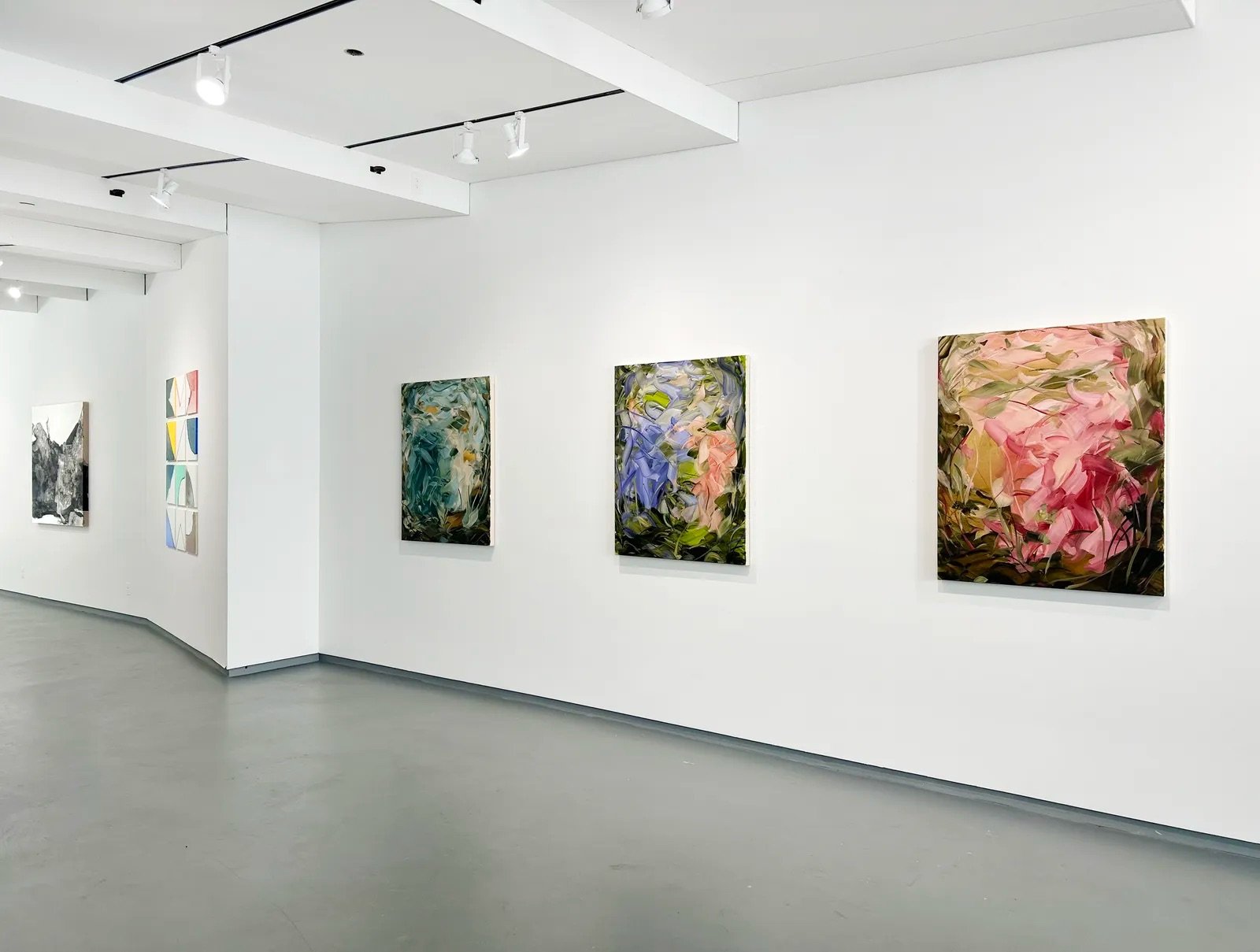
Installation view, Material Memory, Hollis Taggart Downtown, featuring works by Megan Baker, Cordy Ryman, and Kelly Wang. Courtesy of Hollis Taggart Downtown.
The exhibition’s artists broaden this proposition rather than merely illustrating it. Ashanté Kindle locates memory in Your Latter Will Be Greater (Believe It) (2025) within embodied experience and ritual. Kindle’s work unfolds as rhythmic, recursive inspiration, layered as preserved earthen topographical circles and ellipses—shapes of seeing the earth both as map and as celestial beings—and held together by a deep monochrome complexity, inviting the paradox of memory as manifestation. Megan Baker’s paintings suggest that memory resides not only in image or narrative but in material itself, where transparency, layered surfaces, and visible traces allow earlier decisions to remain active throughout the painting. Across the exhibition, inherited imagery, reconstruction, fragmentation, and cultural translation become diverse ways of carrying visual knowledge forward.
As memory becomes woven into relationships of color, form, rhythm, structure, and material, it becomes less descriptive and more available to the viewer. The work no longer asks us to recover specific memories. Instead, Material Memory creates the conditions for viewers to bring their own acts of recognition, association, and recollection into the encounter.
Material Memory argues that memory is not simply embedded in objects; it is embedded in artistic practice itself. In the artist’s studio, memory is a generative force that continually shapes the present. Memory is not only what art preserves—it is a working structure that artists continually transform.
Material Memory runs through June 20 at Hollis Taggart Downtown, 109 Norfolk Street, New York.