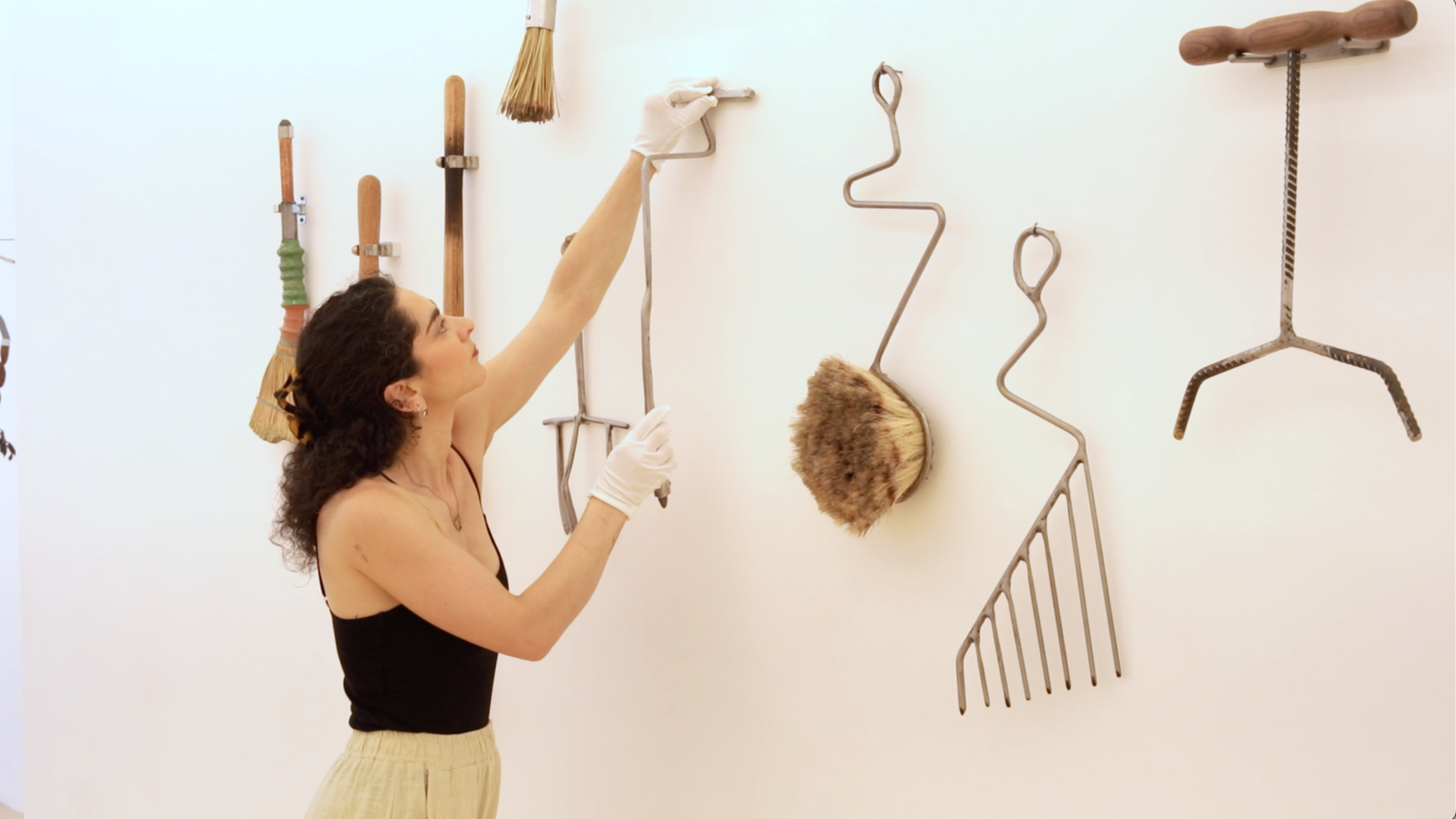
To walk into an exhibition of Dena Paige Fischer’s sculptures is to enter an enchanted world of anthropomorphic drawing tools that seem ready to come off the walls and begin drawing on their own. The transition into Fischer's imaginative universe began before I even stepped inside.
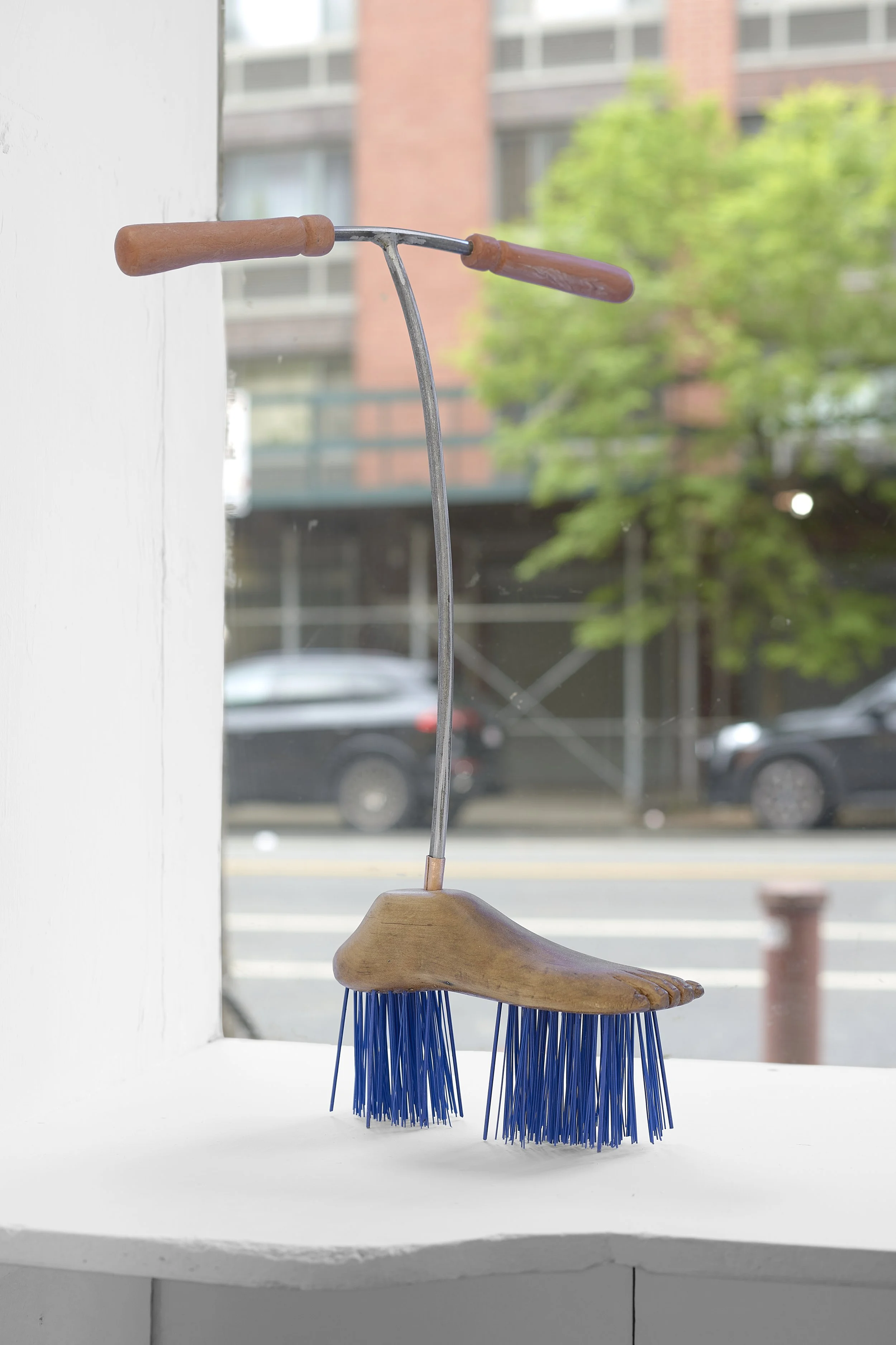
Approaching the Parent Company Gallery beneath an awning inscribed with Chinese characters, I passed open cellar doors leading down to the basement, an alternative exhibition space. In the window stood a carved wooden foot, blue bristles sprouting from its sole and something resembling bicycle handlebars emerging from the top of the foot. At the entrance, the gallery door was locked. A sign instructed visitors to “Please Ring Bell,” though no bell exists. None of these details, with the exception of the foot with its blue bristles, were part of the exhibition itself. Yet together they created an atmosphere of delightful incongruity that seemed to foreshadow the work waiting inside.
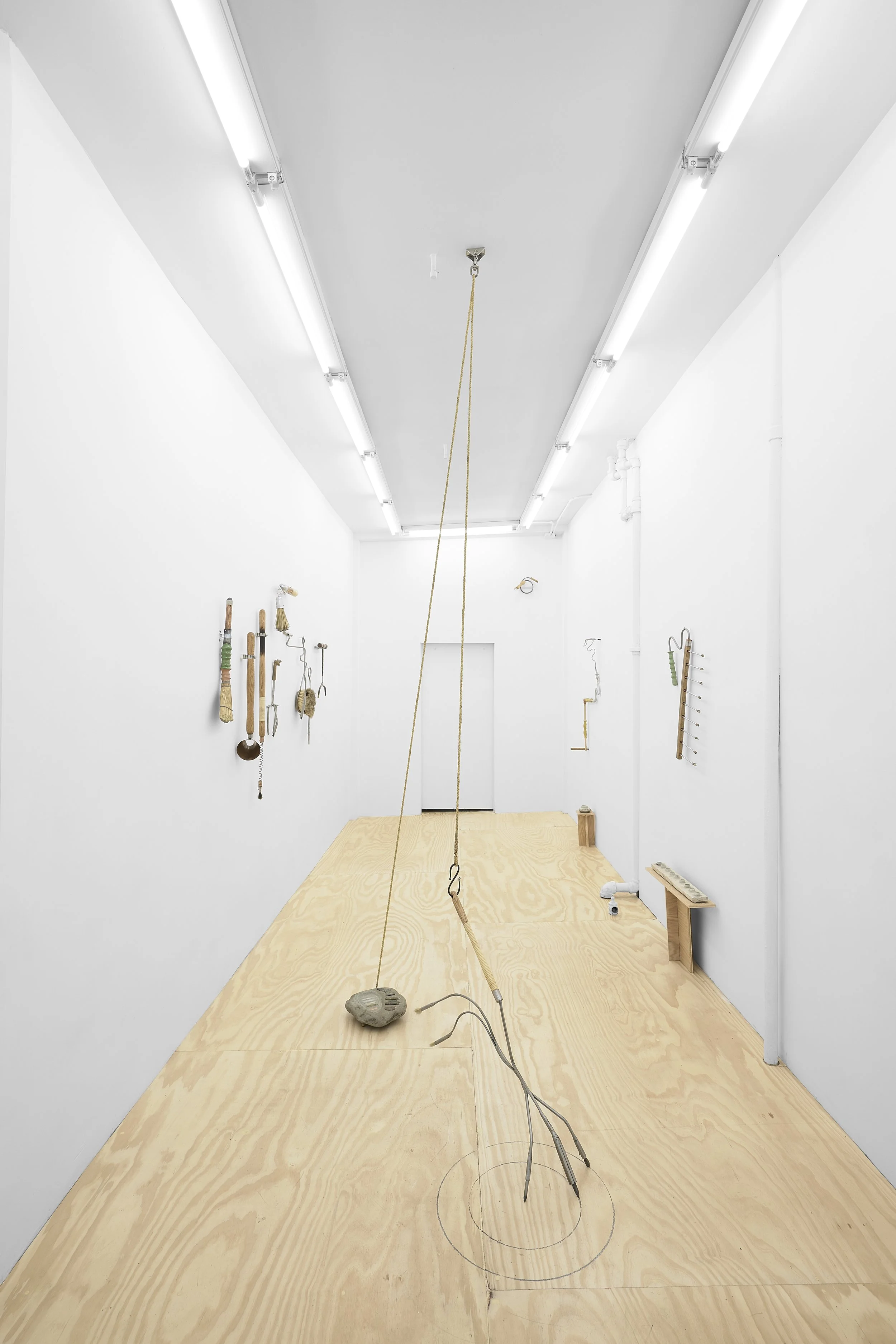
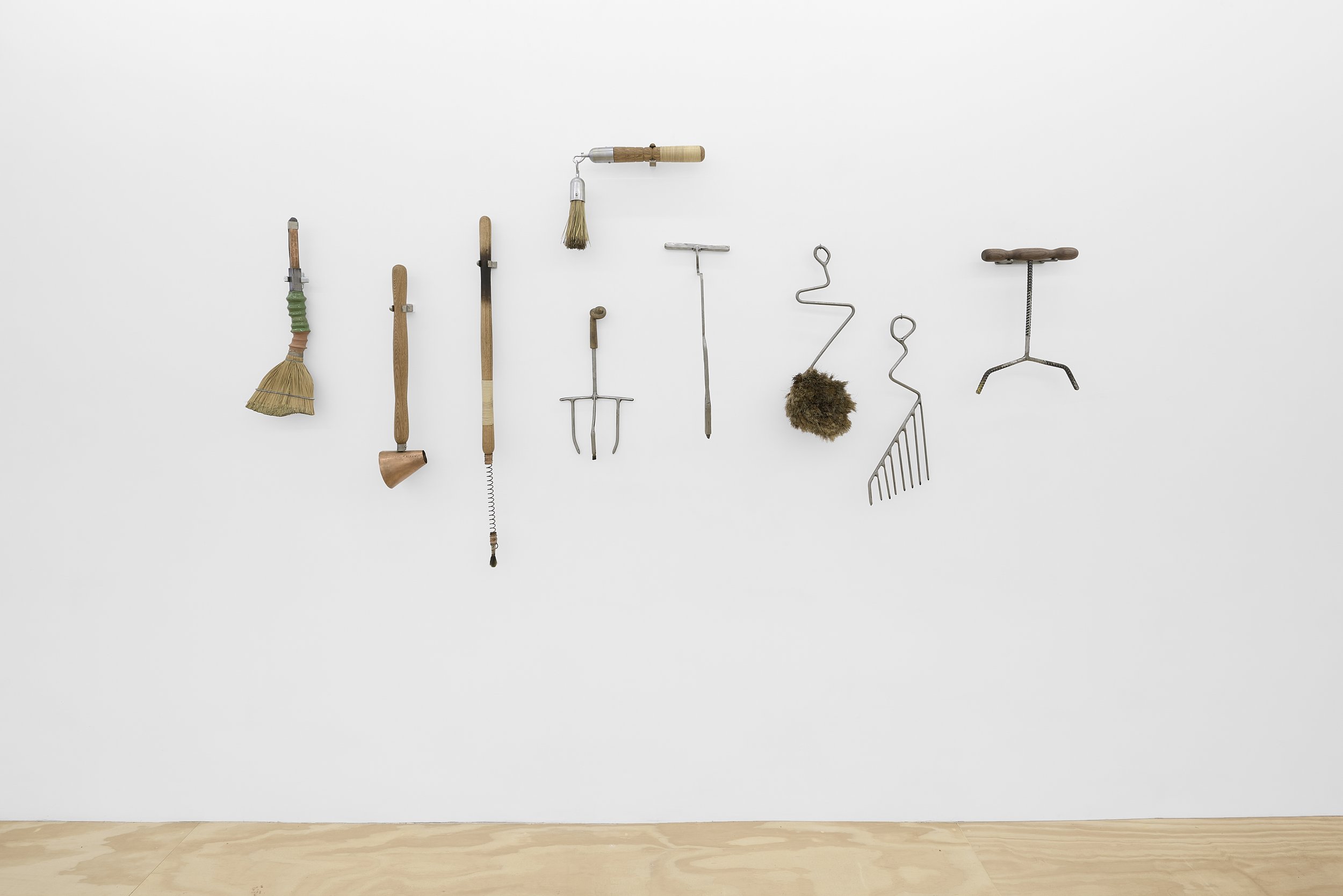
I knocked, and the gallerist opened the door. Stepping inside, I entered a narrow gallery, a typical white-walled space with wooden floors. What transforms the space is Fischer's work which hangs on the walls with one piece suspended from the ceiling by a rope, held in place by a stone. At first glance, the exhibition resembles a minimalist hardware store stocked with strange and unfamiliar tools. It is only upon closer inspection that their true nature begins to emerge.
The title, Implements for Deviation, provides an entry point into Fischer’s thinking. The implements are drawing tools she has designed to introduce an element of chance, or deviation, into the drawing process. Because they resist complete control, the marks they produce become collaborations between the artist and the tools themselves. This immediately raises a central question: where does the artwork reside? Is it in the drawings produced by the tools, or in the tools themselves?
Fischer answers this question by making the implements the focus of the exhibition. No drawings are displayed, although prints of the drawings are available. Instead, the viewer encounters the tools as autonomous sculptural objects. Their functional purpose is not clearly evident, their forms possess a personality and presence that exceed utility. They seem less like tools and more like shamanistic devices, ready to be used in some mysterious ritual. Fischer does, in fact, use her drawing tools in public demonstrations, activating the implements she has created while producing new drawings. This performative aspect reinforces their dual identity as both functional instruments and sculptural artworks.
The exhibition also complicates the traditional distinction between craft and art. Functional objects are often categorized as craft, where value is associated with technical mastery, precision, and usefulness. Art, by contrast, has historically been linked to self-expression and conceptual inquiry. Fischer’s implements occupy both realms simultaneously. They are carefully engineered to perform a task, yet they also stand independently as imaginative sculptures. By fusing function, chance, and anthropomorphic form, Fischer creates objects that transcend such categories.
Fischer’s drawing tools are amalgamations of found, acquired, and handmade elements, fusing wood, metal, and concrete into cohesive forms. One of her greatest strengths is her ability to make these disparate materials and components come together seamlessly and naturally.
Presented in the gallery, the tools appear enigmatic and mysterious. It is not immediately clear how they are used or what kinds of marks they might produce. Fortunately, Fischer is highly adept at demonstrating them. On June 6, she activated the tools and showed visitors how they function.
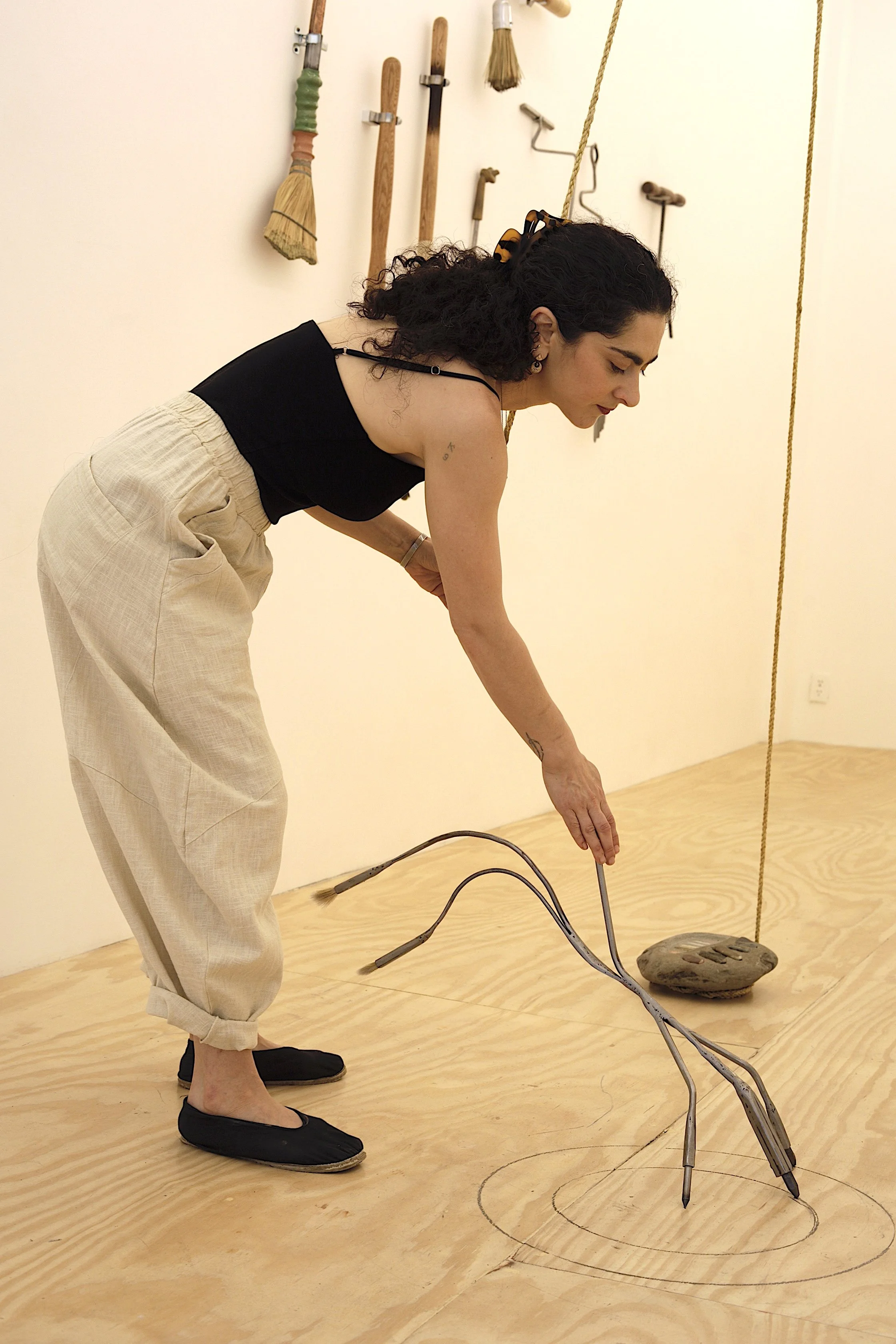
Once set in motion, the logic behind many of the implements becomes apparent, though their ingenuity remains surprising. Some of the implements are relatively straightforward, and the marks they create can be anticipated. Nine Liner (DRW_01), for example, consists of nine twisted metal rods evenly spaced and attached to a straight wooden handle. Each rod ends in a calligraphy-style pen nib. Fischer constructed a custom ink well with nine evenly spaced wells designed specifically to accommodate the rods and nibs of the device. The ink well, cast in concrete and patinated to resemble aged ceramic, is itself a carefully considered object. The tool produces evenly spaced lines that Fischer manipulates to create a variety of visual effects.
One of the simplest-looking yet most ingenious tools is DRW_03, which is made from a whisk broom trimmed short. At the opposite end of the “handle,” a piece of graphite is mounted. During the demonstration, Fischer pressed the graphite to the paper to create a dark line, then used the broom end to “sweep” the graphite, smudging it and producing subtle, wispy marks.
Other tools are even more intriguing. BRU_03 is shaped like a trident with three prongs, and one might assume it would create three parallel lines in the manner of Nine Liner. Instead, Fischer ingeniously tilts and spins the device, using it like a compass to draw circles. The transformation of a seemingly rigid tool into an instrument of fluid, dynamic movement captures the inventive spirit at the heart of her practice.
Hanging in the center of the gallery is DRW_04, it is held in place by a stone that Fischer carved last summer during a stone-carving workshop in upstate New York. The stone serves not only as an anchor but also as a functional component of the work. It contains six carefully carved compartments designed to hold smaller stones. When rubbed with water in their respective wells, these stones produce natural pigments that Fischer uses in combination with her other tools to create marks and drawings. The piece exemplifies the artist's ability to merge sculpture, process, and utility into a single object.
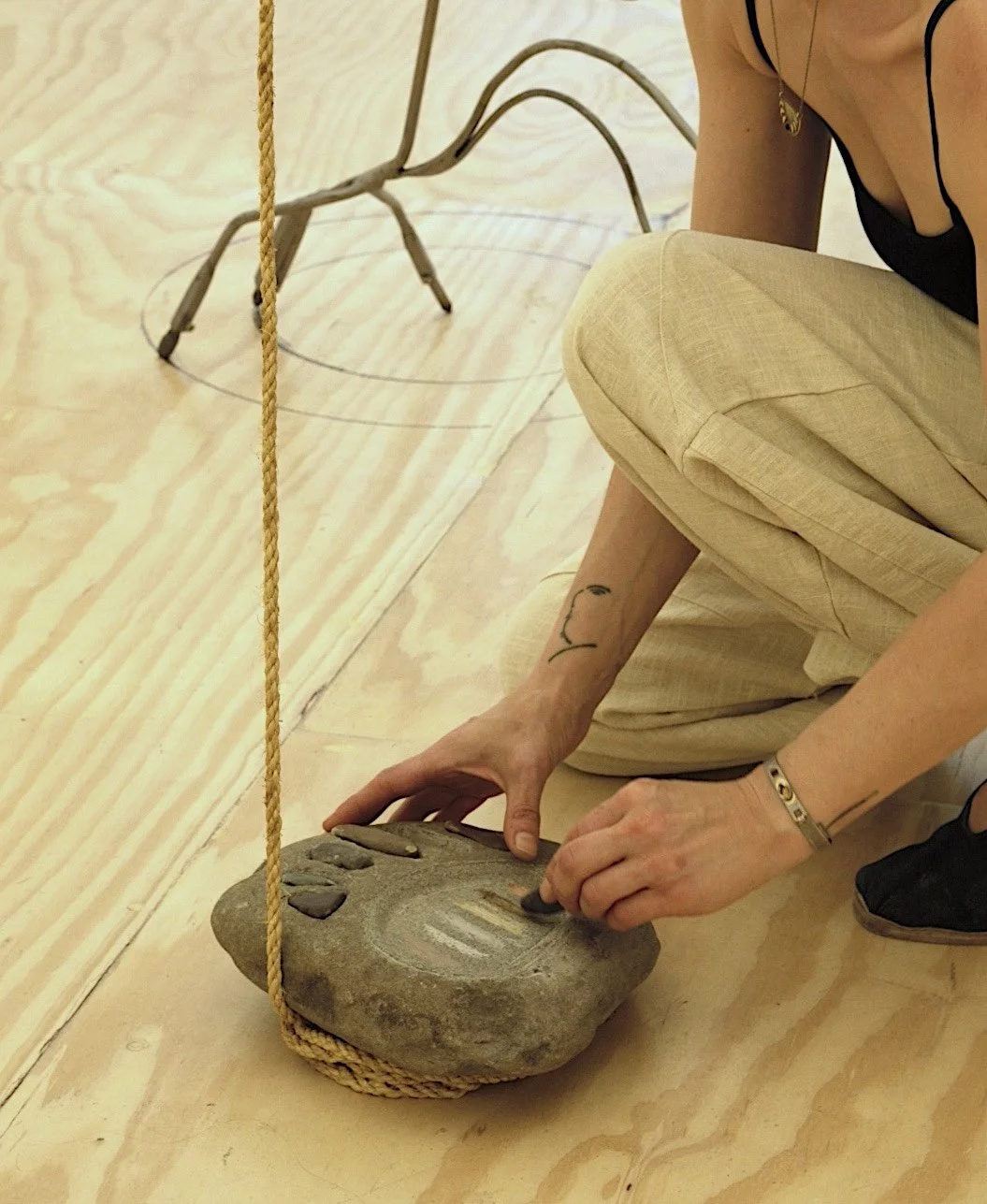
This fusion of object-making and mark-making extends beyond the gallery walls. Fischer is currently an artist-in-residence with the Taiwanese American Arts Council on Governors Island through September, where she has two drawing machines on view that are not included in the exhibition at Parent Gallery, inviting visitors to experiment with them firsthand.
During my visit, I watched Fischer demonstrate one of her more complex drawing machines, which requires the wearer to don a harness, manipulate part of the device with one foot, and maintain balance on the other. Observing her was like watching a slow, ritualistic dance or a practitioner of Tai Chi moving with deliberate precision. Looking at the drawings, one gains an appreciation for Fischer's extraordinary bodily-kinesthetic intelligence and her ability to translate complex bodily movements into visual form. The act of drawing becomes a performance in itself, with the artist's body serving as an integral component of the apparatus.
At the same time, Fischer's drawing machines inherently incorporate elements of randomness and chance. In this respect, her process recalls Dadaism, which embraced chance operations to subvert traditional logic and challenge notions of artistic control and intentionality. While Fischer's work is grounded in carefully built objects, the resulting drawings emerge from a dynamic interplay between design, movement, and unpredictability.
Fischer grew up in New York City as the child of two artistic parents. Her father, the sculptor R.M. Fischer, is best known for his clock design that enhances the Manhattan portal of the Brooklyn-Battery Tunnel and the Rector Gate, a fifty-foot-tall archway in Battery Park City made of steel, bronze, and granite that takes inspiration from Constructivism and science fiction. Her mother, Patti Paige, a painter, founded the company Baked Ideas. The company specializes in making sculptural and artistically decorated cakes and cookies. Fischer clearly inherited her parents' sense of playfulness and whimsy but quickly found her own voice while studying at SVA and the Maryland Institute College of Art.
Parent Company is a nonprofit exhibition space founded in 2023 by Ada Potter. The gallery began in an unconventional setting: a rented shipping container in Brooklyn that Potter found on Craigslist. When that space became unavailable, she relocated the operation to the basement of its current storefront gallery. Today, the basement serves as both a project space and the home of a residency program that runs from June through September.
Dena Paige Fischer | Implements for Deviation
On view May 7 - June 27, 2026
Parent Company is open Wednesday - Saturday 11-6pm and by appointment
54 E Broadway, New York, NY