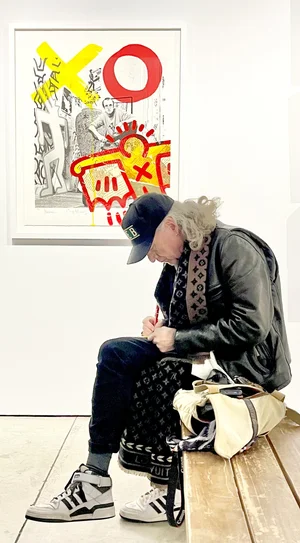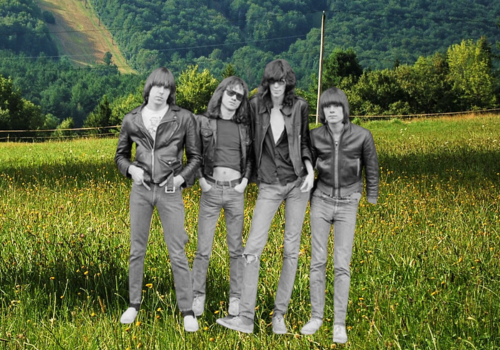
Collage featuring the iconic Roberta Bayley photograph of the Ramones.
There's a silkscreen of Debbie Harry hanging on a wall in the Berkshires now. Shepard Fairey reinterpreted the image—a Bobby Grossman photograph from the height of Lower East Side’s CBGB's era—and somewhere in the translation from photo to print, Harry's stare got harder, more iconic, more art. A few feet away, a drawing captures Iggy Pop mid-scream, mouth open on the line "I am the world's forgotten boy," from "Search and Destroy." Behind both works: not the Bowery, not Forsyth Street, but the green sprawl of the Berkshire mountains, just steps from this new show at Mass MoCA's Research & Development Store.
That's the joke and the point of 50 Years of PUNK, the exhibition that originated at Ki Smith Gallery on the Lower East Side last winter and has now relocated to a museum campus three hours north of punk's ancestral home. Punk's mythology has always been hyperlocal: CBGB, the Bowery, a specific corner of downtown Manhattan in the late-1970s where a photocopied zine turned a regional scene into a global one. Planting that mythology in rural Massachusetts, framed by mountains instead of tenements, isn't a contradiction. It's proof of how far the thing actually traveled.
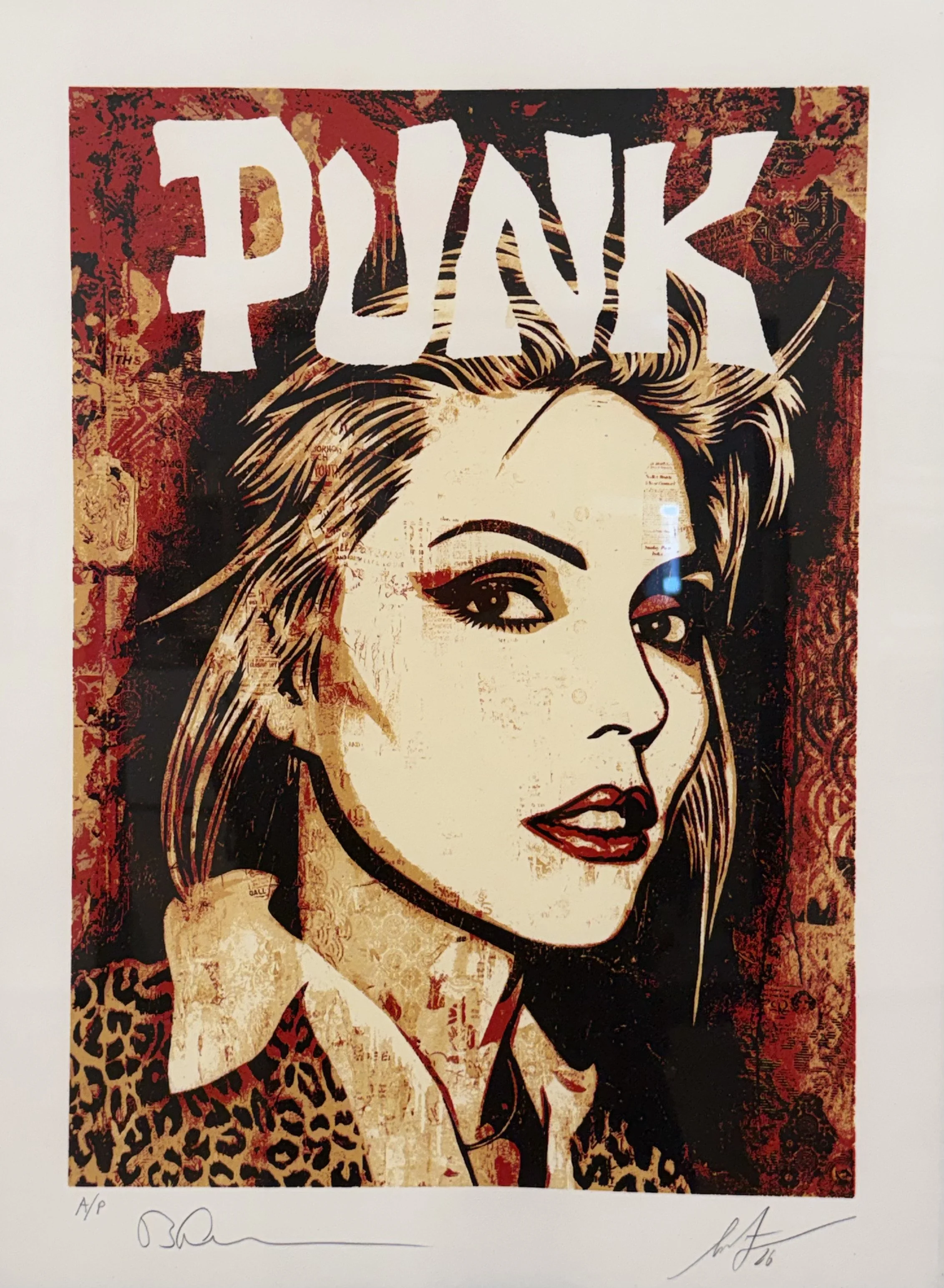
Punk 25, Shepard Fairey, original photo by Bobby Grossman, silkscreen by Gary Lichtenstein.
“Punk music is not just local to New York,” Ki Smith told B Scene Zine on the eve of the show’s opening at Mass MoCA. “To me, growing up in the in the East Village or Lower East Side, all these folks were larger than life, but you get outside of the bubble of New York and you see how much these same people that moved you have moved so many other people. And I think that, more than anything, punk is about an attitude that is common among people from all over,” he said.
“It's applicable in New York for sure, but it's also definitely applicable, even in the beautiful Berkshire Mountains,” Smith said adding that he’s already working on new venues to host the show afield of the Lower East Side. “One hundred percent, there's no world where this is the show's last stop,” he said
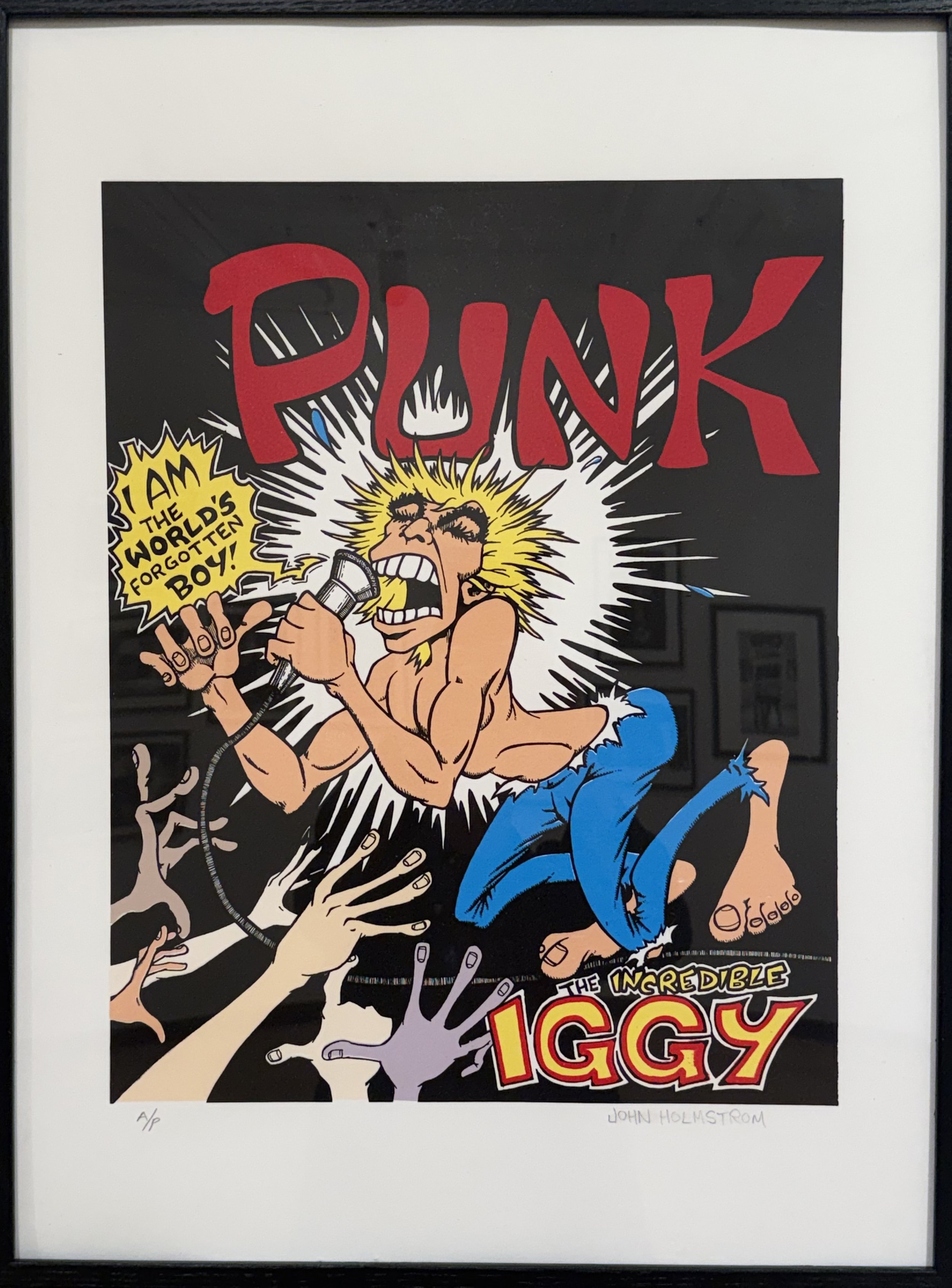
Iggy PUNK 4, 2025, John Holmstrom, silkscreen by Gary Lichtenstein.
The original show, curated by Smith and PUNK Magazine co-founder John Holmstrom, ran at Ki Smith Gallery from November through January. It was built around the 50th anniversary of PUNK's first issue—the one with Lou Reed on the cover. The show drew on PUNK's archive of Roberta Bayley and Chris Stein photographs, R. Crumb and Holmstrom illustrations, and a suite of new silkscreens by master printer Gary Lichtenstein that were signed by contributors including Brian Eno and the surviving members of DEVO.
Mass MoCA picked up 50 Years of PUNK almost by accident. Lichtenstein had already worked with the Research & Development Store on a benefit portfolio tied to the museum's 25th anniversary, and it was through Lichtenstein that Smith's exhibition found its way to Chris Conti, the store's creative producer. "We're trying to promote analog content to people who are consuming culture. You’d be surprised how many visitors to the museum will be captivated by a show like this," Conti said, describing the store's mix of records, books, and print media as a natural fit for a magazine built on photocopiers and staple guns.
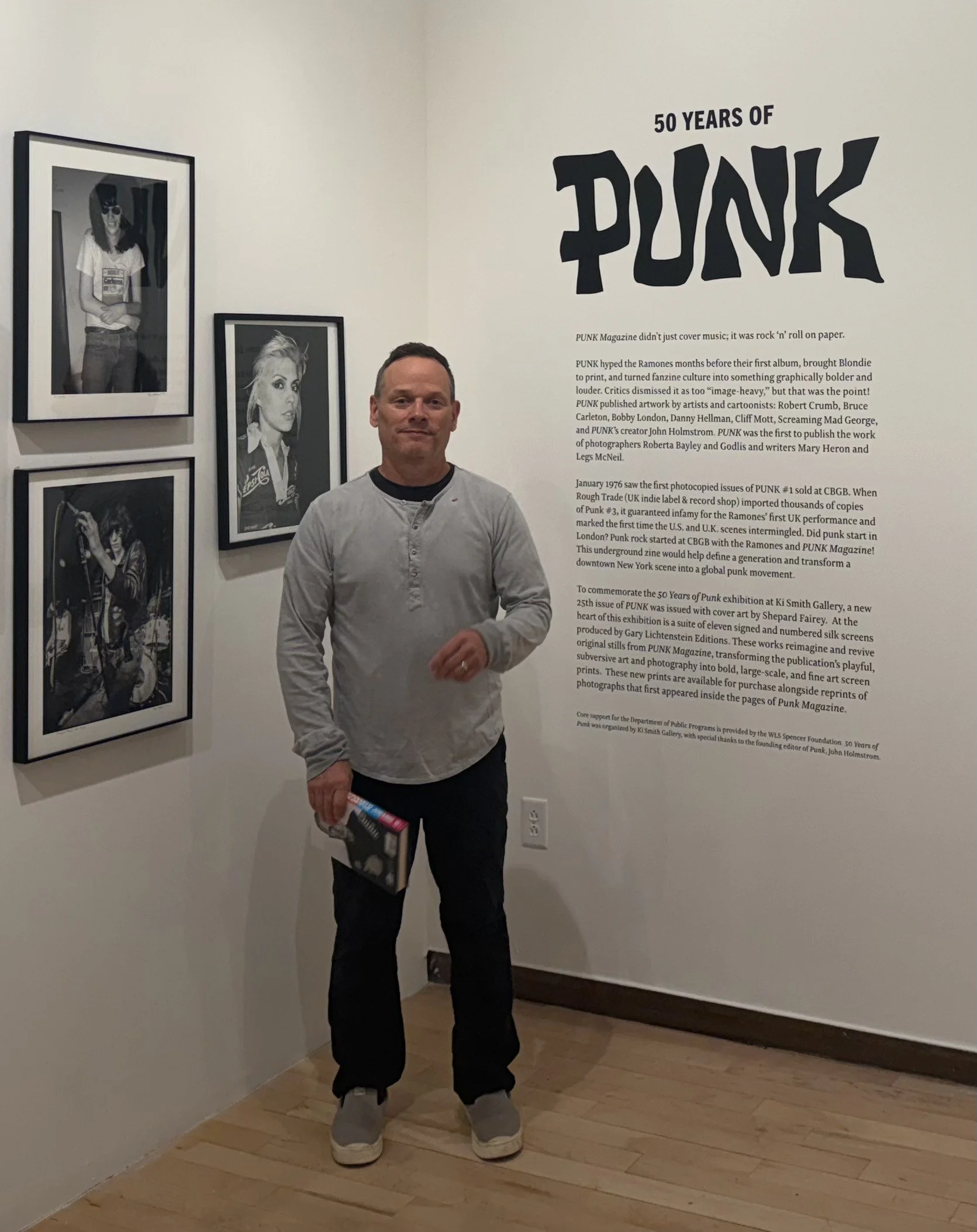
Chris Conti, creative producer at Mass MoCA's Research & Development Store, in the gallery. Photo by Lisa Freeman
The timing also works: the show opens June 26, during Solid Sound, the museum's annual music festival, which Conti says pulls in roughly 8,000 visitors a day—an audience, in his words, of "music nerds." Kicking off the weekend: Gang of Four front man Jon King, himself a punk legend, promotes his new book To Hell With Poverty in the same expanded gallery space.
Lichtenstein, who has spent decades printing for fine artists, street artists, photographers and others in NYC, said bringing the LES to the Berkshires is a better fit than it might seem at first glance. “It's a very interesting little synergistic thing that you've got going here. You know, like there's nothing much else to do here, so bringing in some downtown culture is pretty cool,” he said.
While the scenery has changed, the exhibition's content has not. The same Iggy Pop drawing, the same Fairey-via-Grossman-Harry print, the same comics Holmstrom drew decades ago for an audience of a few thousand zine readers—now hanging in a museum gift shop turned gallery, in a town with more cows than punks, during a festival built around the kind of analog devotion PUNK invented. The mountains outside may seem a contradiction, but they're the whole argument: the thing that started in a six-block radius of downtown Manhattan was never really about the real estate.