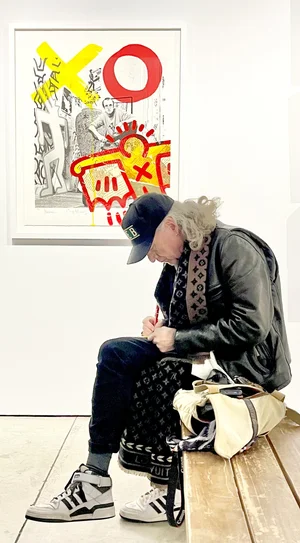
The monumental, three-part Untitled (Cake Train) is on the left. Photo by J. Scott Orr
A white mass creeps across the canvas like whipped cream magma from some confectionary volcano. At the edge of Untitled (Torta Ettore), a single candle, its courageous flame flickering even as it seems to be in retreat, leans against a polished red apple. Nothing in Andreas Schulze's paintings behaves quite the way you’d expect. Gravity loosens. Furniture curls into decorative flourishes. Fruit becomes ornament. Cakes become architecture. The ordinary remains recognizable, but only just.
That unstable territory is the subject of Cake, Schulze's first exhibition at Sprüth Magers' New York gallery, bringing together a new body of paintings built around a motif the German artist has returned to periodically for decades. Cake serves as both a literal object and a vehicle for ideas about display, pleasure, decoration, color and the rituals of everyday life. It’s a sweet, lighthearted topic; the paintings are hardly so.
In Untitled (Her), a checked blue backdrop recalls kitchen wallpaper or a picnic cloth, but it quickly dissolves into something stranger. A monumental swirl of white folds across the canvas like fabric, icing or cloud, framing a crinkly, dimensionally obscure eyeball, with a brightly rendered fruit pupil. The fruit is painted almost photographically while everything surrounding it exists in stylized abstraction. Schulze has long built paintings from precisely this collision between convincing illusion and invented space, refusing to settle into either representation or abstraction. That oscillation has defined his work since he emerged from Cologne's influential art scene in the early 1980s.
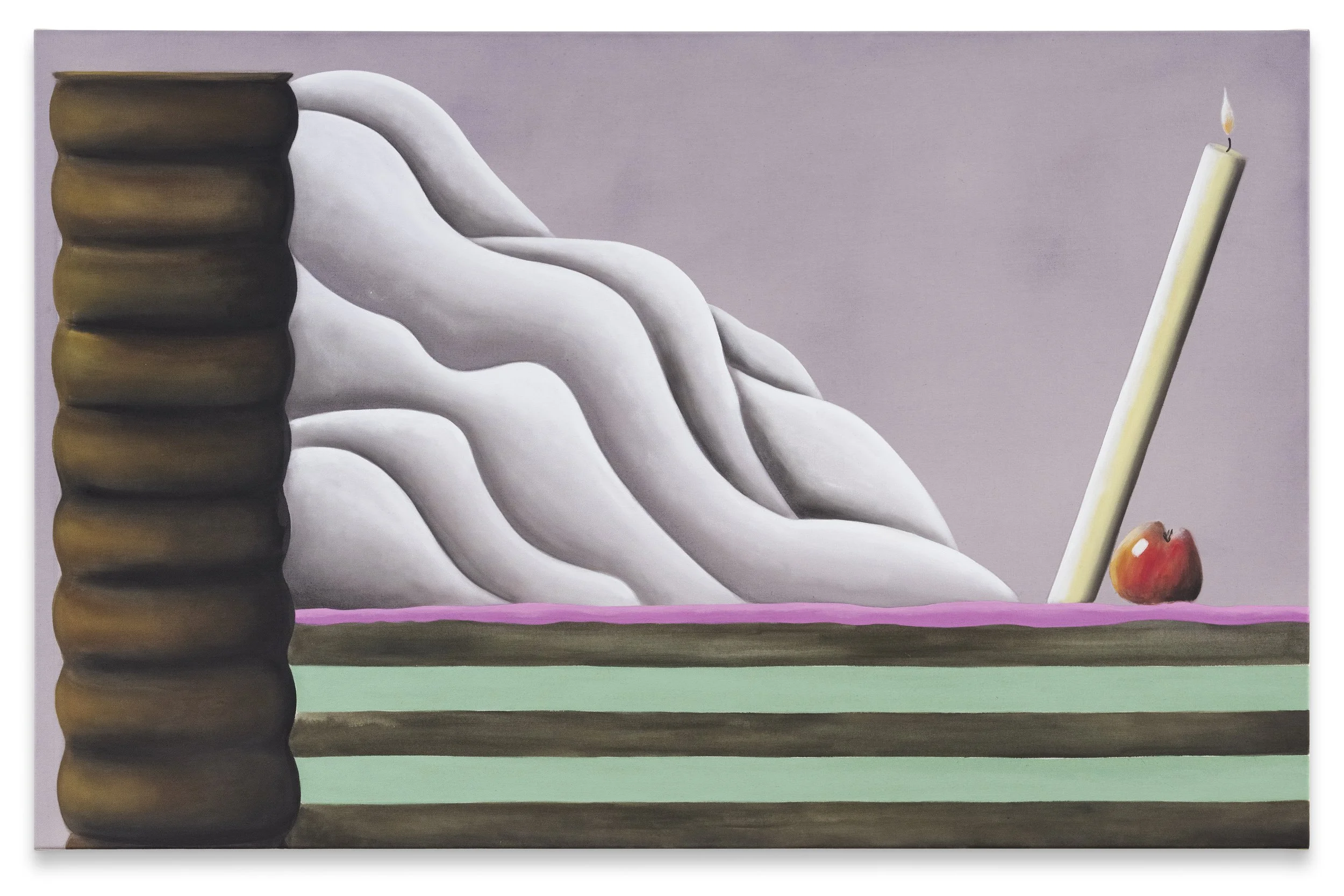
Andreas Schulze, Untitled (Torta Ettore), 2026. Courtesy the artist and Sprüth Magers. Photo by Mareike Tocha
Schulze came to prominence alongside the generation of German painters associated with the resurgence of painting after conceptual art, but his pictures never shared Neo-Expressionism's aggression or theatrical brushwork. Instead, he developed a highly controlled vocabulary of rounded forms, flattened interiors and cartoon-like domestic objects that borrowed freely from Surrealism, Pop Art and commercial design without settling comfortably into any of them. The result was a visual language that has remained remarkably consistent for more than 40 years.
That consistency becomes especially apparent inside Sprüth Magers' Upper East Side townhouse. The installation avoids spectacle despite including one genuinely monumental work. The painting reads simultaneously as toy, machine and confection. Stretching across one wall, the three-panel Untitled (Cake Train) transforms a locomotive into a rolling layer cake, but is it a toy, a machine or a confection? The train appears to be transporting desserts rather than freight, yet its scale allows it to dominate the narrow gallery corridor without overwhelming it.
Elsewhere, Untitled (MSC) pushes Schulze's visual logic even further, applying a coat of confection to a stylized cruise ship. In it a smooth white form rises beneath a turquoise sky punctuated by soft clouds. Tiny metallic dots spread across its surface in regimented rows before giving way to sharp bands of lime green, yellow and blue that zigzag across the composition. Along the horizon sits another procession of fruit—kiwi, grapes, citrus, cherries—carefully arranged as though waiting to decorate a pastry. The painting balances precision against absurdity. Every object is crisply painted, yet no stable space ever fully emerges.

Andreas Schulze, Untitled (Her), 2026. Courtesy the artist and Sprüth Magers. Photo by Mareike Tocha
Schulze has spent more than four decades refining a visual language that has remained remarkably consistent while resisting easy categorization. Writing in Art in America, critic Barry Schwabsky argued that Schulze's paintings resist the usual oppositions between abstraction and representation. Rather than resolving that tension, they sustain it, allowing recognizable objects to drift into pattern, ornament and geometry without ever fully abandoning the physical world. That ambiguity is less a stylistic trick than the foundation of the work itself.
The exhibition essay accompanying Sprüth Magers' presentation describes Schulze as "an inventor of new pictorial worlds" who has developed "an autonomous and unmistakable visual language." That language is built from familiar things—not just cakes, fruit, trains and boats, but also chairs, curtains, automobiles and other mundane items—but stripped of their ordinary function and reorganized into carefully ordered compositions where decoration, architecture and still life become inseparable.
The cake itself becomes an unusually productive symbol. It belongs equally to domestic celebration, commercial display and painterly artifice. It is made to be looked at before it is consumed. Schulze lingers in that suspended moment, when decoration carries as much weight as function.
For an artist who has spent decades building improbable worlds from chairs, curtains, automobiles and clouds, cake feels less like a new subject than an inevitable one. The paintings remain playful without becoming nostalgic, decorative without surrendering to decoration. Even at their sweetest, something never quite settles. The icing continues to slide. The candle keeps burning. And beneath every carefully arranged surface lies the quiet possibility that the whole confection could collapse.
Cake will be up at Sprüth Magers, 22 80th St., New York, though July31.