The East Village Never Stood Still. Daniel Root's Photographs Show What Changed, and What Didn’t
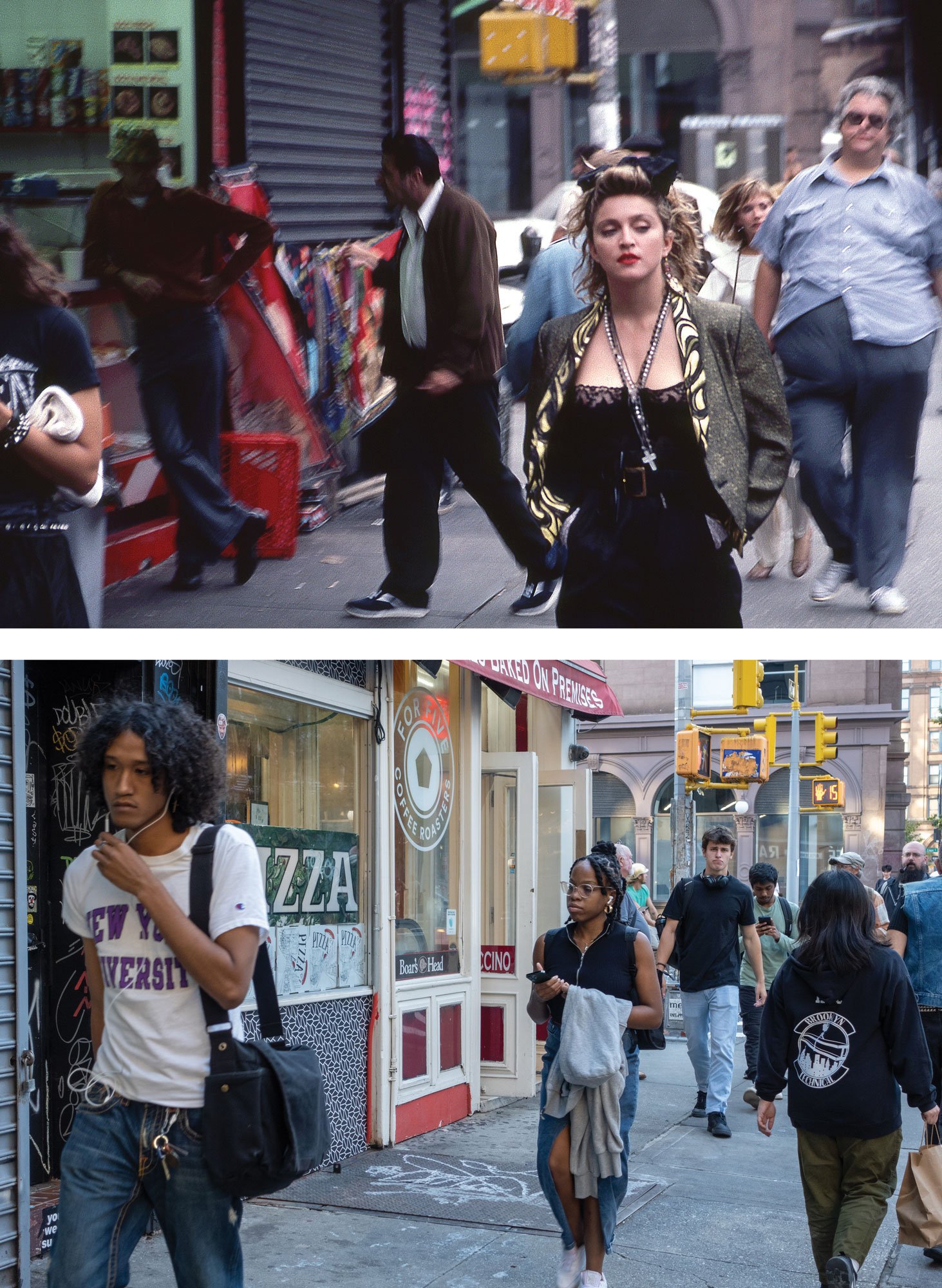
2 SAINT MARK’S PLACE 19: (Top 1980s) Madonna strolling in a scene from the movie Desperately Seeking Susan with Cooper Union in the background. (Bottom today) An after-school walk home
Madonna, dressed in black lace and an oversized sparkly jacket, walks along St. Mark's Place during the filming of Desperately Seeking Susan. A man leans against a storefront, not giving he shit. Others seem similarly nonplused. Cooper Union is a blur in the background. Daniel Root happened to be there with a camera, originally photographing the East Village for a book that never materialized. Forty years later the long-time East Village resident returned to the same corner. Madonna is gone. Students now fill the sidewalk after class. The storefronts have changed, but the rhythm of the street really hasn’t.
That tension between dramatic physical change and everyday continuity drives The East Village Then and Now, Capturing the Changing Streets, Root's newly published collection of paired photographs from the East Village and Lower East Side. Each spread places an image from the early 1980s beside a contemporary photograph made from nearly the same position. The obvious story is gentrification. The story revealed in Root’s book is more complicated.
"The East Village and Lower East Side were fully functioning neighborhoods in the 1980s despite the drugs and crime," Root told The Lo-Down. "They are still fully functioning creative neighborhoods."
It is a deceptively simple observation. Popular memory often reduces the East Village of the Reagan years to a shorthand of abandoned buildings, heroin markets, punk clubs and avant-garde galleries. Those elements existed for sure, but so did families walking children to school, retirees spending afternoons in Tompkins Square Park and immigrant-owned businesses serving customers who had lived on the same blocks for decades.
"Everyone used Tompkins Square Park," Root said. "Older retirees spent the afternoon on park benches, talking, and playing chess. Children's theater was in the bandshell and children played in the sprinklers."
That perspective distinguishes the book from countless nostalgic looks back at downtown Manhattan. Rather than chasing vanished legends, Root pays equal attention to ordinary rituals that survived the neighborhood's reinvention.
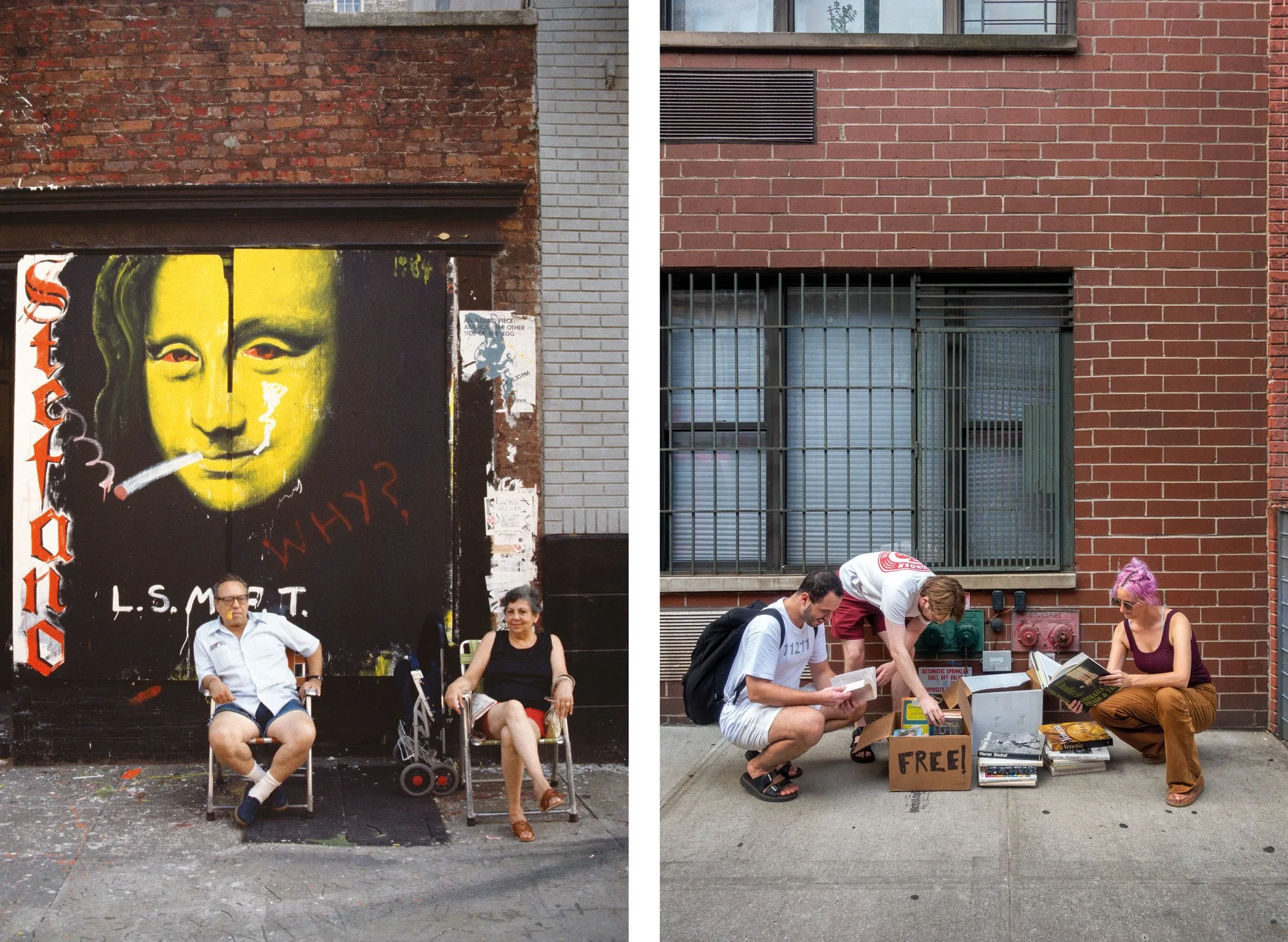
254 EAST 10TH STREET: (Top 1980s) Smoking Mona Lisa, “Stefano,” a neighborhood couple (Jerome Golding, landlord) out for an afternoon smoke in front of Fun Gallery. (Bottom today) The ritual of a move and getting rid of books
One of the book's strongest pairings was shot outside the former Fun Gallery at 254 East 10th Street. In the earlier photograph, neighborhood residents sit beneath the gallery's famous "Smoking Mona Lisa" mural while the pioneering East Village gallery occupies the storefront behind them. Founded in 1981 by Patti Astor and Bill Stelling, Fun Gallery helped introduce artists including Jean-Michel Basquiat, Keith Haring, Kenny Scharf and Fab 5 Freddy to a wider audience before closing in 1985.
The contemporary photograph doesn't linger on what disappeared. Instead, it shows several people crouched over boxes of free books left on the sidewalk apparently after a hasty move. The mural is gone. The impulse to gather in front of the building is not.
The same restraint shapes Root's photographs of Ray's Candy Store at 113 Avenue A. His earlier image captures a cramped storefront selling newspapers, magazines and egg creams beneath a Breyer’s Ice Cream sign. The present-day photograph reveals the current hand-painted sign featuring Ray’s profile, the newspapers are gone, but the tight quarters, snacks and egg cream endure. Since opening the store in 1974, Ray Alvarez has become an institution nearly as recognizable as the storefront itself.
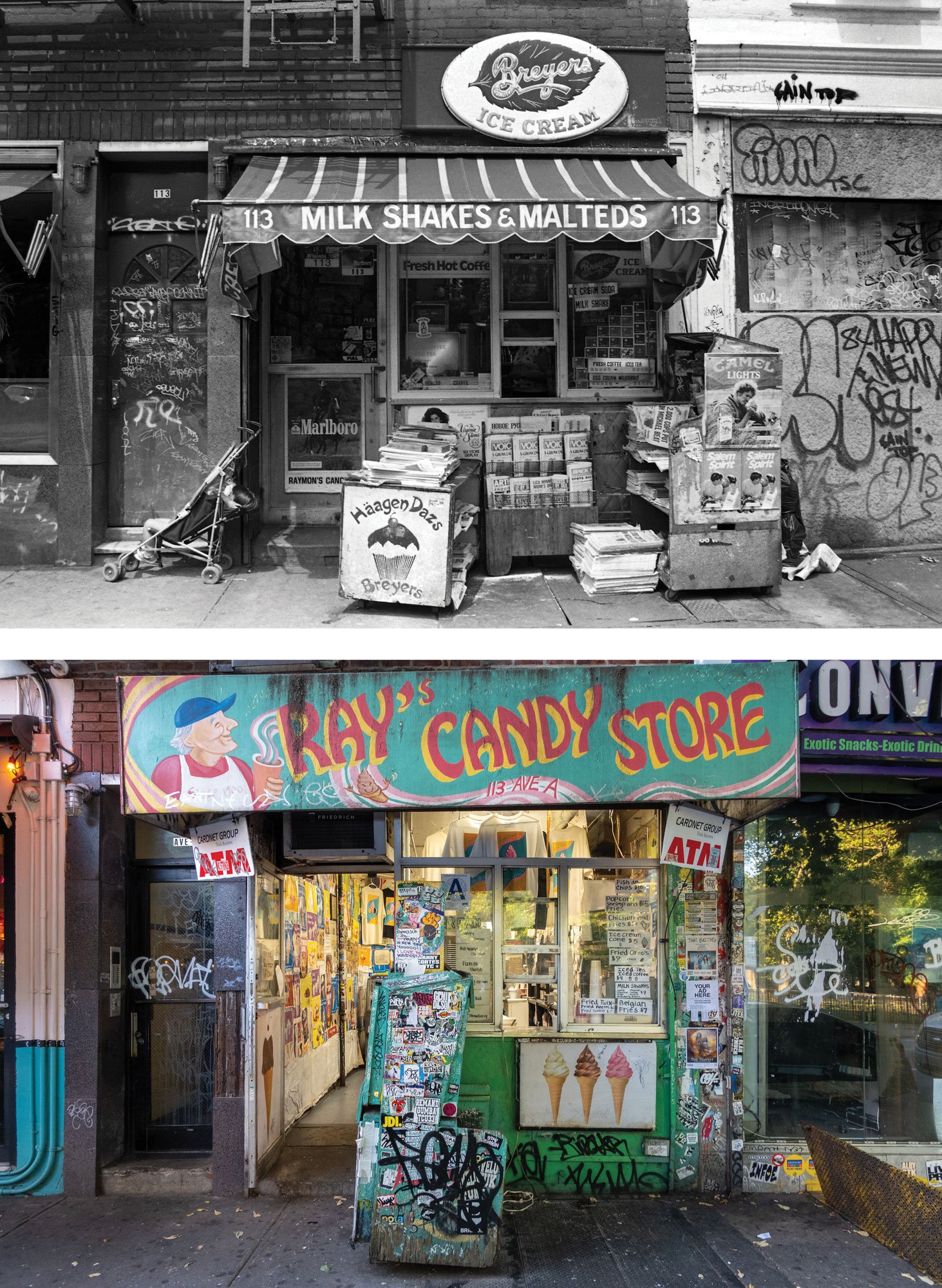
113 AVENUE A: (Top 1980s): Ray’s Candy Store, open 24-hours since 1974. (Bottom today). Now Ray’s is more sweets and munchies.
The biggest visual surprise, Root says, isn't luxury housing.
It's trees.
"The biggest difference, visually and money aside, is the amount of green," he said. "Street trees and community gardens are everywhere. To the point I could not take some now photos in the summer because the trees/leaves now block the views."
That small detail says as much about the neighborhood as any real estate statistic. Vacant lots have become community gardens. Saplings planted decades ago now obscure buildings that were once fully visible from the street.
The Christodora House on Avenue B appears first as a largely vacant shell looming over Alphabet City, a reminder of the disinvestment that scarred much of the neighborhood in the early 1980s. Its companion image shows a restored building, warm interior lights and pedestrians heading home from work and school. The building has become one of the East Village's most recognizable luxury addresses, but Root deliberately avoids making it the subject. His attention remains fixed on the people moving across the frame.
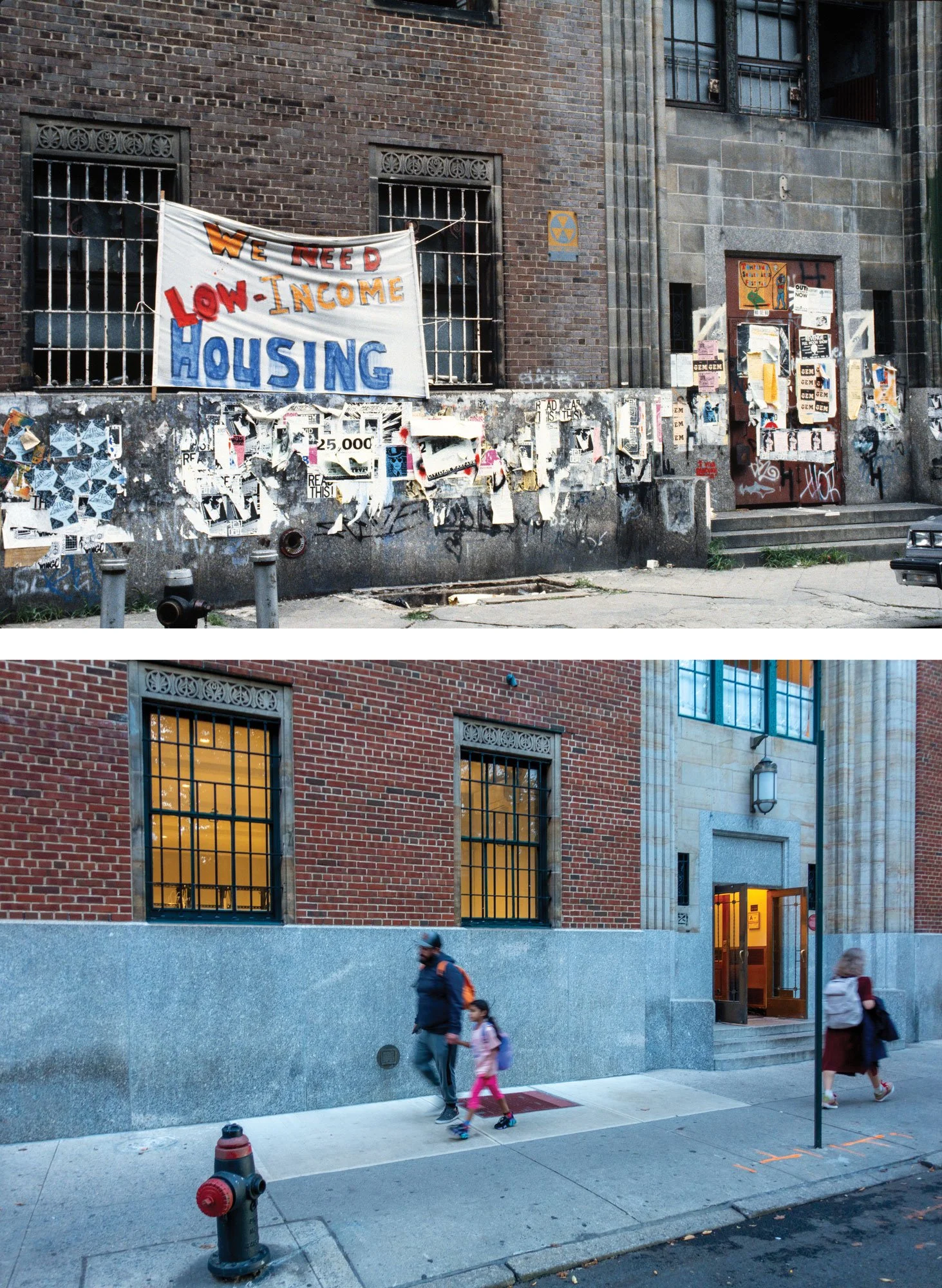
143 AVENUE B: (Top 1980s) Christodora House, vacant, before the rapid changes. (Bottom today) Christodora House, walking home from school, walking home from work.
The book's accompanying essays reinforce that broader perspective without romanticizing the past. In his introduction, Allen Ginsberg archivist Bill Morgan argues that Root joins a lineage of photographers who have documented New York through periods of upheaval. "Daniel Root's masterful images are an excellent example of this," Morgan writes, adding that the photographs record "that on-going rapid change that seems to happen to this spot on earth with lightning speed."
Artist Peter McGough, who lived on Avenue C during the 1980s, contributes a memoir of a neighborhood where burned-out buildings, drug markets, artists and immigrant families occupied the same streets. His recollections underscore the conditions from which many of Root's earlier photographs emerged, while reminding readers that memory itself often privileges extremes over ordinary life.
Root's photographs quietly resist that tendency.
The East Village has accumulated enough mythology to make every discussion of its past sound predetermined. The galleries became famous. The artists became famous. The rents became infamous. Root's camera keeps drifting back to something less dramatic: people sitting outside a storefront, children walking home from school, neighbors sorting through discarded books, strangers crossing St. Mark's Place.
Those moments don't deny how profoundly the neighborhood has changed.
They ask whether change was ever the whole story.