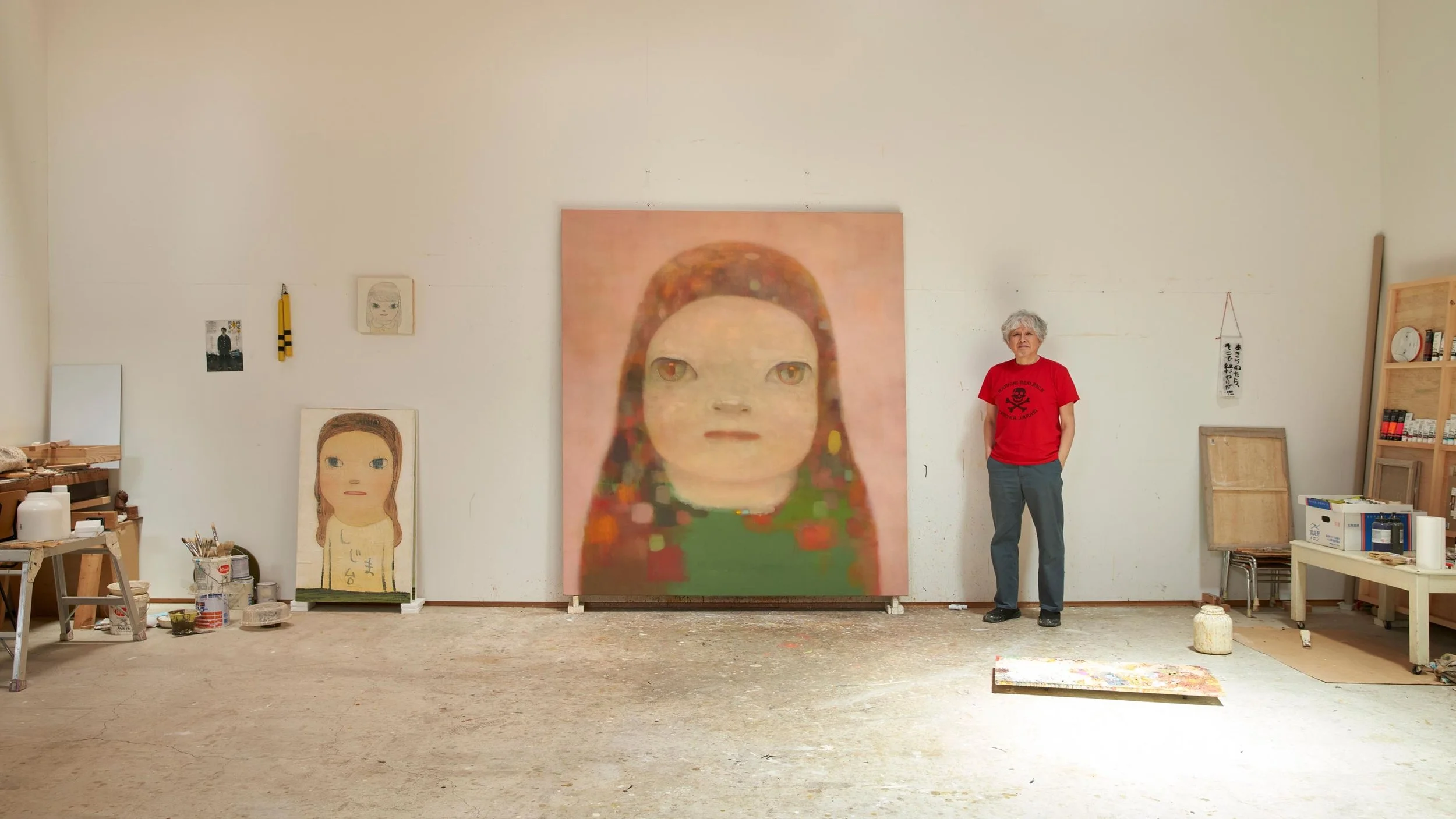
Yoshitomo Nara in his studio, 2026. Photograph: Keita Saiki, Artwork: Yoshitomo Nara
There is little in Yoshitomo Nara's studio to suggest one of the world's most successful living artists. In a recent photograph, there’s no immaculate showroom, no carefully staged monument to success. He stands off to the side of a towering new canvas in gray pants and a faded red skull-and-crossbones T-shirt whose slogan appears to celebrate beer freaks, whatever that might mean. It is the sort of shirt you’d expect to find on a punk-rock-lifer in a downtown club, not on an artist whose paintings have sold for more than $25 million at auction and whose work anchors museum collections around the world. The contradiction is real, and it has always been part of Nara's appeal.
That contradiction anchors Nara's first solo exhibition with David Zwirner, opening October 29 across the gallery's West 19th and West 20th Street spaces in Chelsea. It is also the Japanese artist's first major solo exhibition in New York in nearly a decade, bringing together new paintings and drawings, recent monumental sculptures and a selection of early works chosen by the artist himself. Zwirner promises the exhibition will present a retrospective of the work that established Nara's reputation along with new work that suggests his visual language is still changing.
Nara’s signing with Zwirner last November, after years with Pace and before that BLUM, was one of the art market's biggest representation moves of the year. It brought one of contemporary art's most bankable artists into the orbit of another blue-chip powerhouse, while underscoring an unusual contradiction: few artists have traveled so comfortably through the upper reaches of the market while preserving an aesthetic rooted in youthful rebellion, solitude and emotional vulnerability.
For more than four decades, Nara has built one of contemporary art's most recognizable bodies of work. Born in Hirosaki in Japan's Aomori Prefecture in 1959, he studied at Aichi University of the Arts before continuing his education at the Kunstakademie Düsseldorf under A.R. Penck, spending much of the 1990s in Germany before returning to Japan in 2000. His paintings, sculptures and installations are now held by institutions including the Museum of Modern Art, the Art Institute of Chicago, LACMA and the British Museum.
Nara's children—if they can still be called that—have long occupied an unusual position in contemporary art. Their oversized heads and direct gazes made them icons of the 1990s, carrying the emotional ambiguity and blunt force of punk rock. Over time, those faces migrated far beyond the gallery, appearing on posters, T-shirts and social media feeds until they became part of visual culture itself. Familiarity, however, has not necessarily made them simpler.
Zwirner says the newest paintings introduce noticeably muted palettes built from increasingly complex layers of color. Rather than the saturated surfaces associated with much of Nara's earlier work, these canvases allow forms to emerge gradually through translucent passages of acrylic and diffused brushwork. Several works begin as colored-pencil drawings before paint is applied, leaving figures whose tear-filled eyes project hesitation rather than confrontation.
The exhibition broadens that conversation through medium. Large monochrome drawings executed with industrial oil-based paint sticks emphasize line over atmosphere, while 13 enlarged bronze heads from 2024 occupy the West 19th Street gallery. Cast at roughly ten times the size of Nara's original clay models and coated in matte white urethane paint, the sculptures draw on the snow-covered forms the artist remembers from winters growing up in northern Japan.
The tension between intimacy and monumentality has become increasingly central to Nara's practice over the years. His figures still stare back with the unsettling directness that first made them famous, but their emotional register has widened. The anger that once dominated the work now shares the surface with vulnerability, fatigue and contemplation.
It is a notable moment for Zwirner as well. Bringing Nara into one of Chelsea's largest commercial gallery programs underscores how completely an artist once associated with outsider emotion and underground music now occupies the center of the international art market. Yet the work continues to resist the polished certainty sometimes associated with blue-chip art. Even surrounded by expansive white walls and museum-scale presentation, Nara's faces remain stubbornly private.