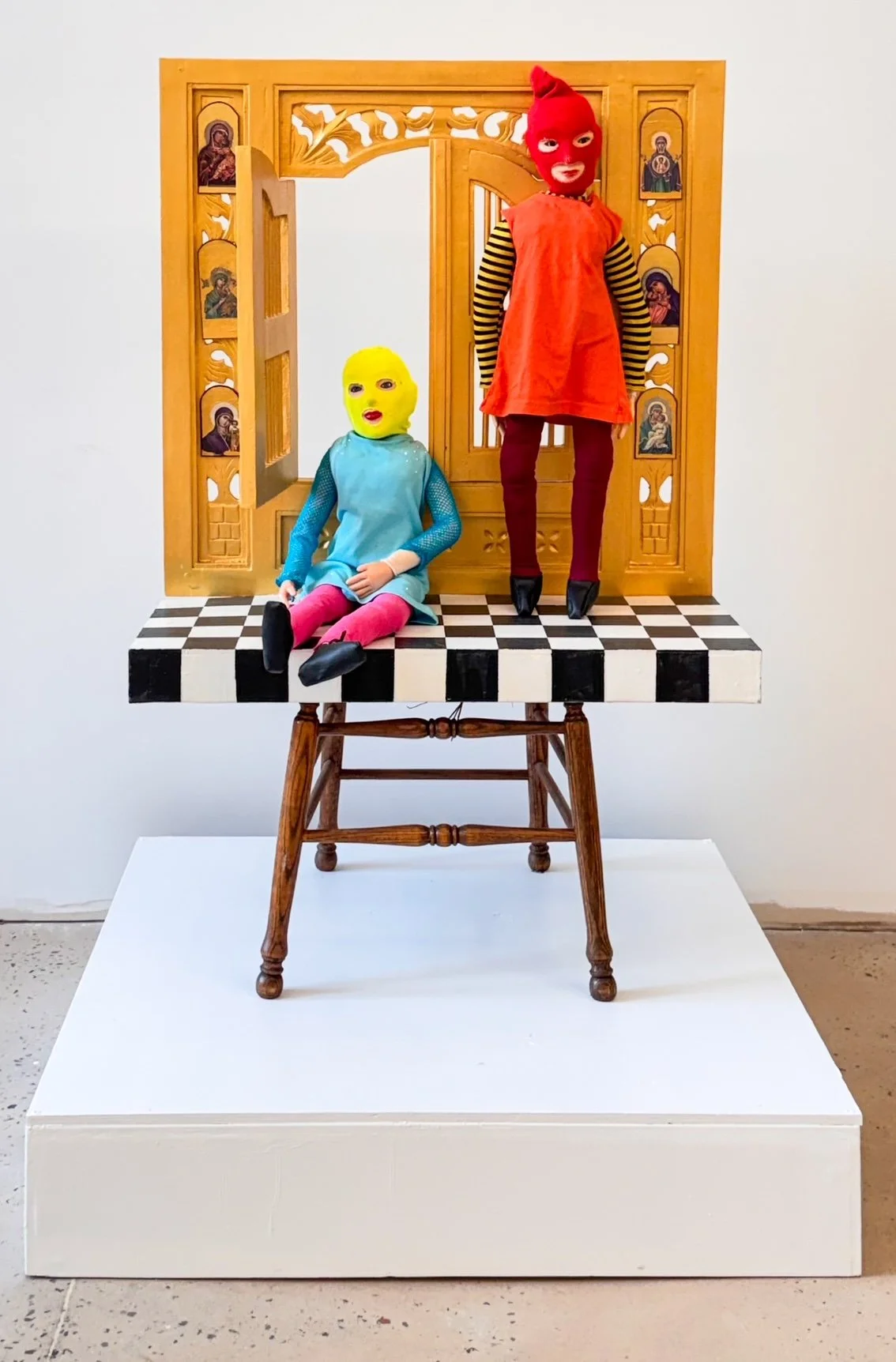
Theodora Skipitares, The Chairs, 2014. Rod puppet. Installation view, Performing Objects — Four Decades of Abundant Ingenuity, The Clemente, New York.
Painters looking at puppets may seem about as peculiar as Townes Van Zandt's poets doing push-ups, but the joke has an unexpectedly serious precedent. In Heinrich von Kleist's 1810 essay On the Marionette Theatre, an accomplished dancer repeatedly returns to watch marionettes because their movement reveals something about grace that his own highly trained body can no longer easily access. He is not preparing to become a puppeteer; he looks elsewhere because another art form exposes something his own discipline has obscured. Approaching the beginning of another New York art season, when artists are once again directed toward the work, galleries, and conversations they are expected to know, refreshing the ways we look seems like studio fodder.
At The Clemente on the Lower East Side, a first visit begins with the architecture. According to The Clemente's account of its history, the building at 107 Suffolk Street was constructed in 1897 as Public School 160, designed by Charles B. J. Snyder during his tenure as New York City's Superintendent of School Buildings. Snyder's remarkably ornate, Dutch-inflected Neo-Gothic school still directs the eye everywhere: pointed windows surface beyond doorways, ironwork cuts across the stairwells, and tiled passages open unexpectedly into galleries and stages. His approach to school design reflected the period's emphasis on light, air, movement, safety, and the communal experience of the building—concerns that seem remarkably suited to its present life.
The building has since passed through several distinct forms of public use. The fourth-floor Cenacle once employed movable partitions so classrooms could be joined into a larger assembly space; the walls are gone, and their tracks remain visible overhead. After a fire left the former school vacant in the 1970s, Solidaridad Humana reopened it in 1981 to serve Spanish-speaking immigrant communities. The Clemente followed in 1993, taking its name from Puerto Rican poet, journalist, educator, and organizer Clemente Soto Vélez and becoming a home for Puerto Rican and Latinx arts and culture. None of these lives has completely displaced the others. The evidence accumulates in the building itself, making adaptation less an institutional concept than something physically legible in its rooms.
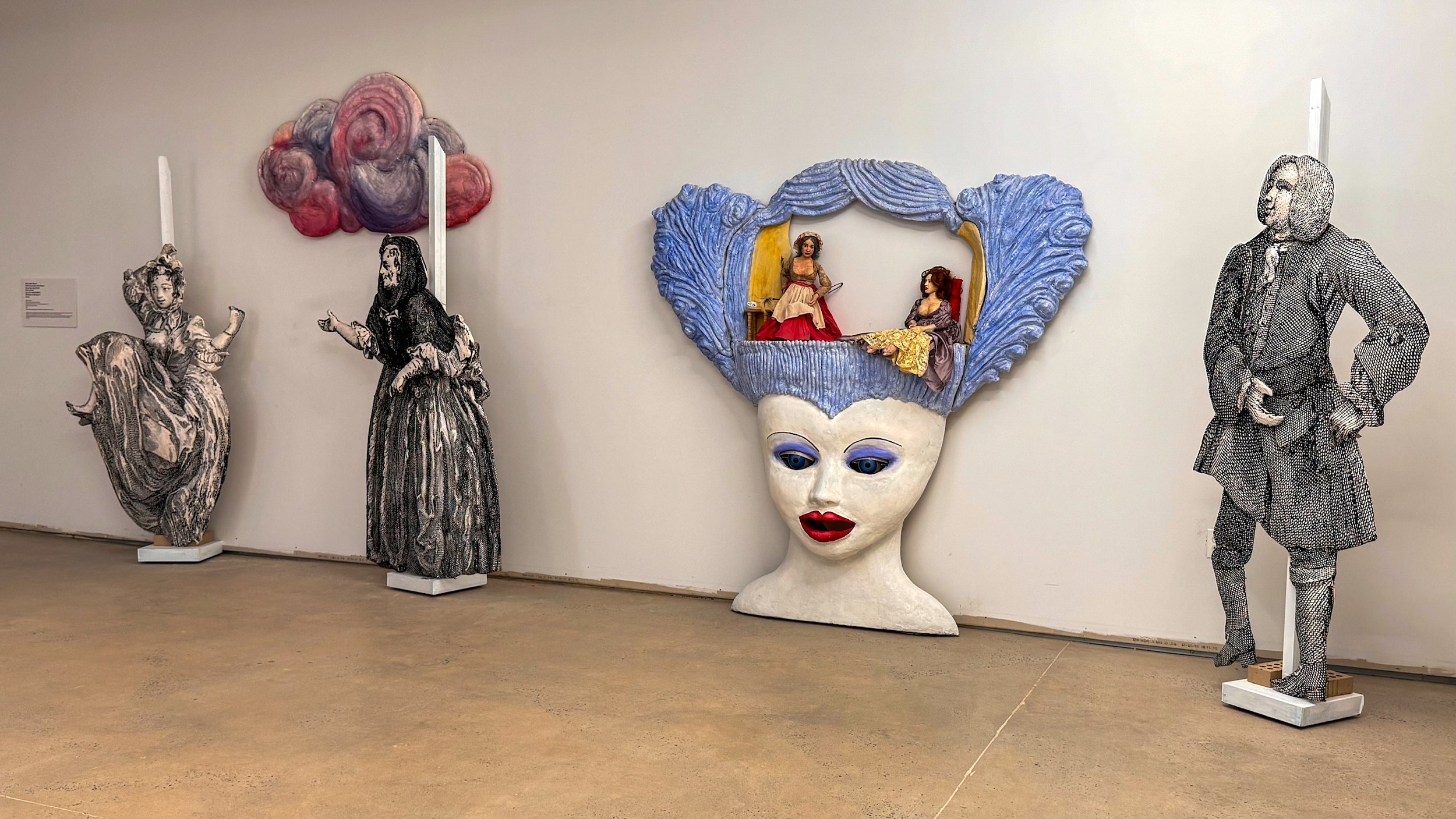
Theodora Skipitares, Harlot's Progress, 1998. Large-scale animated puppet and two-dimensional jointed cutouts from Skipitares's chamber opera for puppets, based on William Hogarth's six-part series. Pictured: giant blue-haired Moll, containing a miniature Moll and her maid, Lucy, with relief figures from the production. Libretto and score by Barry Greenhut.
During the International Puppet Fringe Festival, the same condition extends into the work. The building-wide retrospective Theodora Skipitares: Performing Objects — Four Decades of Abundant Ingenuity, curated by Nina Felshin, establishes one historical current, while Scattered Happy Memories of Puppet Friends by a 93-Year-Old, photographs by Nancy Staub and curated and designed by Matt Sorensen, supplies another: puppetry remembered through a lifetime of looking.
For decades, Skipitares has moved between downtown theater, visual art, constructed objects, and puppetry. The shift in scale and venue matters. Her works are not presented as an eccentric tributary to contemporary art, but as the sustained practice of an artist who has long inhabited these crossings. Moving through her work inside The Clemente makes the building itself feel activated by the proposition that an image need not remain flat, an object need not remain mute and theater need not begin with an actor.
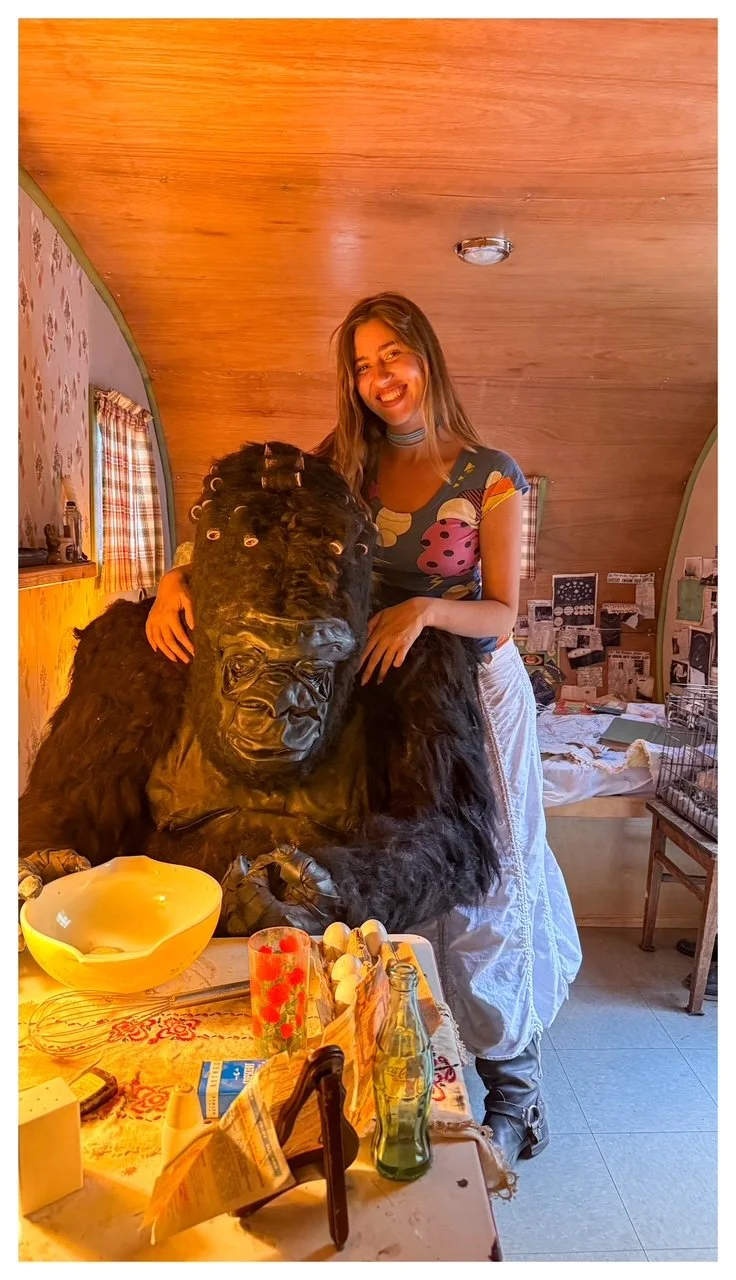
Jo Cunningham, The Freak Family Roadshow, 2026. Traveling sculptural installation in a restored vintage trailer; papier-mâché, tire innertubes, encaustic wax, and found objects. Installation view, International Puppet Fringe Festival, The Clemente, New York.
Jo Cunningham's The Freak Family Roadshow pushes that permeability toward something more social and soulfully vital. Painted scenery and constructed figures mingle with domestic objects and theatrical debris; the whole world feels less installed than inhabited. When I asked Jo what she does with the trailer when it is not on display, she told me she travels with it and has been doing so for the past year. There was something wonderfully pure in that answer: the work travels because she wants it to travel, without waiting for permission from the New York art world or a gallery affiliation. Throughout the festival, heads become platforms, furniture acquires faces, and flat figures become bodies. Puppets are populated things, capable of making families, grotesques, witnesses and neighborhood friends from a colorful array of artist materials and whatever happens to be available. Their subject, finally, is the fertile canvas of the populace.
The question of whether such work belongs inside or outside fine art feels exhausted before it is asked. What interests me more is what an artist discovers by looking at something without any intention of adopting its medium. Artists do not need more generalized exhortations to "experiment"; they need to accumulate empirical evidence of their own taste and develop the skill required to act on it. An artist encountering a puppet might discover an appetite for an abrupt change of scale, a grotesque silhouette, the theatrical placement of a figure, a material edge, a constructed body, meticulous patterning or the strange authority of a face made from almost nothing. The artist need never make a puppet. What matters is returning to the studio knowing something more exact about what produces conviction.
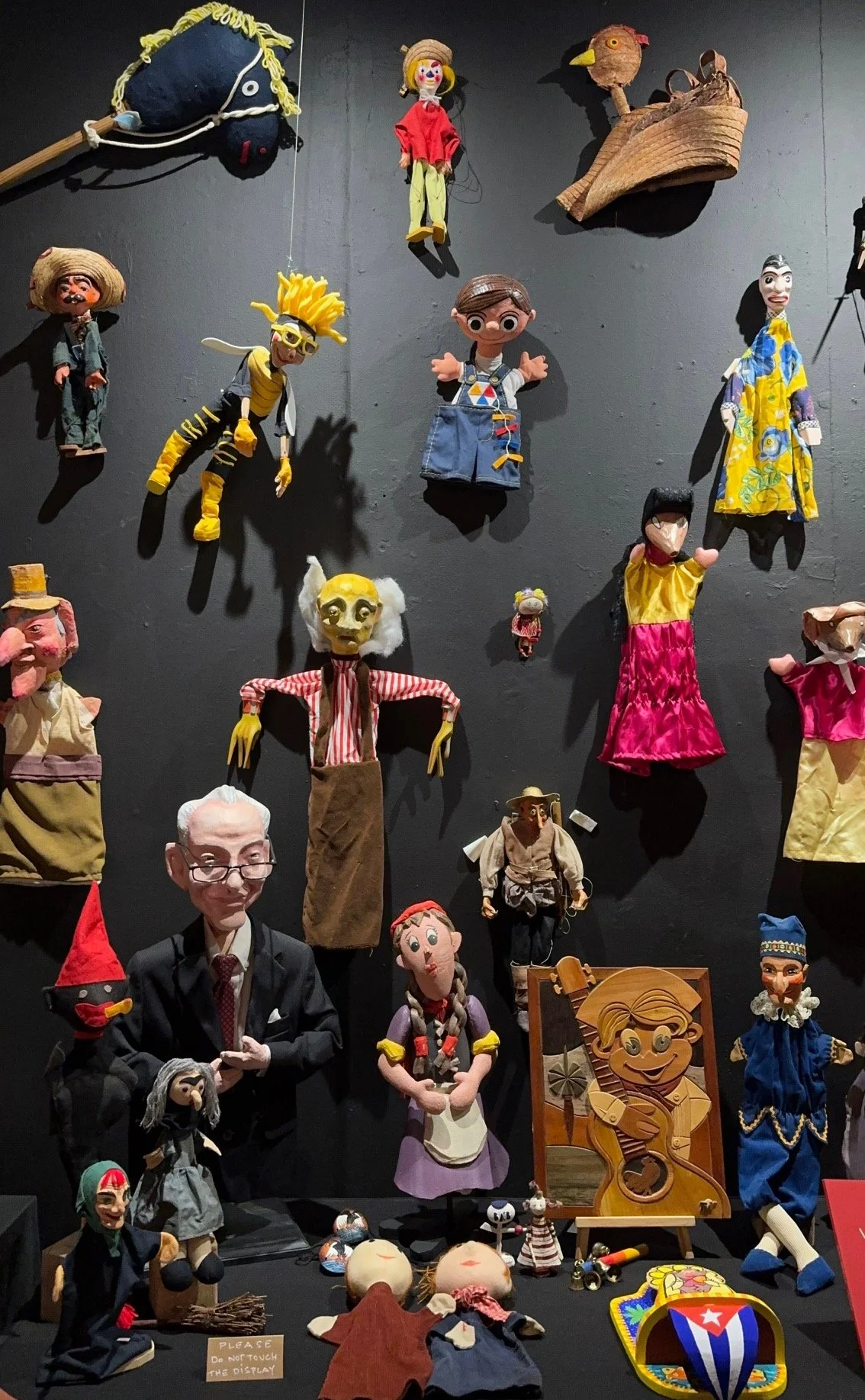
Teatro SEA's World Puppet Collection, installation view, Tamayo Gallery, The Clemente, New York. The exhibition brings together puppets from diverse geographic, historical, and material traditions, tracing the form across ancestral practices and contemporary visual theater.
Puppetry also makes literal one of art's oldest ambitions: inert matter is asked to live—or, at minimum, to touch the soul. Paint and crafted supports remain motionless, yet a painted body can turn, collapse, hover, seduce, grieve or look back at us. A puppet gives the image weight, joints, strings and a physical presence among other bodies. I could not miss the irony that, surrounded by puppets, I felt exceptionally alive. The feeling came partly from moving through an environment in which objects, spectators, performers, architecture and images were continually acting upon one another, making it impossible to isolate aesthetic experience inside a single autonomous thing.
John Dewey gives philosophical form to precisely this kind of encounter. In Art as Experience, he resists the artificial separation of art from the ordinary conditions of living and understands aesthetic experience as an intensified version of the reciprocal process through which we act upon the world and undergo its effects. At The Clemente, that reciprocity is physical. Climbing a staircase changes what can be seen; a doorway frames a stage; a sound coming from another room alters an object already in view; encountering a figure at bodily scale changes one's relation to its surface. The building cannot be separated from the work because the work is partly what happens while passing through it.
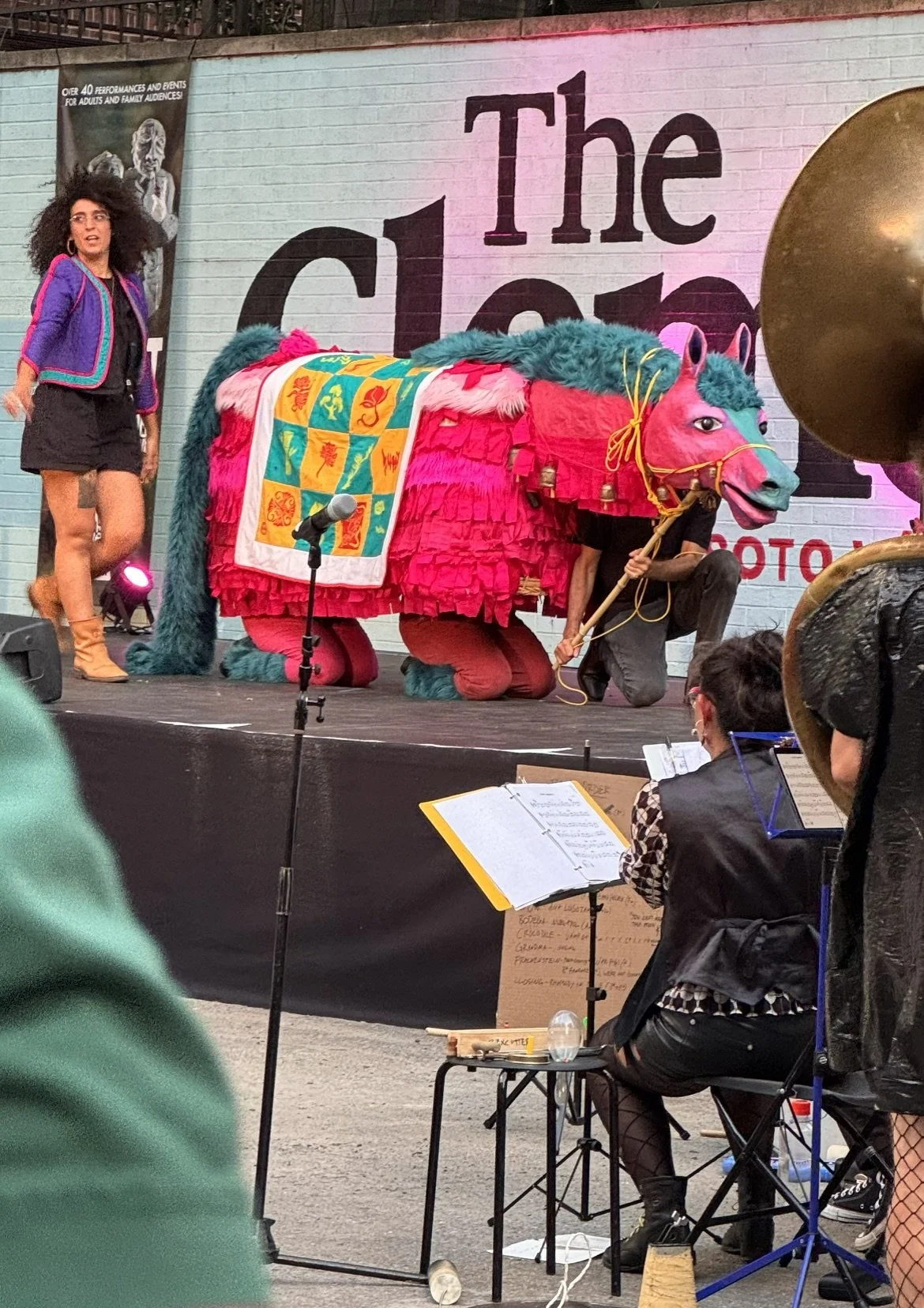
Boxcutter Collective, The Cardboard Pizza Puppet Circus, 2026. Performance at the 4th Annual International Puppet Fringe Festival, The Clemente, New York. Pictured: the Fire Horse puppet, created in honor of the Year of the Fire Horse.
Boxcutter Collective makes the social possibilities of the form especially plain. In The Cardboard Pizza Puppet Circus, painted and constructed figures move directly into neighborhood absurdity and the everyday theater of being a New Yorker. Here the image does not simply leave the wall; it acquires a public life. It can join a crowd, carry an argument, make a joke or embody a shared irritation.
Peter Schumann's Bread and Puppet Theater belongs to an earlier New York history of this same impulse. Founded on the Lower East Side in 1963 and now based in Vermont, Bread and Puppet brought enormous painted figures into processions, performances, protests, and communal spaces. These images could function simultaneously as painting, sculpture, costume, puppet, political actor, and moving architecture. Once given a body and released among people, their meaning extends beyond material form and enters public life.
At The Clemente, this current runs through the works of Skipitares and Cunningham, as well as Nancy Staub's photographs, Boxcutter Collective's performances, and Teatro SEA's collection. Each approaches the movement between object and character, private imagination and public encounter through a different visual language.
Countercurrents, then, are not an argument for eclecticism or interdisciplinary virtue. They describe where artists structure their attention, focus their gaze and touch material. Kleist's dancer returns to marionettes because they reveal something his own training has concealed. Boxcutter turns civic life into moving images; Skipitares and Cunningham show how richly these crossings can still be inhabited, while The Clemente itself continues to remake inherited structures for collective use. An artist can leave all of this with no desire to change mediums and still return to the studio knowing more precisely what produces conviction in their own work. A countercurrent need not carry an artist away from a practice; it can return them to it with a sharper sense of where they want to go.
Exhibitions at The Clemente
Theodora Skipitares: Performing Objects — Four Decades of Abundant Ingenuity, curated by Nina Felshin and designed by Matt Sorensen
Scattered Happy Memories of Puppet Friends by a 93-Year-Old, photographs by Nancy Staub, curated and designed by Matt Sorensen
Teatro SEA's World Puppet Collection
Jo Cunningham, The Freak Family Roadshow
The first three exhibitions remain on view through August 30. The Freak Family Roadshow closed August 16.