The Aerosol Awakening: Shepard Fairey On Street Art’s Infiltration of Miami Art Week
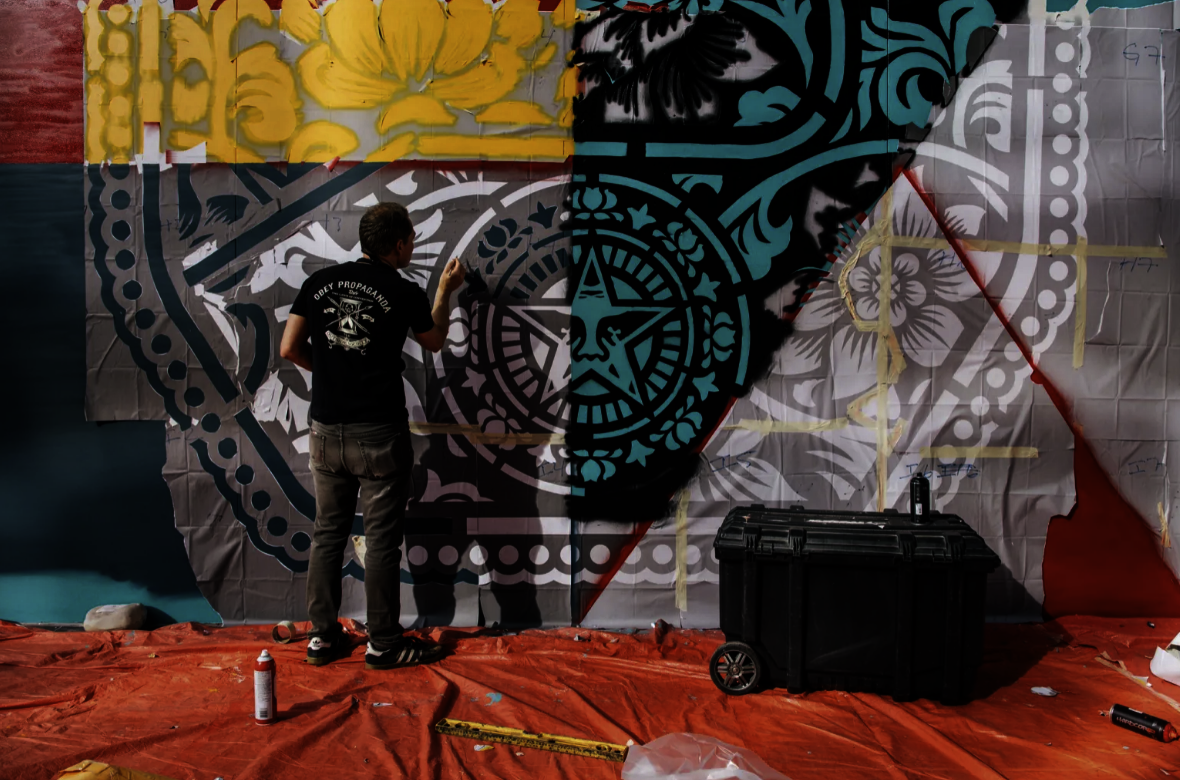
Fairey working earlier this year in Aspen. Courtesy of 212GALLERY
The gritty revolution that started with spray cans and subway cars continues its assault on the rarified precincts of Art Basel.Shepard Fairey stands in the warm glow of Wynwood Walls on a balmy December evening, wearing a worn black Bad Brains t-shirt. Around him, the outdoor museum has surrendered to raucous celebration—a rock band thunders from a makeshift stage, bars dispense cocktails and cold beer, and the aroma of Cuban street food drifts through the crowd of artists, collectors, and graffiti writers gathered at the start of Miami Art Week.
Surrounded by admirers and his street art brethren, Fairey is focused for the moment not on spray paint and stencils but on 19th-century French painting: “To me, it’s sort of absurd that impressionism was such a secessionist movement, and then like five years later, it was the dominant movement,” Fairey tells Observer, drawing a direct line from the Parisian avant-garde who were initially rejected by the academic Salon to today’s street artists storming the gates of Art Basel. “Street art people have been making great work for many years, and it still isn’t totally accepted, but ultimately, good work is good work.”
The parallel is impossible to ignore. Just as Monet, Renoir and their ilk were dismissed by the establishment before revolutionizing how the world saw art, street artists are well into a watershed moment that has lasted years. And Miami Art Week—with its dual epicenters separated by three miles of Biscayne Bay—has become ground zero for this cultural shift.
On one side of the bay, Art Basel Miami Beach and a dozen other fine art fairs unfold in climate-controlled convention halls where collectors in linen suits fret about the state of the high-end art market while negotiating six-figure acquisitions over champagne. On the other, Wynwood pulses with a different energy: beer-drinking crowds in sneakers and t-shirts gather beneath towering murals by artists who may or may not be associated with a gallery or art market network. Despite the deep class and cultural differences between these two worlds, the barricades have been breached.
For the artists, the trajectory from street to gallery isn’t entirely new—Jean-Michel Basquiat made the leap from tagging with street artist Al Diaz as SAMO in downtown Manhattan to blue-chip galleries before his death in 1988. Keith Haring went from chalk drawings in subway stations to museum retrospectives. Kenny Scharf‘s cosmic characters traveled from New York’s Club 57 scene to major collections. But what’s changed is the scale and velocity of street art’s acceptance by the commercial art world and the economic muscle it now wields.
Works by Banksy and KAWS at SCOPE Art Show in Miami Beach. Photo by Lisa Freeman
Consider KAWS, who started by illegally modifying bus shelter advertisements in early-1990s New York. His paintings now regularly exceed a million dollars at auction, with The KAWS Album fetching $14.8 million at Sotheby’s in 2019. Banksy’s work sells for tens of millions while he maintains outsider credentials through guerrilla installations. Fairey himself parlayed his “Andre the Giant Has a Posse” street campaign into mainstream recognition with the now-iconic Obama HOPE poster, then into a thriving practice that bridges street credibility with gallery sales.
Visit any of the fine art fairs taking place here during the annual early December art world pilgrimage, and you’ll see Fairey’s work prominently displayed alongside that of more traditional contemporary artists. And he’s not alone. Every year, more and more street artists find themselves en route to art world success. “In the last 25 years, there hasn’t been a more culturally impactful, cohesive movement than street art,” Fairey continues. “As far as being very diverse and inclusive, street art is the movement that I think has the greatest volume and impact.”
It’s a bold claim, but one that echoes up and down the streets of booming public art destinations around the world, led by street art’s holy trinity of Wynwood (Miami), Bushwick (Brooklyn) and Shoreditch (London). At the Wynwood Walls celebration, diverse voices tell the shared story of street art’s ubiquitous engagement and its evolution from underground rebellion to institutional heavyweight.
A Parent's Guide to Managing Child Illness While TravelingAirMedCare Network
Miss Birdy, at 32 the youngest artist and the only woman invited to paint a mural at Wynwood Walls this year, traced the unlikely trajectory that took her from her hometown of Columbus, Ohio, to the brink of street art stardom. “I started out painting in the street, and everybody was posting and recognizing it online, then it became this thing where we’re actually trying to make a living at it. It goes from painting on the street, creating murals, then doing gallery work. It kind of naturally merges itself.”

Street artist Miss Birdy stands before the mural she painted for this year’s Wynwood Walls. Photo by Lisa Freeman
Her presence represents something significant—not just youth but the breaking down of gender barriers in a historically male-dominated scene. “When you’re coming up in the scene, you’re going to a lot of graffiti jams, you’re painting in a lot of abandoned places. That’s really seen as a male-dominated area. And when you’re driving a boom lift, you’re scaling 90 feet on scaffolding—that’s really not seen as a feminine job,” she says. “But the thing is, that’s what I love to do. So I’m used to the feeling of being the only woman.”
RISK, born of the Los Angeles graffiti scene, is another artist who has bridged the gap between street art and fine art with work here in Wynwood and also across the way at the big art fairs. He sees street art’s ascension to legitimacy in the art world as owing to timing rather than any concerted effort on the part of artists.
“The funny thing is we’re not making a move. We’ve been doing this for 40-something years. So it’s just a gradual lead to this, you know? People always say, ‘Did you expect to be in the galleries and museums?’ Well, I’ve been doing this for my entire life. So I think it’s just that the time has come for us….I think it’s just timing. Everything’s timing,” he explains.
Daze, a first-generation New York graffiti pioneer who painted subway cars in the 1970s and 1980s, has witnessed the entire arc of street art’s journey from criminalized vandalism to museum-worthy art form. His presence at Wynwood Walls connects today’s scene directly to the movement’s origins in New York’s underground.
“It’s always been kind of two separate things, but somehow what’s going on in Wynwood and elsewhere has become so big that it’s become hard to really ignore,” he says. “So it’s great to see both of those things together; I’m kind of a crossover.”
For Daze and many others here, the path from street to gallery isn’t about selling out but an evolution. “For me, it’s just all kind of part of my evolution. Whether I’m painting something for a gallery exhibition, or we’re doing a mural project or something on the street, it’s just a kind of a natural evolution as an artist.”
While progress has been steady, Fairey suggests there are still some things about street art that make the establishment nervous: “When work is done on the street, it’s a public process, so it’s not all going to be curated, it’s not a top-down proposition, but the best stuff still rises to the top. I think the art world is threatened a little bit by there not being the same economic model for the gatekeepers.”
That democratic spirit—the refusal to wait for institutional approval—remains central to street art’s identity even as it achieves commercial success. “There’s a really generous spirit to people in street art, public art, graffiti, where people are doing things that they want everyone to be able to experience, and there’s no barrier to entry,” Fairey asserts.
Jessica Goldman Srebnick, curator of Wynwood Walls, acknowledges this tension. In remarks to the assembled faithful, she traces the movement’s trajectory over the past decade and a half. “We began this tradition of an artist party in 2009 when we opened Wynwood Walls, with a very small dinner and a very small team, to celebrate an idea that the artists contributed to its magical essence,” she says. “This open air street museum in the middle of a forgotten neighborhood has become the heartbeat of not only this area, but it sparked a movement around the world.”
The numbers tell part of the story: Wynwood Walls has welcomed over 20 million visitors since opening, including hundreds of thousands of children. The museum has featured 150 artists over the years. And the neighborhood itself has been transformed from a forgotten industrial warehouse district into an international art destination—evidenced not just by the galleries and murals but by the arrival of restaurants and bars and residential and hotel development. The latest addition? Gibson Guitars is opening a new venture just down the street from the Walls.
For Miami Art Week 2025, Wynwood Walls presented “ONLY HUMAN,” a theme exploring what remains uniquely human amid rapid technological growth. The exhibition featured the debut of murals by Cryptik, Joe Iurato, Miss Birdy, Persue, Quake, SETH and RISK. For the first time in 12 years, El Mac and RETNA reunited for a joint mural and collaborative canvases.
Down the street, the Museum of Graffiti—celebrating its sixth anniversary during Art Week—plays a crucial role in maintaining the movement’s street credibility while documenting its history. Alan Ket, the museum’s co-founder, sees street art as nothing less than “the biggest art movement of our time and perhaps the biggest art movement that the world has seen outside of digital art. This is an art movement that is in every major city around the world and has been going on for over 50 years.”
For Art Week, the museum debuted two major exhibitions. “Origins” traces graffiti culture from the 1970s to today, featuring original paintings by United Graffiti Artists members PHASE2, FLINT 707, SNAKE 1 and COCO144 that haven’t been seen since their 1973 debut at New York’s Razor Gallery—marking one of the first moments graffiti entered the gallery setting. Alongside “Origins” is “El Tiguere,” a solo exhibition by JonOne, who began painting trains in Harlem before rising to global recognition as a contemporary painter based in Paris.
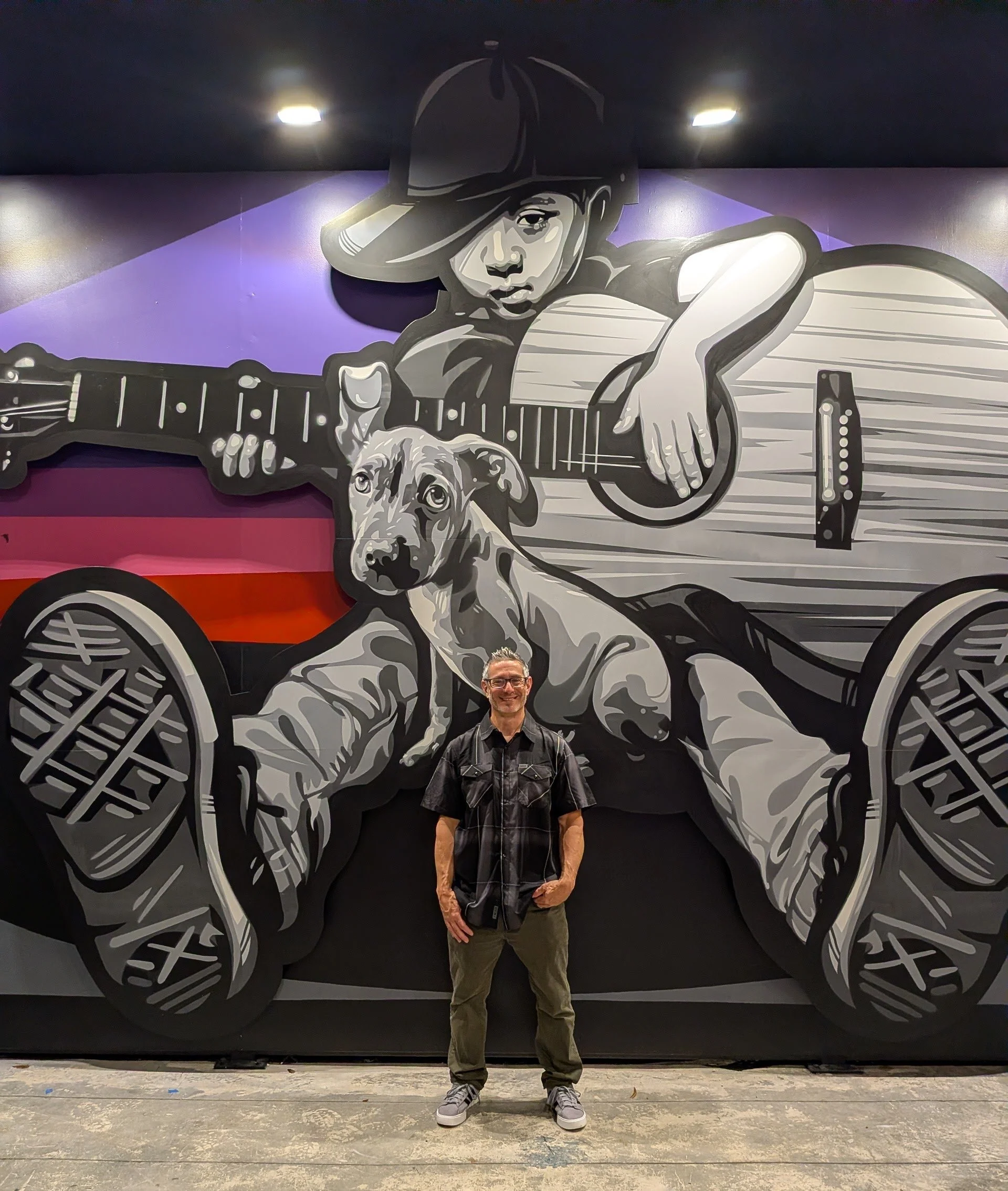
New Jersey street artist Joe Iurato with his mural. Photo by Lisa Freeman
The museum’s role extends beyond exhibitions to maintaining a connection with the movement’s roots. “This world, this art world of graffiti street art, has infiltrated the mainstream art world and fairs all over the world,” Ket says. “These are artists who have been working for decades in the streets and coincidentally in the studio, creating incredible works of contemporary art. I’m not surprised that it’s being accepted or shown more at fairs. I’m surprised that it’s taken so long.”
Miss Birdy sees this historical moment clearly: “I 100 percent agree with that. I think that right now is the time where a lot of people feel open to express themselves in a really big way. And right now, we’re able to do that on a large scale. And it’s not taboo anymore.”
In the 1870s, the Impressionists held their own exhibitions after being rejected by the Paris Salon. Within a decade, they had transformed the art world. Street art’s journey from criminalized vandalism to Art Basel has taken a bit longer, but the revolution is no less real.