Seven Things Not to Miss at Art Basel Miami Beach 2025
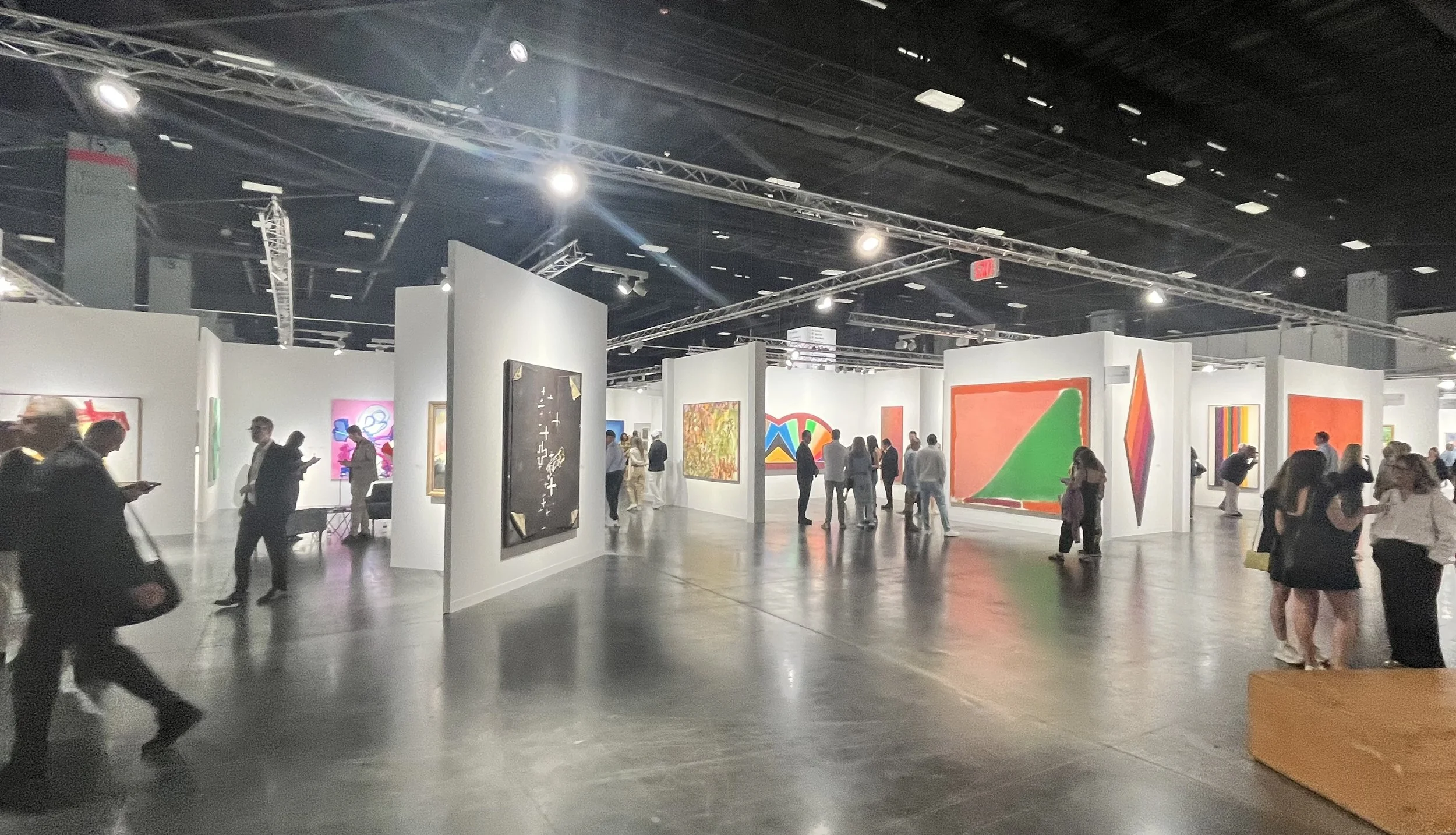
MIAMI BEACH – VIPs swarmed the Miami Convention Center Wednesday morning and within hours the telltale rhythms of Art Basel were back in full swing: gallerists huddling in urgent consultation over potential sales, gallery staff with come hither looks, collectors moving with purpose through the aisles, artists lingering in hopeful anonymity to gauge reaction to their work. By late afternoon, the fair had that familiar hum—part marketplace, part cultural parliament, part high-stakes theater where careers get made and the contemporary art canon gets written in real time.
This 23rd edition of Art Basel Miami Beach comes at a time of angst and uncertainty in the fine art market which prompted more than a dozen blue chip galleries to bail on the fair altogether this year. Galleries at all levels have been laying off staff; many have been shuttered. Still, the season got a jump start two weeks ago with record shattering auctions in New York at Sotheby’s, Christie’s and Philips that saw nearly $2 billion in art change hands.
Art Basel Miami has long since evolved from scrappy American outpost to essential pilgrimage. The numbers tell part of the story: 281 galleries from 43 countries, representing everyone from blue-chip mega-dealers to first-time exhibitors, from the masters of contemporary art to new arrivals on the world stage.
Walk the sprawling corridor of the convention center floor and you encounter hope that stops somewhere short of optimism about the economics of high-end art, As the market adapts, contracts, expands over time, Art Basel Miami survives year in, year out on the premise that the appetite for work that challenges, provokes, and reframes our understanding of contemporary practice will endure.
Beyond the business of art, beyond the VIP lounges and the endless fair parties that colonize every available Miami Beach venue, Art Basel still delivers. It delivers because gallerists bring their best material, because artists present ambitious new work, and because—despite the circus atmosphere that envelops the broader Miami Art Week—the convention center floor remains the space where serious looking and serious thinking can happen, even when serious buying doesn’t. Here are seven presentations that cut through the noise and demand your full attention.
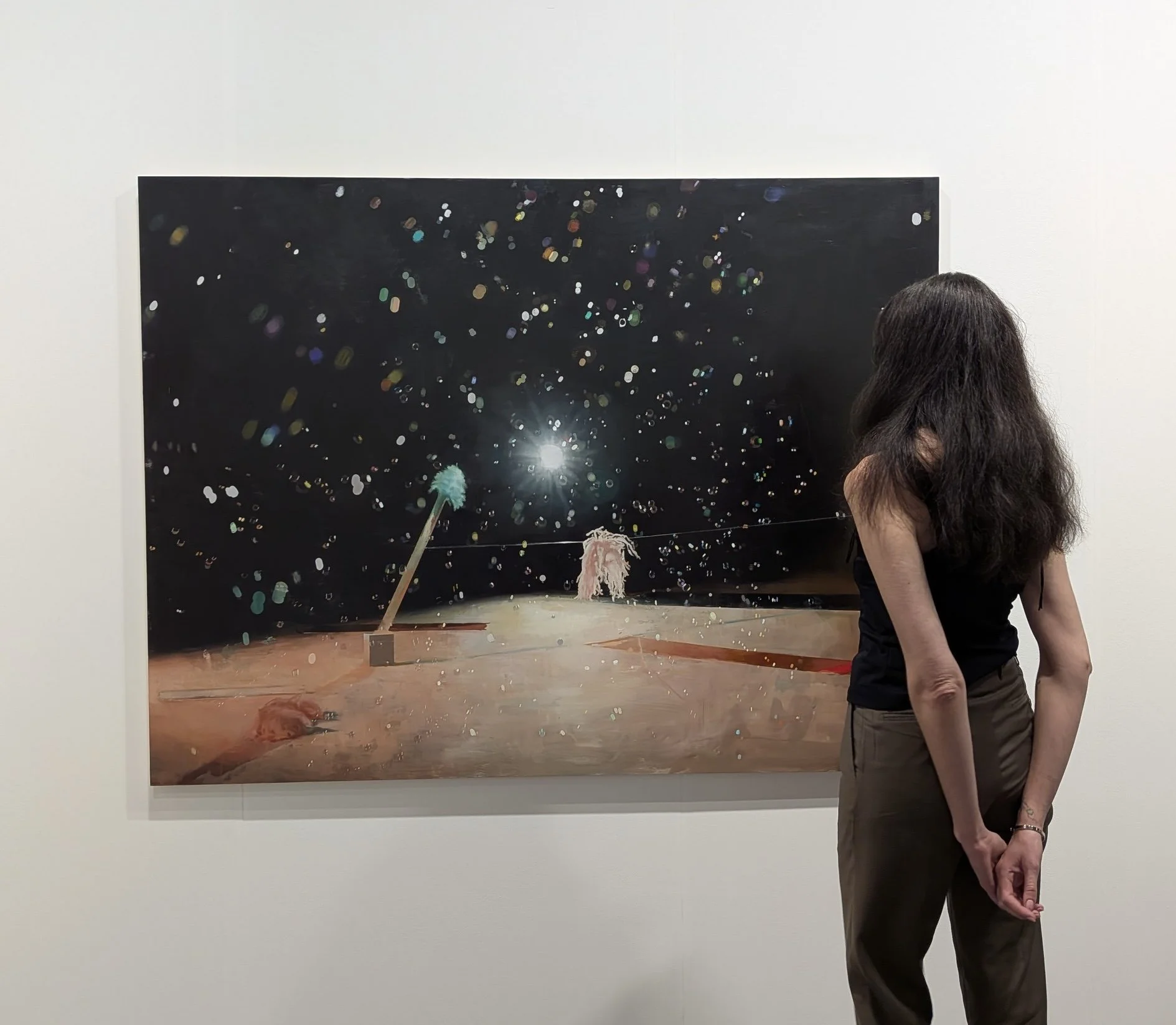
Kelsey Isaacs, The Winter, 2025. Photo by Lisa Freeman
Kelsey Isaacs
The Winter, 2025
Theta, New York
Kelsey Isaacs operates in the gap between the photograph and its painted interpretation, that charged space where reality gets reconstructed and then deliberately exposed as artificial. Born in Los Angeles in 1994 and now working in New York, she's part of a generation interrogating how we see in an image-saturated world. Her process is forensic: stage a scene, spotlight it, photograph it, then paint from that photograph—each step introducing another layer of mediation. The result is work that feels hyper-real and uncanny simultaneously.
The Winter, 2025, exemplifies her approach of cropping and skewing photographic source material into compositions that resist easy classification. The painting employs her signature technique of meticulously building an artificial reality through strategic use of light, color, and finish, only to pull back the curtain on the apparatus itself. Whether emphasizing the flatness of the photographic process or exaggerating the materiality of paint, Isaacs creates work that oscillates between realism and abstraction—a visual double-take that forces viewers to reconsider their relationship to representation. Since showing with Chapter NY in 2022 and mounting a solo with Theta in 2023, she's been expanding her investigation into video installations, pushing these choreographies of seeing into temporal dimensions.
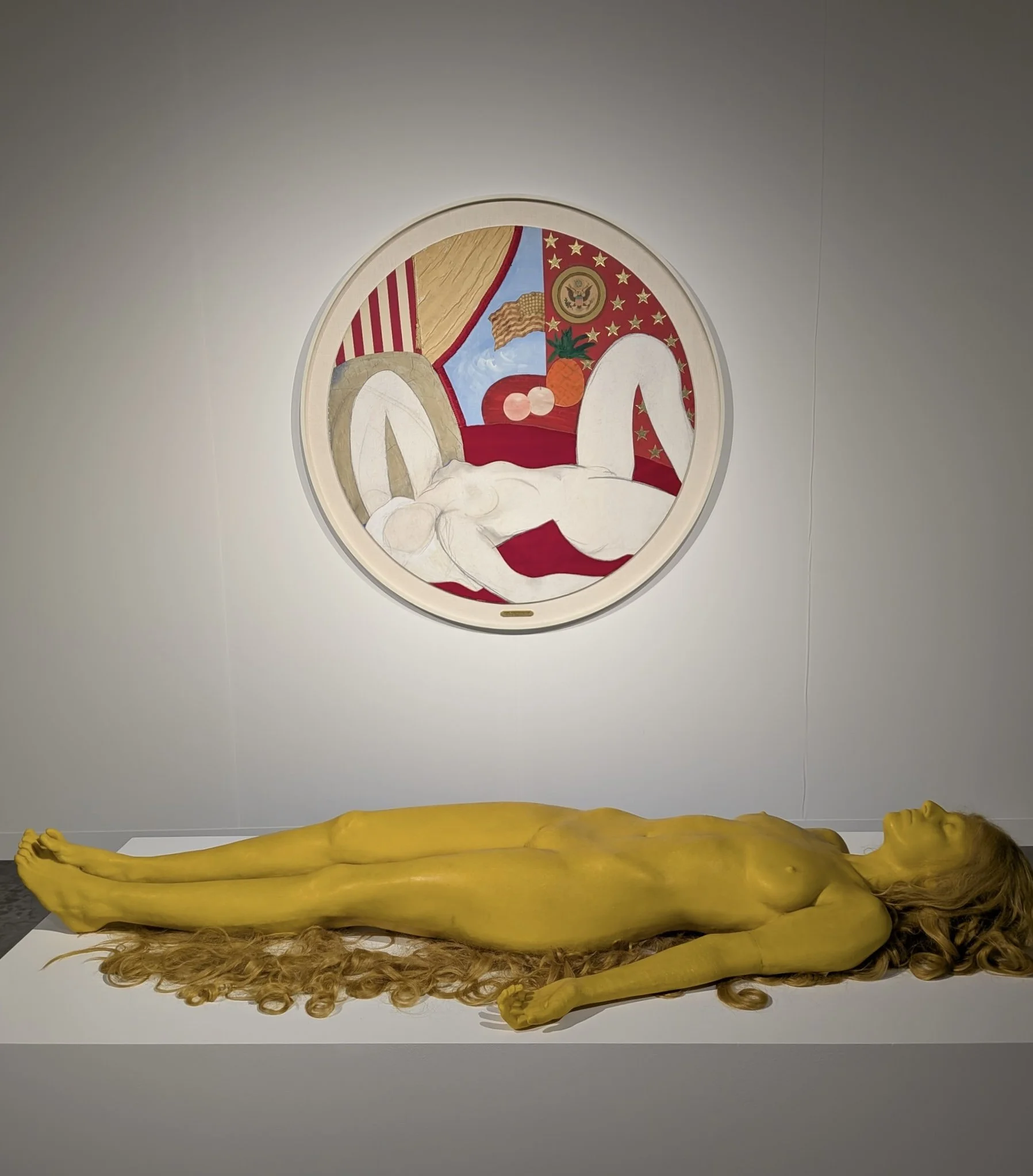
Tom Wesselmann, Great American Nude #8, 1961. Photo by Lisa Freeman
Tom Wesselmann
Great American Nude #8, 1961
Jeffrey Deitch, New York
Tom Wesselmann's Great American Nude #8 (1961) stands as one of the Pop artist's most striking early experiments, a 48-inch circular mixed media and collage on board that distills his revolutionary vision into a concentrated patriotic blast. The piece was created the same year Wesselmann launched his American Nude series, in which he pursued a dream—literally. After dreaming about the phrase "red, white, and blue," the Cincinnati-born artist decided to paint a Great American Nude, restricting his palette to those colors plus gold and khaki, the shades of flags and army uniforms. What emerged was a series that married classical representations of the female nude with magazine cutouts, advertising ephemera, and slices of American iconography—stars, stripes, portraits of founding fathers—all collaged together in formats that grew increasingly ambitious and monumental.
Jeffrey Deitch Gallery centers its booth around this iconic painting, surrounding it with works by contemporary artists including Isabelle Albuquerque, Celeste Dupuy-Spencer, Frances Stark, Anna Park, Ella Kruglyanskaya, Judy Chicago, Vanessa Beecroft, and others. The Great American Nude series, which Wesselmann produced from 1961 to 1973, rejected the Abstract Expressionist orthodoxy of the day and helped define Pop Art's irreverent fusion of high and low culture. These works combined sensual depictions of the female figure with references to art history and consumer culture, ultimately totaling one hundred numbered works that explored everything from patriotic kitsch to pure formal experimentation. Wesselmann, who died in 2004, remains one of the movement's most audacious chroniclers of postwar American desire.
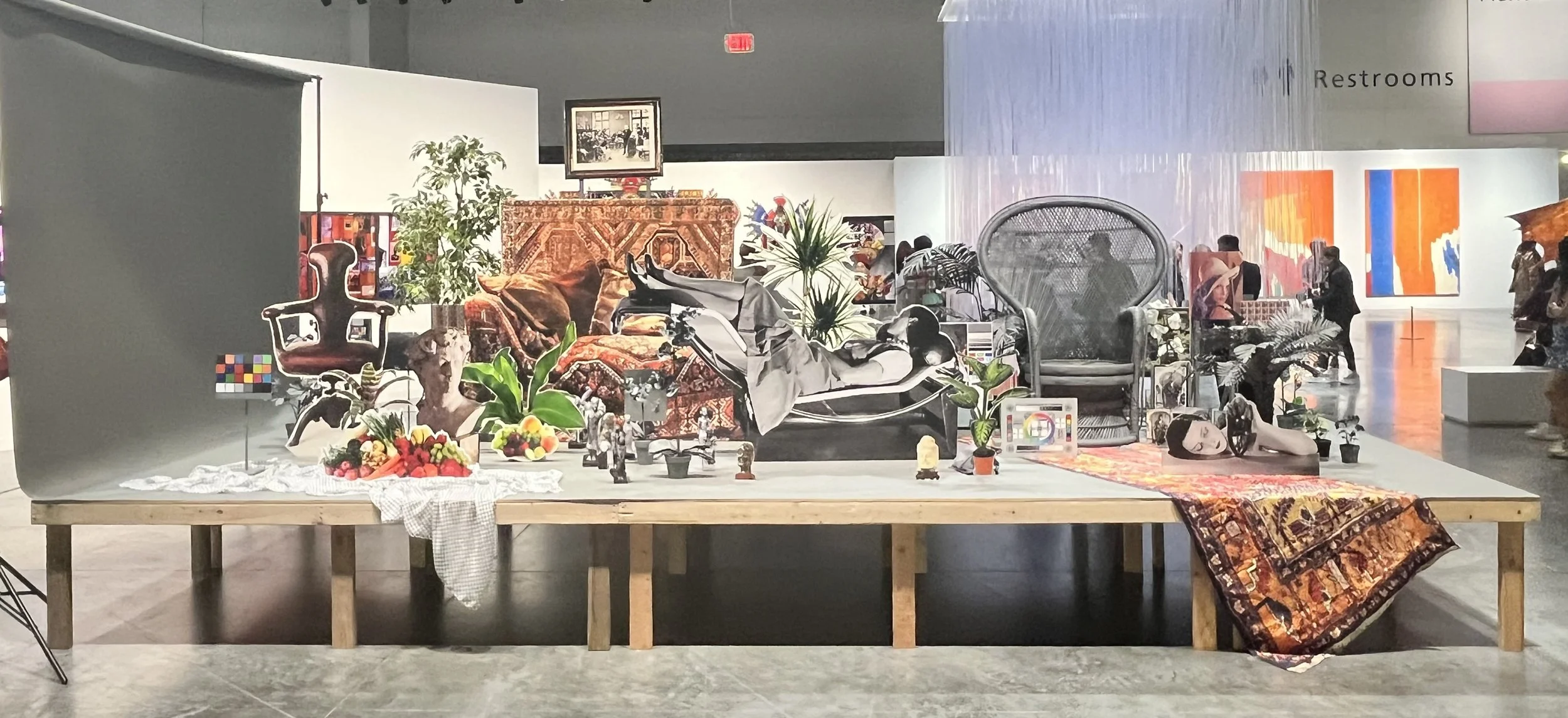
Stephanie Syjuco, Neutral Calibration Studies (Ornament + Crime), 2016. Photo by Lisa Freeman
Stephanie Syjuco
Neutral Calibration Studies (Ornament + Crime), 2016
Catharine Clark Gallery, San Francisco (co-presented with RYAN LEE Gallery)
Looking at Stephanie Syjuco's Neutral Calibration Studies (Ornament + Crime) (2016), you're confronted with what appears to be a chaotic stage set or deranged museum display—a 20-foot-wide wooden platform strewn with a deliberately disorienting mix of flat printed images, three-dimensional objects, and neutral gray props that refuse to sit still in your perception. The Oakland-based artist, who teaches sculpture at UC Berkeley, constructs what she calls a contemporary "still life" that draws its inspiration from photographic color calibration charts used to establish "correct" or "neutral" color in imaging—except there's nothing neutral about what she's assembled here. Against an oversized color calibration chart, Syjuco stages a visual indictment of empire, Modernism, and the supposedly objective tools of documentation.
Catharine Clark Gallery co-presents this major platform installation with RYAN LEE Gallery in Art Basel Miami Beach's Meridians section, marking the San Francisco gallery's debut at the fair. The work operates as a kind of ideological collage, mixing laser-cut wooden flats mounted with digitally printed images. Walk behind the installation and you'll find everything—the wooden struts, the fabric sandbag weights—painted neutral gray, as if the infrastructure of power itself is trying to hide in plain sight. Syjuco, a Guggenheim Fellow whose work lives in MoMA and the Met, describes her practice as one that "recycles, copies, resuscitates, warps, reframes, rips off, plunders" existing forms because "the past is still unfinished business." This installation doesn't just question what we've naturalized in the name of the master narrative—it stages a full-blown intervention.
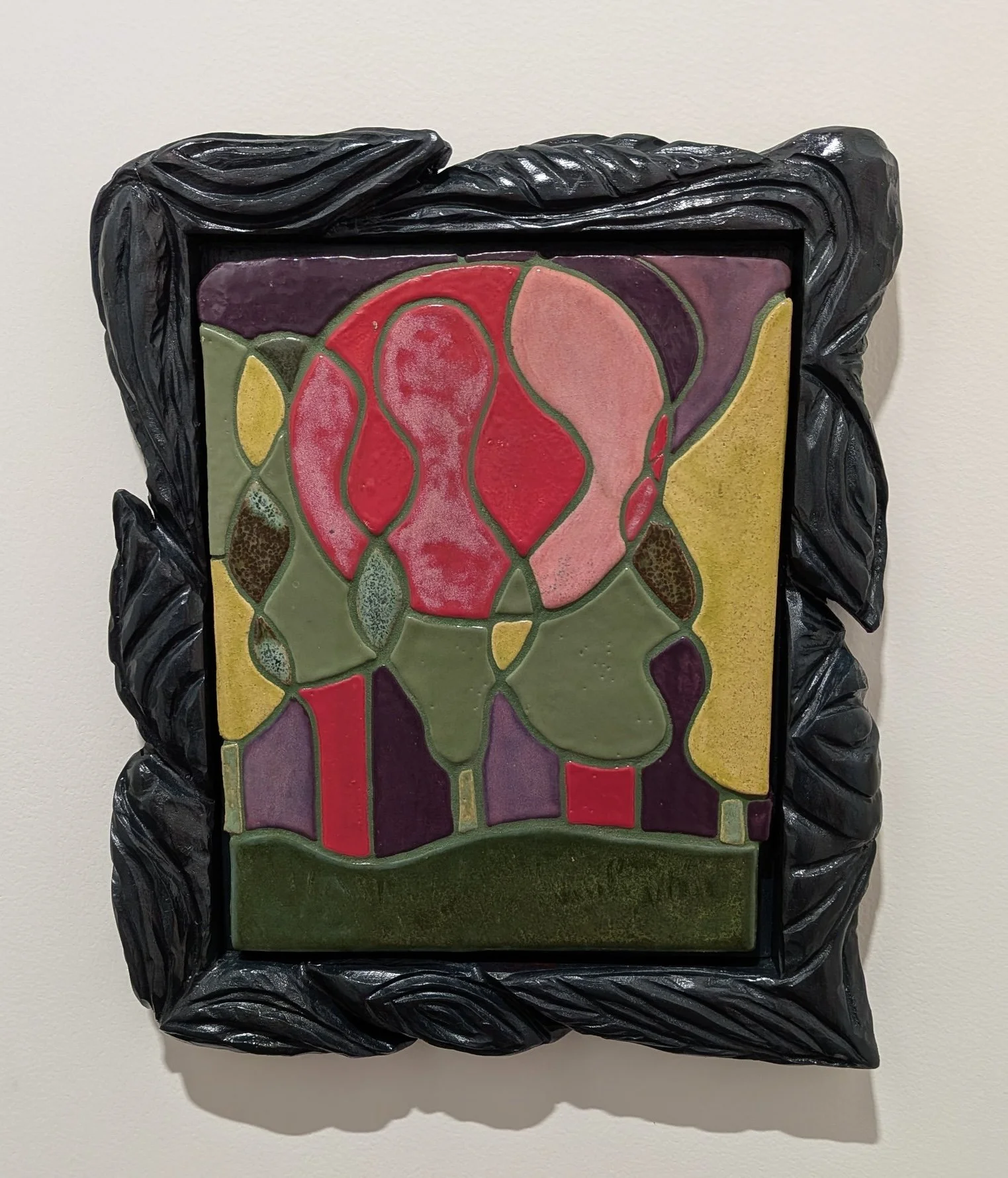
Woody De Othello, red moon, 2024. Photo by Lisa Freeman
Woody De Othello
red moon
Karma, New York
Karma is presenting new works from Woody De Othello, the Oakland-based, Miami-born artist who is simultaneously being featured in a solo exhibition at the Pérez Art Museum Miami (PAMM). The exhibitions extend the artist's meditation on ancestral heritage and embodied emotion. Through material experimentation and sculptural gesture, De Othello considers how objects carry history, absorb meaning, and serve as vessels for both spiritual and emotional experience—his sculptures suggesting a quiet vitality that speaks to the unseen forces shaping our daily lives.
The PAMM exhibition features a new body of ceramic and wood sculptures, tiled wall works, and a large-scale bronze that investigate the relationship between body, earth, and spirit—an immersive installation complete with clay-painted walls and subtle herbal scents that ground visitors in De Othello's material world. Rooted in precolonial and diasporic African traditions, De Othello draws inspiration from spiritual practices, hermetic philosophy, and cultural artifacts including nkisi power figures, Dogon ritual objects, and Egyptian pyramids. The convergence of museum exhibition and fair presentation offers a rare opportunity to see how De Othello's practice moves between institutional and commercial contexts while maintaining its commitment to exploring the deep connections between materiality, tradition, and the body.
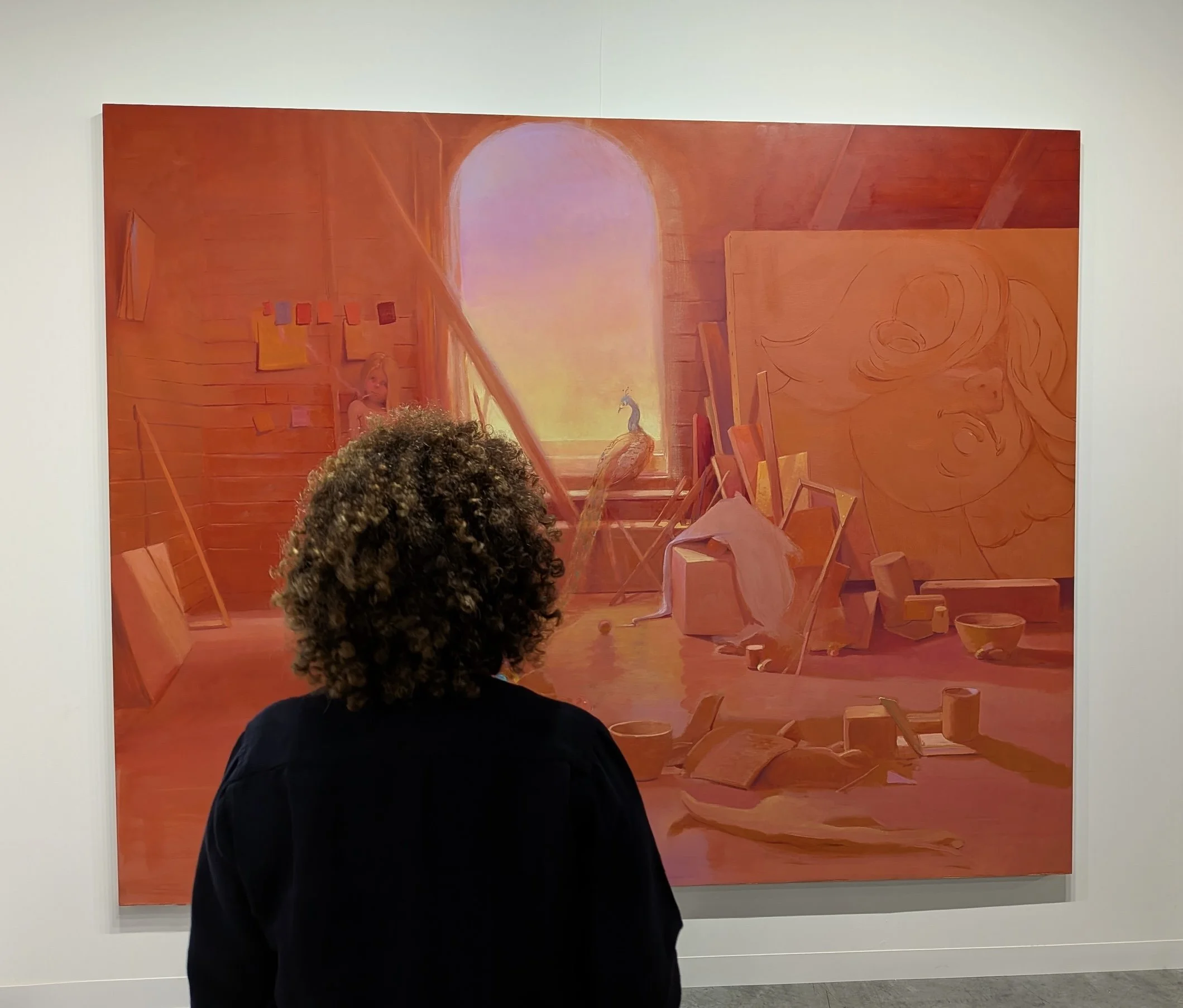
Peacock in the Garret, 2024
Lisa Yuskavage
Peacock in the Garret, 2024
David Zwirner, New York
Lisa Yuskavage conjures interior worlds where the studio itself becomes a surreal dreamscape. In Peacock in the Garret, 2024, the Philadelphia-born painter bathes the studio in saturated coral and orange —a chromatic temperature that reads somewhere between sunset glow and ambient heat. The peacock, that baroque symbol of vanity and transformation, perches on what appears to be a makeshift pedestal surrounded by the chaotic detritus of art-making: scattered canvases, paint containers, sketches pinned to walls, overturned vessels. This is the garret as both sanctuary and pressure cooker, where creation happens amid beautiful disorder.
Yuskavage's signature approach—using color as the primary vehicle of meaning—reaches an almost monochromatic intensity here, the warm palette creating an atmosphere that's simultaneously inviting and suffocating. The arched doorway or window in the background glows with ethereal pink and yellow light, suggesting either escape or divine intervention, while the peacock stands as a witness to the artist's process. There's a meta-theatrical quality to the composition: is this the artist observing herself, or the exotic bird as muse surveying its domain? The painting literalizes the notion of the struggling artist in the attic while subverting it with Yuskavage's characteristic blend of irony and sincerity. After three decades of challenging conventional understandings of genre and viewership, she's still finding new ways to make the studio portrait feel both timeless and urgently contemporary.
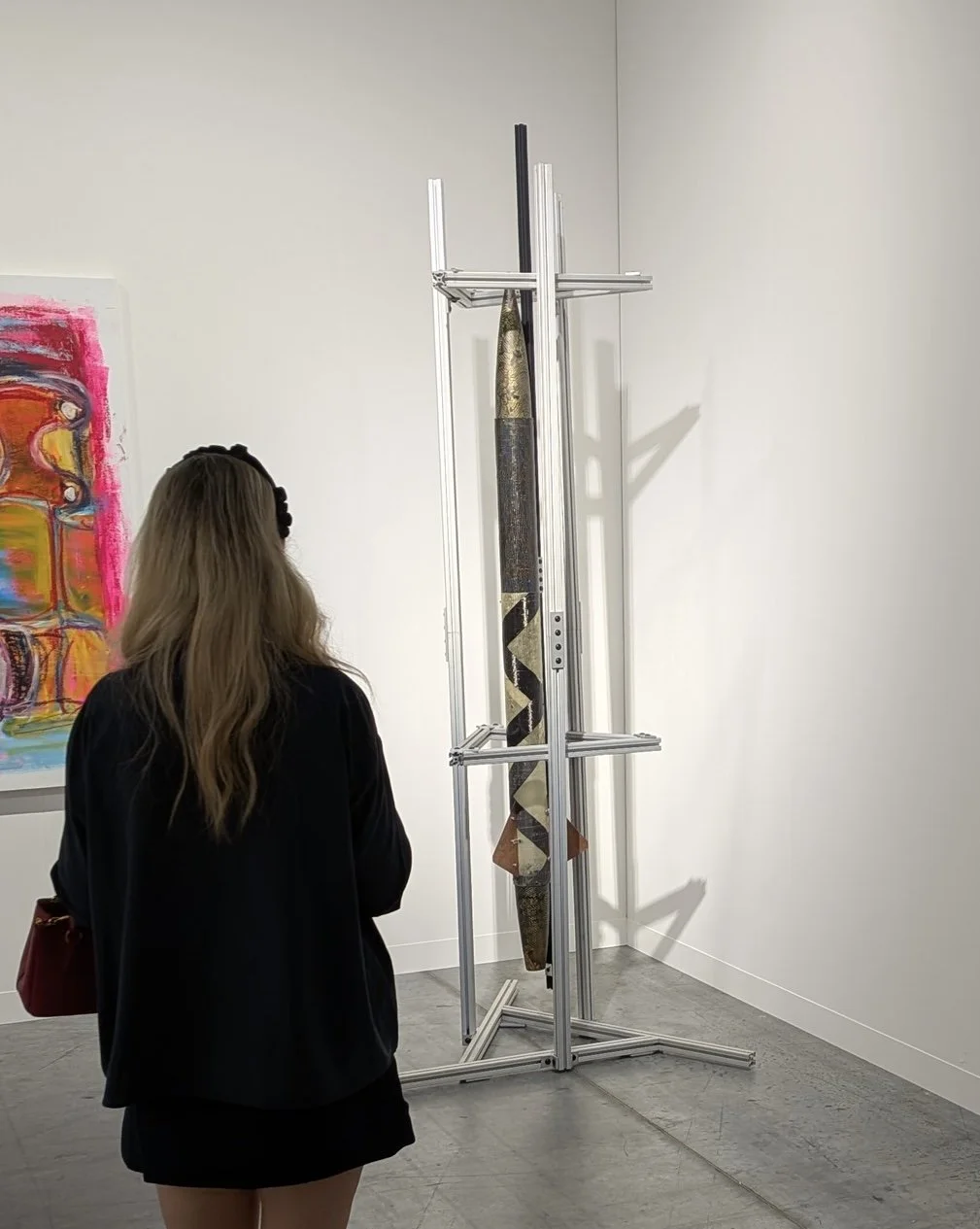
Daid Roy, Danger Noodle, 2023. Photo by Lisa Freeman
Daid Roy
Showroom of Possibilities
56 Henry, New York
56 Henry presents Daid Roy's Showroom of Possibilities, a speculative vision that reimagines transportation through the lens of sustainable innovation and social accessibility. Born and raised in South Central Los Angeles, Roy brings an urgent intimacy to questions of mobility—having witnessed firsthand the social barriers posed by inadequate transit infrastructure and the environmental devastation wrought by pollutive vehicles, particularly the catastrophic wildfires that have become endemic to Southern California. The presentation bridges Roy's multidisciplinary practice—sculptures, paintings, photographs—with their ongoing work through BlackNASA, the space agency they founded in 2016 to teach rocketry and space exploration ideals to underrepresented youth. Here, that ethos extends earthward: the Speculative Vehicles on display exist at the nexus of aesthetics, function, and craft, proposing that true sustainability demands accessibility, not the ethically compromised electric vehicles or fuel-guzzling machines that dominate contemporary roads.
Roy's Showroom includes large-scale oil paintings and a new series of drawings, but the focus is clearly on the Speculative Vehicles themselves. These hand-built works range from the entirely conceptual to the seemingly functional, each embodying what Roy describes as "the optimism of invention, innovation that benefits society." Returning agency to the user through handcraft and sustainable materials, Roy transforms utilitarian objects into vessels of possibility, asserting that art and life remain endlessly, inextricably intertwined.
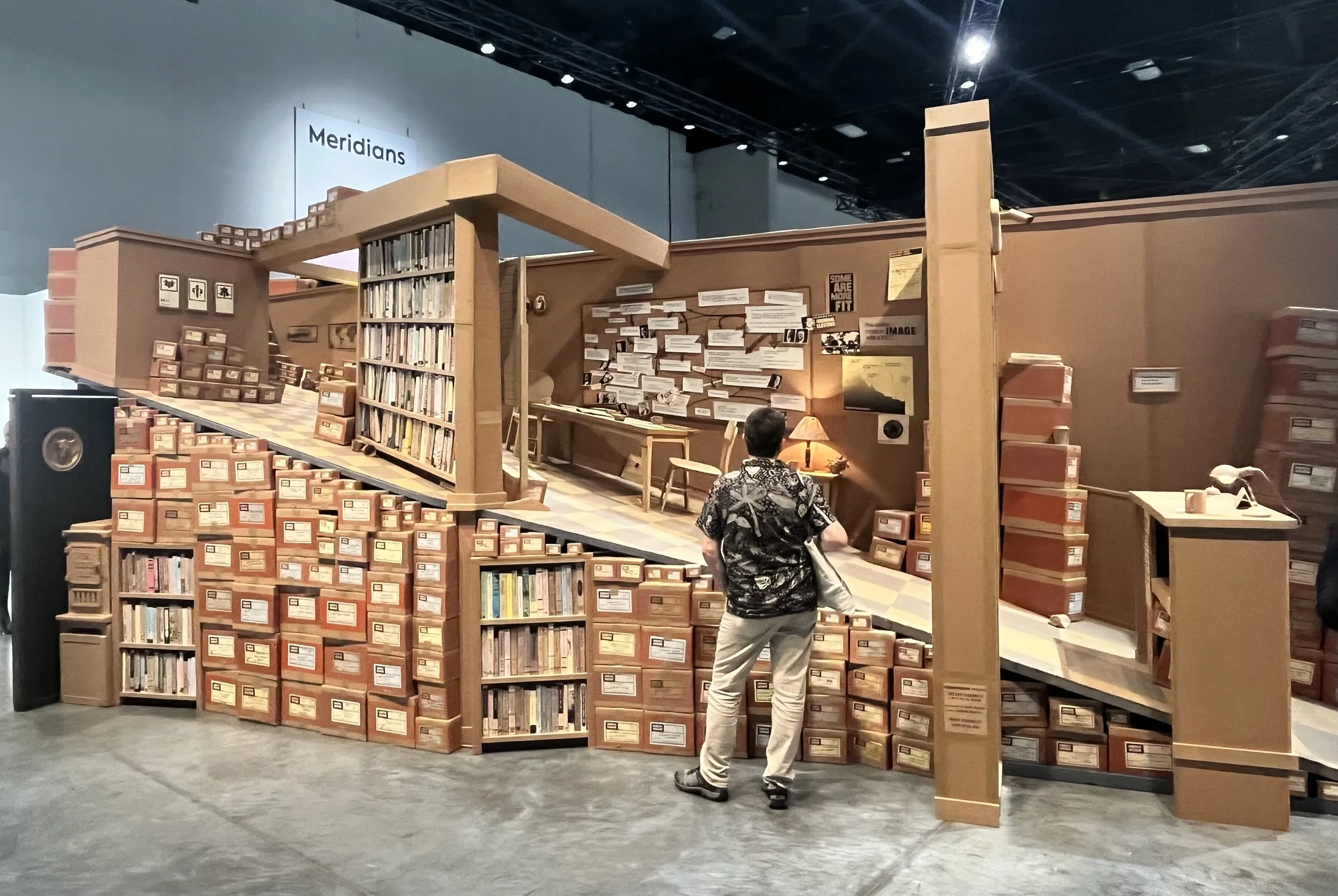
Ward Shelley with Douglas Paulson, The Last Library IV: Written in Water, 2020-2025 Photo by Lisa Freeman
Ward Shelley with Douglas Paulson
The Last Library IV: Written in Water, 2020-2025
Freight+Volume, New York
Ward Shelley's The Last Library IV: Written in Water arrives at Art Basel Miami Beach's Meridians section suggesting that democracy's information architecture is collapsing in real time. Collaborating with Douglas Paulson, Shelley constructs an elaborate fiction—a shambles of an office archive where banned books pile precariously next to stolen documents, where Project 20,25 shares shelf space with the 1619 Project, where WikiLeaks printouts crowd against books that were never written and books that were never read. Everything is handmade: fake spines, fabricated covers, illusory forced perspective creating secret rooms within rooms. The installation operates as both holding pen and detention center for the written word itself, "as it awaits deportation, as it is hustled off the stage of history." In Shelley's speculative taxonomy, instruments of propaganda and advertising stand equal to the Magna Carta and the Declaration of Human Rights—a deliberate collapse of hierarchies that mirrors our contemporary epistemological crisis.
The work arrives poised on what Shelley calls "the threshold of the Post Truth Era," interrogating the written word as the foundational technology that enabled democracy, science, and the rule of law. Embedded in a "back room" are Shelley's informational diagrams—his signature method of mapping complex systems and historical movements—creating a meta-layer where the artist known for visualizing how ideas propagate presents a monument to their potential obsolescence.