At the Brant Foundation: Keith Haring Returns to the East Village

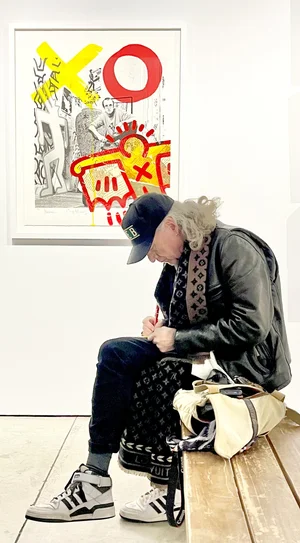
Nine monumental works by Keith Haring anchor the show in the main room of the Brant Foundation East Village gallery. Photo by Jamie Lubekin
More than four decades after he began covering blank subway advertising panels with chalk drawings, Keith Haring returns to Lower Manhattan in a show that captures a shining moment of unbridled creativity—when the East Village was raw, cheap, and exploding with artists intent on rewriting the rules of contemporary art.
On March 11, the Brant Foundation opens Keith Haring, an exhibition focused on the artist’s early breakthrough years between 1980 and 1983. The show runs through May 31 at the foundation’s East 6th Street space, just blocks from where Haring’s visual language first took shape.
The location is anything but incidental.
Haring’s rise was inseparable from Lower Manhattan in the early 1980s, when the East Village and Lower East Side functioned as a laboratory for artistic experimentation. Cheap rents, abandoned storefronts, nightclubs, and a thriving street culture brought together graffiti writers, painters, musicians, filmmakers, and downtown provocateurs. Out of that volatile mix came a downtown movement that would reshape contemporary art.
“This neighborhood is where it all happened—his first major show was at PS 122 just two blocks away, and places like FUN Gallery were only a few blocks from here,” said Dieter Buchhart, an art historian and author who curated the show with fellow art historian Anna Karina Hofbauer. Buchhart, the author of dozens of books on contemporary art including 2022’s Keith Haring/Jean-Michel Basquiat: Crossing Lines, led a press walkthrough of the exhibition in advance of the public opening.

Curators Dieter Buchhart and Anna Karina Hofbauer discuss the work of Keith Haring during a press walk through at the Brant Foundation. Photo by Jamie Lubekin
The Brant Foundation has increasingly positioned its East Village outpost as a kind of historical anchor for the moment. Since opening in a former Con Edison substation in 2019, the space has hosted exhibitions devoted to several defining figures of the downtown scene—including Andy Warhol, Jean-Michel Basquiat, and Kenny Scharf—artists who collectively blurred the lines between street culture, pop imagery, and the commercial gallery world.Haring belonged at the center of that constellation.
After arriving in New York in 1978 to study at the School of Visual Arts, he quickly gravitated away from the classroom and into the city itself. The subway system became his first audience. Using white chalk on black advertising panels, he began drawing radiant babies, barking dogs, dancing figures, and pulsating symbols—images executed quickly but with remarkable graphic clarity. Commuters often stopped to watch.
The drawings spread through the subway system faster than a downtown IRT, and soon the art world was paying attention. Within a few years Haring, along with contemporaries like Basquiat and Scharf, helped collapse the long-standing divide between graffiti and gallery art.The Brant show gives special attention to Haring’s subway drawings, featuring eight surviving examples. Between 1981 and 1985, Haring made some 10,000 of the drawings, possibly the largest public art project ever created.

A guest considers an 1984 subway chalk drawing at the Brant Foundation. Photo by Jamie Lubekin
“The subway project worked because people encountered the drawings day after day, moving through the system and connecting the images over time,” Buchhart said. As he became better known as his work gained value, poachers removed the subway drawings as fast as Haring could create them. “People began removing the drawings and collecting them, which Haring didn’t like—but in a way we’re lucky they were preserved,” Buchhart said.
Meanwhile, above ground, Haring was creating a body of work that carried the restless density of his subway drawings into the galleries. One untitled 1981 work in ink and acrylic on paper captures Haring’s evolving technique, with its maze of looping forms in alternating flashes of black, red and green. A pair of barking snap at each other amid crawling figures, arrows, and radiating bodies packed edge-to-edge, closer to graffiti improvisation than to traditional painting.

An early 1981 untitled ink on paper work by Keith Haring. Photo by Jamie Lubekin
Within a year, however, Haring had begun distilling his vocabulary into the bold graphic clarity that would make his work instantly recognizable. An untitled 1982 piece—one of five day-glo pieces that come alive when under black light—is dominated by a towering red dog-man against a bright yellow background. The figure is clutching a small green body, while another green figure tumbles beneath its foot.
The meaning of all this is open to interpretation. The larger figure could be protective or predatory—rescuing or attacking. Haring’s figures functioned less as characters than as symbols within a visual language designed to be read subjectively, whether on a subway wall, a poster, or a gallery canvas.Taken together, these two works chart a crucial shift: from the crowded improvisation of early subway drawings to the stripped-down graphic system that would soon carry Haring to international fame.

A 1982 enamel and day-glo on metal comes alive under blacklight. Photo by Jamie Lubekin
Unlike many artists who left their street origins behind once gallery success arrived, Haring continued to move fluidly between worlds.By the mid-1980s he was selling paintings and sculptures to collectors while simultaneously producing public murals across New York and around the world. Among the most famous is Crack Is Wack, the anti-drug mural he painted in Harlem in 1986, which still stands today along the Harlem River Drive. He was the first artist to paint the Bowery Wall, transforming the raw downtown surface into one of the city’s most visible outdoor art sites.
Public art was never a side project for Haring—it was central to his philosophy that art should exist outside the confines of galleries and museums.That belief also shaped his activism during the AIDS crisis. As the epidemic devastated New York’s creative community in the late 1980s, Haring used his imagery and public platform to advocate for awareness, safe sex education, and compassion for people living with HIV. Haring died of AIDS-related complications in 1990 at the age of 31.
His death—along with the earlier loss of Basquiat in 1988 and the broader toll of drugs and disease—marked the end of an era in Lower Manhattan’s art scene. The explosive cultural ecosystem that had flourished in the East Village during the early 1980s gradually dispersed.But the legacy of that moment continues to resonate.
Artists who survived the period, including Scharf, painter Jane Dickson and many others, are now experiencing renewed institutional attention, while museums and collectors continue to reassess the influence of the downtown scene.Walk a few blocks from the Brant Foundation today, and the East Village looks very different from the one Haring encountered in 1978. The streets are safer, the storefronts polished, the rents way out of reach for young artists like those who once filled these blocks with studios, clubs, and improvised galleries.
This exhibition returns that story to the neighborhood where it began, reminding viewers that one of the most influential art movements of the late 20th century grew not in museums, but in the streets of Lower Manhattan.
Keith Haring is on view at the Brant Foundation, 421 E 6th Street, New York, March 11–May 31, 2026.