Permission Granted: On Avenue A, a Wall Finally Pays Its Painters
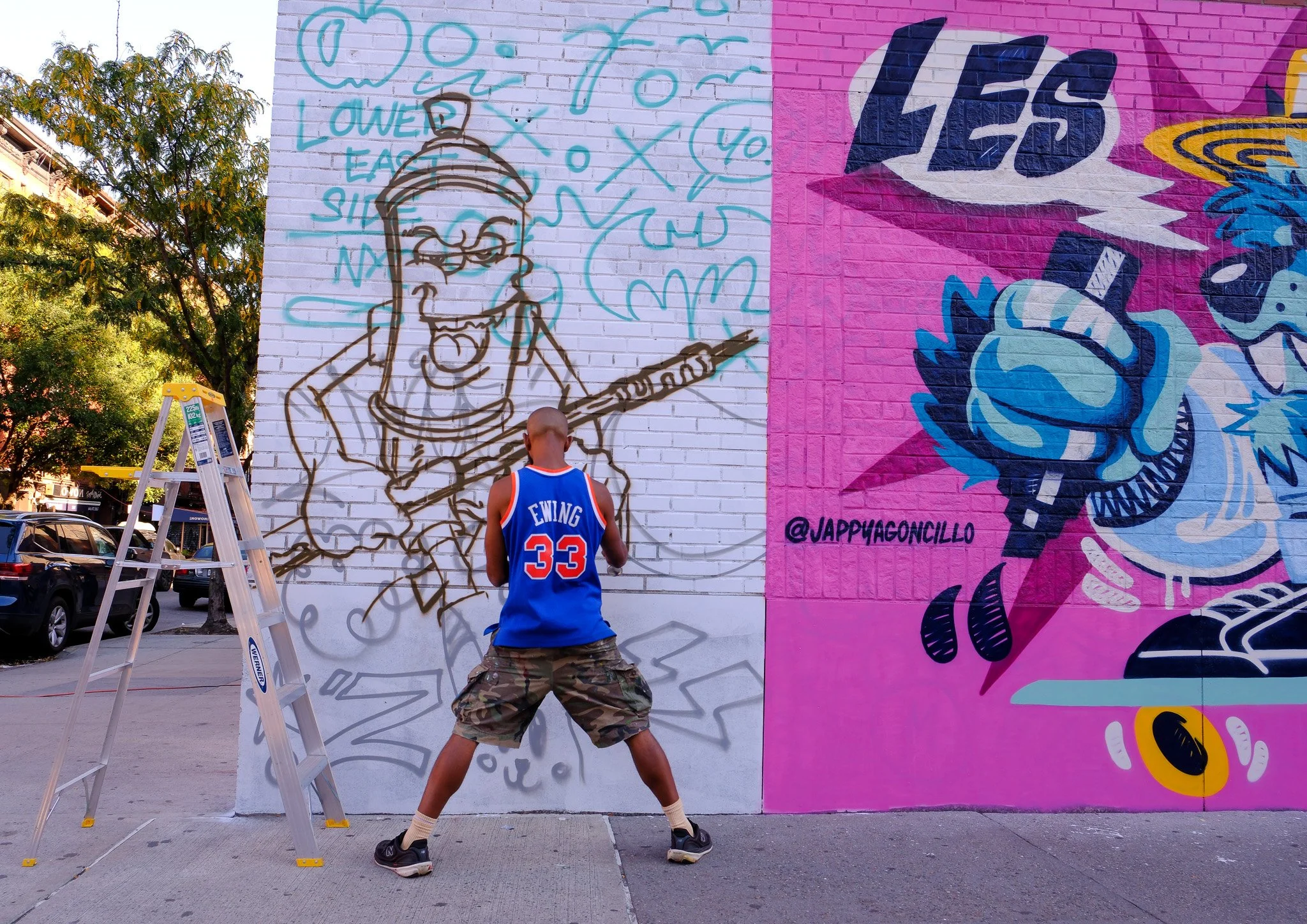
For decades, the brick walls of the Con Edison substation on Avenue A between East 5th and East 6th streets belonged to any volunteer with a can of spray paint. This month, for the first time, the utility is paying artists to paint it.
"Loisaida Walls," organized by the public-art nonprofit ArtBridge and sponsored by Con Edison, handed 25-by-10 foot sections of the substation wall to established graffiti artists to create a block-long homage to the East Village and Lower East Side's role in street-art history.
The roster reads like a roll call of graffiti heavyweights: Al Diaz, Optimo, Chino BYI, Toofly, Indie184, Andre Trenier, Cekis, William Power, Jappy, Marissa Molina, SKI, Cramcept, among others. The painting wrapped with a community day on October 3, when the artists worked the wall as the neighborhood went about its Saturday regular.
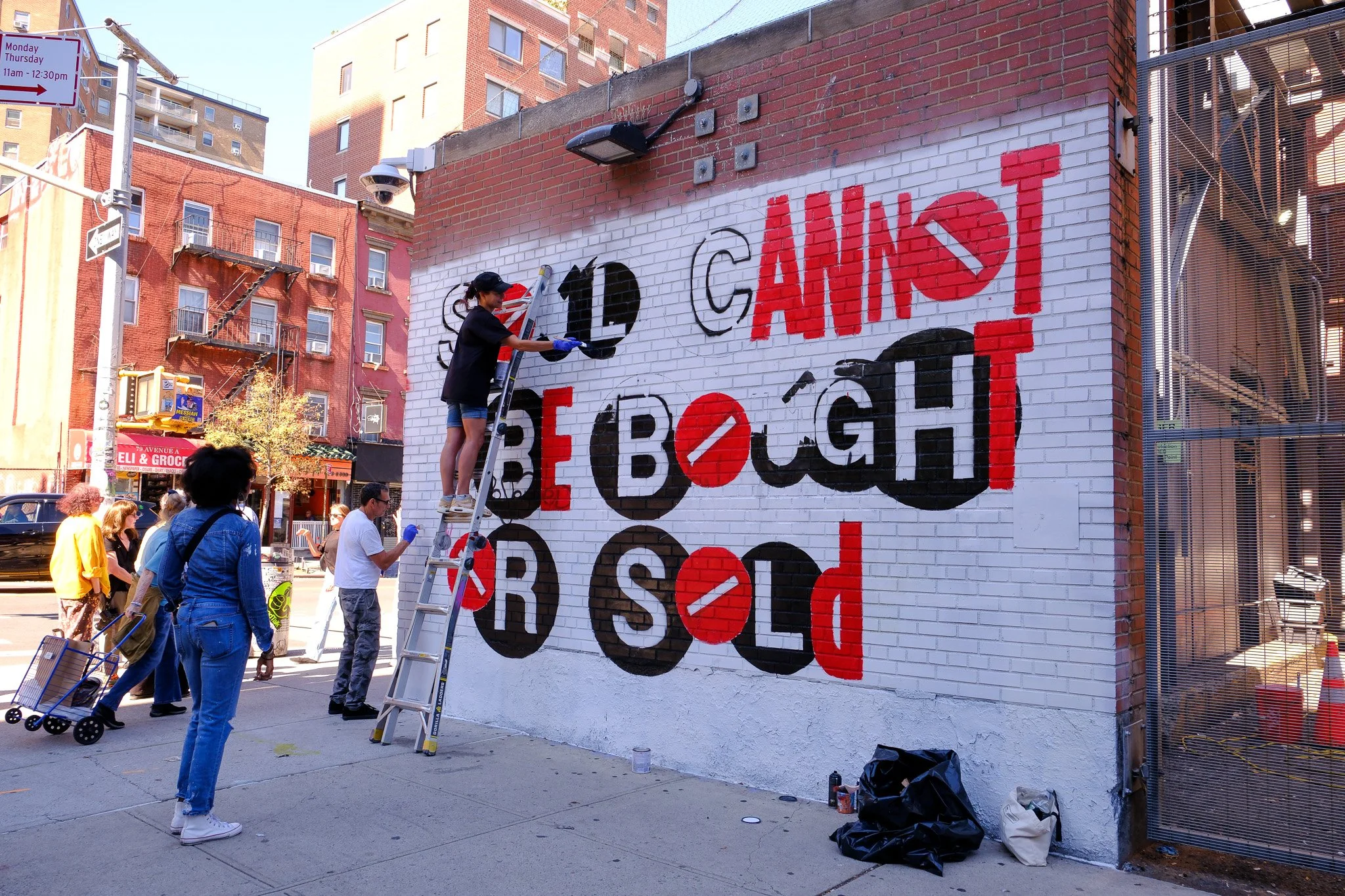
Al Diaz and Mariah Fox Hausman work on his mural at the corner of Avenue A and E. 5th Street in the East Village. Photo by Jamie Lubetkin
For Optimo it was a return to a nabe he knows well. Though he grew up in Chelsea, Optimo spent years as part of the skater scene just a few blocks north of the Con Ed wall in Tompkins Square Park. Unlike the others, Optimo went with a colorless palette for his section: "I go black and white myself," he said.
Across the brick, he rendered his signature towering top hat, a grinning Muppet-esque character, a boy's portrait rendered with comic-book tenderness, Betty Boop in a North Face puffer coat, piano keys arcing across the middle of the composition like a bridge, and a nod to Skate N.Y.C. to commemorate the neighborhood's skating legacy.
"Each spot has my art, but it's a bit different, and it relates to the neighborhood," he said. A placard in one character's hand reads "SAY NO." Elsewhere: the letters "ABC," a street sign reading "E 5 ST," and down the length of a long coat, the words "LOWER EAST SIDE."

Optimo stands in front of his black and white work on Avenue A. Photo by Jamie Lubetkin
He got the call the way these things usually happen: word of mouth. "What I told them was, I usually freestyle my work on the spot," Optimo said during a break from painting. He'd shown the organizers something similar to what he had in mind, then worked it out directly on the brick, bit by bit, without a fixed plan. "That's how I always work." He said he relished the chance to use the wall to "spread my message of sobriety in the neighborhood." Written in large letters across the bottom of the piece: "SAY NO."
ArtBridge, Optimo noted, is "making sure everybody who paints gets paid — which is great." It's a point of principle for him: "If it's a permission wall, I don't do it unless it's paid. I've done so many walls for free over the years." The exception is charity work — "that's different" — but a company asking an artist to make its building look better should pay for the privilege.
This is a model ArtBridge has followed since it was founded in 2008: it takes writers from the graffiti world and hands them a sanctioned wall and a check. The neighborhood benefits from the art, the artists get paid, the culture stays intact because the people painting it are the culture.

Cramcept takes a break from painting his work along E. 6th Street. Photo by Jamie Lubetkin
Nobody at the wall the other day was romantic about what happens next. Diaz, the graffiti legend who co-created SAMO with Jean-Michel Basquiat, was blunt when asked whether the commissioned work will survive: "With tagging, you know, it's going to get tagged. But that's just the way it goes, especially in an active neighborhood like this, where you've still got a lot of kids that like graffiti, that don't necessarily appreciate street art or a more ambitious or more thought-out thing other than a throw-up."
Diaz used his wall to send a soulful message to the neighborhood, spelling out Soul Cannot Be Bought or Sold in his signature subway sign letters in red and black on a white background. Diaz grew up on the Lower East Side and was instrumental in bringing first-generation graffiti culture and techniques he encountered during childhood visits to Washington Heights to the neighborhood.
"I really like the fact that it's right here on Avenue A near where I grew up," Diaz said while taking a break from painting. Everywhere he looked, he encountered a childhood memory. "I went to school right down there, I had a friend of mine living in that building right there as a kid. I know this neighborhood has changed so much over the years, but it has this history. It has a place in the history of this art," Diaz said.

Pedestrians walk by a colorful work by Cekis on Avenue A. Photo by Jamie Lubetkin
Dave "Chino" Villorente, who spent 1993 to 2005 running the graffiti column in the back of The Source magazine, sees the Avenue A wall as part of a longer vindication. "This is an American art form, maybe the last to be embraced," he said. "It's a lot like jazz, where we had an abundance of talent that wasn't celebrated."
"What they're doing here for the neighborhood and for the artist—I think it's long overdue," Chino said. "I've been working behind the scenes for the better part of the last three and a half decades to push the culture forward through art, shows, curation, applications, prints, from magazines to books, workshops, blogs. And this is another step forward for the art form and the culture," he added.

Andre Trenier at work on his mural on the corner of Avenue A and E. 6th St. Photo by Jamie Lubetkin
Stephen Pierson, ArtBridge's executive director, said ArtBridge made its name turning the city's construction sheds into exhibition space, but city regulations bar any words in that art," and unfortunately for a lot of these old-school writers, that's their art," Pierson said. The Con Ed wall is different: private property, different permits, far more permissible. It also breaks a cycle.
The wall, Pierson said, had been stuck in "an endless cycle of tagging and buffing because the community didn't like what's up here," which forced Con Ed to keep paying for cleanups. "Rather than continue that cycle, we thought, why not turn it into an asset that provides a permanent platform for some of these old-school guys, that can be more embraced by the community and that can get these guys paid."
Will it last? Optimo refuses the question on principle. "I don't like to think negatively... this is the streets. Anything you put in the street, it's like leaving a bag at a train station." Maybe nobody touches it; maybe it's gone the next minute. "I believe people will respect it," he said. "There are plenty of walls to paint anywhere. Let some murals rock, and let some graffiti rock too."

Fernando “SKI” Romero in front of his work in progress on Avenue A. Photo by Jamie Lubetkin
He's heard the other line, too: neighbors telling him they're glad the graffiti is gone. He answers without a second thought: "I didn't get rid of anything — that's not my role here." The wall was never his to erase. For the first time, though, it's his to get paid for.