Wistful Latency: Eve Ackroyd, Call If You Need Me, Turn Gallery
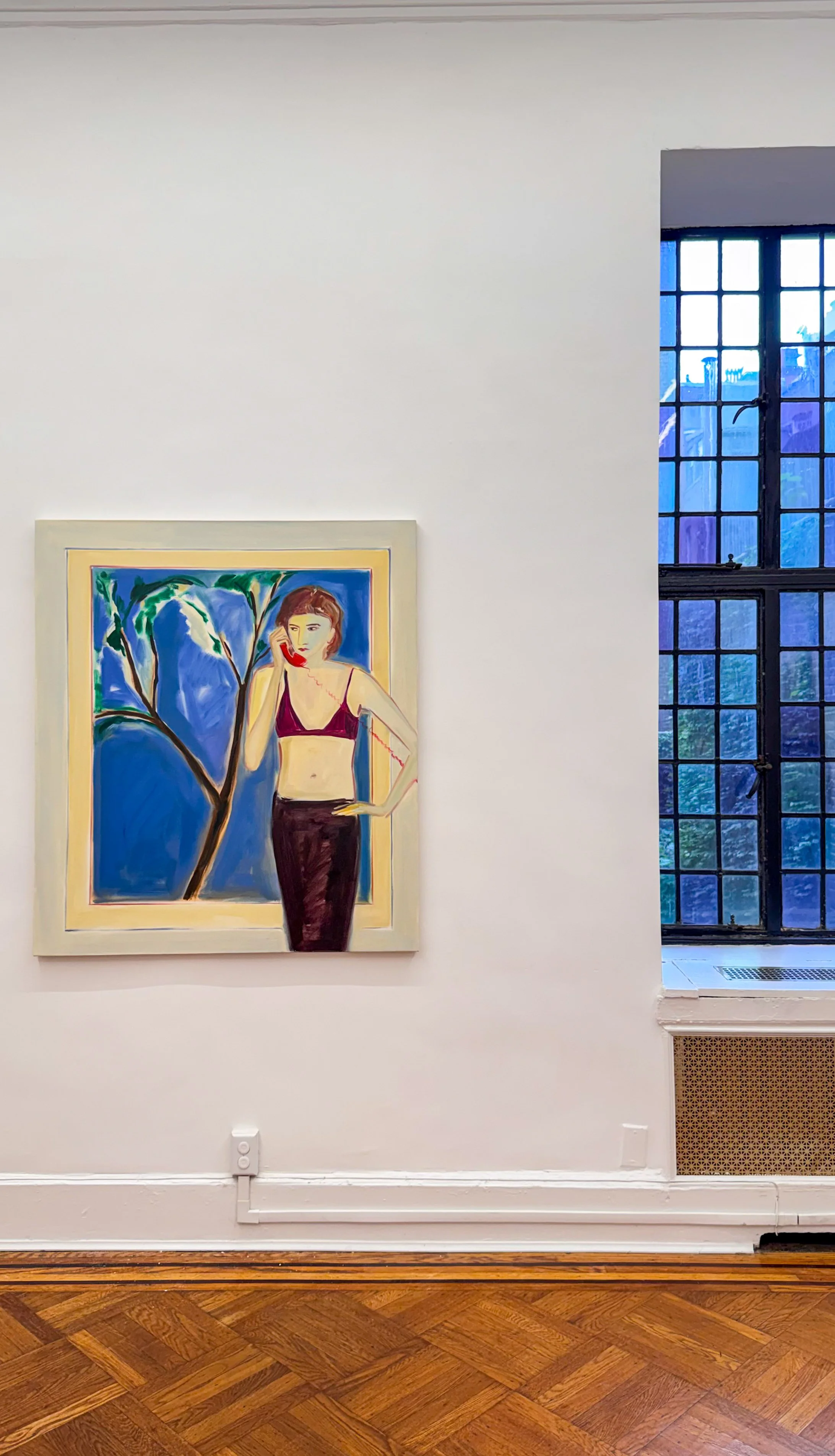
Installation view, Turn Gallery, New York, with the colored-glass window beside Eve Ackroyd's Call If You Need Me (2026). Photo: Lauren Ball.
The rooms at Turn are elegant in their specificity, and a window of colored glass in the main room, its panes washed in blue and violet, nudges the space into another sense of time: a suspended timeline that calls to memory a cottage, an English country house, a place of quiet devotion. Eve Ackroyd's figures do not enter this world so much as bend it around them: space softens, stretches, and gathers about a person before slipping away.
I share a devotion to short stories with Ackroyd and the gallery's owner, and the show takes its cues from a circle of writers: Raymond Carver above all, whose story gives the exhibition its title (Turn notes that Ackroyd read it two decades ago and has lately revisited), alongside Lucia Berlin, Samanta Schweblin, and Guadalupe Nettel. Ackroyd does not illustrate them. She converts the story's tension into paint, compressing a life without pretending to conclude it, so that an ordinary room is charged by what preceded the visible instant and what may follow it. The moment lengthens at the brushstroke's edges; painting invents a durational instant.
Most of these paintings imply a dyad: the figure and the person beside them, the figure and an absent listener, or the figure and us. A prop often does the connecting. It becomes a transmitter, and in the sociologist Bruno Latour's terms, a mediator rather than an intermediary, since it transforms what it carries instead of passing meaning along intact.
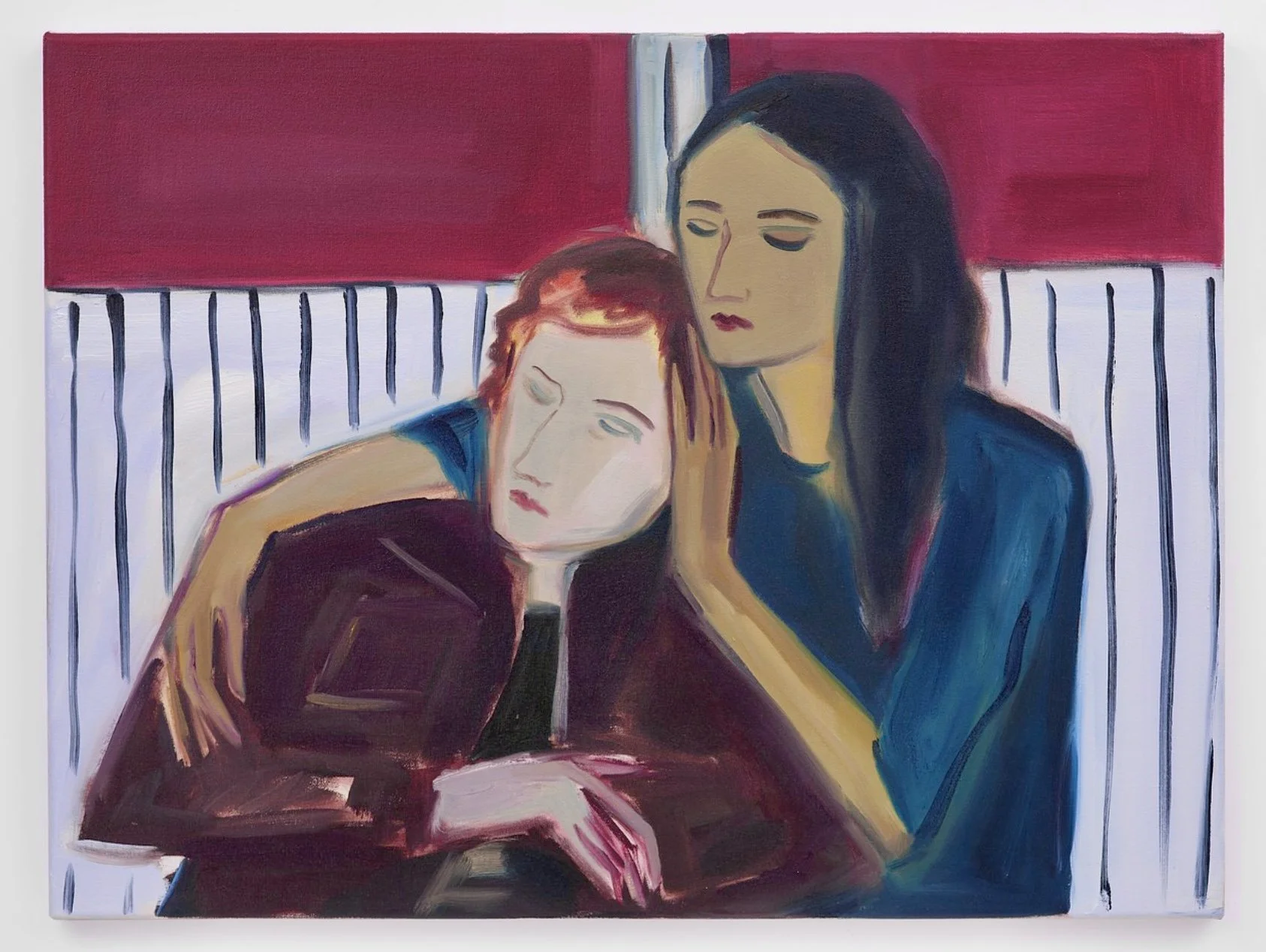
Eve Ackroyd, Backseat, 2026. Oil on canvas, 31.5 x 23.5 in. Courtesy the artist and Turn Gallery.
Call If You Need Me (2026) sets a red receiver at the ear, its cord scribbling down the torso and arm to a hand on the hip, before a cobalt window: a call is possible, perhaps desired, but nothing assures us it will be answered. Short Stories raises a rectangle we cannot name, mirror or screen, between one figure and us, receiving something while shielding the person behind it. Backseat (2026) is a pietà staged where the setting will not decide what it is: behind the two figures, black-and-white stripes read at once as the towers of heaven, the bars of a jail cell, and the booth of a diner. One figure cradles the other's head, and the closeness makes neither wholly legible. Black Cat (2026) lets its figure borrow the animal's sight, the cat rising across the lower face like a mask, a transmitter that looks back on our looking. Hands recur as a device: they hold receivers, they lift a rectangle, and they hold people. In Backseat, one hand is left unheld and another is lost from view; in Black Cat, one hand clutches while its partner is tucked away and guarded beneath the animal. None of these gestures explains the scene. Each changes who can perceive whom.
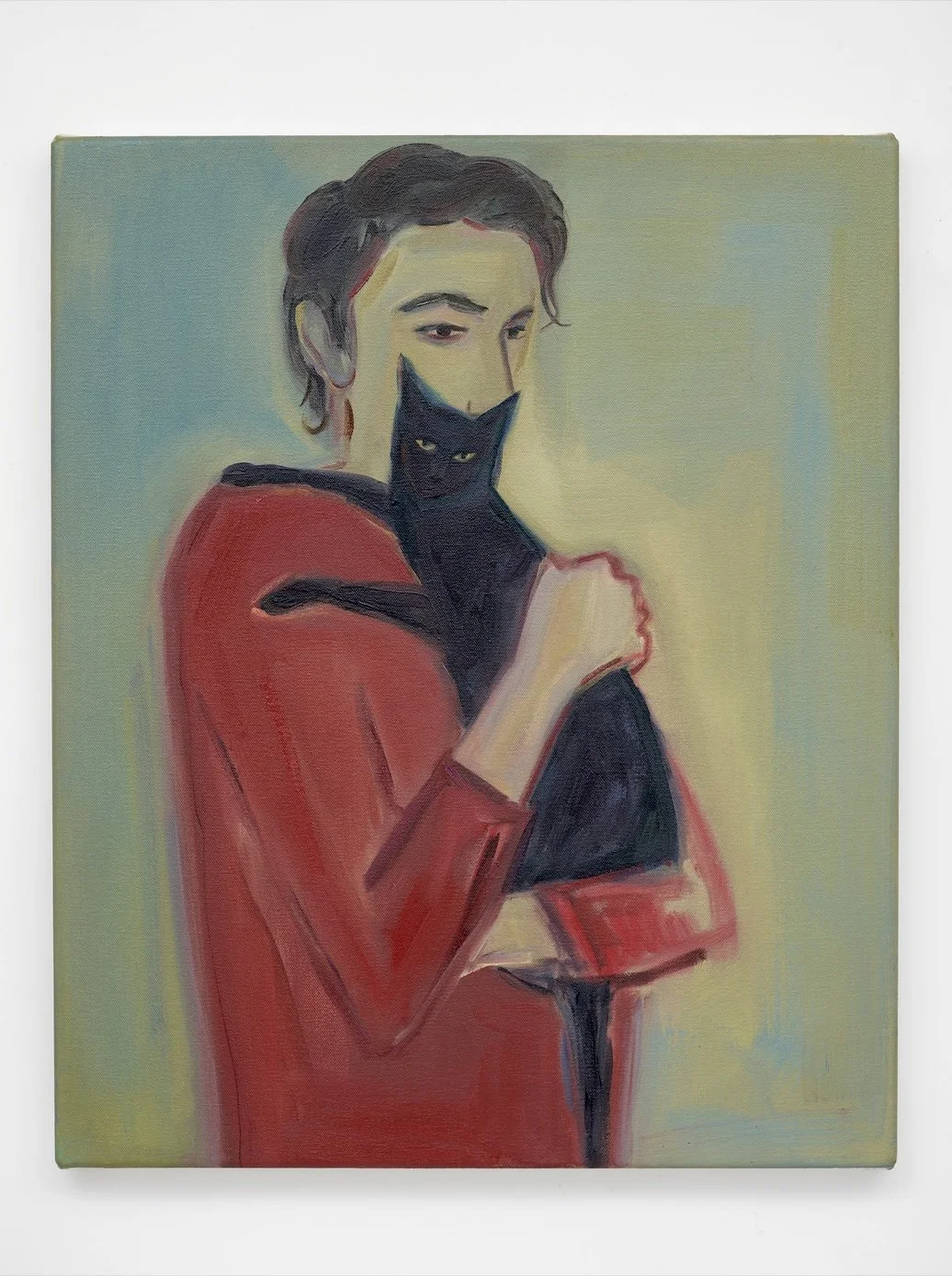
Eve Ackroyd, Black Cat, 2026. Oil on linen, 22 x 18 in. Courtesy the artist and Turn Gallery
The air in these paintings is a dreamy, crystalline haze. Ackroyd's whites are alive and frosty at once: soft across open ground, then turning acidic as they approach a contrasting color, and streaked in a single direction by a painterly gesture that carries a hint of foreboding or mystery. They hold her figures in suspension rather than in a setting. Paint is handled wet into wet, with passages of translucency. The restraint is remarkable: the paintings feel as though they happened all at once, and that simultaneity is the counterweight to the story inside them, a secret we cannot learn, unfolding in perpetuity.
These figures unsettle portraiture's old promise that a subject can be identified, located, and possessed. They lean into one another without becoming fully legible to us, and closeness need not cancel separateness. John Berger's claim that women learn to survey themselves as they are surveyed is a useful way into Call If You Need Me, where a woman stands framed at a window. Ackroyd is most persuasive where no controlling spectator can finish the account. The red receiver holds the title's offer, call if you need me, poised between devotion, distance, and a promise yet to be tested. Ackroyd gives us not the secret itself, but its latency: the wistful, unanswered experience of living beside it.
Call If You Need Me is at Turn Gallery, second floor, 32 East 68th Street, New York City,