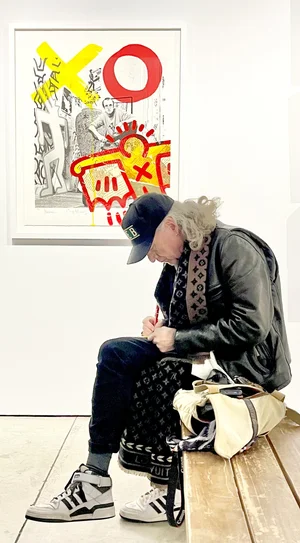
Looking at the work of the great masters, it can be easy to forget that, in their day, they were punk rock provocateurs. And, as a new show at The Met demonstrates, Raphael may have been the leading Renaissance rock star.
Raphael: Sublime Poetry, opening at The Met on March 29, brings together more than 200 works in the first major U.S. survey of the artist, a reminder that what later generations took as doctrine began as disruption.
By the time Raphael died in 1520, he had already rewritten the rules so completely that his innovations would harden into orthodoxy. Before they became the academy, Raphael and his pals da Vinci, and Michelangelo were the disruptors. They collapsed the distance between antiquity and the present, pushed the human figure toward a new kind of ideal, and treated composition not as tradition but as something to be engineered, tested, and bent. What some would canonize as harmony and perfection began as risk: a recalibration of how art could look, function, and assert authority.
Three centuries after his death, the Pre-Raphaelite Brotherhood declared Raphael the problem. In 1848, they staged a pointed rebellion against what his art had become—formula, finish, institutional taste—and named themselves against him, casting Raphael as the moment painting went soft. They could have named themselves the Pre-DaVinciites or the Pre-Michelangeloites, but they didn’t.
They weren’t entirely wrong about Raphael’s influence. But they were also repeating a historical pattern. Raphael had been the insurgent; now he was the establishment. The Pre-Raphaelites, with their manifestos and refusal of polish, were the new punks. And like every movement built in opposition, they would calcify in turn.
This is the cycle: revolt becomes style, style becomes system, system invites attack. Every revolution produces its own orthodoxy. Every orthodoxy gets torn down. The Met’s exhibition lands inside that loop—less a defense of Raphael than a reminder that he was never the fixed ideal his critics wanted him to be.
Below, five works from the members’ preview.
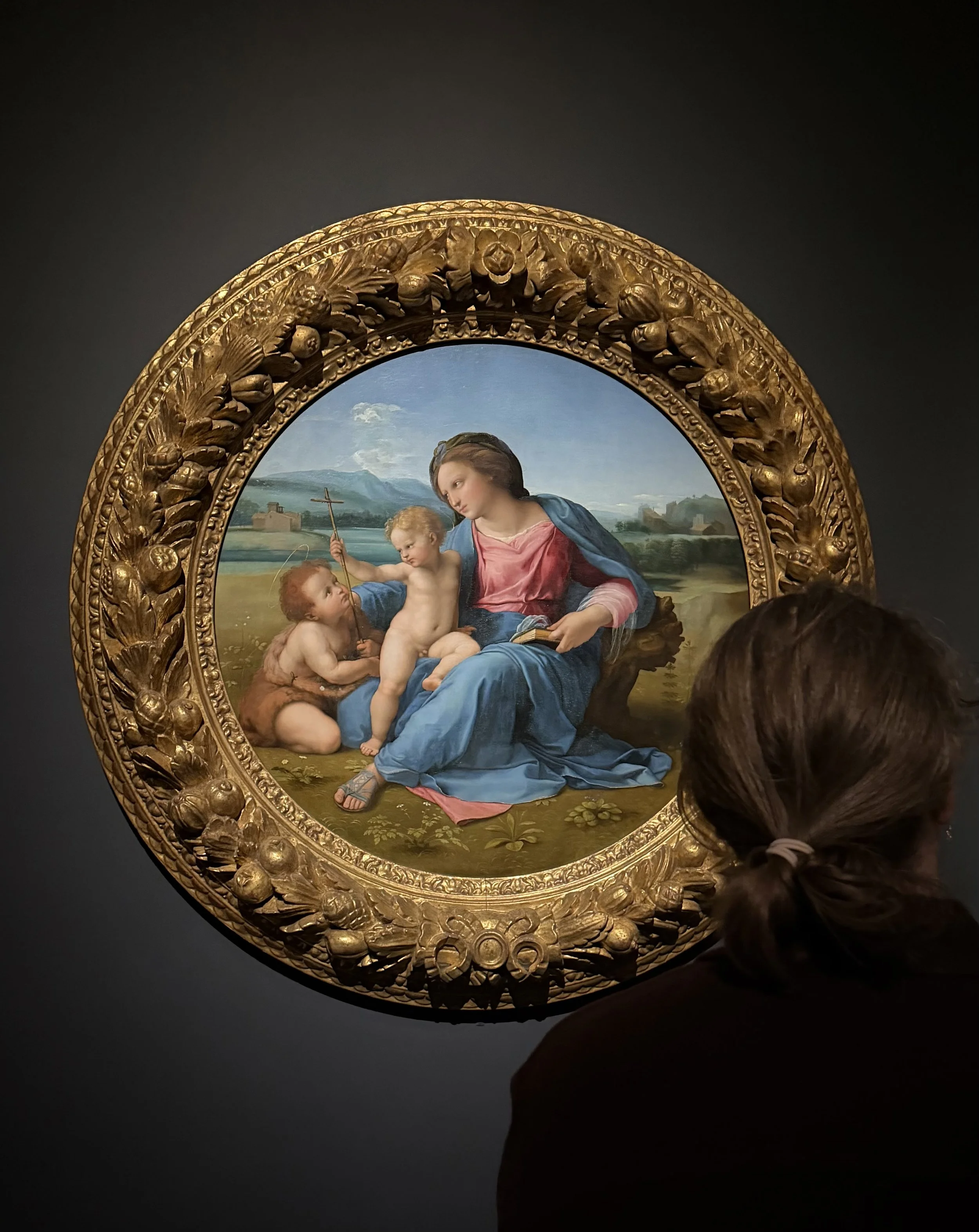
The Virgin and Child with the Infant Saint John the Baptist in a Landscape (The Alba Madonna), ca. 1509–11 Oil on canvas, transferred from wood. Photo by J. Scott Orr
National Gallery of Art, Washington, D.C. (1937.1.24)
Between 1450 and 1515, many Florentine artists and patrons favored a round format, or tondo, for paintings and relief sculptures—a reflection of the Renaissance interest in classical geometry, which characterized the circle as a perfect, infinite shape. Here, Mary sits on the ground rather than enthroned, a traditional type known as the Madonna of Humility, while the Christ Child stands to seize a reed cross from the infant Saint John the Baptist, an allusion to the triumph of the Resurrection. Raphael's composition relies on an interplay of color, light, and geometry to create a remarkable chromatic and formal harmony. Tender gazes, exchanged along a diagonal, unlock an equally arresting psychological world. Although the patron is unidentified, the archaeologically precise style of the Virgin's sandal suggests a shared interest in ancient Rome.
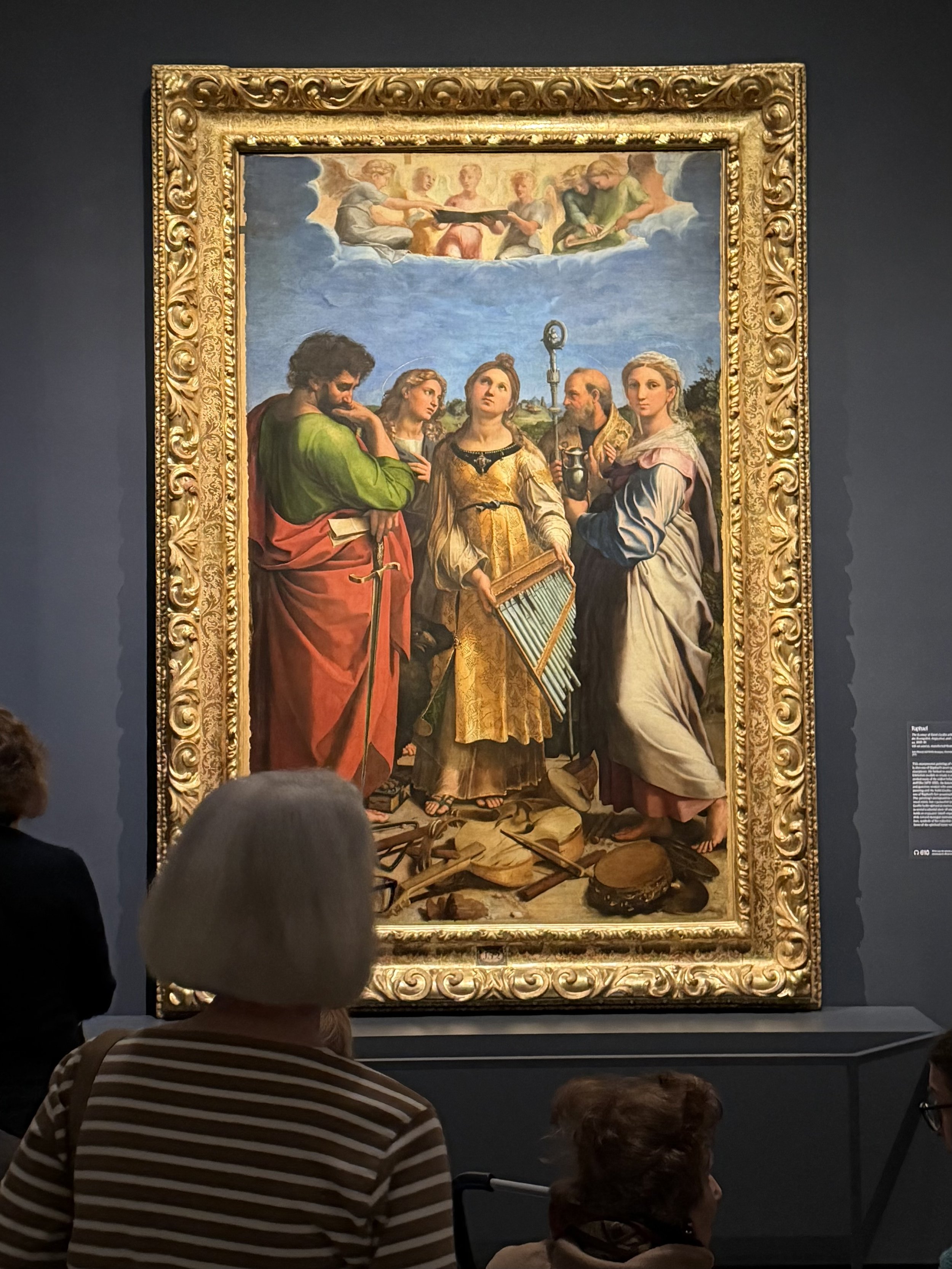
The Ecstasy of Saint Cecilia with Saints Paul, John the Evangelist, Augustine, and Mary Magdalen, ca. 1515–16 Oil on canvas, transferred from wood. Photo by J. Scott Orr
Polo Museale dell'Emilia Romagna, Pinacoteca Nazionale di Bologna (577)
This monumental painting of virtuosic technique is also one of Raphael's most spiritually inspired altarpieces. He looked to ancient and Early Christian models to create a composition that evoked many of the ardent beliefs of Elena Duglioli dall'Olio (1472–1520), the famously chaste, devout, and generous woman who commissioned the painting and the Saint Cecilia chapel. Elena was one of Raphael's few prominent female patrons. The painting's juxtaposition of instrumental and vocal music has a powerful symbolic function. Cecilia looks upward in rapture as the heavens part to reveal a celestial choir of angels. She passively holds an organetto (small organ) that has begun to slide toward damaged instruments strewn at her feet, symbols of her rejection of earthly music in favor of the spiritual inner voice.
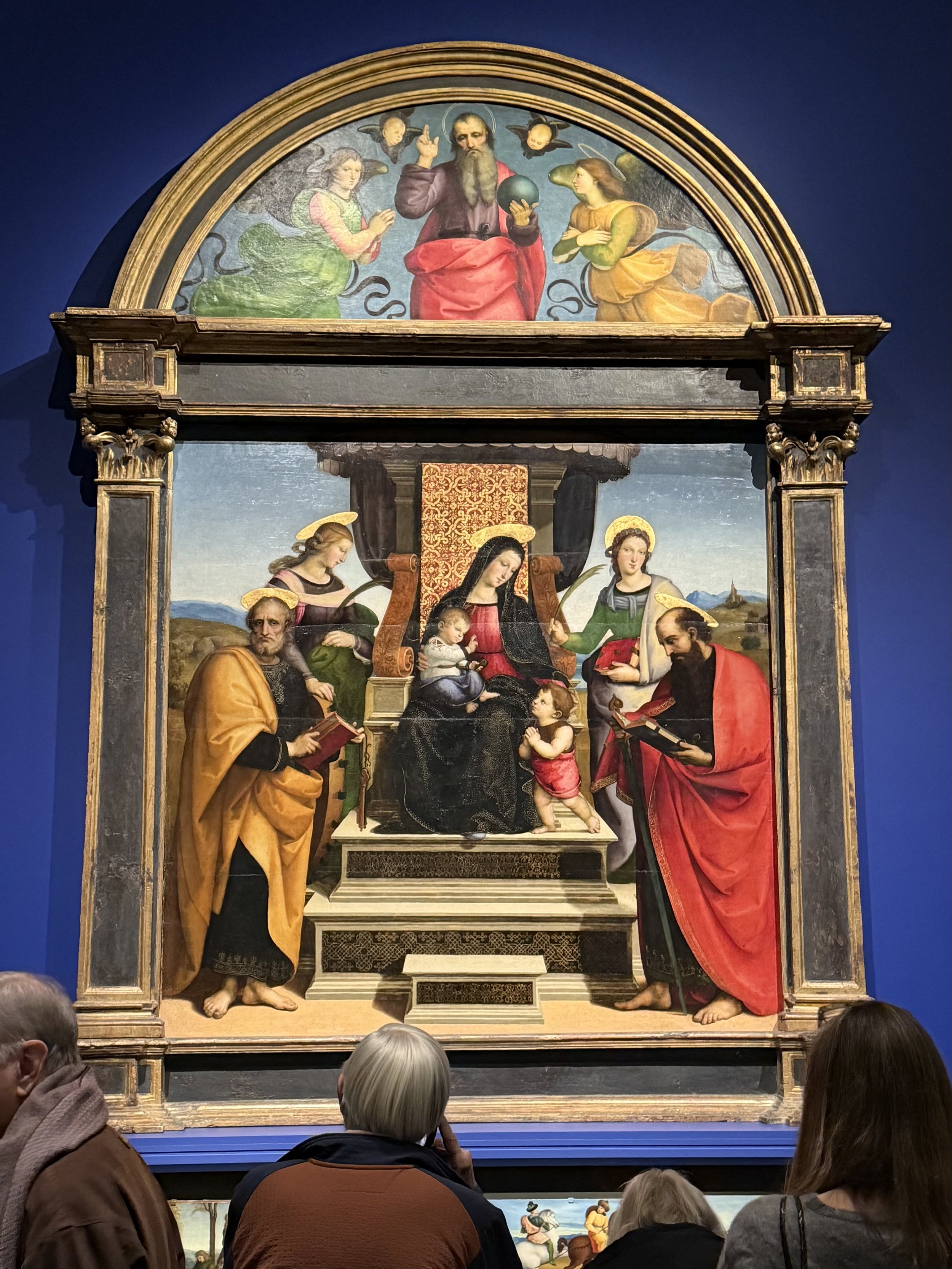
The Colonna Altarpiece. Photo by J. Scott Orr
Raphael's exploration of perspective is on full display in the multipart altarpiece's main panel, which shows the Madonna and Child on a large, stepped throne. The infant is clothed, an uncommon choice likely requested by Raphael's conservative patrons, the cloistered Franciscan nuns of Sant'Antonio di Padova in Perugia. The altarpiece is an experimental work by the artist, uniting the traditional styles of Perugino and Pinturicchio with the "modern" Florentine style seen in Saints Peter and Paul in the foreground. These two figures are rendered with dramatic chiaroscuro and sculptural monumentality.
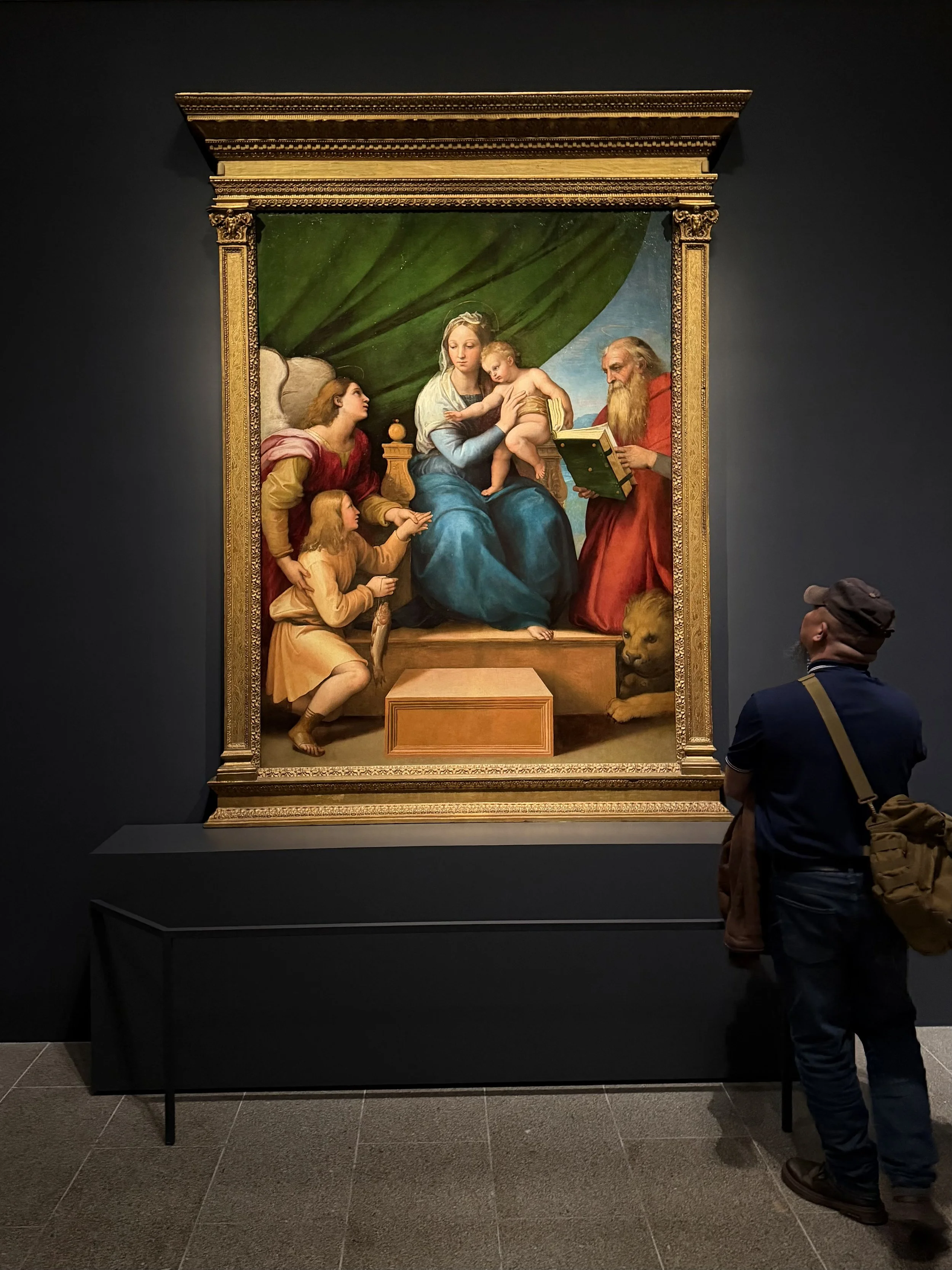
The Virgin and Child with Raphael, Tobias, and Saint Jerome (The Madonna of the Fish, or The Madonna del Pesce), ca. 1512–14 Oil on canvas, transferred from wood. Photo by J. Scott Orr
Museo Nacional del Prado, Madrid (P000297)
In a traditional sacra conversazione, or "holy conversation," the Virgin and Christ Child are grouped together with saints in a relatively static composition. Here, Raphael transformed the type so that the figures interact with one another to create a story, although the holy mother and infant have no connection to these saints in biblical time. The informal title refers to the small fish held by the child, Tobias, which alludes to a miraculous episode in the Book of Tobit but also perhaps to the Greek word for fish, used as an early Christian acronym for Jesus Christ, Son of God, Our Savior. Raphael painted this altarpiece with some assistance from his workshop for a chapel in the church of San Domenico Maggiore in Naples.
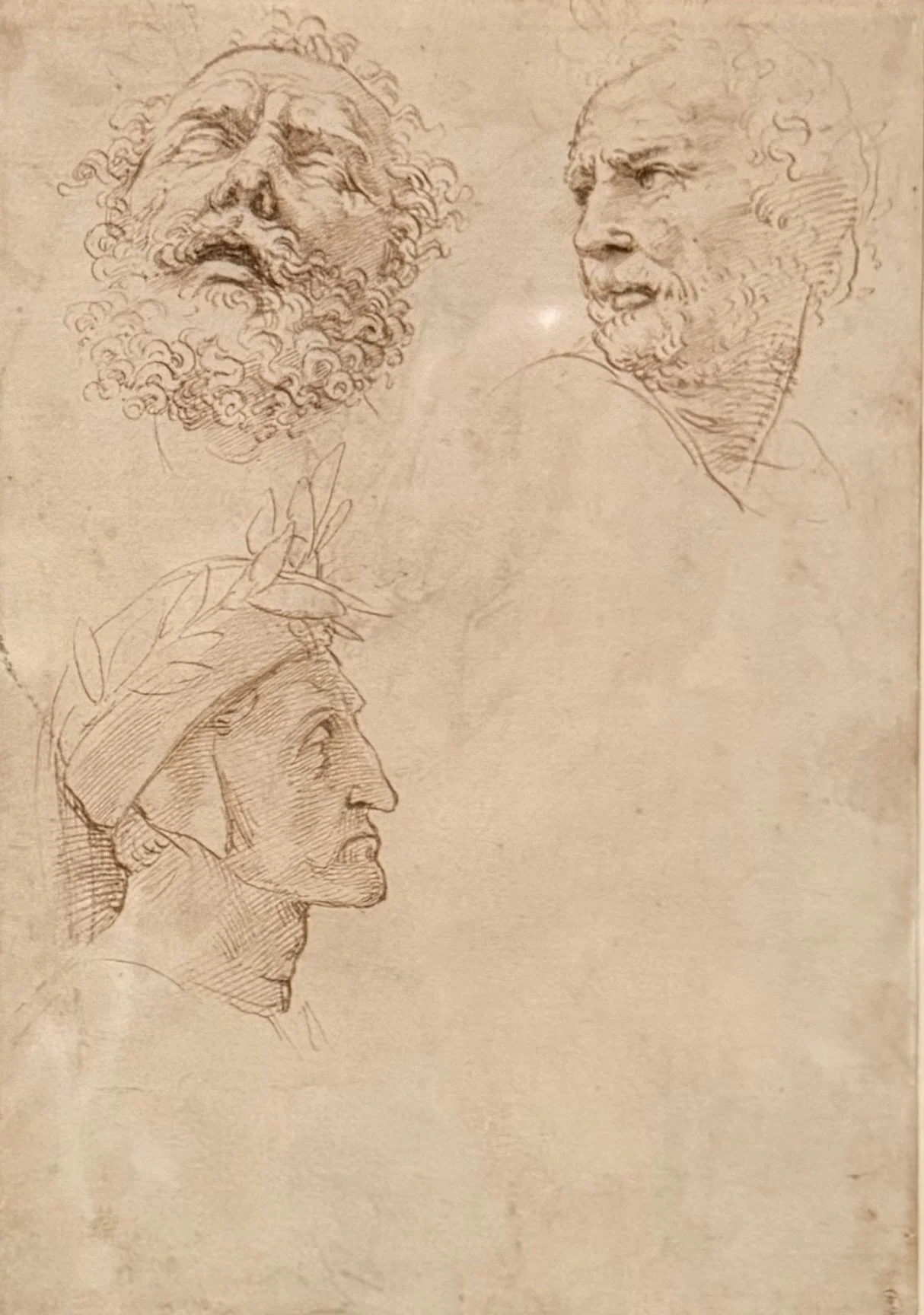
Studies of the Heads of Three Poets (Homer, An Unidentified Poet, and Dante) for the Parnassus, Stanza della Segnatura, ca. 1511–12 Pen and brown ink(?) over traces of black chalk, on paper. Photo by J. Scott Orr
The Royal Collection / HM King Charles III (RCIN 912760 recto)
This magnificent sheet of studies for the heads of three poets in the Parnassus fresco looks like a page from a pictorial archive ready for consultation by the artist. It represents Homer of ancient Greece, an unidentified poet (who stands next to Sappho in the painting), and the medieval Italian writer Dante. As with the drawing for the muse Euterpe that hangs nearby, Raphael used Pope Julius II's collection of antiquities as a source of inspiration. He based Homer's likeness on a classical sculpture known as the Laocoön.