Radiant Belonging: Elliott Green’s Lost Horizon
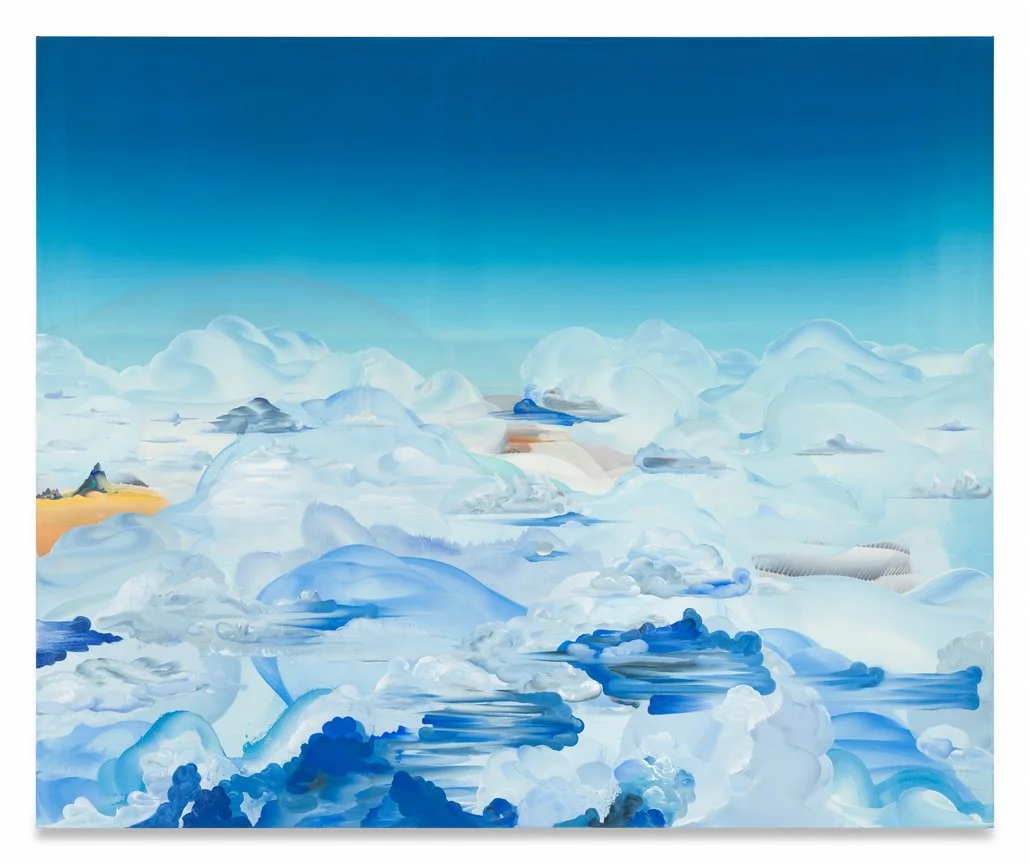
Benevolent Heights, 2025, Oil on linen, 76 x 92 inches. Photo courtesy of the artist and Miles McEnery Gallery, New York.
Elliott Green does not place himself within the world represented in Lost Horizon. No figure stands among its mountains, clouds, currents, or atmospheric expanses, and no surrogate body instructs the viewer how to enter them. Yet the paintings do not feel vacant. They leave us alone but not abandoned. Their separate entities—clouds, peaks, streams, ridges, bodies of light—remain distinct enough to be admired while still belonging to a larger order. Green’s paintings suggest that belonging is fundamentally perceptual rather than narrative. It arises from a mode of looking in which separateness and relation are allowed to coexist.
The strongest works resist becoming descriptions of specific sites. Cloud, mountain, atmosphere, and water remain unresolved, not because their identities are hidden, but because Green constructs relationships that keep several readings active at once. Familiar forms—sky, mountain, cloud, ice—orient us within terrains that might otherwise seem remote or inhospitable. Sustained looking turns distance into intimacy, making even a glacial expanse feel unexpectedly sheltering.
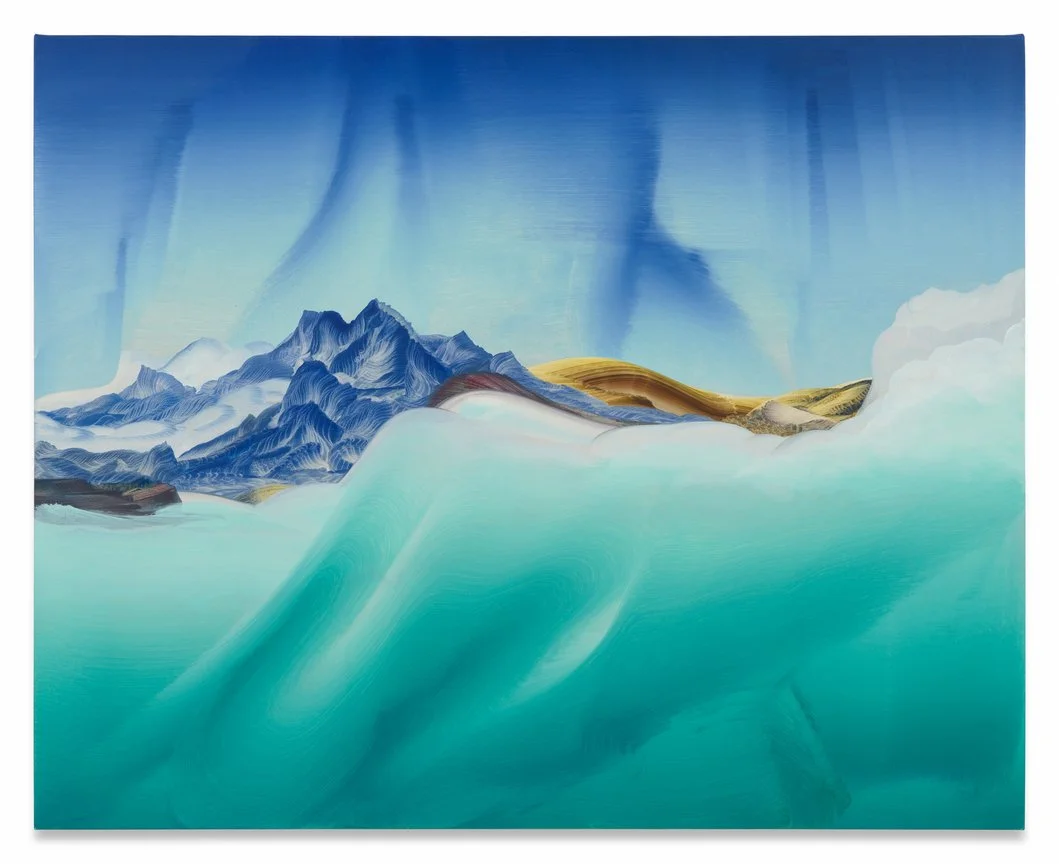
Elliott Green, Incalculable Bliss, 2024, oil on linen, 32 × 40 inches. Photo courtesy of the artist and Miles McEnery Gallery, New York.
In Incalculable Bliss (2024), Green stages a quiet argument with Odilon Redon’s Composition: Flowers without a Vase (c. 1905): a cloud without a sky, a bouquet without its vessel, color detached from the object that would ordinarily anchor it. Green’s blue mountains take on the same unmoored, almost petal-like quality, their drags of aquamarine and blue behaving less like geological form than like aurora—northern lights compressed into a mountain range. In the foreground, a single vast form reads simultaneously as peak, cloud, and reclining figure, a body laid on its back and looking up at its own sky. Faces surface throughout Green’s recent work, and one appears here too, dissolving as quickly as it coheres. Drag lines descend like rays from the heavens, recalling—despite oneself—the engineered radiance of Bernini’s Saint Teresa, or something stranger still, not quite terrestrial.
The composition in Benevolent Heights (2025) follows landscape convention while subtly destabilizing it. Its most saturated color occupies the foreground, receding through cooler value toward a grayish arc at the horizon that might be a rainbow or might be smoke. Clouds read equally as water, ice, and geologic sediment—a single vocabulary serving cloud, current, and stone at once. Several self-contained worlds appear nested within the larger field, arranged in a loose triangular structure echoed by the generalized geometry of the clouds themselves. On the left, a passage of open, directional paint handling, the wedge of the tool visible in every stroke, resolves into something like a dragon’s face appearing from blue-violet hues. The pleasure of the passage is almost tactile: the tool skids, and pigment trails behind it like a wake.
Light is the ground condition. Everything appears lifted from its dark. Green’s pale blues and violets feel like the upper register of fuller intensities that have been withheld rather than eliminated. Light does not fall theatrically upon an already completed world. It precedes the objects to which it might belong. The palette calls to mind Odilon Redon and Pierre Bonnard, painters for whom color exceeds local description. In Redon’s late pastels, brightness can appear distilled from the darkness of the earlier noirs, as though incandescence were the afterimage of a deeper chromatic event. Bonnard allows color to absorb the distinction between object and atmosphere, producing light across the whole field rather than attaching it to discrete forms. Green arrives at a related condition through his own material vocabulary. The radiance is not merely depicted; it is built into the paintings’ value structure.
White, accordingly, does not behave as emptiness. It acts as the reflective ground of a devotional panel: something the visible color covers yet continues to depend upon. The analogy is perceptual rather than literal—Green is not painting over gold leaf. Luminosity seems to emanate from beneath or within the atmospheric color, so that the viewer registers light before identifying an object that might produce it. The whitest passages are also among the most materially present. Ridges and deposits left by Green’s custom tools catch the actual light of the gallery, allowing a highlight to represent illumination while physically receiving it. At moments, the forms acquire the shallow relief and sculptural presence of architectural ornament.
Writing about Redon in 1883, J.-K. Huysmans called the work “difficult to define”—less a complaint than a diagnosis. In Redon’s Chimera drawings, a form can remain compositionally resolved while its identity stays unsettled. Green’s atmospheric fields make a similar demand: not to decode an image, but to remain inside a perceptual state that the painting sustains rather than resolves. Where Redon achieves this through darkness and dream logic, Green achieves it through light and altitude.
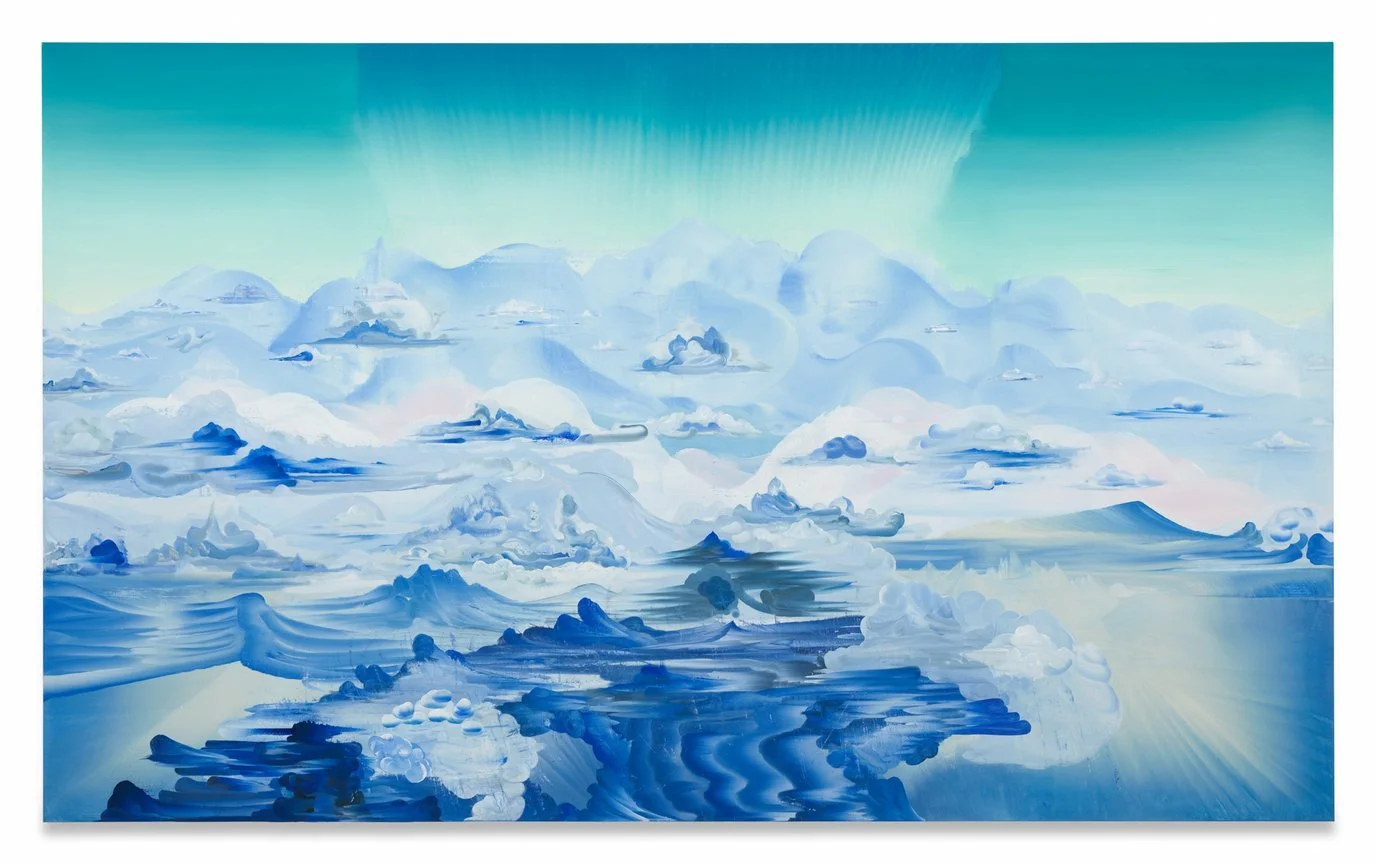
Elliott Green, On Top of Thin Air, 2026, oil on linen, 76 × 126 inches. Photo courtesy of the artist and Miles McEnery Gallery, New York.
On Top of Thin Air (2026) pushes this logic further. Green drags the gradient horizontally in an all-at-once motion, then breaks it apart with directional strokes that become rays, water, and cloud—water passing over cloud, or water becoming cloud. Worlds nest within worlds the closer one looks, producing a dispersed, patterned architecture in which each formation retains its own internal order while participating in the larger field. The palette moves from teal green at the top through a dense middle register of blue and pink toward a pale oxide-yellow note glimpsed through the lower passages. Whether Naples yellow or a neighboring hue, it lends the otherwise atmospheric field an unexpectedly earthly weight.
On the right, where the central teal green rays meet the contour of the cloud band, a face surfaces and withdraws before it can be fixed—the same withholding at work in Incalculable Bliss, given here a sharper edge. Here, geology and atmosphere do not seem invented so much as fully embodied in paint.
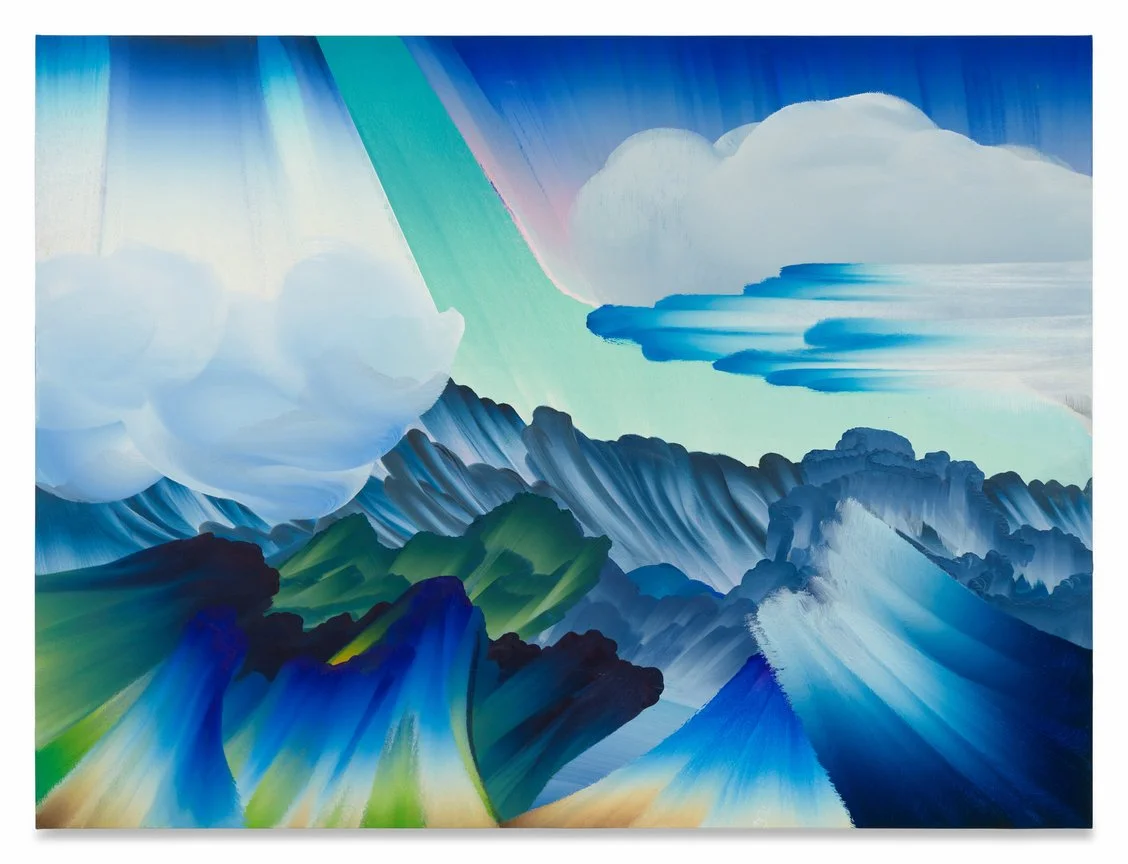
Elliott Green, Airstreams, 2026, Oil on linen, 48 x 64 inches. Photo courtesy of the artist and Miles McEnery Gallery, New York.
By contrast, Airstreams (2026) pulls the palette toward greater saturation and, with it, toward greater closure. The icy blues read as glacier rather than atmosphere—form merging rather than dissolving—and the painting’s surreal charge comes less from compound identity than from the impression of ice and air caught mid-negotiation. Green’s procedures remain visible, but they reinforce a more descriptive pictorial structure. The landscape becomes legible sooner, offering fewer opportunities for sustained perceptual oscillation than Incalculable Bliss or On Top of Thin Air. Increased saturation and firmer edges alter the temporal experience of looking.
Green’s paintings reveal realism as a paradox. They feel most convincing precisely where their forms become least securely nameable. Reality is not experienced as a sequence of perfectly named objects. It arrives through partial recognition, association, projection, and continual revision. Green builds that instability into the paintings as controlled referential drift: a cloud becomes mountain, current, wave, body, apparition, or paint without ceasing entirely to be any of them. His realism lies not in correcting this instability, but in preserving it.
In Manet’s Silence and the Poetics of Bouquets, James H. Rubin argues that naturalist description, by taking possession of the world as something external to the self, risked surrendering the viewer’s sense of being within it. Green does not restore that presence by inserting a human figure into the landscape. Instead, the landscape refuses to become a completed object external to the viewer; its coherence remains contingent upon sustained looking. His clouds are central to this coherence because they do not signify so much as allude. Like Manet’s bouquets, they are familiar forms capable of gathering associations without resolving into a singular narrative. Green’s clouds are multivalent, holding peak, current, distant water, animated body, apparition, weather, ascent, and paint in simultaneity. They do not resolve into one thing, but neither do they become merely vague. Their density lies in the coexistence of several interpretations at once.
Green’s forms are organized less by resemblance than by correspondence. Clouds anticipate mountains; mountains echo clouds; currents correspond with the contours of both. Mirroring occurs without perfect symmetry, producing a network of likenesses that never settles into duplication. Beneath the atmospheric surface lies an armature of directional vectors, recurring apexes, and asymmetrical echoes—most visibly, cross-like intersections where vertical forms rise and horizontal forms open outward, quietly orienting the eye before it recognizes why. Green does not prescribe a single route across the painting, but neither does he leave the eye directionless. Belonging begins in our being given enough structure to dwell without first resolving everything we see.
A dragged passage remains opaque even as it approaches recognizable things—atmosphere, mountain, cloud, wave, current—never exhausted by any single reading, the viewer enveloped in the weather of a mind still forming its own image.
The Japanese woodblock technique mokumezuri offers a useful material comparison. In “wood-eye printing,” the grain of a specifically chosen block becomes visible within the printed image rather than disappearing behind it. Green’s carved sponges, shaped foam rollers, and dragged fleece work through a related logic: the ridge left by a tool is simultaneously cloud and evidence of the instrument that produced it. Atmosphere and material fact occupy the same mark.
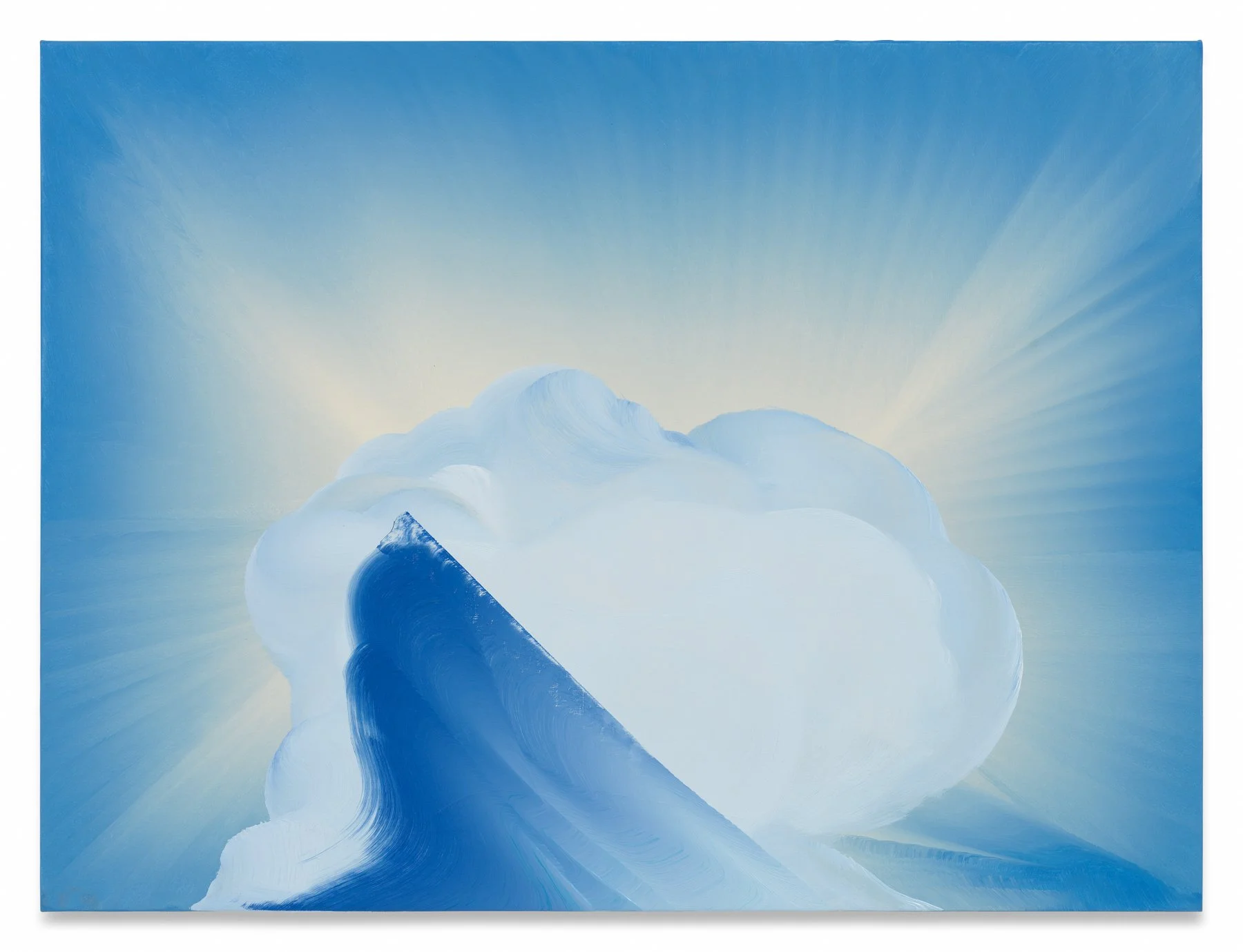
Elliott Green, Buoyancy, 2026, oil on linen, 30 × 40 inches. Photo courtesy of the artist and Miles McEnery Gallery, New York.
Buoyancy (2026) makes the relation among instrument, pigment, and support especially clear. Ground color and transparency carry a composition built almost entirely from the pressure of the tool against the surface, each pass preserving a legible record of contact. The resulting form recalls the sensation of watching a cloud overtake an airplane wing through the window, with matter and vantage merging into a single event.
Albert Pinkham Ryder offers a precedent for light functioning as both image and object. His raised moons, wave crests, and marine highlights represent illumination while catching actual light. Green’s clouds and mountains similarly behave as repeatable, individuated forms belonging to a larger pictorial grammar. In Gary Brewer’s catalogue essay for Lost Horizon, Green describes his clouds as having “an individual quality,” like animated characters, and as forms that came to him through dreams.
Turner may be the more obvious comparison for matter dissolving into weather—for cloud, mountain, steam, sea, and light trading identities—but Turner’s storms carry narrative pressure: danger, catastrophe, technological sublimity. Green’s uncertainty is gentler. It produces a suspended world in which instability can be sustained without crisis. Green’s paintings answer to a world in which identity does not have to be fixed to be trusted, and solitude does not have to curdle into isolation. The absence of figures is crucial. No painted person possesses these landscapes in advance or tells us how to interpret them. Nothing mediates the relation between the viewer and the forms before us. We experience ourselves as singular, looking outward at other singular things that are then revealed to be, like ourselves, multiplicitous. Clouds, mountains, currents, and bodies of light remain separate enough to be admired. Their individuation reflects our own, yet their correspondences prevent the world from feeling dismembered. The paintings make solitude feel like a form of relation.
Every dragged ridge, broken edge, deposit, and interval of opacity records bodily action: evidence that someone touched matter and transformed it. Rubin distinguishes between possessing the world through representational mastery and drawing manual gestures from oneself that “testify to empathy with and immersion in the world.” Green’s marks enact that distinction. They preserve pressure, drag, interruption, and contact within the finished surface, turning contact into atmosphere, mountain, cloud, water, and light.
Green’s paintings also invite the language of devotional looking without becoming religious images. Devotional art historically organized attention through reserved color, reflective grounds, rayed light, repeated motifs, and compositions that taught the eye to wait. Such structures can persist after their theological objects have disappeared. The luminosity already present in Green’s raised whites and blue-violet fields recalls the devotional use of highly valued pigments, in which chromatic intensity marked what exceeded ordinary description. What remains is a devotional structure without a devotional figure: reflective ground without gold, radiance without saint, luminous blue without the Virgin it once clothed. Green asks the viewer to remain until perception itself becomes altered. The revelation is not doctrinal. It is the recovery of confidence that sustained looking can still disclose an intelligible world.
Rubin ends Manet’s Silence and the Poetics of Bouquets by describing Manet’s paintings as “magic mirrors” that do more than reflect. Green’s paintings likewise do more than return the visible world to us. They return us to the visible world, producing the unease of uncertain recognition alongside confidence that perception can remain mobile without becoming incoherent. This is the deeper meaning of belonging in Lost Horizon. Elliott Green’s painting recovers realism not by describing the world more completely, but by refusing to allow description to become complete. His paintings leave the viewer alone with a world that cannot be possessed, yet can still be entered—a world that remains separate from us and nevertheless permits us to dwell within it.