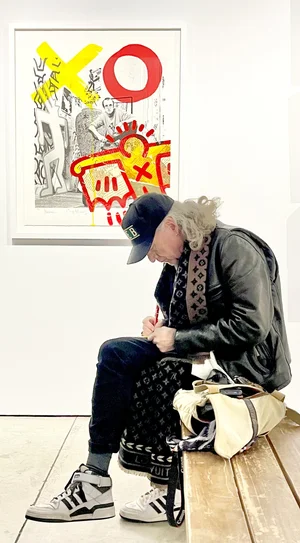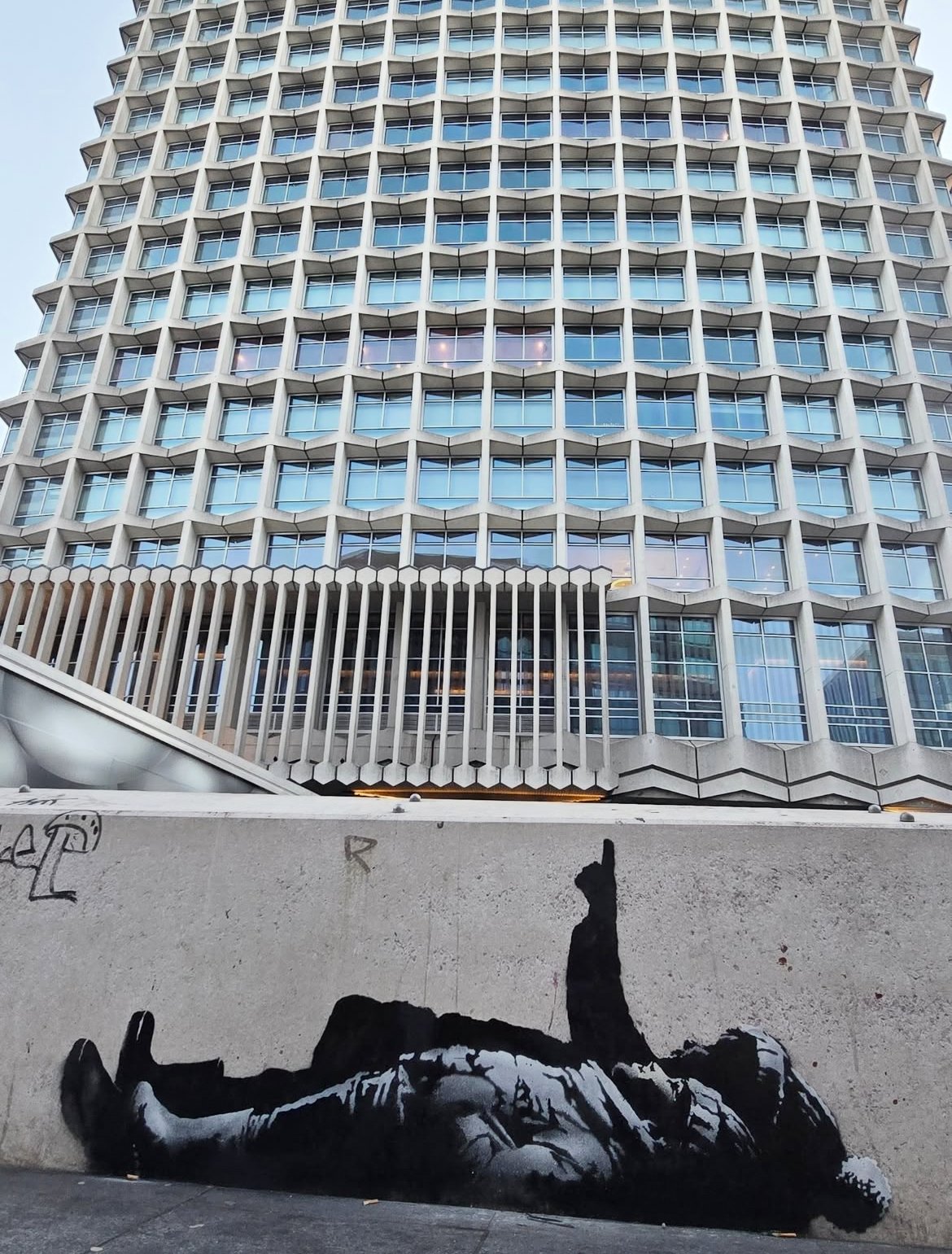
Photo @marrosi
UPDATE: Bansky confirmed on Instagram that this latest intervention is indeed his work.
Two children lie flat on cold London pavement, bundled against winter in woolly hats and oversized wellies, pointing skyward. The mural appeared this December on a wall near Centre Point, the infamous skyscraper that sat empty for a decade while people slept rough on surrounding streets. From one angle, the children appear to be stargazing. From another, their outstretched fingers point directly at the brutalist tower looming above—the building that gave its name to Centrepoint, the youth homelessness charity founded in 1969.
Banksy hasn't confirmed the piece on Instagram yet, but the placement speaks volumes. In Britain today, one young person becomes homeless every four minutes. An estimated 4.5 million children—31 percent of the total—live in poverty. The mural's children aren't romanticized figures but participants in an urban economy where inequality has become structural wallpaper. Their gesture of looking up is quietly political: Are they playing childhood games, guessing shapes in clouds? Or does their pointing finger direct our gaze toward Centre Point itself, now converted to luxury apartments while the homelessness crisis has only deepened?
If confirmed, the piece would mark another entry in the street art legend's nearly two-decade practice of using Christmas as a deadline for highlighting uncomfortable truths. For nearly two decades, Banksy has used the holiday season to stage interventions aimed at highlighting injustice in the face of the retail sentimentality machine. His Christmas work functions less as celebration and more as tactical disruption—moments when collective attention is trained on nativity scenes and flying reindeer, he inserts images that refuse to comfort. Here are a few standout works from recent years:
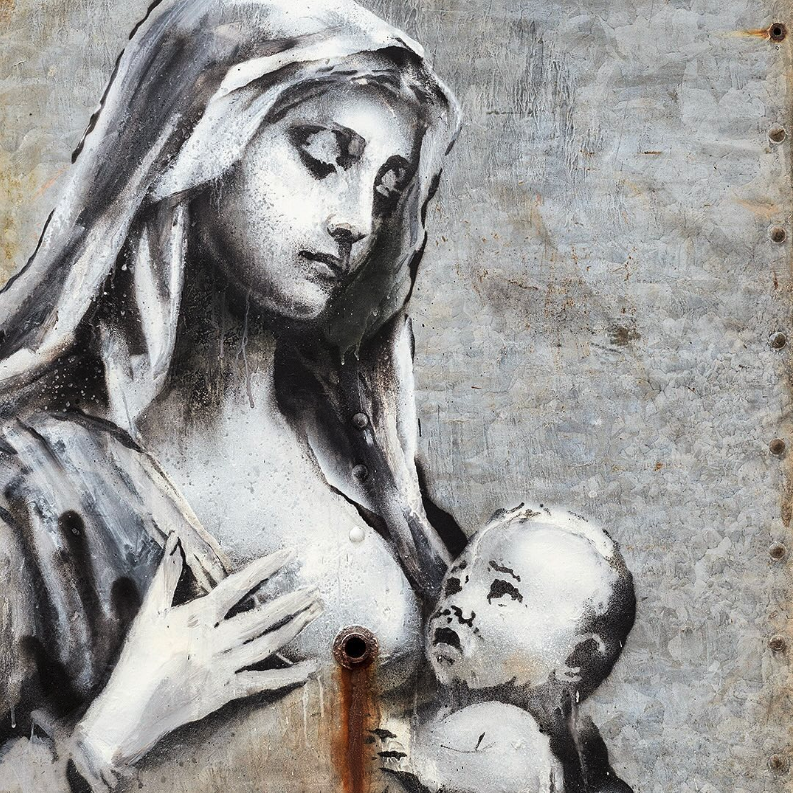
Breastfeeding Madonna, (2024): A plea for Gaza
In December, 2024, Banksy confirmed his creation of a mural showing a breastfeeding Madonna, her face veiled, the infant Christ looking up in distress. Where Renaissance masters painted nipples, Banksy placed a rusted hole in the metal surface itself, industrial decay bleeding into sacred iconography.
One week before Christmas, during escalating violence in Gaza, the image triggered immediate associations with Bethlehem, where Christ was born and where Palestinian mothers now navigate checkpoints and concrete barriers. Social media exploded with interpretations linking the rusty wound to bullet holes, to poisoned milk, to the corroded promise of sanctuary. Banksy said nothing, letting the silence speak.
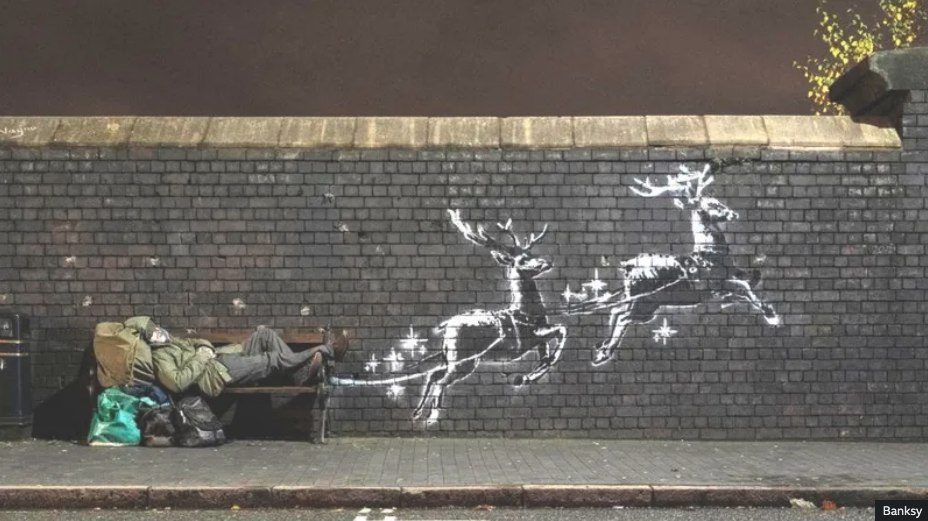
The Birmingham Reindeer (2019): Homelessness as Spectacle
The most direct hit came in December 2019 when two spray-painted reindeer appeared on a wall in Birmingham's Jewellery Quarter, seemingly tethered to a park bench. Banksy filmed a man named Ryan settling onto that bench for the night, his possessions piled beside him like Santa's bag of gifts. Pull back the camera and the illusion materializes: Ryan becomes Father Christmas, the bench a sleigh, the reindeer lifting him into the sky.
Banksy's caption praised Birmingham: during the 20 minutes of filming, passersby brought Ryan hot drinks, chocolate bars, a lighter—all unsolicited. The piece operated on Birmingham's brutal statistics: 1 in 73 residents experiencing homelessness in a city of 1.1 million. Nationally, Shelter reported 320,000 homeless across Britain, 135,000 of them children.
The mural didn't last long in pristine condition. Someone added red noses to the reindeer within days. The artwork was later sold to raise funds for homeless charities including The Wild Goose and Feed the Homeless Bristol, with Banksy creating accompanying merchandise.
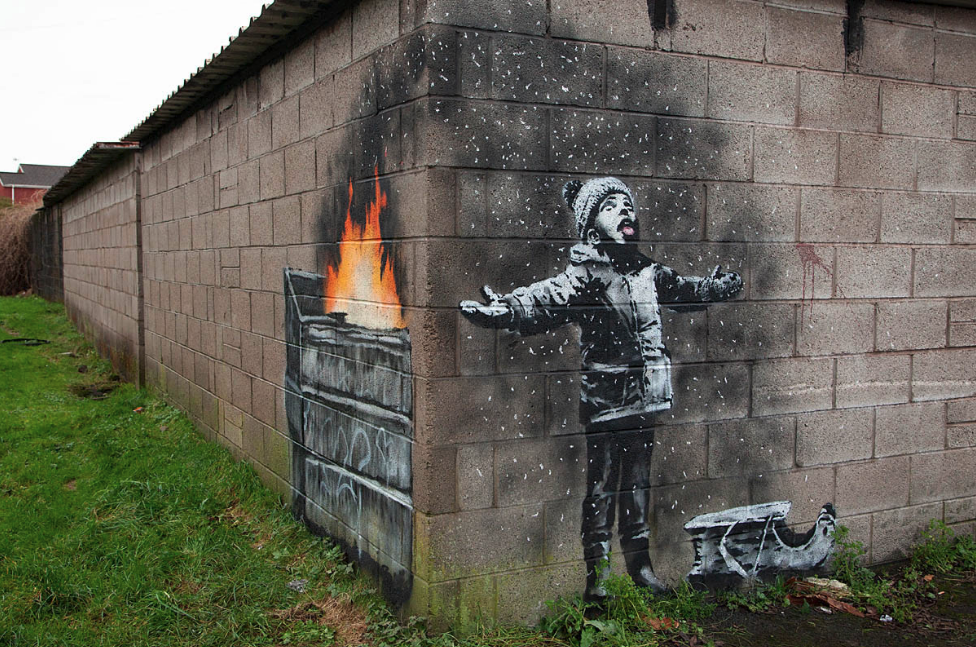
Season's Greetings (2018): Environmental Violence in Port Talbot
A year earlier, Banksy wrapped a garage corner in Port Talbot, Wales, transforming architectural geometry into narrative horror. On one wall: a child in winter clothes, tongue out to catch snowflakes, sleigh ready nearby. Turn the corner: a dumpster fire spewing ash and smoke directly at the kid. The "snow" was industrial fallout.
Port Talbot carried the designation as Britain's most polluted town, home to the UK's largest steel plant. That summer, black dust from the works had blanketed cars, houses, pets. Residents reported respiratory issues. Banksy's placement was surgical: the mural sat between the blast furnaces and the M4 motorway, yards from where Richard Burton grew up, with the steelworks visible in the background.
The piece appeared December 19, 2018, on steelworker Ian Lewis's garage. Lewis later published a book about the experience, describing how instant fame corroded into stress, security concerns, and eventually sale to gallery owner John Brandler. The mural left Wales in 2022 after vandalism attempts, destined for touring exhibitions. Its removal sparked local protests—the only Banksy in Wales, gone.
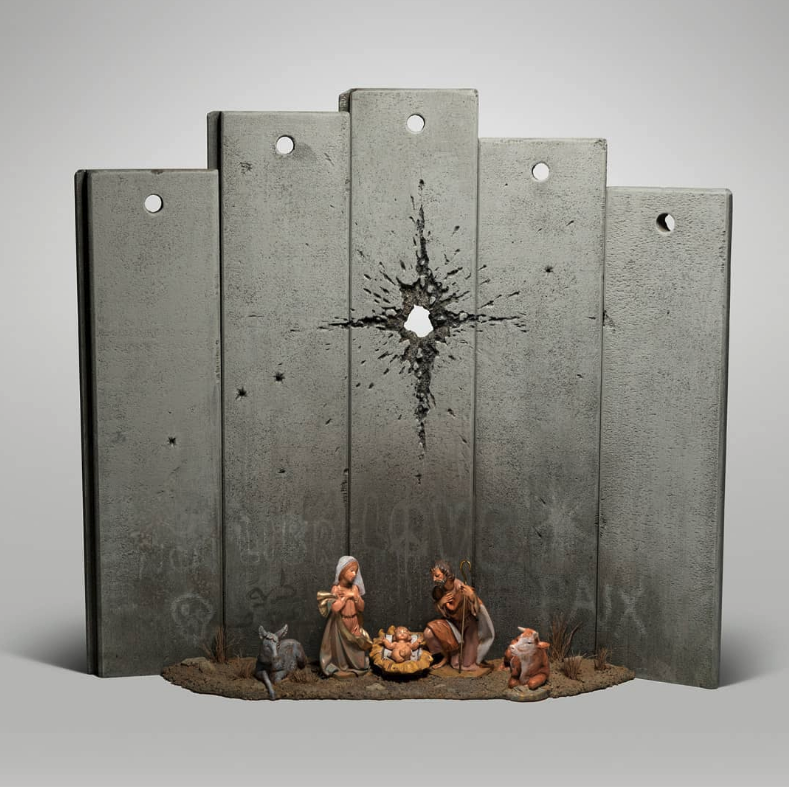
Scar of Bethlehem (2019): The Wall as Star
December 2019 brought a pair of works. While Birmingham got flying reindeer, Bethlehem received Banksy's most direct Christmas statement. Inside his Walled Off Hotel—the establishment with "the worst view in the world," overlooking Israel's separation barrier—appeared Scar of Bethlehem: Mary, Joseph, and infant Jesus arranged before a miniature concrete wall. The Star of Bethlehem manifested as an explosion-shaped hole, pockmarks radiating outward like shrapnel damage. Graffiti on the wall read "Love" and "Paix."
The installation joined Banksy's ongoing West Bank interventions dating to 2005, when he painted nine images along the barrier including a girl lifted by balloons and a window opening onto peaceful mountains. The Walled Off Hotel, opened in 2017, functions as permanent institutional critique—a boutique hotel that weaponizes tourism against normalization.
Across these works, patterns emerge beyond political messaging:
Perspectival manipulation: Banksy consistently uses architectural corners and physical objects to create visual tricks. The Birmingham bench becomes a sleigh only when viewed from specific angles. The Port Talbot garage requires viewers to physically turn a corner, transforming innocent snow into industrial poison. The Scar of Bethlehem uses real bullet-hole damage in concrete to replace celestial light. These aren't murals that can be photographed from one position—they demand movement, forcing viewers to construct meaning through spatial navigation.
Institutional co-option as strategy: Unlike earlier street artists who resisted commodification, Banksy deliberately leverages commercial mechanisms. The Birmingham mural generated merchandise funding homeless services. Season's Greetings was sold for preservation. The Walled Off Hotel functions as self-sustaining propaganda, generating revenue while maintaining ideological position. The December 2024 Madonna piece was reportedly sold privately in February before its Instagram reveal, suggesting Banksy now treats holiday posts as seasonal marketing moments detached from physical location.
Sacred iconography as entry point: By appropriating Christmas imagery—Santa's reindeer, children playing in snow, nativity scenes, the Madonna and Child—Banksy accesses cultural vocabulary with universal recognition. These aren't obscure political cartoons requiring expertise to decode. Everyone knows what reindeer mean in December, what the Star of Bethlehem represents. The disruption works because the foundation is so stable. Renaissance Madonna paintings establish tender maternal bonds; Banksy's rusted breast wound activates because it violates that expectation.
Timing as content: The seasonal clustering isn't incidental. December brings heightened consumerism, charitable impulses, and religious observance into compressed weeks. Banksy's interventions land when attention is already focused on giving, homelessness appeals, and sacred narratives. The work doesn't fight for mindshare—it hijacks existing cultural momentum.
Documentation replacing permanence: Most Banksy Christmas works don't survive intact. The Birmingham reindeer were defaced. Season's Greetings left Wales. The Madonna's location remains unconfirmed. Yet their circulation through Instagram, news media, and commentary ensures broader reach than physical preservation could achieve. The work lives in screenshots and think pieces, not protected by Perspex.
Ambiguity as productive force: Banksy's refusal to explain generates interpretive labor. The Madonna's rusted wound becomes bullet hole, poisoned milk, environmental contamination, maternal suffering—all simultaneously valid. This interpretive openness allows the work to accumulate meanings across contexts without losing coherence. It's strategic vagueness that weaponizes viewer projection.
What distinguishes Banksy's holiday interventions from typical activist art is their refusal to offer explanation. The Birmingham piece doesn't lecture about housing policy. Port Talbot doesn't include charts about air quality. The Scar of Bethlehem doesn't explain the separation barrier's history. Instead, they function as disruptions in the holiday's semantic field, introducing cognitive dissonance that forces viewers to reconcile Santa's reindeer with sleeping rough, Christmas snow with industrial ash, the holy family with concrete walls.
The works operate less as arguments and more as contaminations—images that can't be unseen once processed. After encountering the Birmingham reindeer, it becomes harder to see rough sleepers on benches without that visual echo. Port Talbot's burning dumpster reframes every "let it snow" greeting. Scar of Bethlehem makes it impossible to see nativity scenes without considering geography, occupation, barriers.
The consistent move across all these works is Banksy's exploitation of Christmas's emotional architecture. The holiday's power derives from its promise of warmth, family, giving, light in darkness, hope renewed. These murals function as parasite images, using that emotional infrastructure to transmit countervailing messages. They don't reject Christmas so much as redirect its affective circuitry toward discomfort.
The question isn't whether these works change anything. It's whether art that achieves cultural permanence through strategic ambiguity, commercial savvy, and perfect timing deserves recognition as a new form of public sculpture—one measured not in bronze longevity but in viral circulation, not in museum preservation but in annual algorithmic resurrection.
Banksy keeps showing up each December with another image we can't quite forget. That might be the most subversive gift of all: memories that contaminate future holidays, making it impossible to see reindeer, snow, or nativity scenes without those rusted holes showing through.