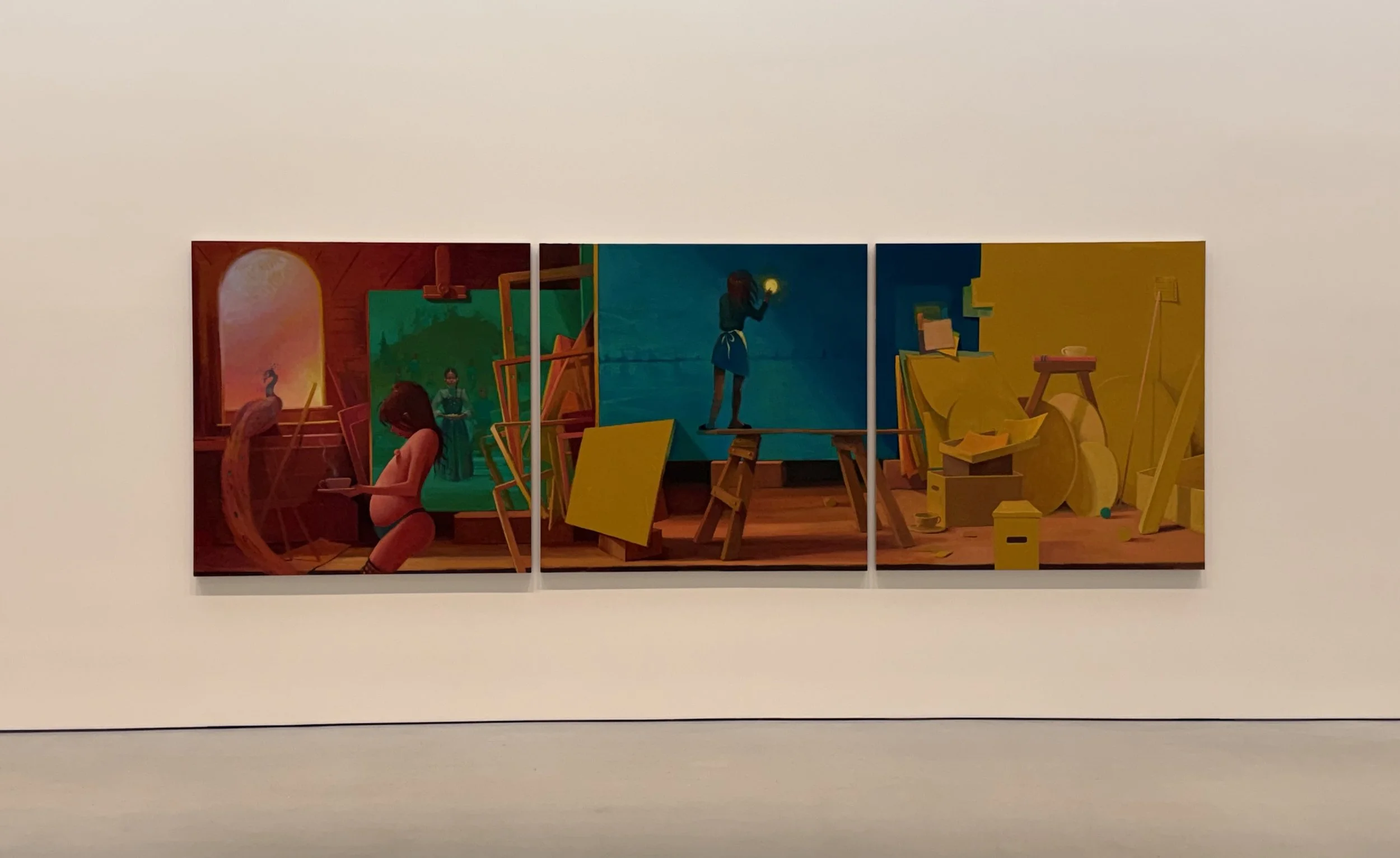
Lisa Yuskavage Endless Studio (portal), 2025. Photo by J. Scott Orr
A peacock stands just inside an arched opening, its tail feathers spilling toward the floor in a vainglorious display of its own effortless beauty. In front of it, a young female wearing blue panties gazes downward toward the steaming cup of coffee she seems to be delivering. Deeper in the room, another woman, fully dressed, raises a point of light to a mural while standing precariously on a rig of wobbly saw horses. Even deeper in, there's a painting on an easel depicting what looks like a tradwife looking on while holding a plate of lemons.
Like so much of the work of Brooklyn artist Lisa Yuskavage, this one, Endless Studio (Portal) (2025) offers an examination of distinct registers of the female condition: beauty, work, strength, poise, doubt, risk and shame. The painting flows into and out of incompatible allusions: the peacock's vanity, the tradwife's simple servitude, the artist's risky lighted intervention, and the ruminations of the young nude, who is rendered with the fleshy luminosity that made Yuskavage one of the most provocative figurative painters of her generation.
The monumental painting anchors Lisa Yuskavage's latest exhibition at David Zwirner, her tenth solo show with the gallery. Her trademarks are well represented here: the young females, nude and clothed; the soft color palette; the unapologetic use of sfumato; and, significantly, studios rendered surreal by untethered mises-en-scène. Endless Studio (Portal) is more than 15 feet wide and five feet high. Executed in three pieces in 2025, it is based on a 2024 Endless Studio painting that is one-fifth its size and is also included here.
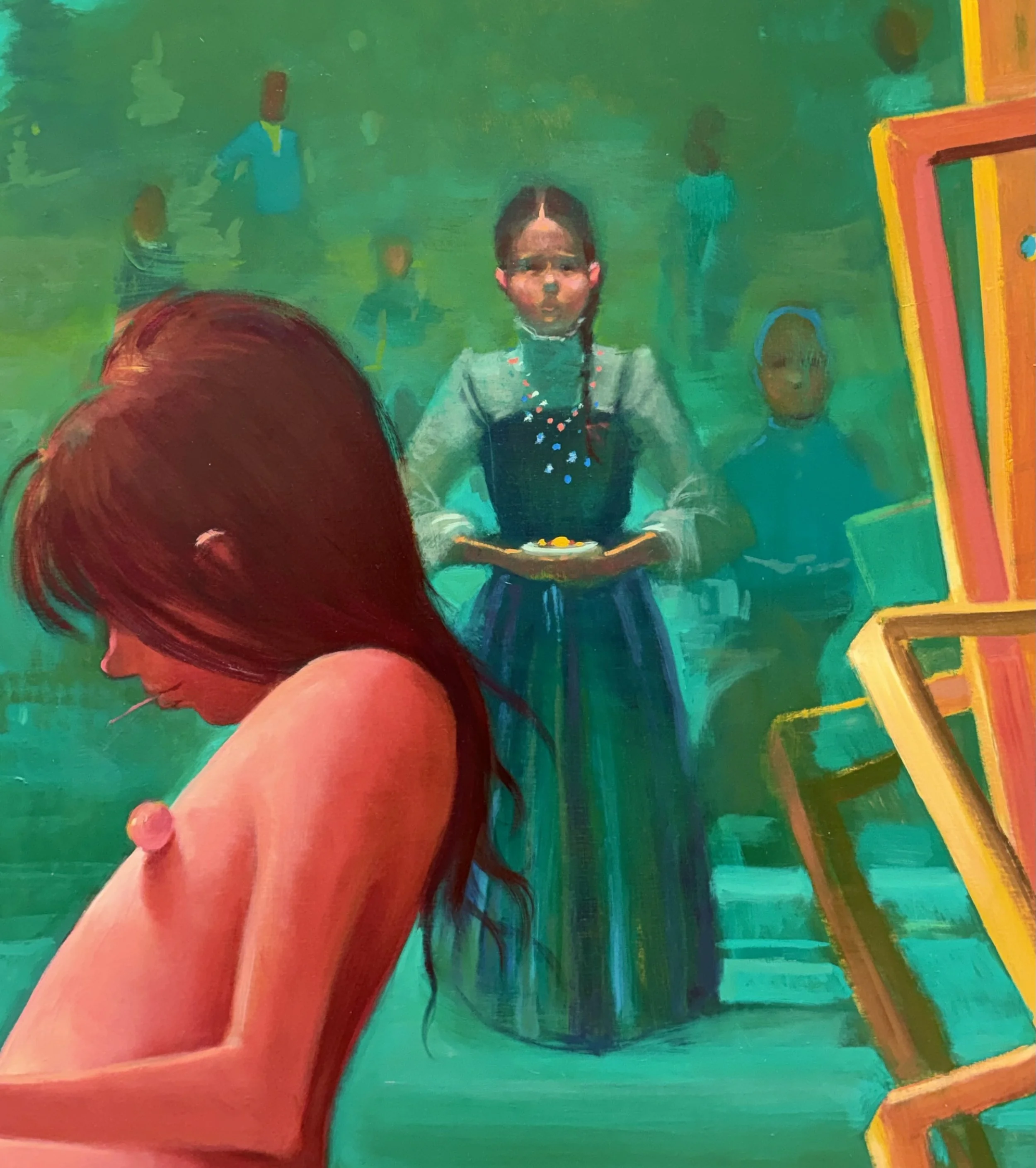
A detail of the tradwife, with the young female in the foreground, from Endless Studio (portal). Photo by J. Scott Orr
Endless Studio could very well have been the title of the Zwirner Show since most of the paintings depict studio scenes, with artists painting, or thinking about painting, or pausing in rapt consideration of works-in-progress.
In Night Classes in Color Theory, Lesson One: Green VI (2026), for example, Yuskavage includes a self-portrait, depicting herself from behind looking up at a monumental black-and-white rendering of one of her signature hypersexualized female nudes, as if confronting a figure she has spent deces inventing and revising. Bathed in shades of green, the painting is a reckoning between artist and subject, a window into the artist's self-scrutiny.
In Self Portrait: Red Yellow Blue (2025), Yuskavage places a monumental portrait of her own pale, masklike face inside the studio, where a smaller figure of the artist crouches before it as if studying her own likeness. Around them, her familiar cast of eroticized female figures and stacked panels turns the painting into a meditation on how the artist has constructed—and been shaped by—the women she has painted for decades.

Lisa Yuskavage Night Classes in Color Theory, Lesson One/ Green VI, 2026. Photo courtesy David Zwirner
For much of her career, Yuskavage built her reputation on paintings of voluptuous young women—nudes with exaggerated proportions, flushed skin, and expressions that shifted between invitation and indifference. When those pictures first appeared in the 1990s, they provoked a now-familiar debate: were they critiques of the male gaze, or glamorous capitulations to it? The answer was way more complicated. Yuskavage painted these women with the technical seriousness once reserved for saints and aristocrats, using lush glazes and carefully modulated light to elevate subjects that seemed deliberately gauche.
Yuskavage addressed the issue in an interview with the New York Times' T Magazine last year. "I was a young female. I wanted to paint young females. And I was being told that that was the wrong thing to do, that I was never going to have a career if I did that. And I felt like, 'This can't be wrong, because doing this is making me feel elated.' I was willing to take the hit of being an unsuccessful person to make paintings that made me feel alive," she told Times writer M.H. Miller.
Color does much of the heavy lifting in Yuskavage's work. In Endless Studio, one wall burns with a saturated yellow, elsewhere, mauves, greens, and pinks compete for attention. The gallery describes color as a "character," and in these paintings, that description is less like marketing spin and more like a straightforward account of what happens. Color interrupts, conceals, and reorganizes the scene. It pushes figures forward, then absorbs them back into the surface.
Yuskavage also delights in destabilizing the space she so carefully builds. An illusion of depth devolves into flatness. A canvas depicted within the painting appears more alive than the body standing next to it. Backgrounds become foregrounds. As your eye moves through a piece, the mere act of looking becomes a process of constant recalibration.
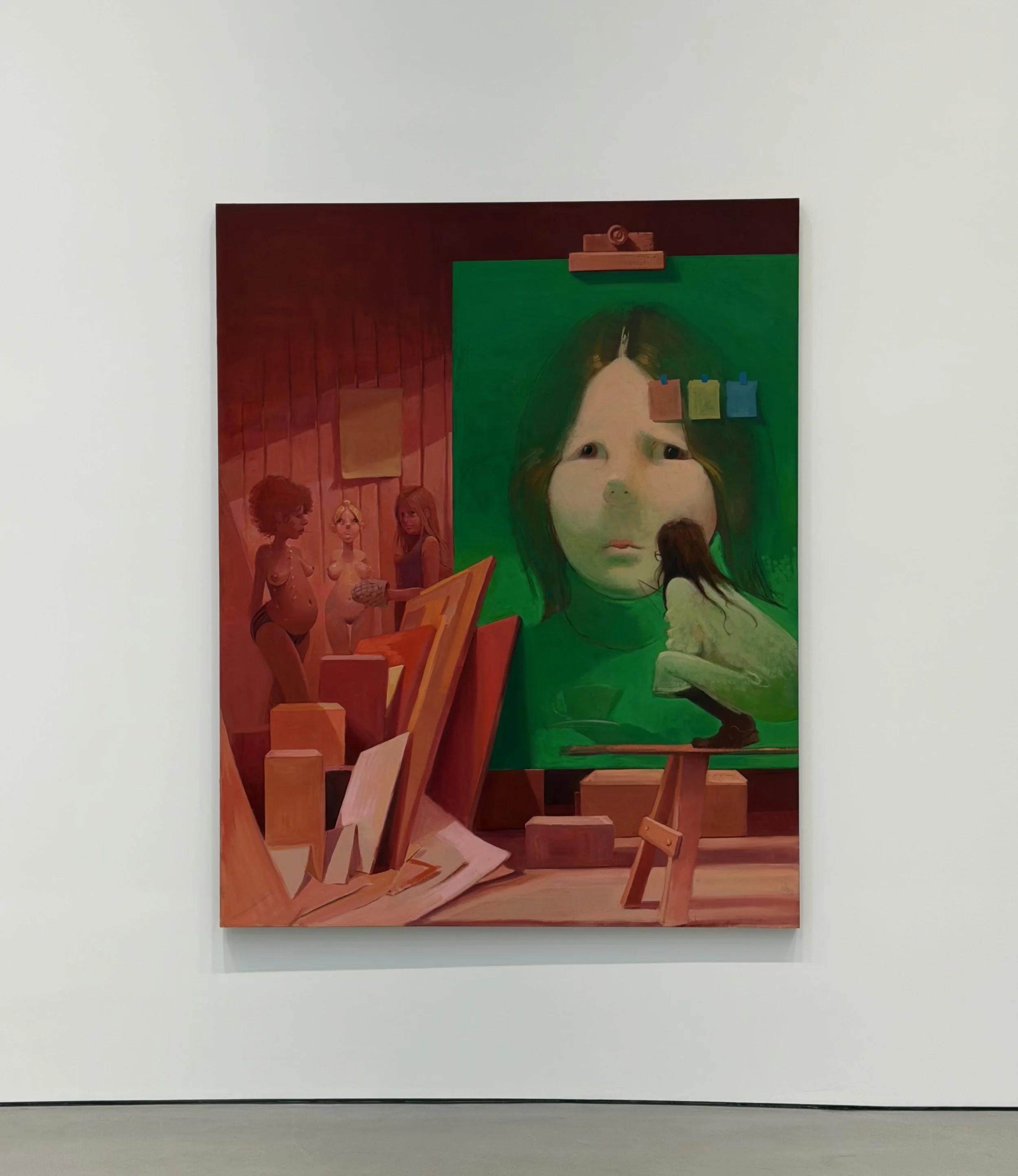
Lisa Yuskavage Self Portrait: Red Yellow Blue, 2025. Photo by J. Scott Orr
Helen Molesworth, the writer and curator, said Yuskavage's latest work "sustains a…state of constant vacillation." She went on to say they reveal "a complex history composed of personal iconography and a range of art-historical allusions—the artist as young girl, the older woman, the painter, the painted—each work functions like a wormhole, moving viewers forward and backward through time."
The exhibition follows a recent survey of Yuskavage's drawings at The Morgan Library & Museum, the first museum exhibition devoted to her works on paper, and coincides with a stunning 150-page monograph from Phaidon. Institutional recognition has finally caught up with a practice that has spent decades oscillating between provocation and formal rigor.
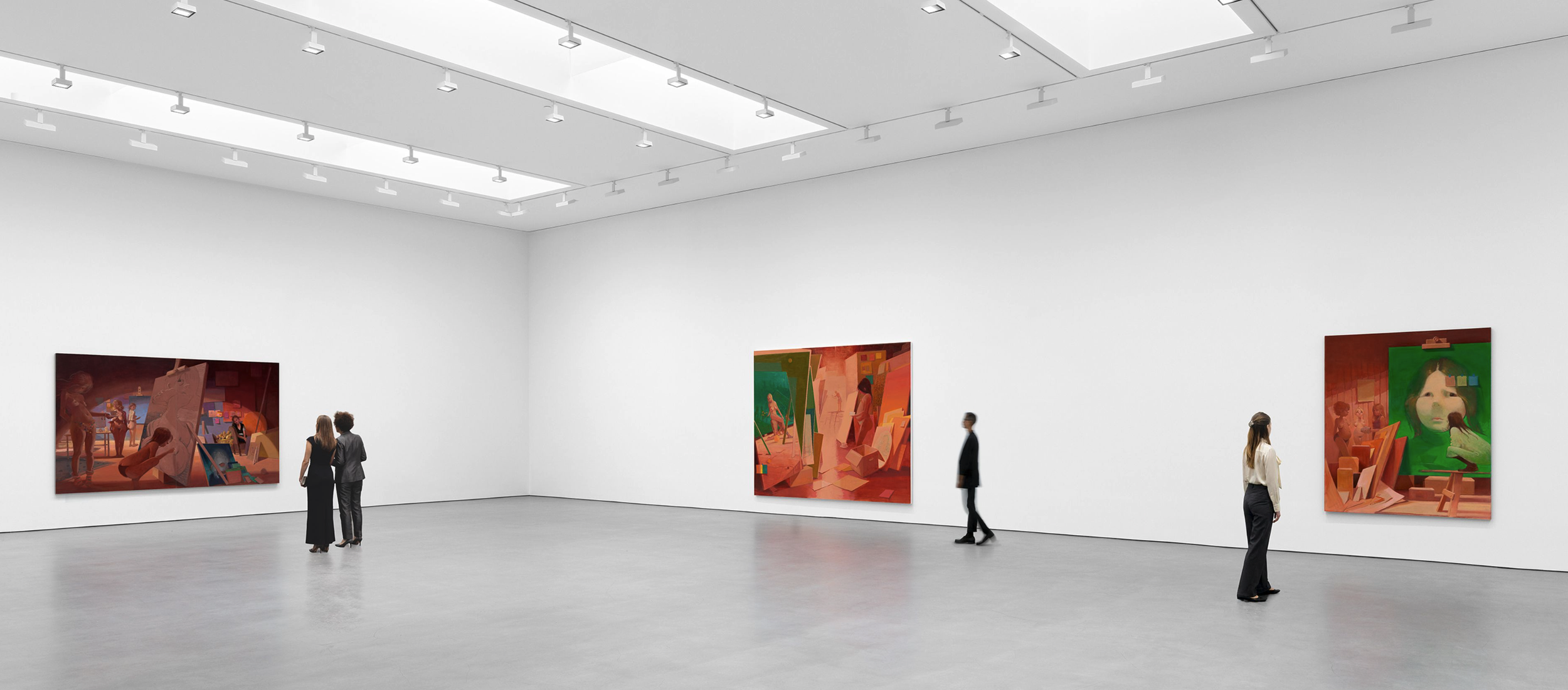
An installation view. Photo courtesy David Zwirner
Back in Endless Studio (Portal), the woman with the flashlight continues to probe the wall. The beam does not so much illuminate as mark a point of contact—a place where seeing begins and where certainty gives out. The peacock remains, decorative and absurd. The women are engaged in various representations of the feminine self. The studio holds together, barely, as a place where painting keeps reinventing itself.
Lisa Yuskavage is on view through June 26, at David Zwirner, 533 West 19th Street, Chelsea.