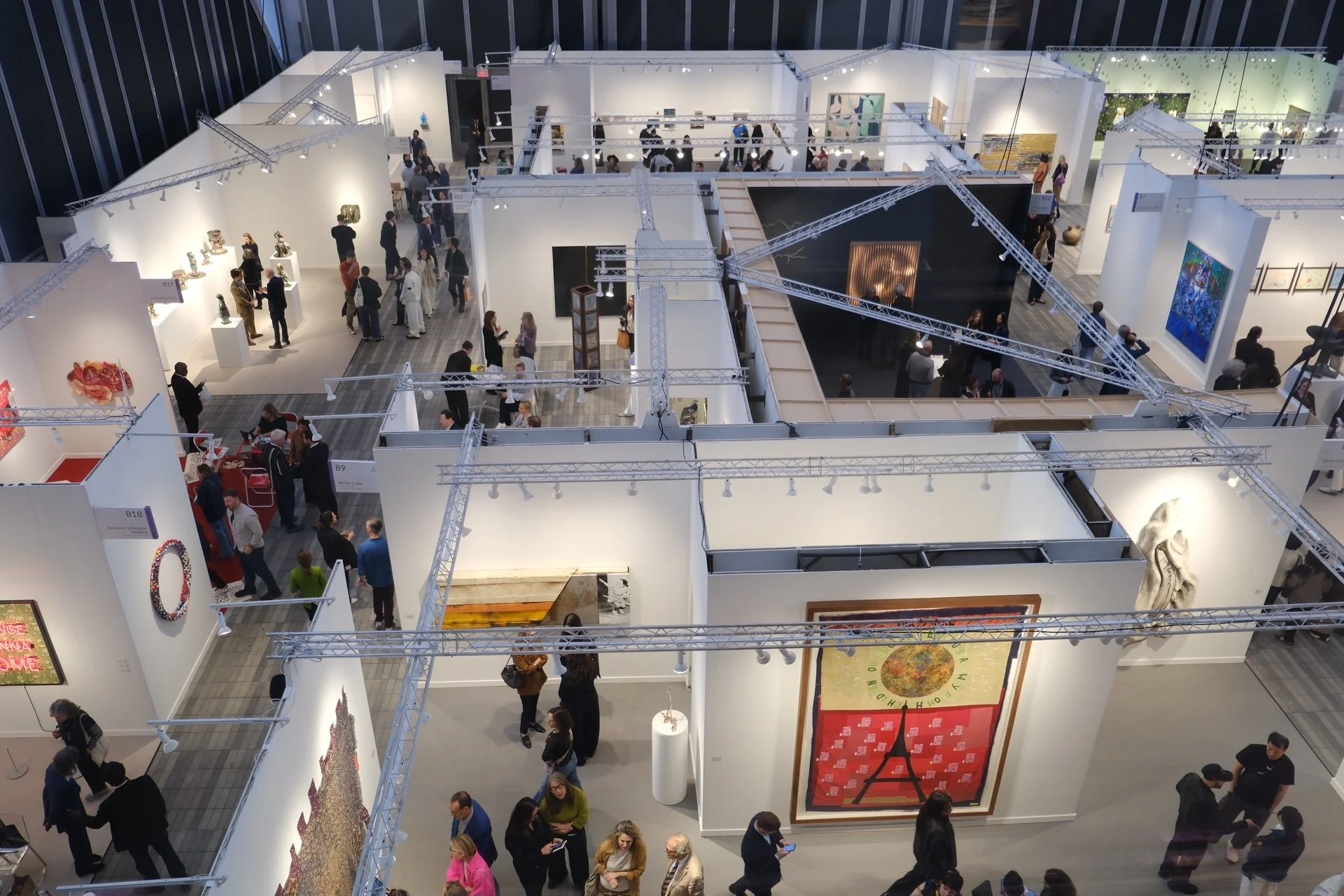
Frieze New York opened its doors at The Shed on Wednesday amid an air of optimism that, for the first time in years, seemed like more than just tired industry spin.
Sure, geopolitics cast an ugly pall over the opening of the Venice Biennale a couple of days ago and a steaming pile of uncertainty is swirling around tariffs, trade wars, and the rising cost of doing business in the art world. At the same time, though, there are signs that the art market is making halting progress toward a rebound after years of malaise.
And that’s what seemed to matter on Manhattan’s West Side yesterday, as the fair opened to VIPs in advance of its public opening Thursday. The chatter among the fashionable shoppers and sellers as escalators ferried them to The Shed’s upper floors focused almost exclusively on art and money, not on inconvenient matters like politics, economics and war.
In the art world’s global echo chamber, what happens here over the next few days matters a lot, because what happens at Frieze New York doesn’t stay at Frieze New York, it sets the stage for what will happen during the rest of 2026: at Art Basel in Basel (June), Frieze Seoul and the Armory Show in New York (September), Art Basel Paris (October), the inaugural Frieze Abu Dhabi (November) and Art Basel Miami (December).
While Frieze New York is the kick-off for this global relay race, it is followed almost immediately by another critical barometer: an extraordinary series of sales at New York auction houses that are expected to fetch more than $1 billion. Up for grabs at Sotheby's and Christie’s in the coming days are three works that alone could fetch a combined $300 million: Mark Rothko's Brown and Blacks in Reds (1957), Jackson Pollock's Number 7A (1948), and Constantin Brâncuși's gilded Danaïde (1913). Expected to gavel in the mid-eight figures: works by van Gogh, Picasso, Mondrian, Matisse, Miró, Lichtenstein, Johns, Warhol, Basquiat and others.
The 2026 Art Basel & UBS Art Market Report, meanwhile, said the global art market looks more stable than it did in 2023–24, but it is still in a recalibration phase rather than a broad boom. The report suggests a split market: lower-price and mid-market activity remained relatively resilient, high-value works regained momentum, and online-only sales fell to their lowest level since 2019 as more top-end buying moved back into in-person environments.
Henri Matisse, who painted some of his most luminous canvases while Europe descended into World War II, once said that art should be "something like a good armchair"—a place of rest and comfort away from the noise outside. With this in mind, let’s slip on a pair of willfully oblivious blinders, silence the macroeconomics and geopolitics for a bit, and focus on what actually matters in the world of art right now: the work 65 international galleries have brought to The Shed for this 15th edition of Frieze New York. Below are seven that demand your full, undivided, geopolitics-free attention.
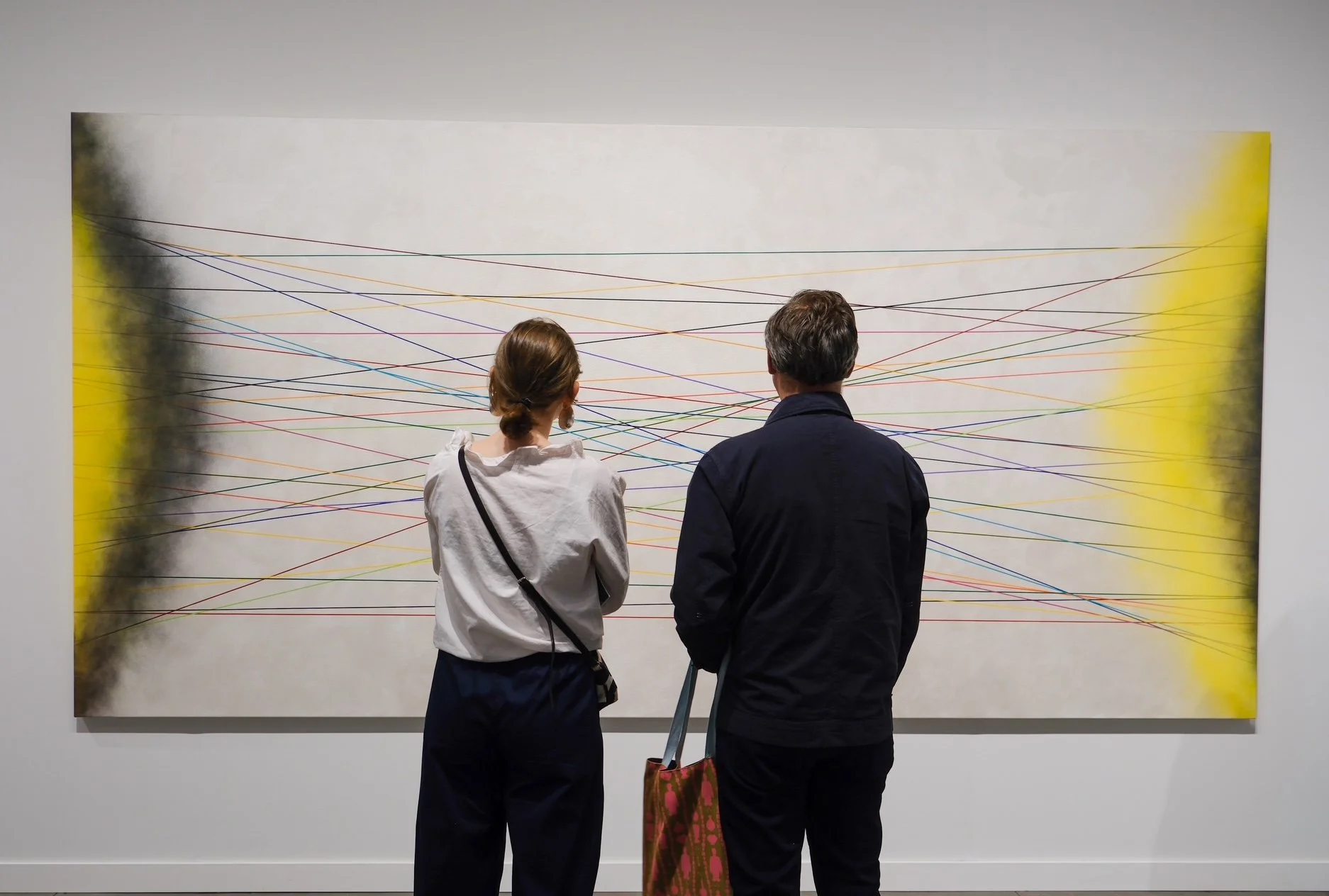
Virginia Jaramillo, Quanta, brought to Frieze by Hales Gallery, London, New York. Photo by Jamie Lubetkin
Virginia Jaramillo
Hales Gallery, London, New York
Virginia Jaramillo’s Quanta turns abstraction into a map of invisible forces. Across a luminous white field nearly 12 feet wide, thin lines in red, blue, green and yellow shoot from edge to edge, criss-crossing in open space. Smoky bands of black and yellow gather at either end, as if compressing and releasing energy across the canvas. Painted in 2021, the work takes its title from quantum mechanics, but it is less like an illustration of science than a meditation on how space might feel. Jaramillo—now 87 and living in Hampton Bays, New York—has spent seven decades refining a language of extraordinary precision. At Frieze, Hales presents a painting that is both rigorously constructed and unexpectedly lyrical—a reminder that abstraction can still feel expansive, mysterious and alive.
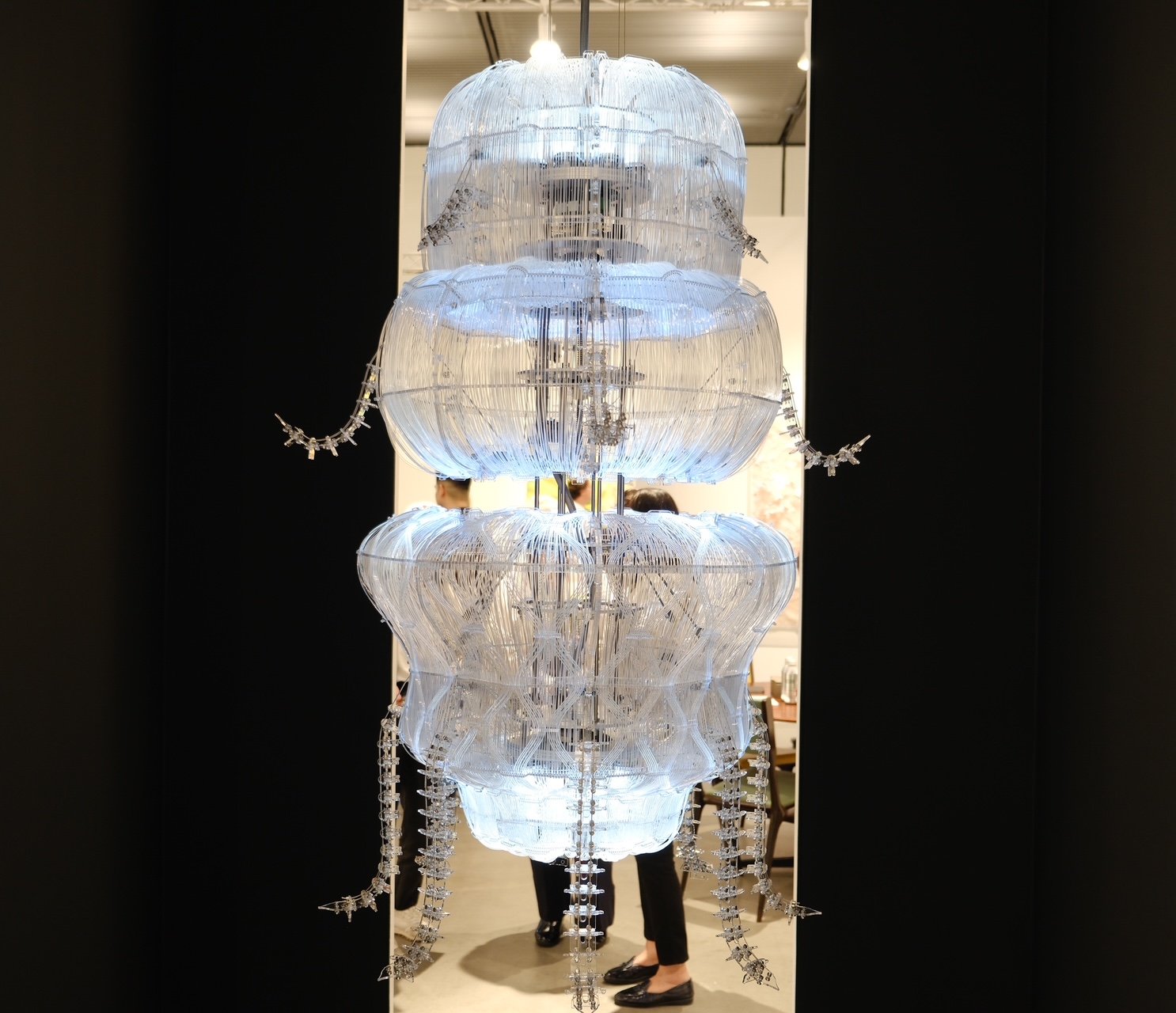
Anicka Yi, Nonseparable Parsley, 2026, brought to Frieze by Esther Schipper, Berlin, Paris, Seoul, New York. Photo by Jamie Lubetkin
Anicka Yi
Esther Schipper, Berlin, Paris, Seoul, New York
Anicka Yi’s Nonseparable Parsley hangs like a glowing organism from some crystalline future ecosystem. Built from optical fiber, LEDs, silicone and other industrial materials, the sculpture resembles a translucent jellyfish, laboratory specimen and chandelier all at once. Light pulses through its delicate filaments while internal motors set parts of the structure into slow, almost imperceptible motion. Yi has long blurred the boundaries between biology and technology, and this work feels both ancient and speculative, as if modeled on a deep-sea creature that evolved after the machine takeover. At Frieze, amid paintings and static objects, it’s a reminder of something vaguely living—fragile, eerie and quietly mesmerizing.
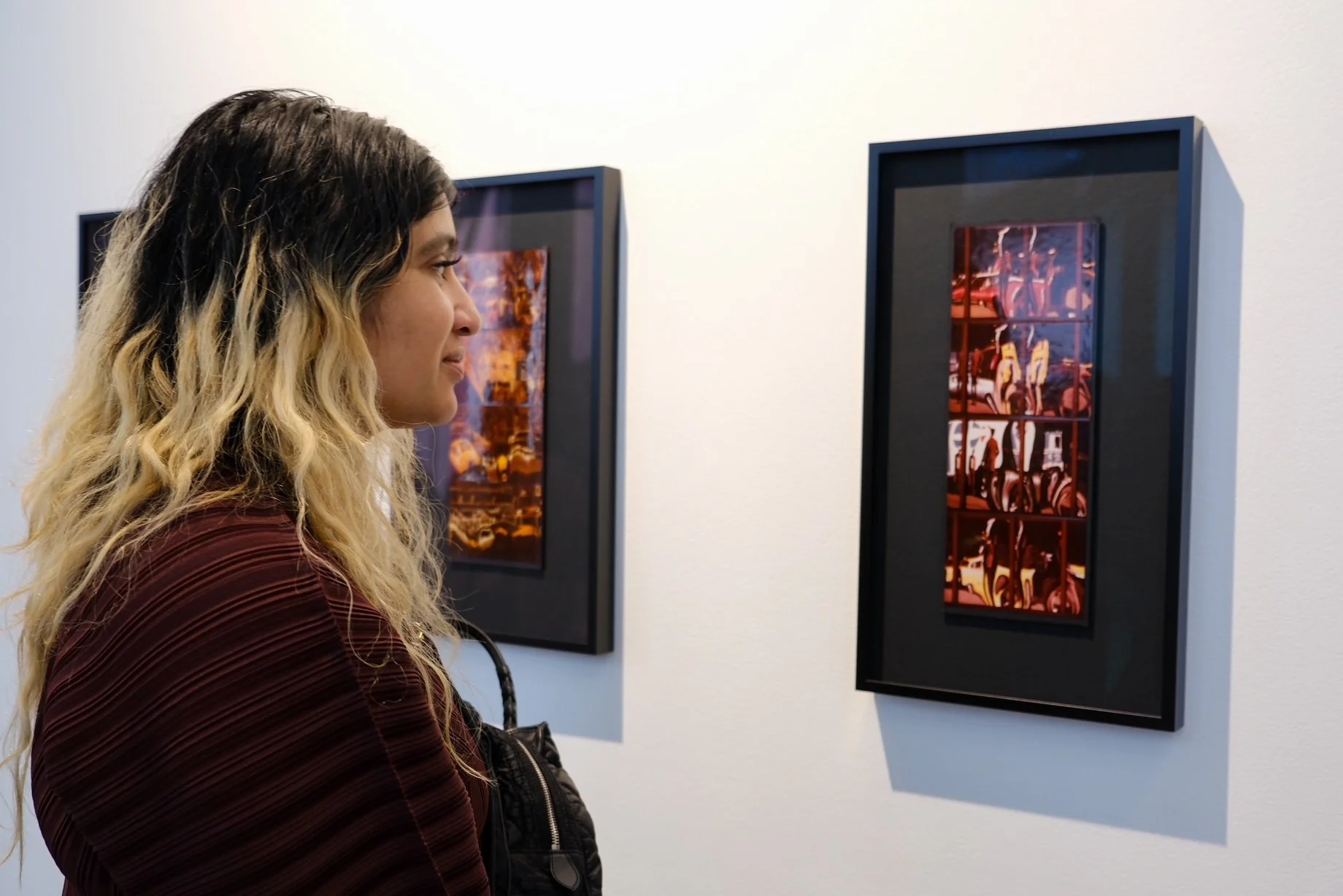
Bettina, Phenomenological New York, 1970-80s, brought to Frieze by Ulrik, New York. Photo by Jamie Lubetkin
Bettina Grossman
Bettina’s Phenomenological New York series turns the city into a warped system of reflections, distortions and unstable surfaces. She turns photos taken on New York streets into a flickering grid of blurred shapes and distorted facades, breaking the street into dozens of small photographic fragments that transform everyday motion into a study of urban perception and time. It’s easy to see why Ulrik has pushed to reposition Bettina beyond the mythology of the Chelsea Hotel bohemian scene. The work shares more DNA with conceptual photography and systems-based art of the 1970s than with the era’s downtown romanticism.
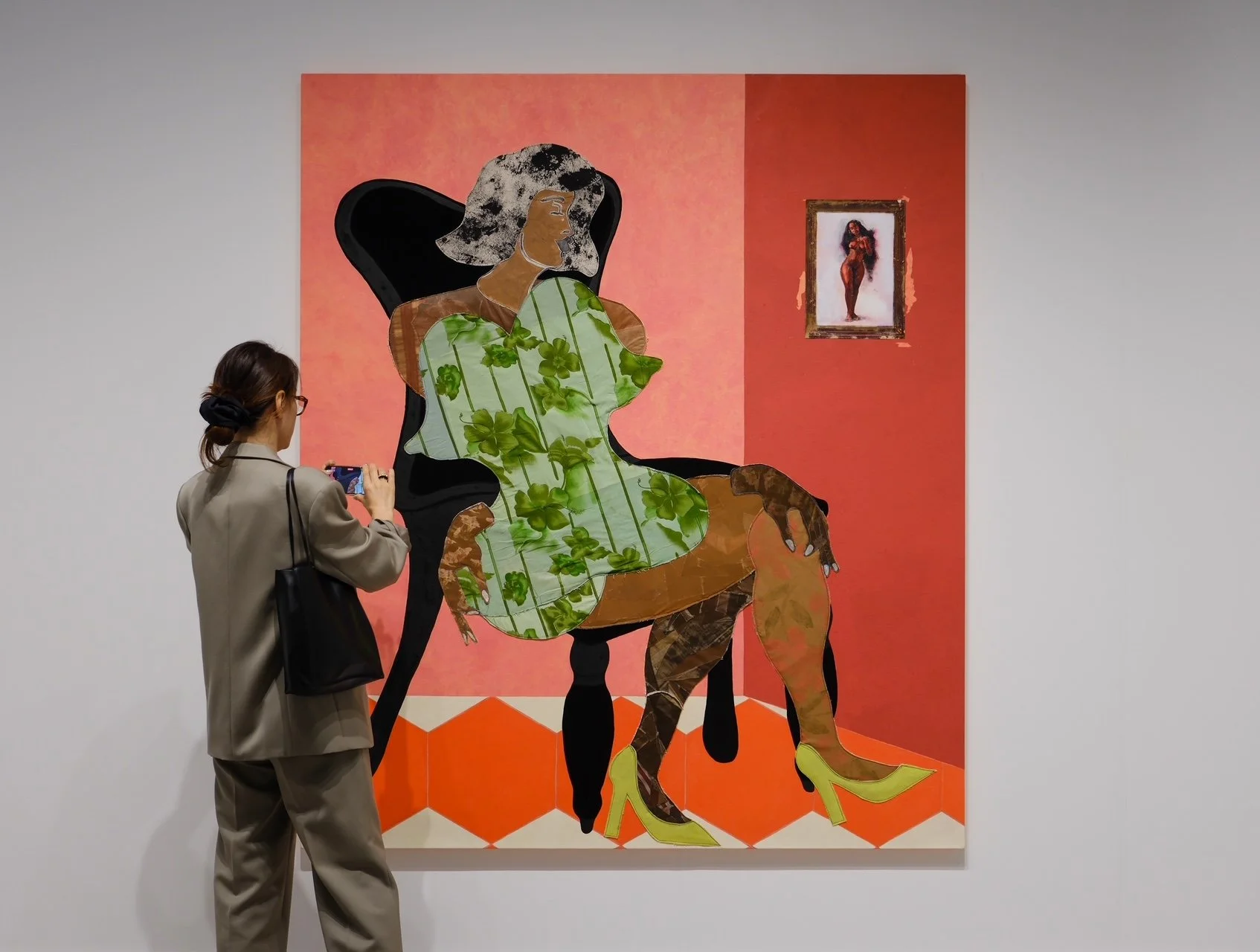
Tschabalala Self, Women in Parlor, brought to Frieze by Galerie Eva Presenhuber, Zurich. Photo by Jamie Lubetkin
Tschabalala Self
Galerie Eva Presenhuber, Zurich
Tschabalala Self builds her figures piece by piece, from fragments that struggle to resolve into a single story. In Women in Parlor, part of the Frieze presentation of Galerie Eva Presenhuber, a woman in a floral green dress reclines in a black chair, one leg crossed, yellow heels planted on a bright orange floor. Her body is assembled from painted and collaged fabrics, stitched together into a figure that is both monumental and intimate. A small painting of a standing nude hangs on the wall behind her, turning the scene into a picture about looking and being looked at. Self’s work has long challenged the stereotypes projected onto Black bodies. Here, the subject appears entirely at ease. She is not performing for the viewer; she doesn’t need to.
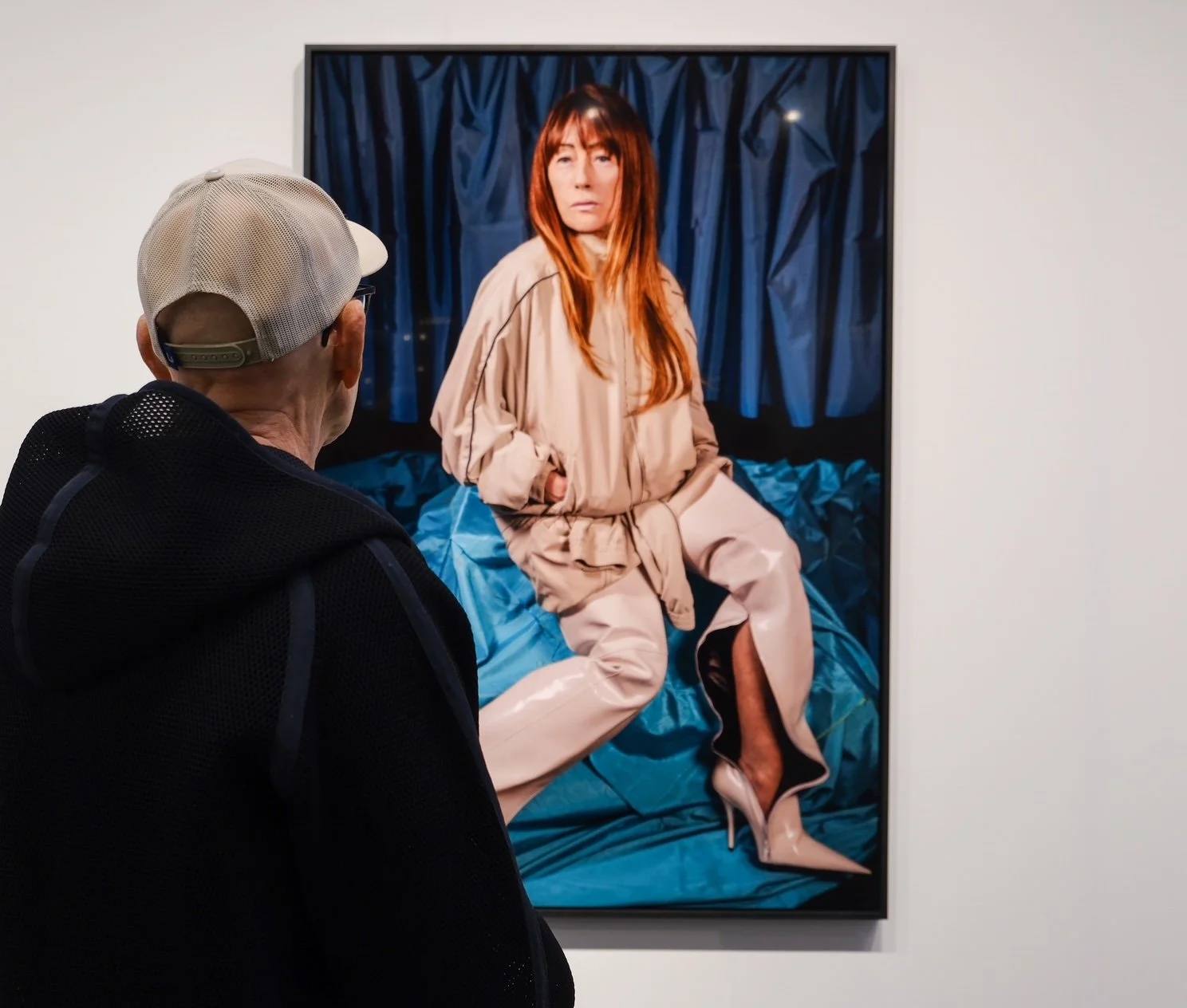
Cindy Sherman, Untitled #690 202, brought to Frieze by Hauser & Wirth, New York. Photo by Jamie Lubetkin
Cindy Sherman
Hauser & Wirth, New York
Cindy Sherman has spent four decades proving that identity is a costume, and this new large-scale print sharpens that point with unnerving precision. Seated against a field of teal fabric, Sherman appears in a beige windbreaker, glossy thigh-high boots and a copper wig, looking less like a fashion model than a figure who has slipped comfortably into her role and isn’t exactly sure how long she might stay. Created in collaboration with The Face and styled with pieces from recent runway collections, the image borrows the language of luxury photography while quietly sabotaging it. The clothes are immaculate, but the expression is blank, almost wary. In Sherman’s world, glamour is never stable; it is a mask that reveals the strain required to hold it in place.
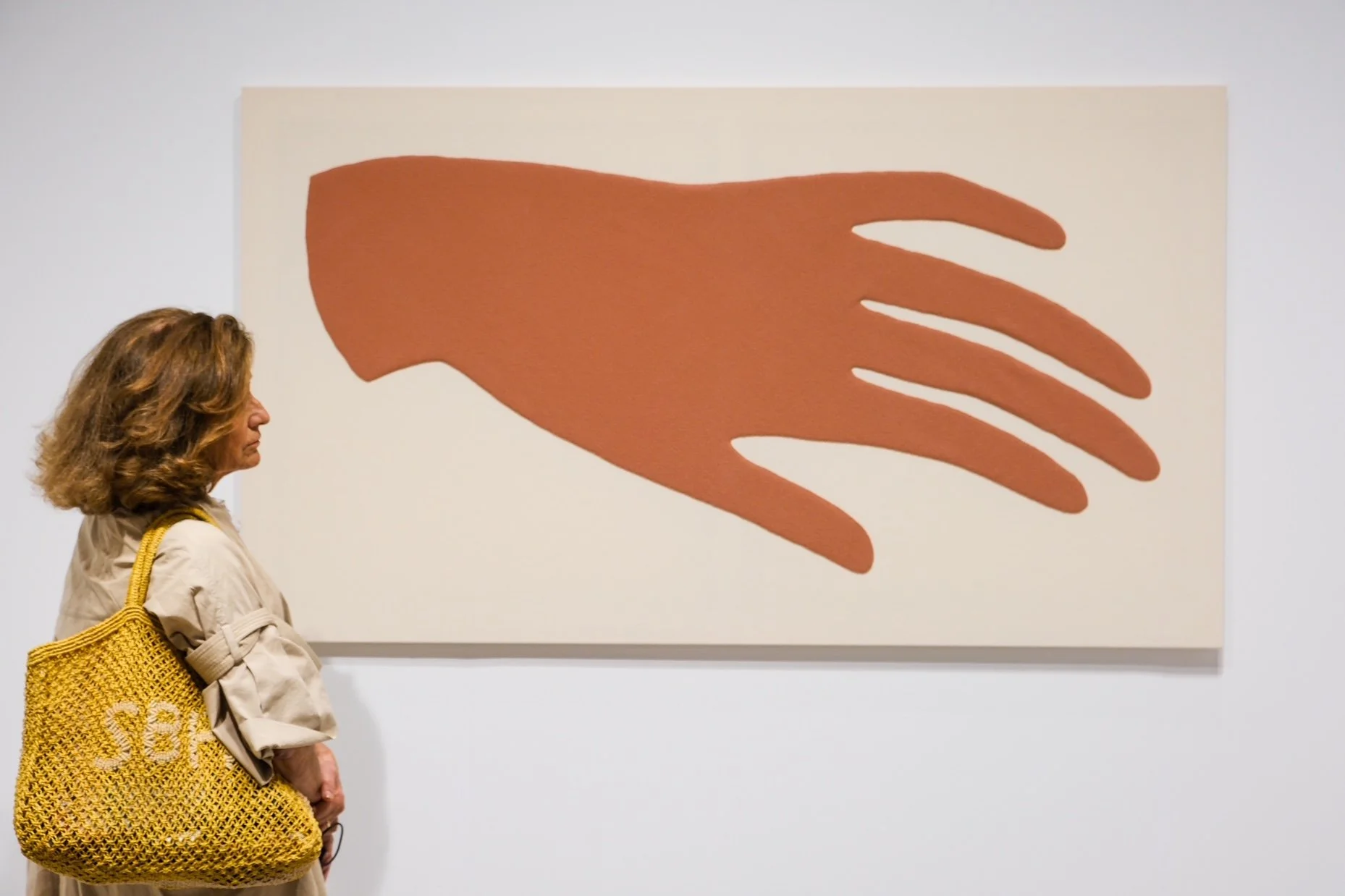
Adelaide Cioni ,The Hand of M., brought to Frieze by P420, Bologna. Photo by Jamie Lubetkin
Adelaide Cioni
P420, Bologna
In Adelaide Cioni’s The Hand of M., a pale pink silhouette stretches across a field of raw canvas, its flattened form hovering between abstraction, devotional image and textile pattern. The work began with a site-specific installation in a small Umbrian church, where Cioni isolated the hand of the Virgin Mary from a 15th-century fresco by Bernardino da Campilio. Stripped of the body, the gesture becomes a symbol of feminine agency and quiet power. Executed in stitched wool, the piece carries the softness of fabric and the directness of a cutout. At Frieze, P420 presents a work that is part modernist reduction and part meditation on the enduring force of women’s labor and presence.
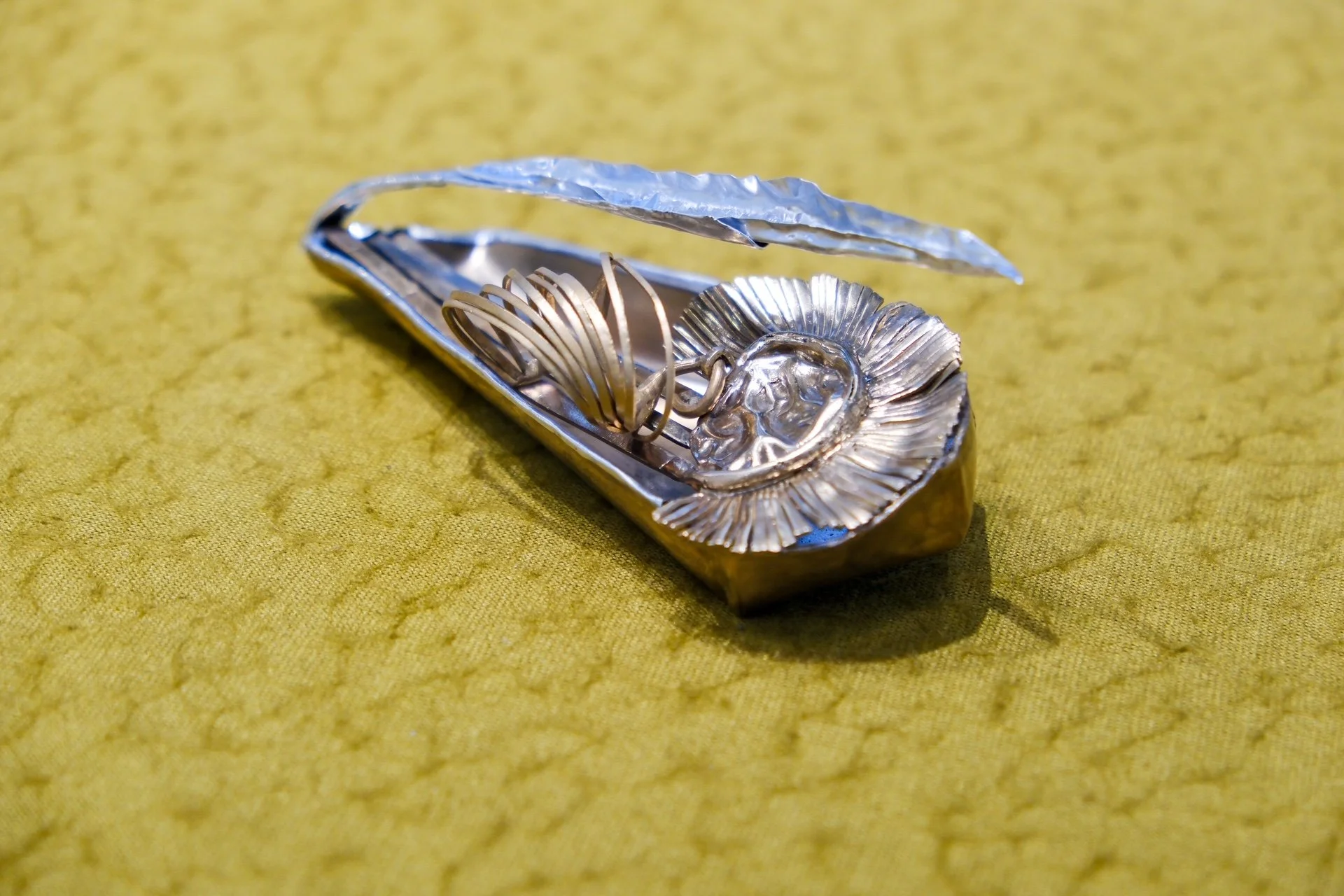
Joanne Burke, Starrchamber, brought to Frieze by Soft Opening, London. Photo by Jamie Lubetkin
Joanne Burke
Soft Opening, London
Joanne Burke’s small bronze sculptures look like artifacts from a civilization that never existed. In works such as Divers Arms and Starrchamber, fan-like fringes, folded metal planes and shell-like forms suggest boats, fish, organs and ceremonial objects all at once. Burke begins by pouring molten wax into cold water, a divination technique known as hydromancy, then translates the resulting forms into bronze and aluminum. The process leaves room for chance, but the finished objects feel uncannily precise. Brought to Frieze by Soft Opening, the body of work sits somewhere between surrealism, craft and alchemy.