The Problem with Showing Duchamp

A little boy considers Duchamp’s Fountain at MoMA. Photo by J. Scott Orr
The woman seems to be searching for an answer, her hand open, palm up as if the words she is searching for might just fall from the sky. In front of her, a child in a mustard jacket and dinosaur print slacks looks up at a porcelain urinal perched on a pedestal. What’s being asked here is unclear, but it doesn’t really matter because there is no answer to the object in front of them. This urinal, Marcel Duchamp’s Fountain sculpture, is not in itself about anything, it’s about everything that came after it.
That’s the problem with trying to stage Marcel Duchamp inside a museum, even one as expansive and self-assured as the Museum of Modern Art, or a gallery, like Gagosian’s new space on Madison Avenue. Duchamp’s stuff just doesn’t sit still. It leaks into the way artists think about making things, into how curators write wall text, into what we even let ourselves call art. This spring’s retrospective at MoMA, the first of its scale in the United States in more than 50 years, does what it can. It maps the trajectory: from early figuration—The Chess Game (1910), bodies arranged in a legible space—to the dispersal that follows, where objects, ideas, and gestures begin to substitute for one another. But mapping Duchamp isn’t the same as containing him.
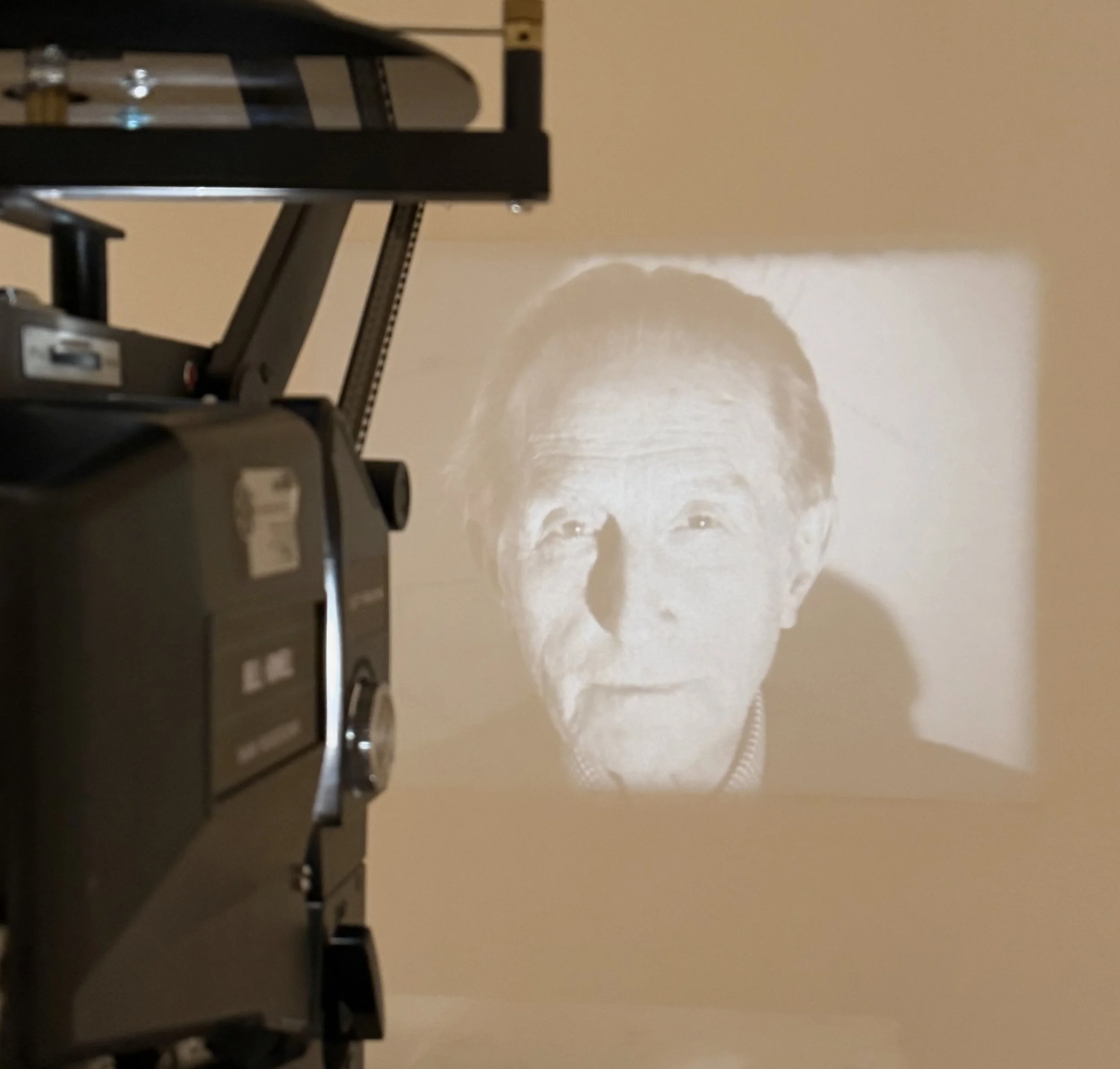
A black and white film of Duchamp shows on one wall of the exhibition at MoMA. Photo by Lisa Freeman
Jeff Koons, whose own work extends Duchamp’s exquisite logic into the present, put it plainly: “His work is a cornerstone for so much that follows. He offers a new way of thinking…a way of opening oneself to the world and a sense that art can be anything.” Koons made the remarks during a discussion with Alison McDonald, the chief creative officer at Gagosian, which opened its own Duchamp exhibition at its new location on Madison Avenue just over a mile away.
Koons offered the commentary less as fan boy praise and more as a structural fact. Duchamp didn’t just produce objects; he altered the conditions under which objects become art. And in doing so, he offered liberation to generations of artists to come. “It was a game changer,” Koons said, “really about opening oneself up, embracing all the freedom, all the possibilities, everything. There’s nothing restraining us in any manner other than ourselves.”
The bicycle wheel mounted to a stool is here, of course, along with an old photograph in which it is used to frame Duchamp standing with Fountain, its spokes cutting the scene into radial lines. Nearby, a small case opens into Box in a Valise, a portable archive of the artist’s own work—miniatures, reproductions, fragments, all arranged with the precision of a filing system that doubles as a critique of filing systems. The gesture is modest in scale, almost private. Its implications are not.
Duchamp’s contribution to contemporary art wasn’t just a set of objects. It was a shift in thinking that made those objects possible—and thus influenced everything that followed. He displaced the emphasis from making to choosing, from craft to concept, from the hand to the decision. The urinal and the wheel—present at MoMA and also at Gagosian—are part of that story, but they’re not the whole of it. They’re entry points into a larger dismantling, one that extends through his optical experiments, his mechanical constructions, his wordplay, his alter ego Rrose Sélavy, his long engagement with chess.

Marcel Duchamp, Rotary Glass Plates, 1920, his first motorized construction. Photo by Lisa Freeman
In one gallery at MoMA, a motorized apparatus—Rotary Glass Plates (1920)—sits on a wooden base, its striped blades aligned in a way that suggests movement even when still. It’s an early attempt to mechanize perception, to make vision itself unstable. Across the room, Duchamp’s face is being projected onto the wall in soft black and white. He looks, well, like he always does, sort of bemused, a bit aloof, thoughtful and cool.
The exhibition moves forward, but Duchamp’s logic moves sideways. By the 1930s, he’s building systems rather than singular works. By the 1940s, he’s compressing his own output into a suitcase. By the time the retrospective reaches the later galleries, the categories start to blur.

One of Duchamp's Box in a Valise, 1935, a miniature museum of his work. Photo by Lisa Freeman
It’s tempting to read this as a progression—from painter to disruptor to something like a conceptual architect. The show is structured chronologically, so it encourages that reading. But Duchamp’s real move was to undermine the idea of progression itself just as he gleefully sacrificed organization in favor of randomness.
That’s where the limits of the exhibition begin to show—not as a failure, but as a best shot at the impossible. Koons circled the same point from another angle when he said Duchamp’s oeuvre, taken as a whole, provided an opening and an opportunity for artists to explore vast new worlds of creativity. A retrospective like MoMA’s can suggest that opening. It can’t contain it.
After it closes in New York in August, the show moves to the Philadelphia Museum of Art, permanent home of one of the world’s foremost collections of Duchamp work. Philadelphia holds Étant donnés (1946–66), Duchamp’s final work, installed permanently and inaccessible except through two small peepholes. Built in secret over two decades, largely in a studio on East 14th Street in New York, the work can’t travel nor can it be replicated in any meaningful way. MoMA pays tribute to Étant donnés with a series of photographs of the installation before it was moved to Philadelphia and Duchamp’s instructions for relocating the piece.
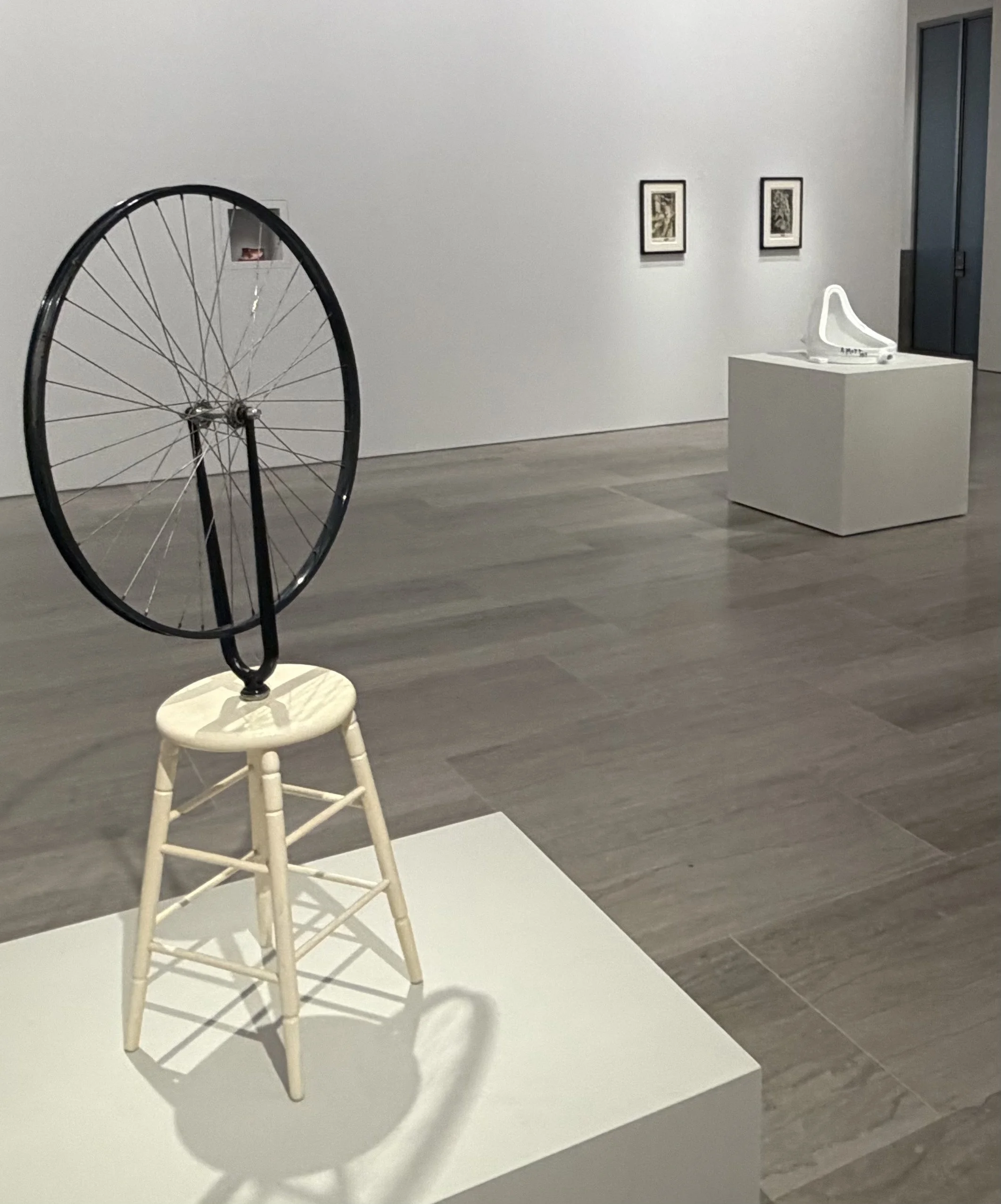
Bicycle Wheel (1964, after 1913 lost original) and Fountain (1964, after 1917 lost original) on display at Gagosian. Photo by J. Scott Orr
Meanwhile, uptown, Gagosian is using the Duchamp exhibition to celebrate its move from the second floor to street level of its Madison Avenue address. The space was formerly occupied by Cordier & Ekstrom Gallery, where editions of some of the works currently displayed there and at MoMA were originally shown in 1965.
“It all started with Duchamp,” Larry Gagosian said. “I couldn’t imagine a better artist or a more critical body of work to be the first exhibited in our new gallery at 980 Madison, a building he showed in just over 60 years ago.”
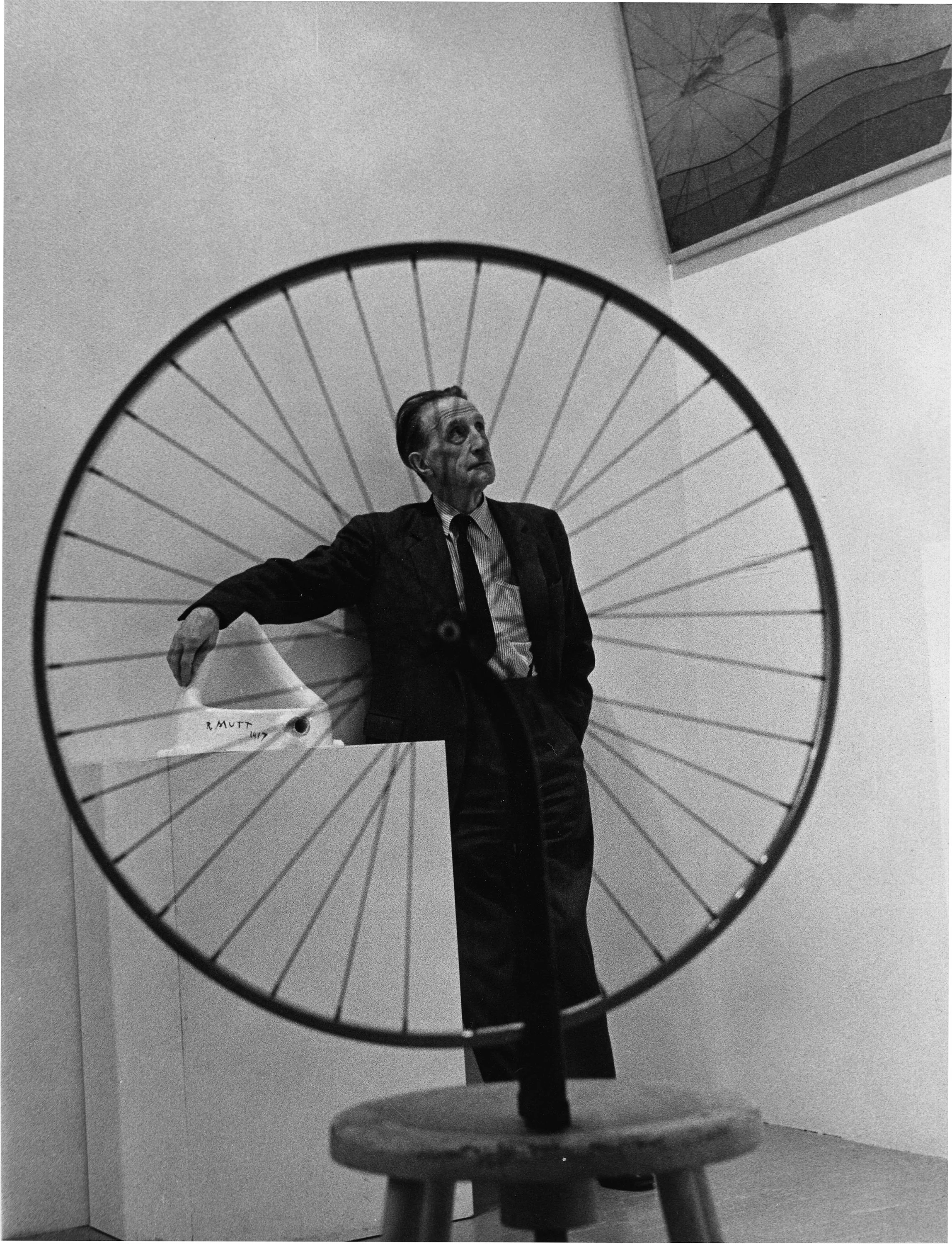
A photo of Duchamp, framed by his ready-made piece Bicycle Wheel. Photo courtesy MoMA
Back in the gallery at MoMA, the child is still looking at the urinal. The woman’s hand has dropped to her side. Whatever explanation was forming has dissolved. The object remains where it is, stable, contained. Everything it set in motion does not.
The MoMA show runs through August 3, Gagosian’s exhibition closes June 28. It opens at the Philadelphia Museum of Art October 10 and runs through January 31, 2027.