She Was Never Just “Mrs. Pollock,” Setting the Record Straight at the Met
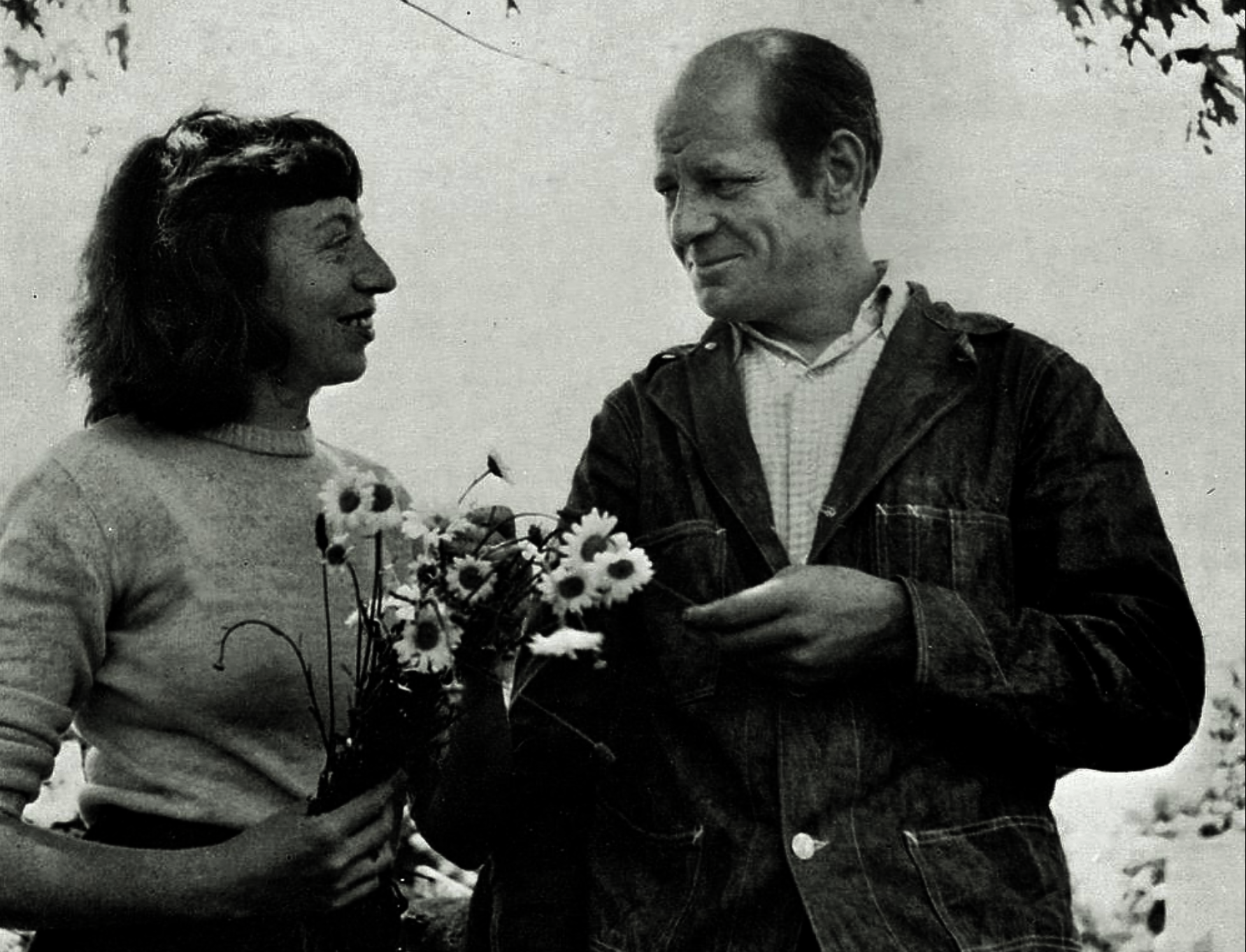
Lee Krasner and Jackson Pollok
For decades, Lee Krasner endured a particular kind of art world erasure. Despite her formidable artistic genius, she was seen mostly as an appendage, perpetually introduced as Jackson Pollock’s wife, footnoted beneath his larger-than-life legend. The woman who introduced Pollock to Willem de Kooning, to Clement Greenberg, to Peggy Guggenheim—who, in a very real sense, helped build the myth of Jackson Pollock before and after his death—was herself reduced to a supporting role in his story. You will search hard to find an example of Pollock being identified as “Lee Krasner’s husband.” The reverse was journalistic reflex for decades.
This October, the Metropolitan Museum of Art begins correcting that record in the most decisive way it knows how: a major exhibition.
Krasner and Pollock: Past Continuous, opening Oct. 4, at The Met Fifth Avenue, is—per the museum’s announcement— “the first major New York presentation devoted to either artist in more than 20 years,” and the first exhibition to look at the full arc of their careers together. The exhibition featured over 120 works and runs through next January. The subtitle is drawn from a 1976 Krasner painting of the same name.
The Met insists their practices be recognized as equally “central to the innovations of art from the mid-20th century onwards.” But let’s be clear about an often overlooked fact: Lee Krasner was a significant artist before she ever met Jackson Pollock.
By the time the two crossed paths in the winter of 1941—Krasner visited his studio after he turned out to be the only artist in a group show she hadn’t yet met—she had already studied at the Women’s Art School of Cooper Union, the National Academy of Design, and the Art Students League. She had studied under Hans Hofmann, who grounded her in Pablo Picasso’s Synthetic Cubism and Henri Matisse’s use of color and outline. She had been a founding member of the American Abstract Artists Group. She had worked through the WPA’s Federal Art Project alongside Stuart Davis, Ad Reinhardt, and de Kooning.
Hofmann, for his part, managed to damn her with breathtaking condescension. Impressed by her work, he told her directly: “This is so good you would not know it was painted by a woman.” She was undeterred.
Krasner is hardly alone in her experience of historical diminishment. Frida Kahlo spent decades being principally identified as Diego Rivera’s wife, despite producing one of the most psychologically singular bodies of work of the 20th century. Helen Frankenthaler—whose soak-stain technique helped define an entire generation of color field painting—was long overshadowed by the famous men in her orbit. The pattern is a reliable one: women artists in proximity to celebrated men get absorbed into those men’s stories, their own gravitational pull quietly dismissed.
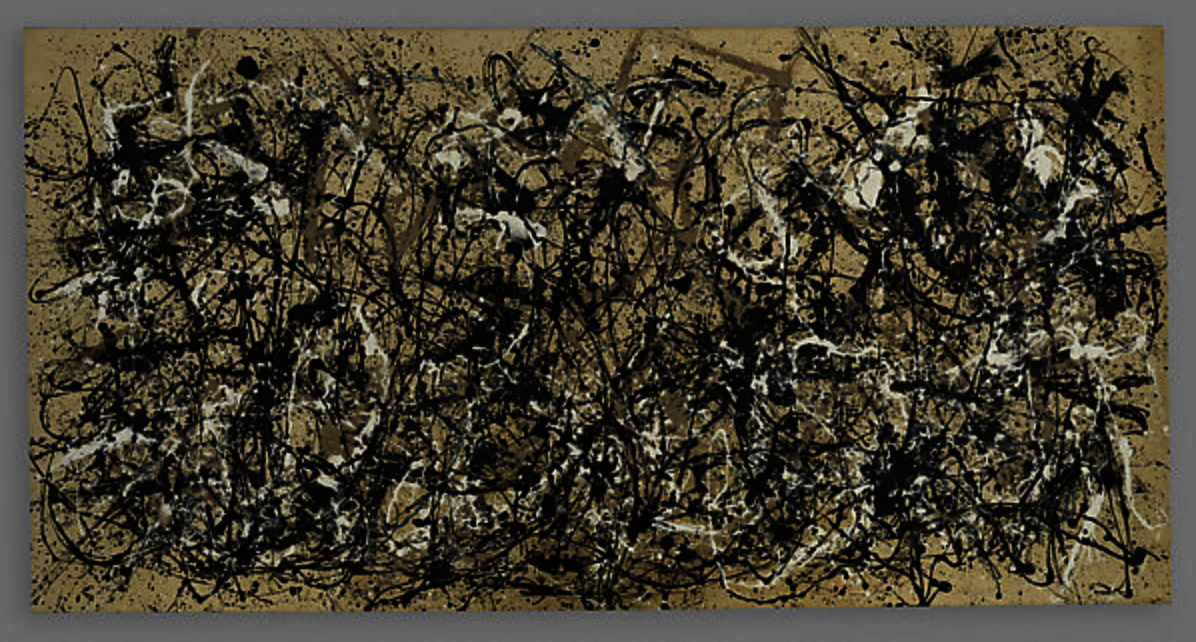
Autumn Rhythm (Number 30), Jackson Pollock, 1950. From the Met’s permanent collection
Krasner and Pollock were genuinely distinct as practitioners—not opposing forces, but different instruments playing in the same orchestra. Pollock, raised in Los Angeles and the American West, trained under regionalist Thomas Hart Benton, whose teaching emphasized complex compositional design rooted in automatic drawing. His breakthrough—the drip technique, working on unprimed canvas laid flat on the floor with industrial enamel and sticks rather than brushes—was volcanic and concentrated.
Krasner’s practice was something else entirely: more cerebral, more restless, and formally wider-ranging. Where Pollock arrived at a signature method and ran with it, Krasner refused on principle to develop a fixed “signature image,” which she considered, in her own words, “rigid rather than being alive.” Hofmann had taught her to abstract from nature and honor the flatness of the picture plane. She moved through cycles — from the hieroglyphic “Little Image” paintings of the late 1940s, constructed from thick impasto and dense abstract symbols, to collages she made by tearing apart her own finished canvases and reassembling the fragments into something raw and entirely new. Critic and art historian Barbara Rose once wrote that Krasner’s “paintings are no relaxed picnics on the grass” — they are, she said, “direct, vigorous, demanding encounters between the psyche of the artist and that of the viewer.”
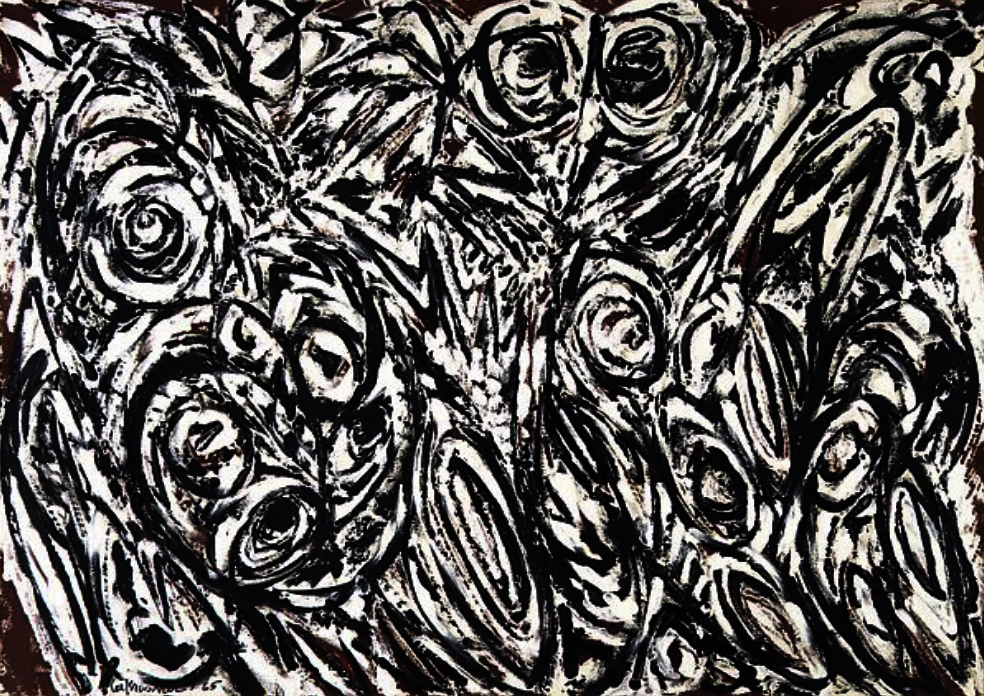
Night Creatures, Lee Krasner, 1965. From the Met’s permanent collection
Greenberg called her 1955 collage exhibition one of the most important shows of the decade. In the 1960s she pivoted again toward large horizontal canvases blazing with hard-edge lines and contrasting color. She never stopped moving.
After Pollock died in a drunk-driving crash in August 1956—a crash that also killed Edith Metzger, a friend of his mistress Ruth Kligman, who was the sole survivor—Krasner stepped in to massage the Pollock narrative. She spent years managing his estate and advocating for his legacy, all while continuing to make her own work. She eventually moved into the barn on their Long Island property that had been his studio, finally claiming the space and the scale it offered.
A MoMA retrospective opened six months after her death in 1984. The New York Times review declared that her work “clearly defines Krasner’s place in the New York School” and that she “is a major, independent artist of the pioneer Abstract Expressionist generation, whose stirring work ranks high among that produced here in the last half-century.” Following her death, critic Robert Hughes called her “the Mother Courage of Abstract Expressionism.” Recognition arrived, as it so often does for women of her generation, too late and too close to gratuitous.
The show opens October 4 in Gallery 899 at The Met Fifth Avenue and runs through January 31, 2027.