The Allegorical Cult of the Ruin, Jennifer & Kevin McCoy's ReLensing at bitforms gallery through Oct 17
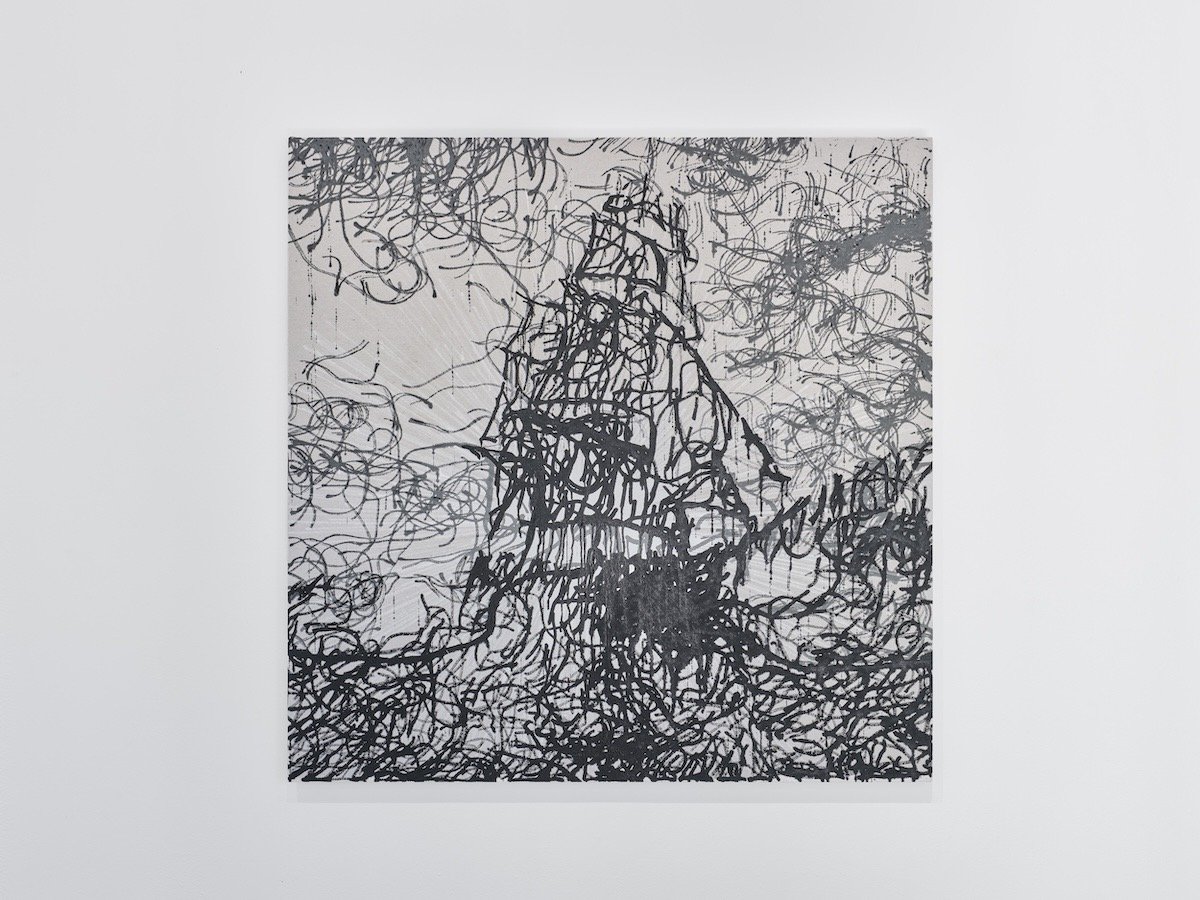
Depth Model, 2026, Acrylic on canvas, 60 x 60 in / 152.4 x 152.4 c. Photo courtesy the artists and bitforms gallery
Every work in ReLensing looks through something before we can focus on anything: a diffusion model, a lens ground into a sphere, cast glass forms generated from 3D-printed forms, a laptop screen propped on the floor, a shadow enlarged across a wall. When you enter bitforms, you meet Depth Model (2026) first: a black-and-white acrylic ship plotted rather than painted, its silhouette scrawled and dripped across canvas. Only beyond a black curtain does Lens Organic (2023) open into the room on the left. Video arrives early, which is rarer than it should be. Most exhibitions save the moving image for a final darkened room. Here it establishes the show's cadence almost immediately.
The McCoys’ point of departure for Depth Model (2026) is a passage from Herman Melville’s Moby-Dick (1851) brought into material being: a literary description of a visual object that becomes an image without ever having been one. Two systems do separate work from there. Stable Diffusion generates images of whaling ships, including interpretations of Melville’s fictional Pequod. A custom-built plotter then translates the resulting image into a painted gesture, dragging ink through the loops and corrections of an actual hand. Separately, the machine’s software reflects a parallel investigation into Neo-Expressionism, drawing on a dataset developed from art-historical sources. The ship passes from literary description to machine-generated image to plotted painting. It is already twice removed from any imagined ocean.
There is something almost comic in the process, though the comedy never cancels the melancholy. Ahab, the whale and the miniature nineteenth-century apparatus of doom and sublimity pass through systems that cannot comprehend what they signify. The machine receives only gesture as statistical residue. What emerges is not the sublime restaged, but the sublime caught in the act of being procedural all along. The machine exposes the structure beneath the myth: code drawn with paint.
Behind the hull, striations rake across the canvas in a rough sunburst. The gesture recalls Charles Hawthorne's painting instructions to look at the dark side of a wave and seek the design on the surface. No one is looking in the manner of observational painting. Instead, the work stages painting's materials while critiquing the image as it is rendered and monitoring its progress. A model is pattern-matching. Perspectival distance is not added to the image afterward; I found myself missing it, although I knew it was present in the canvas and ground. That implied distance is where the image begins.
Craig Owens's "The Allegorical Impulse" gives this distance its sharpest vocabulary. Writing about Troy Brauntuch, Sherrie Levine and Robert Longo, Owens argues that the appropriated image is often already a reproduction. Through copying, cropping or enlargement, the artist empties it further of its inherited authority. What remains is the object under what Owens, borrowing from Walter Benjamin, calls the melancholy gaze: an object drained of its former life and placed under the allegorist's control. Depth Model performs this operation through diffusion and plotting. Its melancholy is algorithmic. The carbon-black surface, flecked with what appears to be reflective particulate—mica or glass beads—removes the seduction of color and reduces the image to grayscale. The ship is not a ghost. It is closer to a burnt ruin: a form whose symbolic life has been stripped away and then reconstructed through procedure.
Lens Organic extends the operation into something more still. Trees warp around the sphere’s curve — the foreground comes from a spherical lens mounted on a twenty-foot pole, extending the camera past the limits of a body standing in the woods — while the ground refuses to hold still, as if the entire image were turning inside a Tilt-A-Whirl. Behind it runs a different place and time entirely: Super 8 footage from the McCoys’ own trip to Paris in the 1990s. Nothing here is appropriated from elsewhere. The layering is autobiographical — a body’s present vision folded over the artists’ own remembered one. The movement has a deliberately made quality, closer to William Kentridge's visible stop-motion than to seamless digital animation. Each cut carries the trace of its construction.
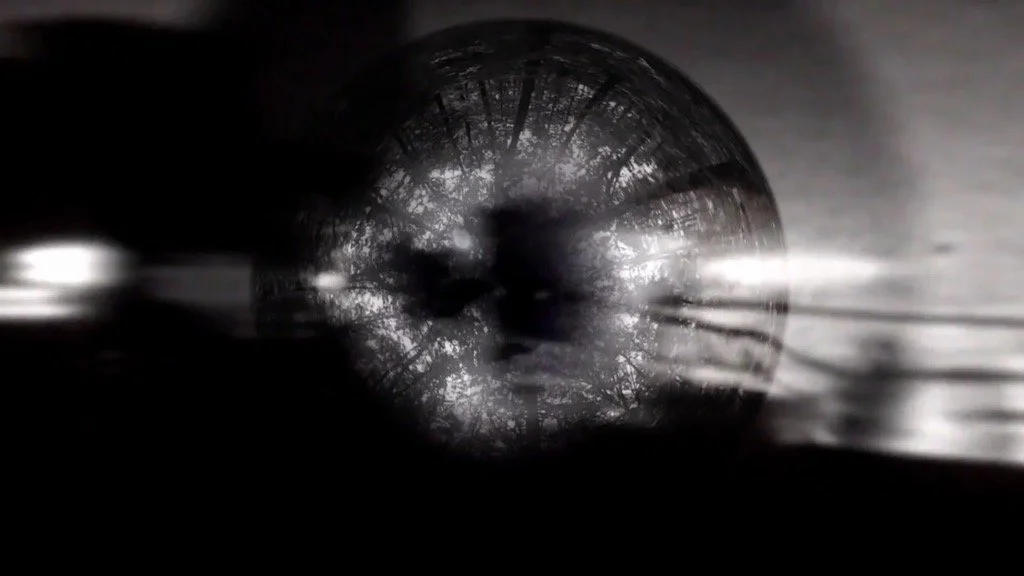
Lens Organic, 2023, Video (black and white, sound), Dimensions variable, 8 min, loop. Photo courtesy the artists and bitforms gallery
The imagery conjures petrified wood: organic tissue replaced cell by cell with mineral, so that the form survives while the life inside it disappears. The black-and-white image reaches this condition before the metaphor arrives. Color is the first thing withheld. Although there are digital tonal shifts, most notably in the white and translucent aspects of the works in the show, the darks feel reflective and galvanized.
The sound complicates that reading. The score is completely uplifting: classical, instrumental, beautiful and unidentified. It does not illustrate the forest's death. It carries the work toward an emotional register that the image itself cannot quite reach as the trees become absorbed by the concentrated perspective of the sky. The walls are painted a muted deep teal, close to a mixture of PB28 and PBr7 with a touch of PY42. The color behaves like the music, arriving with a slight warmth without confirming where it belongs in the narrative, although blue belongs to both sea and sky.
Vilém Flusser's account of communication across distance fits here. A message crosses a sea, and the sender has no way of knowing whether it was heard. The forest becomes a transmission whose origin cannot be recovered and whose reception remains uncertain. Long before Deleuze is named in relation to the Crystal Films, Lens Organic makes a related condition felt: the present image cannot separate itself from the image that came before it. Memory does not sit inside the present like an insert—it actively alters the present's structure.
The nature of memory becomes physical in Ghost Ship(2025). A model ship — found, not built for the piece — floats near the back wall while a light throws its shadow fourteen or fifteen feet across the gallery. Its motor is precise, but what it produces remains almost childlike: an up-and-down, wave-like motion with the modesty of a toy truck crossing an uphill and uneven floor. Sophisticated technology has been translated into plain mechanical motion. Its matte, cool medium-dark grey coloring makes it appear like a shadow in three dimensions. It also seems oriented as one might be oriented at sea, looking out across the water toward the possibility of another ship. The vessel is not merely a model of a ship. It is a ship as apparition, suspended between object, shadow and remembered encounter. Both the ship and the laptop are found objects, repurposed rather than made new. In a show preoccupied with machine vision, their reuse makes the mechanism visible instead of burying it in another layer of simulation.
Ghost Ship’s sails are paper-thin and move with a restrained mechanical rhythm—this is where J. E. Gordon’s Structures: Or Why Things Don’t Fall Downbecomes one inaudible echo throughout the exhibition. Gordon describes sails, tents, eardrums, fish fins and bat wings as open membranes that sustain pressure from wind or water. A membrane is a constant-stress device: it has one stress to offer, operating in every direction. He also describes flexible sails that bow between their supports as wind increases, allowing tension to remain roughly constant however hard the winds blow.
The work’s soft structures make pressure perceptible as a mental condition, not through physical give but through a near-stasis. The found ship looks constructed of paper—a material that remembers every fold—yet its sails do not billow; the visible mechanics around it move more than the vessel itself. Gordon’s discussion of the masts of HMS Victory as a cantilevered truss becomes especially resonant here. The enormous engineering of a ship is reduced to a hanging model and then expanded again through light.
On the floor, a small Acer laptop gives a 16:9 view of the ocean—sunlit and expansive, filled with chop and glare. Even at that small scale, the ocean communicates its inviting expanse, but it is hollowed and lonely as a digital space. The laptop presents a digital facsimile of the natural environment of the ship. The water becomes the ship’s absence. The wall renders it as shadow, or as a haunting; these elements have been separated and redistributed across the installation.
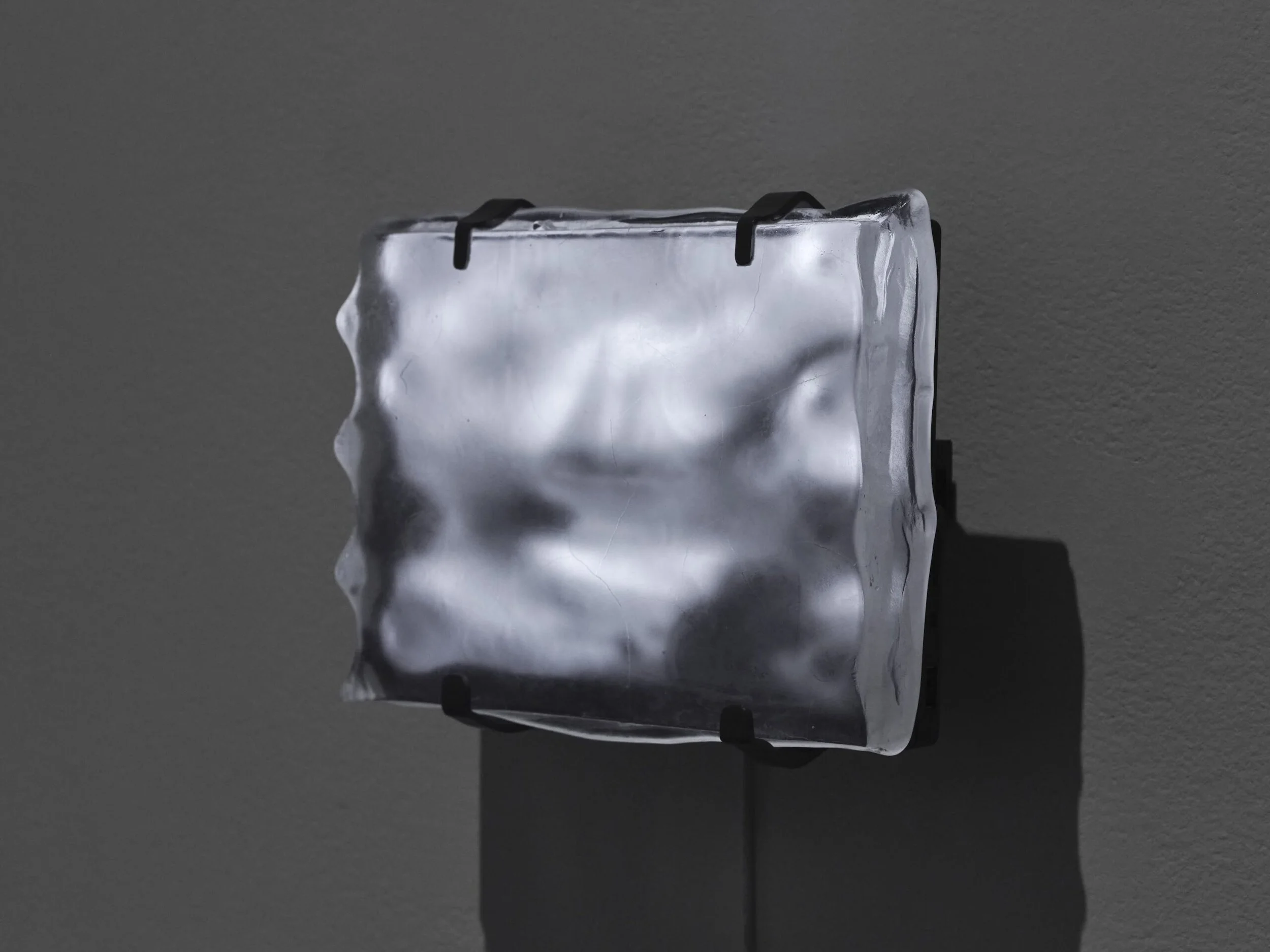
Crystal Films #1 (ship), 2026, Glass, video (color, silent) 11 min 24 sec, loop
10 1/2 x 8 x 2 1/2 in / 26.7 x 20.3 x 6.3 cm
Hawthorne's instructions on reflections read almost like a diagram for this separation. Reflections sit lower in key than the thing itself. One should seek the design on the surface and avoid becoming too mechanical about reflection. In Crystal Films #1 (ship) (2026), wave-edge patterns are pressed into a cast-glass sculpture generated from a 3D-printed form and mounted over a screen that loops fragments from Orson Welles’s The Lady from Shanghai (1947). The glass looks, at first, like a strange polymer resin. Its material presence interrupts the sleekness of the screen and makes the image feel physically trapped. It is as though we are viewing the image from the future, encapsulated in a wall of ice: the last ghosts of imagery and the chatter of a civilization long extinct.
The Crystal Films series takes its conceptual structure from Gilles Deleuze's crystal-image. Deleuze describes a condition in which the image no longer allows the present and the remembered past to remain clearly separate. Each seems to call up the other. The works do not present memory as a second layer placed behind contemporary experience. They make the two times occupy the same image at once. Like light caught in ice, the film fragment remains visible while its original time becomes inaccessible.
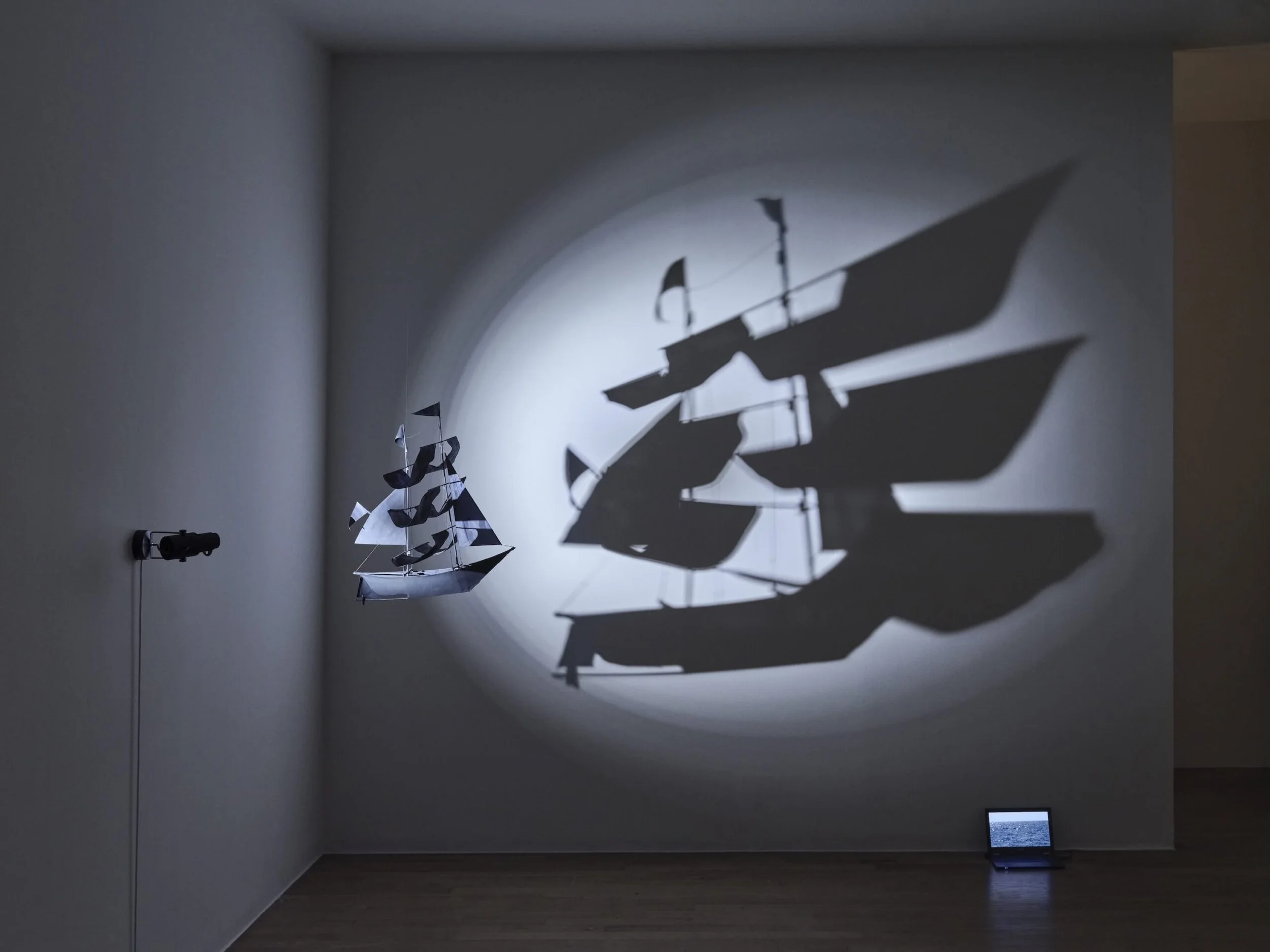
Ghost Ship, 2025, Installation with ship model, laptop, video (color, silent) motors, lights, Dimensions variable
Owens identifies allegory with ruin, fragment and incomplete sequence. ReLensing follows that structure. In Depth Model, the progression is a mathematical program that precedes the organic intervention of paint: sphere, shadow, membrane, reflection, glass, plotted mark, then back to the sail. Across the exhibition, that logic expands into a loop. Resolution becomes ritualistic and repetitive rather than final. Each work recasts the one before it.
The Sabian symbol for the twenty-second degree of Cancer pictures a woman awaiting a sailboat. Marc Edmund Jones reads the image as expectancy held on faith. Dane Rudhyar pushes further, toward a form of waiting that is not passive but poised: a trust in something already underway, even though it has not yet come into view. That is finally what the exhibition asks of us. The allegorical cult of the ruin is not nostalgia. It is reanimation — not the machine's, but ours. Ship, forest, wave and cinematic image return after their authority has broken down, newly available to whatever pressure comes next. We remain on the shore, watching for the shape of the sail.