Photo by Jamie Lubetkin
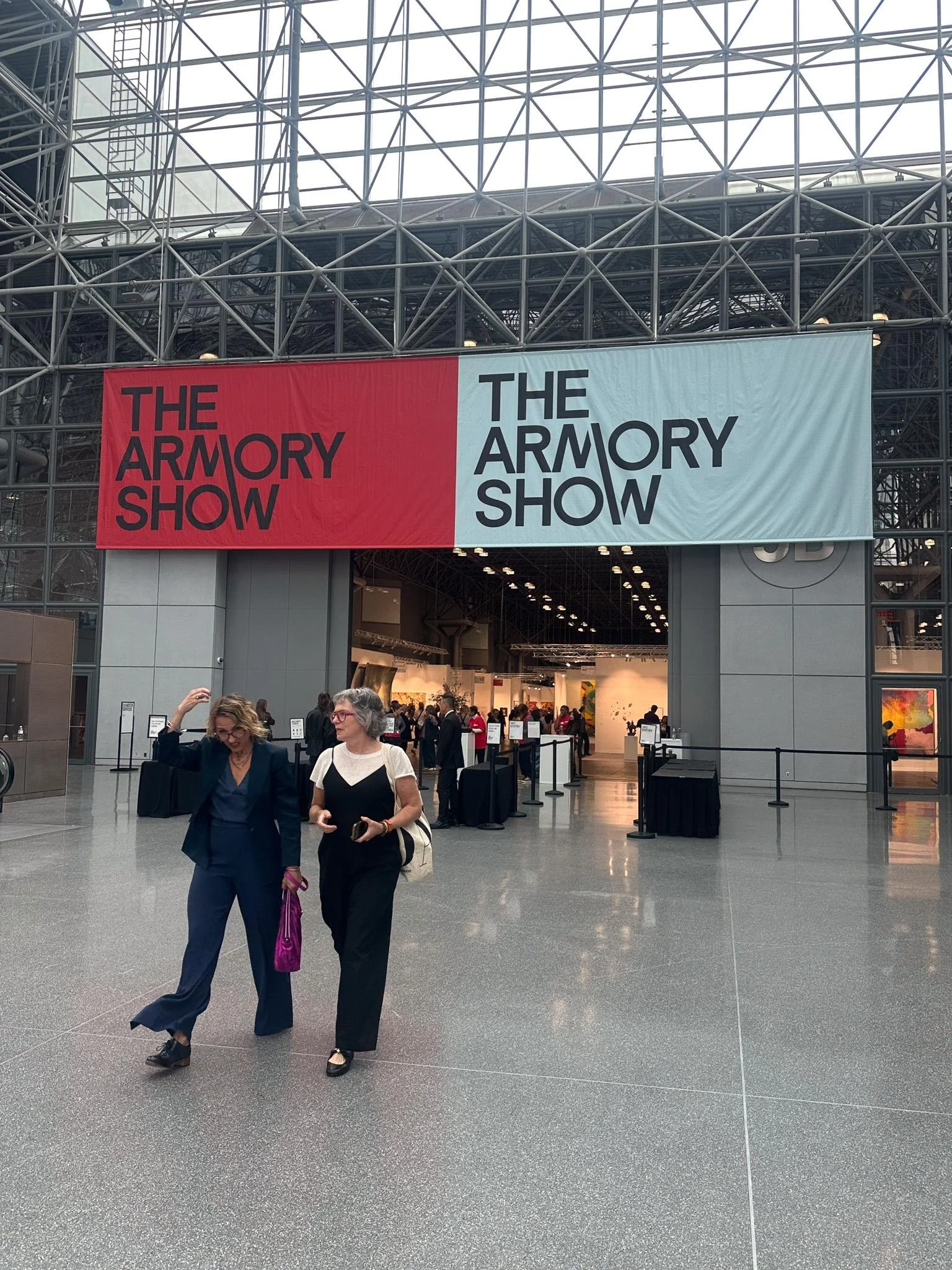
The Platform section of The Armory Show showcases large-scale sculptures and installations interwoven throughout the fair. This year, the section focuses on the Caribbean diaspora and is curated by Jovanna Venegas, currently the curator at SculptureCenter in Long Island City. Titled Passages and Thresholds, Platform explores the cultural, and economic connections of the Caribbean and the movement of people, traditions, and ideas across its many islands and territories. Passages and Thresholds brings together artists whose work considers questions of migration, identity, memory, power, and cultural inheritance.
Physically, the Platform section cuts through the middle of the Armory space, creating a division that is not unlike the border wall referenced in Margarita Cabrera's sculptures. The larger, more established galleries are positioned near the entrances, while the nonprofit galleries and Presents galleries, which are younger than 12 years old, are pushed toward the rear corners of the fair. The sculptures and installations are installed on a brown rug, with gallery booths, the fair's restaurant, and VIP lounge circling the space, creating a visual cacophony that makes it difficult to appreciate the sculptures on their own terms. No installation suffers more from the physical arrangement of the fair than Cabrera's Space in Between sculptures, which are installed next to the Champagne Pommery Lounge, also positioned on the brown carpet in the center of the Platform section. Cabrera is a Mexican-American artist. (No, Mexico is technically not part of the Caribbean, but the curator should be allowed some latitude.) Her thoughtful and powerful work is difficult to fully appreciate with all that is going on around it. Cabrera collected U.S. Border Patrol uniforms and organized collaborative workshops with South American immigrant communities, who sewed and embroidered the cut-up uniforms to represent vegetation indicative of the collaborators' homelands. Many take the form of cacti, some flowering with delicately embroidered flowers. The individuals who produced the soft sculptures remain anonymous due to immigration status issues and the current political climate. As part of the project's social component, a portion of the proceeds goes to charities chosen by the migrants who contributed to the project.
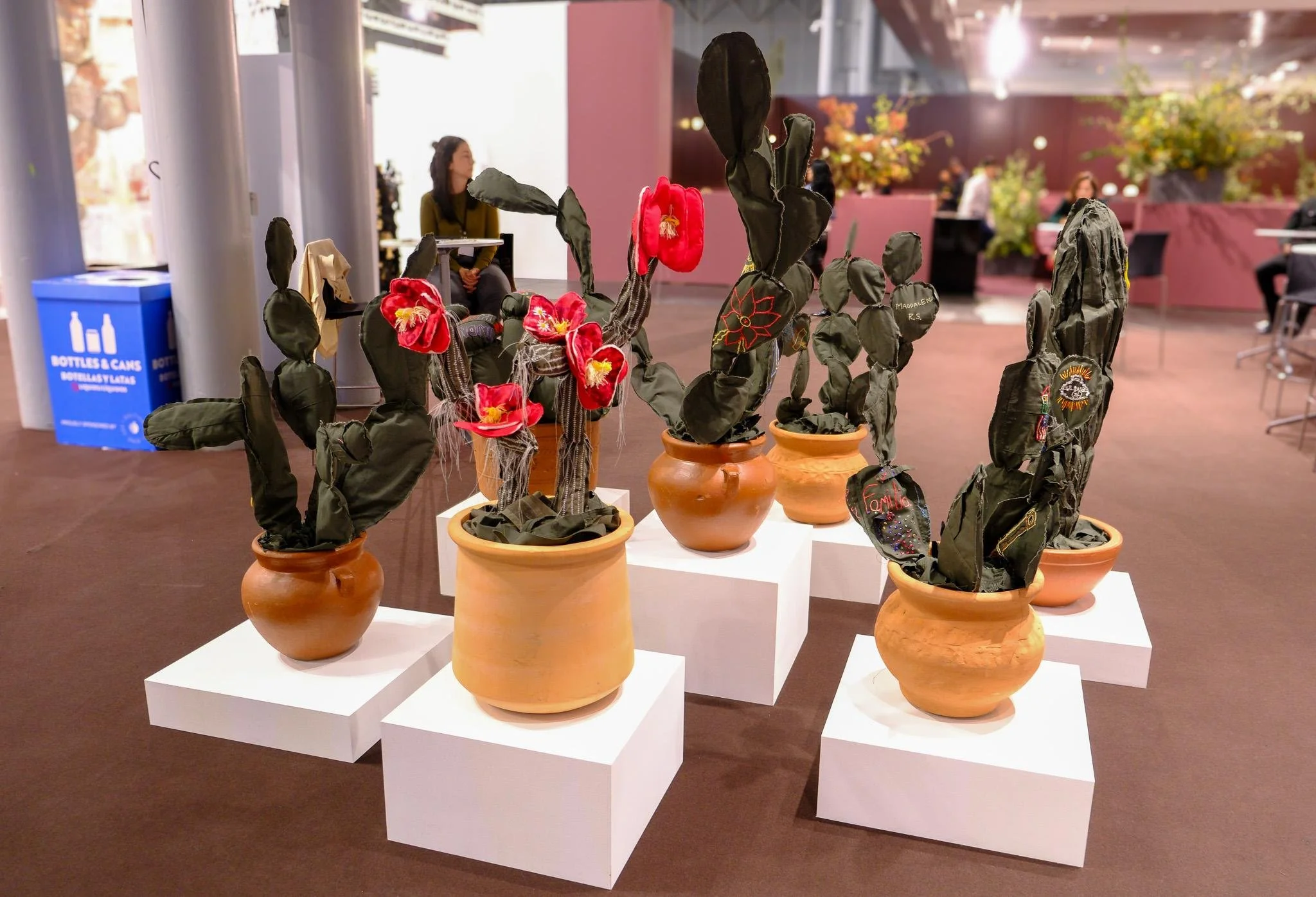
Margarita Cabrera Space in Between. Presented by Jane Lombard Gallery, New York. Photo by Jamie Lubetkin
Propped against a wall opposite the Champagne Pommery Lounge is María Magdalena Campos-Pons’s very large and colorful watercolor painting, Portrait #4: Cousin María, Feast for Ogún. Its size allows it to dominate the space, although the viewer can’t get far enough back to fully appreciate the piece. Campos-Pons, a Cuban artist, explores her multicultural heritage and the spiritual traditions intertwined with it, incorporating Yoruba and Santería motifs from different perspectives across interconnected works. In Portrait #4: Cousin María, Feast for Ogún, a woman honors Ogún, the deity of iron and war, holding a platter of ritual fruits while seated on an iron stool with her feet resting on a machete, one of Ogún’s symbols. Like many of the Platform sculptures and installations, I yearned to see it in a simpler, more forgiving environment.
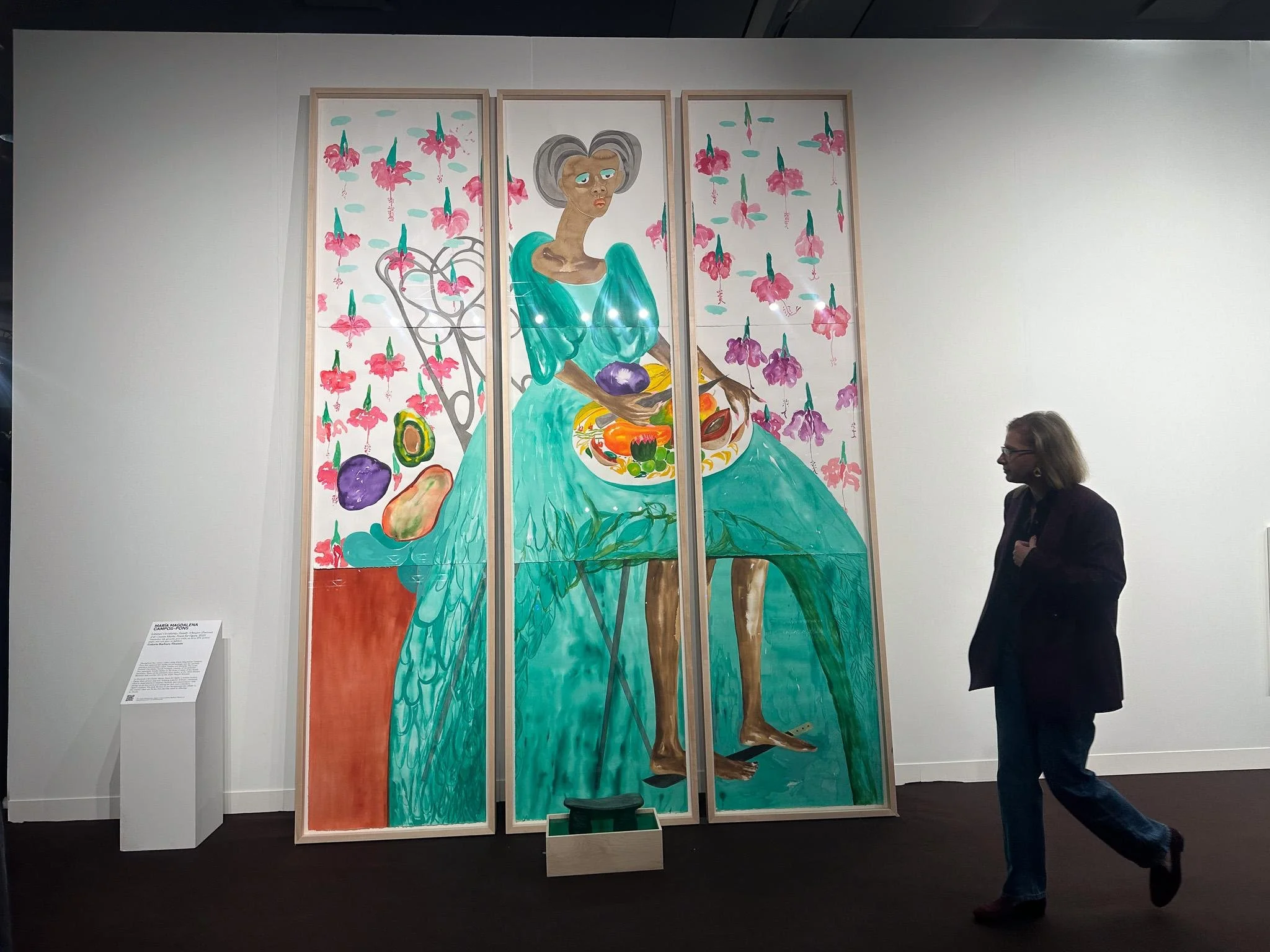
María Magdalena Campos-Pons (Portrait #4) Cousin María, Feast for Ogún. Presented by Galerie Barbara Thumm, Berlin. Photo by Jamie Lubetkin
Miami-based Venezuelan artist Lisu Vega’s large installation A Momentary Whole has no problem dominating the space due to its immense size, approximately forty by twenty-two feet. The floor-to-ceiling weaving is constructed from translucent Poly Silk and deconstructed rope. Vega unwound commercially made rope, using the softer inner strands in the piece representing the gentle embrace of familial history. She said that she enjoys working with materials that can be hard and soft at the same time. The piece is dedicated to Vega’s late grandmother, who passed away in 2021. The project became a way for her to work through the loss, which she described as feeling like a “black hole inside of her.” Using a family photo album she brought with her from Venezuela, Vega selected photographs from the archive and wrote about the memories they triggered. She included photographs from her grandmother’s life as well as her own, showing how past, present, and lineage are intertwined. Vega used the dye sublimation process to transfer the images onto the fabric, repeatedly pressing the inked transfer paper onto pieces of fabric until it would no longer leave an image. The process becomes a metaphor for the way memories fade over time. The piece is paired with three other freestanding sculptures which also incorporate deconstructed rope which act as “totemic guards”. Lisu Vega was awarded the Pommery Prize for her installation.
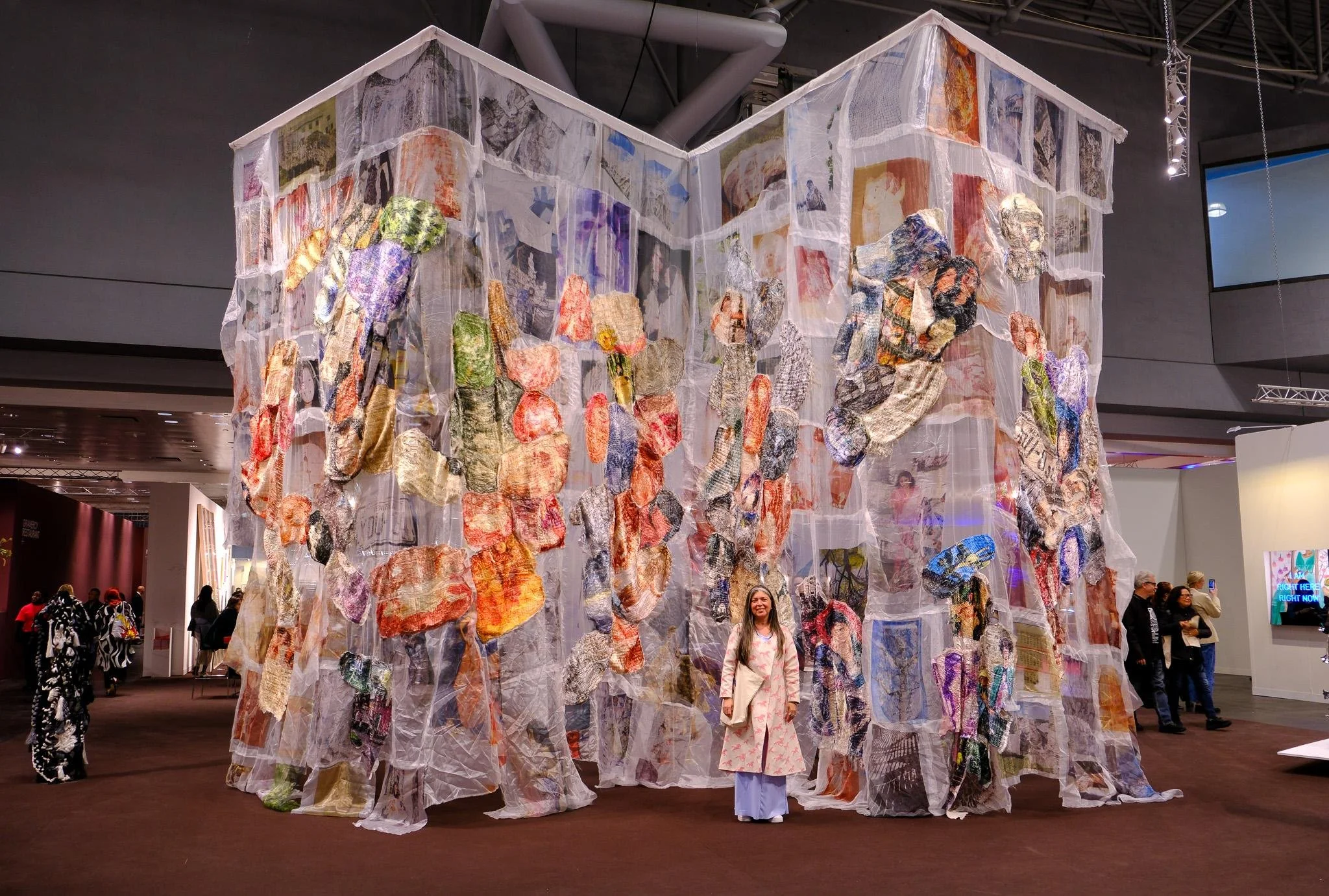
Lisu Vega A Momentary Whole. Presented by Gladwell Projects, New York. Photo by Jamie Lubetkin
Curtis Talwst Santiago relayed how his miniature works, two of which he is presenting at the Armory, first came to the attention of Brooklyn Museum’s Ann Pasternak at Spring/Break Art Fair and how important that recognition was for his career. Concurrently with his presentation at The Armory Show, the artist is presenting a solo exhibition at Contemporary Calgary in Alberta, Canada. The relationship between cultural identity and transformation is central to Santiago’s mixed-media works. The Canadian-Trinidadian artist addresses histories of migration and colonialism through miniature dioramas small enough to be presented in jewelry boxes. In contrast to the miniature works being presented at the fair is the life-size sculptural figure Dingolay FC, Dance Through the Defence, which depicts a soccer player poised as if about to kick a ball.The player represents the artist’s alter ego, Sir Dingolay, which combines familiar athletic and cultural imagery with precious materials. Here, the green figure, a color Santiago told us came to him in a dream, is dressed in blue athletic wear and what appears to be Medieval chainmail armor. However, on closer inspection, the armor is made of thousands of tiny glass beads that draw you into the sculpture. Gallery owner Lucy Liu said Santiago “has always moved between the intimate and the monumental,” and this piece is a combination of that quality. The combination of the life-size figure, intricate beadwork, and references to both contemporary sports and historical armor demonstrates Santiago’s ability to bring very different worlds together within a single work.
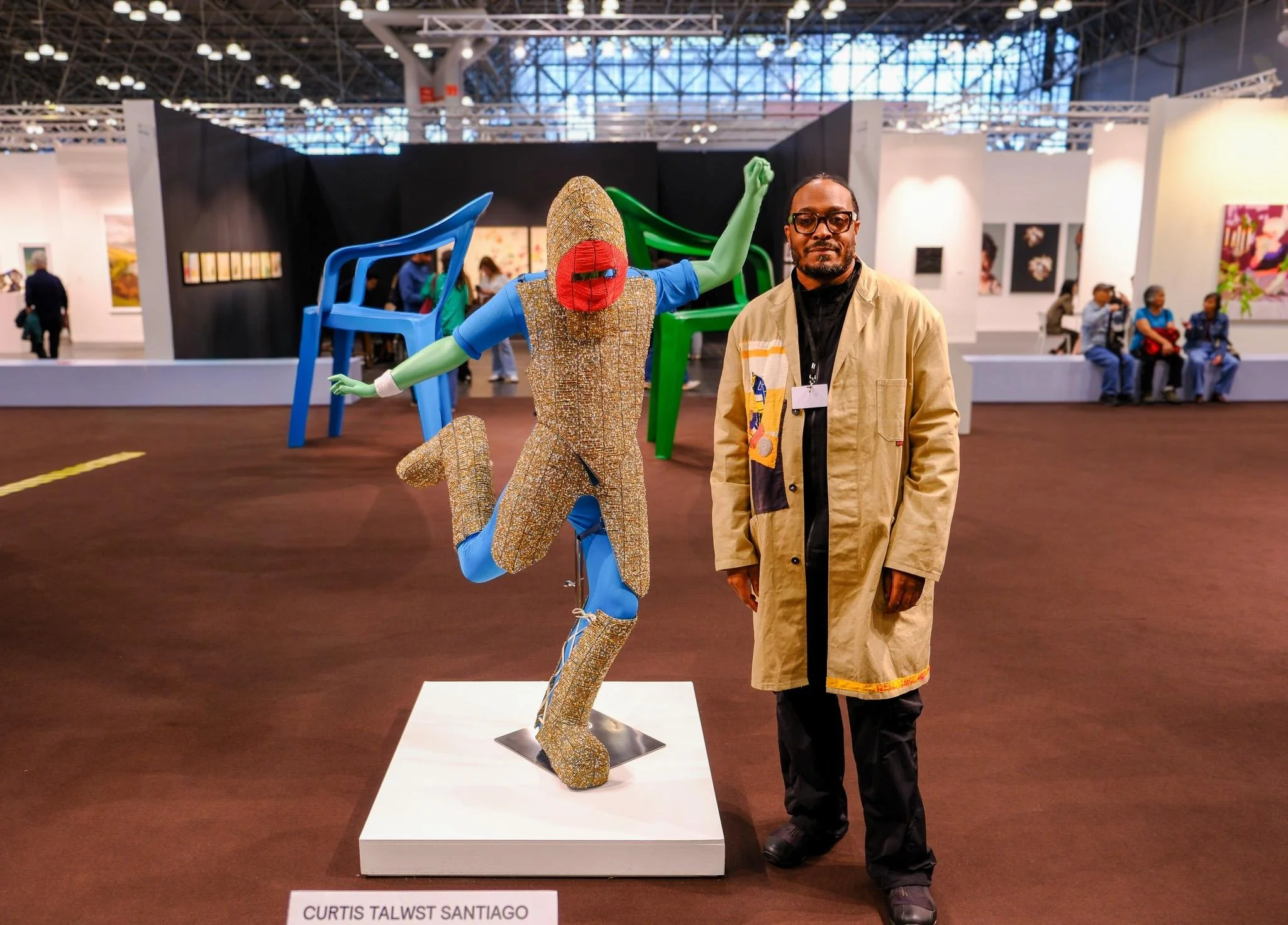
Curtis Talwst Santiago Dingolay FC, Dance Through the Defence. Presented by Uffner & Liu, New York. Photo by Jamie Lubetkin
Bony Ramirez, whose work was previously featured in Cattleya, an exhibition curated by Elena Muñoz at the Newark Museum in 2024, will be presenting La Carta. The complex, baroque, and somewhat opaque installation centers on a girl reclining on a canopy bed after receiving devastating news, according to the installation text. The installation does not give any sense of what that devastating news is, except to say that “she faces a situation that seems like a death sentence.” Through the combination of painting and assemblage, Ramirez creates a scene that feels both psychologically charged and somehow deeply personal. The bed becomes more than a piece of furniture. It is a place of vulnerability and reflection, a private space in which the consequences of a single piece of information are experienced physically and emotionally. The work considers the moment when bad news changes one’s understanding of the world and the resilience required to move forward. The sculpture installation is divided into four chapters, with its configuration changing daily throughout the fair to tell a different part of the story: Open Letter, Judgment Day, The Right Path, and A Soul Bigger Than Any Obstacle. Unless the viewer attends every day of the fair, one is left to wonder what the outcome will be.
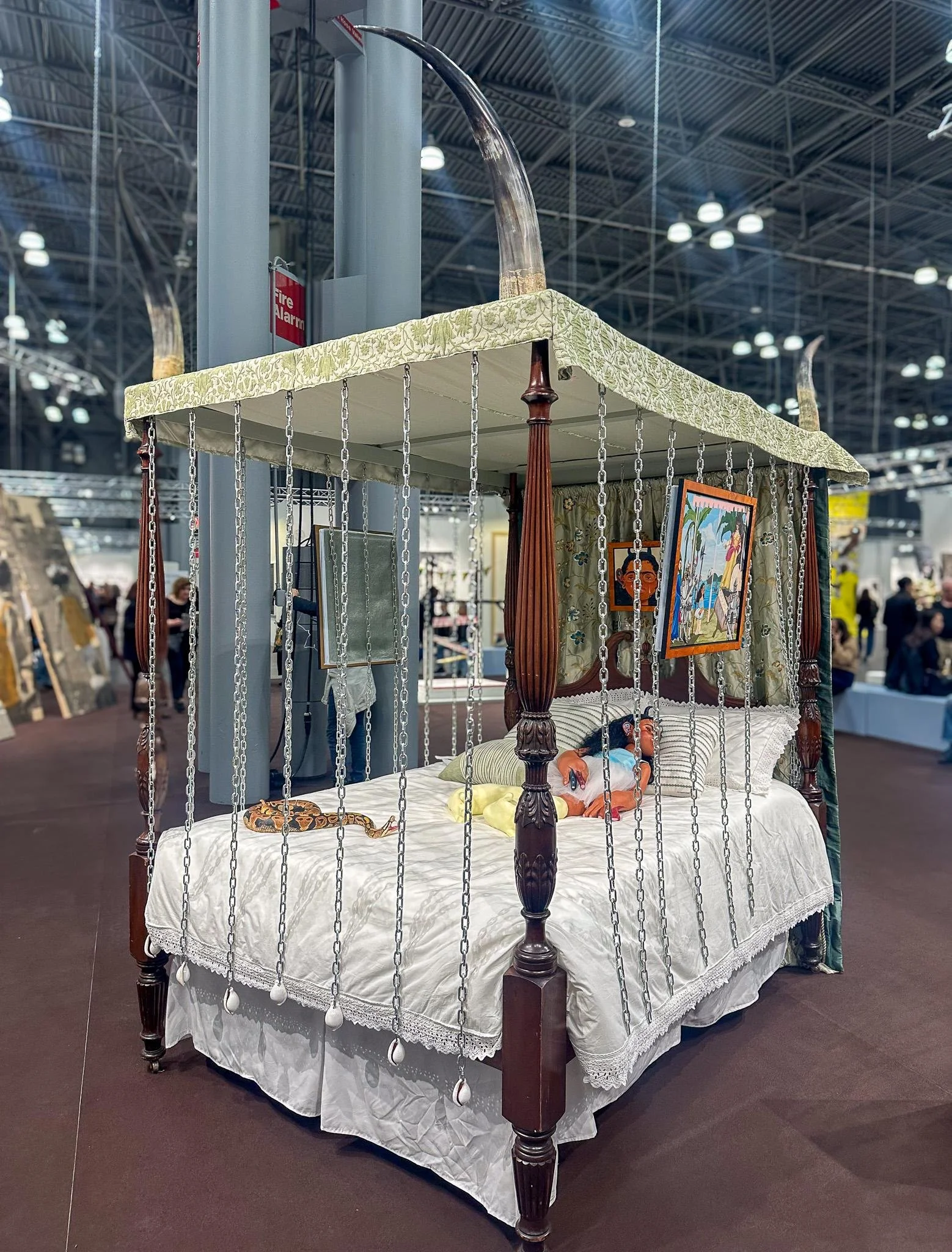
Bony Ramirez La Carta. Presented by REGULARNORMAL, New York. Photo by Jamie Lubetkin
Other Recommended Booths Presenting Sculpture and Installations
YAM Gallery
Betsabeé Romero
Although not part of the Platform section of the fair, Betsabeé Romero’s presentation by YAM Gallery in Guanajuato, Mexico, is closely connected to Margarita Cabrera’s Space in Between. Both artists address issues surrounding migration across the U.S.-Mexico border and use community-based collaboration as an important part of their practices. Both also work primarily with women, drawing on craft traditions that have historically been associated with women’s labor and production. In doing so, their work connects the political realities of migration with the personal experiences of the people directly affected by it, while also bringing traditionally marginalized forms of labor and craft into the context of contemporary art.
The booth includes a photograph of Romero’s project Ayate Car, which documents her 1997 project in which she took a 1950s Ford Victoria and, along with community members, covered the car with burlap, then decorated it with painted, stylized flowers and filled the interior with thousands of dried roses. The car’s placement at the border wall was prescient given the current political atmosphere and the U.S. president’s obsession with building a border wall. The installation also includes a tiny model of the car, hand-painted in the same manner as the original. Several truck tires carved with Mexican motifs and detailed with gold and silver leaf are also included in the booth, extending Romero’s use of everyday objects to explore Mexican identity, migration, and the cultural exchange that takes place across the border.
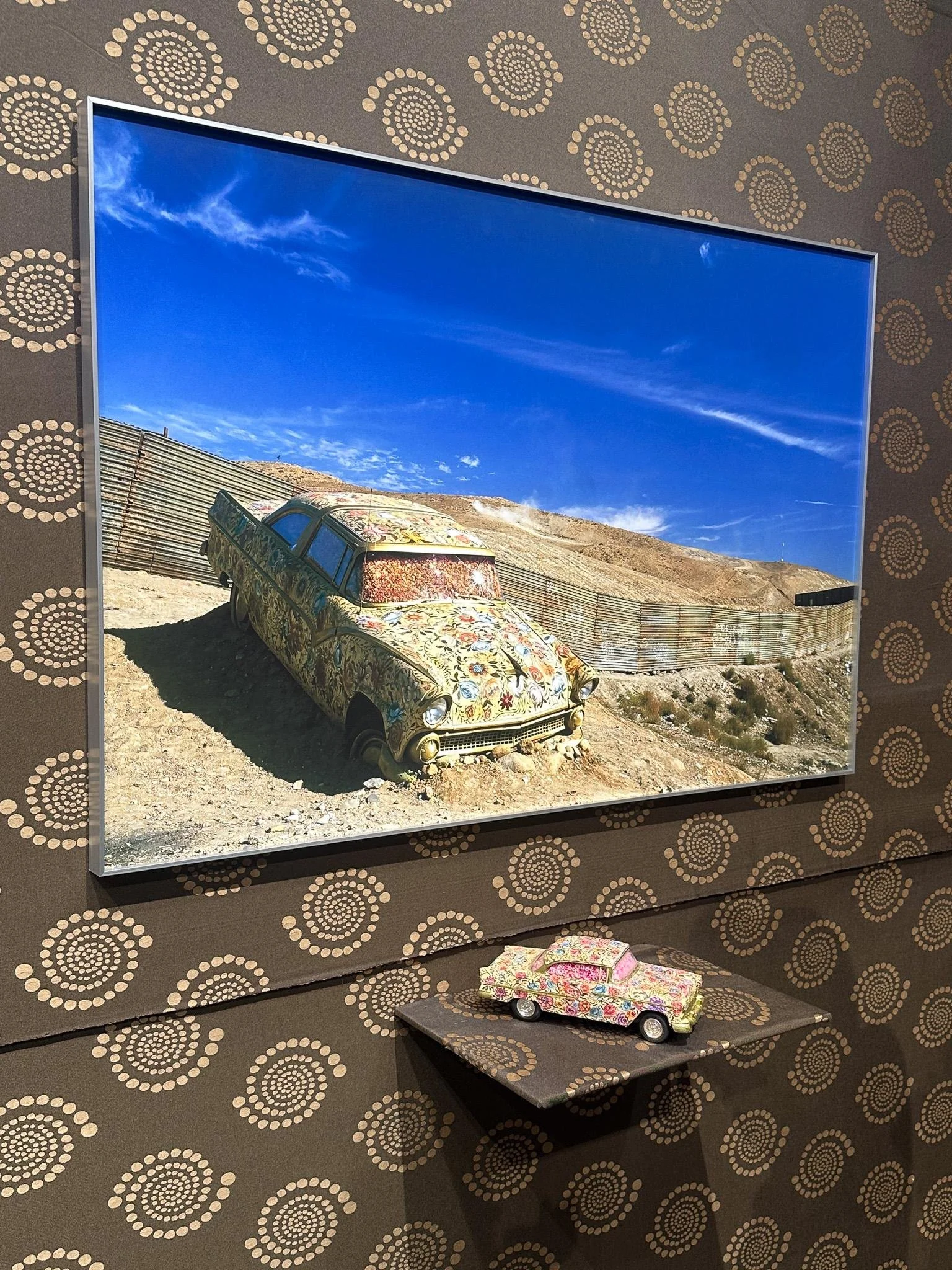
Betsabee Romero Ayate Car, YAM Gallery. Photo by Jamie Lubetkin
Mindy Solomon
Yanira Collado
Yanira Collado was awarded the SAUER Art Prize, which is presented to an artist featured in the Focus section. Her works, which hang on the walls, lean against them, and are installed on the floor of the booth, are primarily two-dimensional, but the artist considers them essentially sculpture. Constructed from materials including reclaimed literary texts, wood, concrete, textiles, iron, and drywall, the works emulate the walls of an old building that has been painted and wallpapered many times over several generations, with each generation leaving a little bit of themselves behind. They function almost like urban archaeological sites, revealing layers of history, use, and human presence. In this way, Collado transforms the remnants of everyday spaces into beautiful sculptural objects.
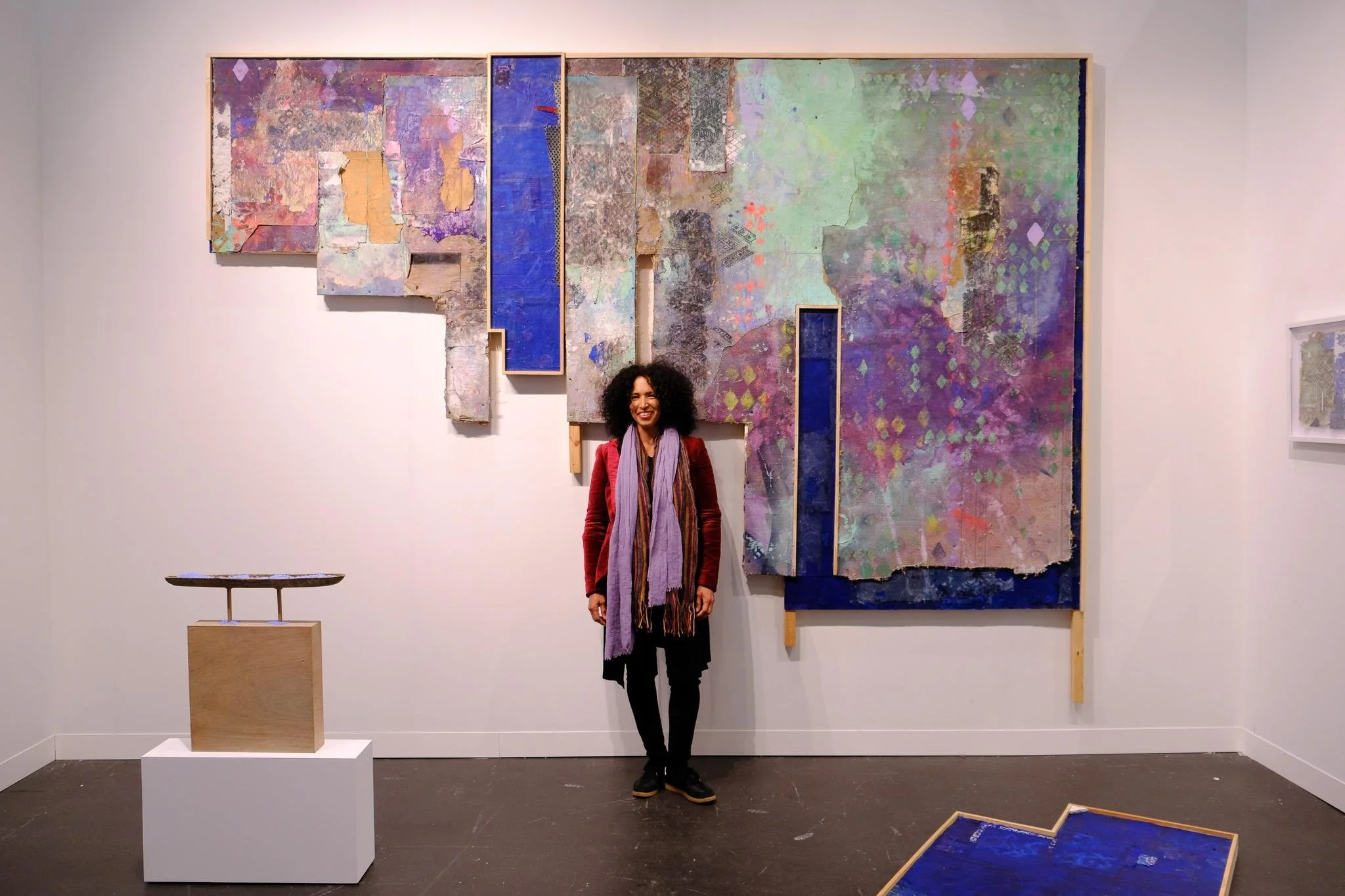
Yanira Collado, Artist and Booth.Presented by Mindy Solomon. Photo by Jamie Lubetkin
Hollis Taggart
Pablo Atchugarry
Atchugarry is a Uruguayan sculptor living in Italy who hand-carves amazingly complex, fin-like sculptures from Carrara marble, the same marble famously used by Michelangelo and Bernini. Hollis Taggart is presenting Untitled, a white marble sculpture from 2026. The booth is also presenting three rare drawings by Jean-Michel Basquiat and Jackson Pollock.
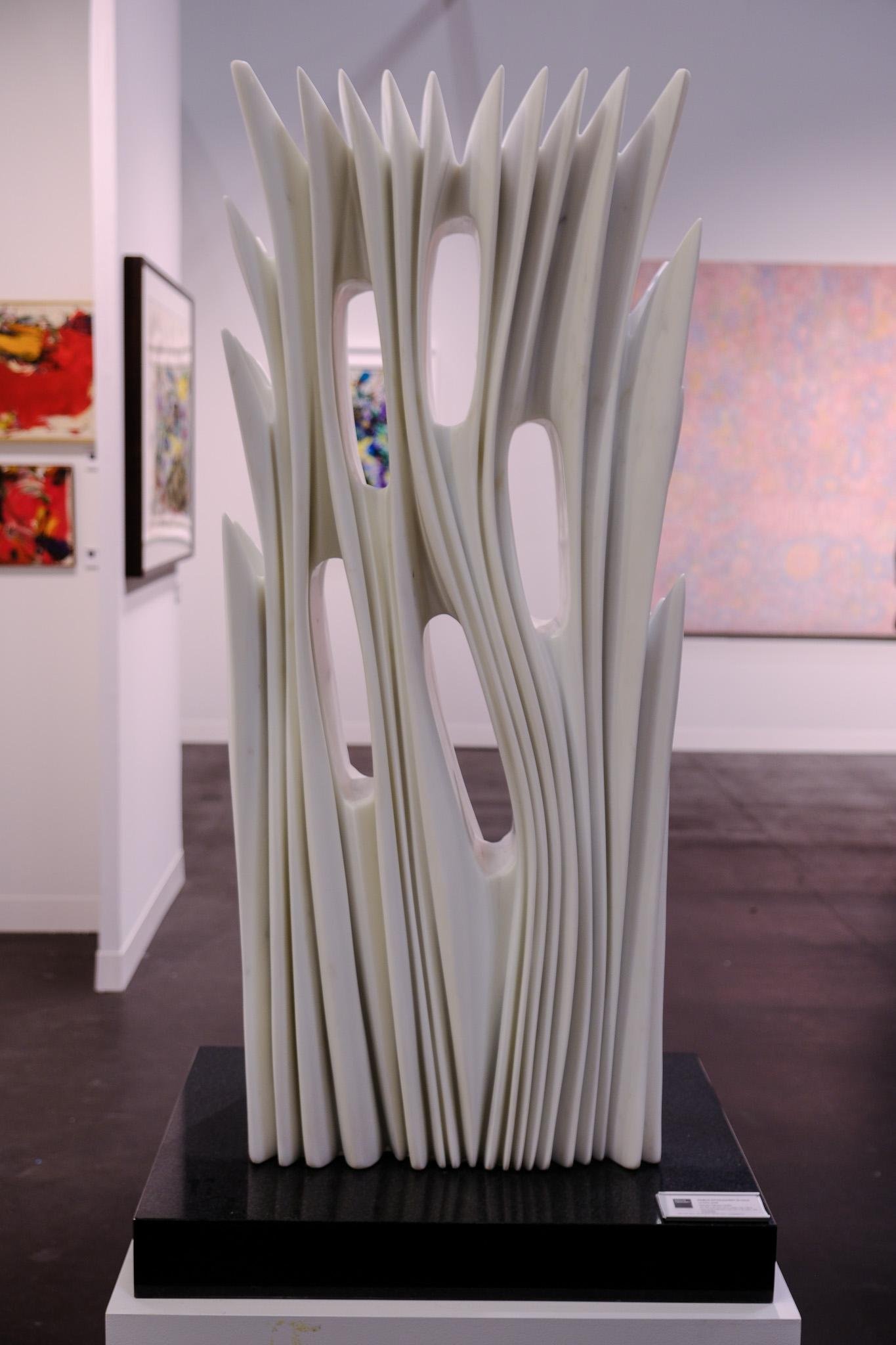
Pablo Atchugarry, Untitled. Presented by Hollis Taggart. Photo by Jamie Lubetkin
Kaliner
MaryKate Maher
Maher, a Philadelphia native, received her MFA from the Pennsylvania Academy of the Fine Arts. Kaliner is presenting a series of her colorful collages and sculptures that move between landscape, bodily forms, and geological fragments. Throughout her work, Maher uses magnified photographs focused on smooth transitions, contrasting them with recycled found materials to create enigmatic, otherworldly works. The combination of photographic imagery and unexpected materials creates a sense of transformation, leaving the viewer to wonder where the physical world ends and the imagined one begins.
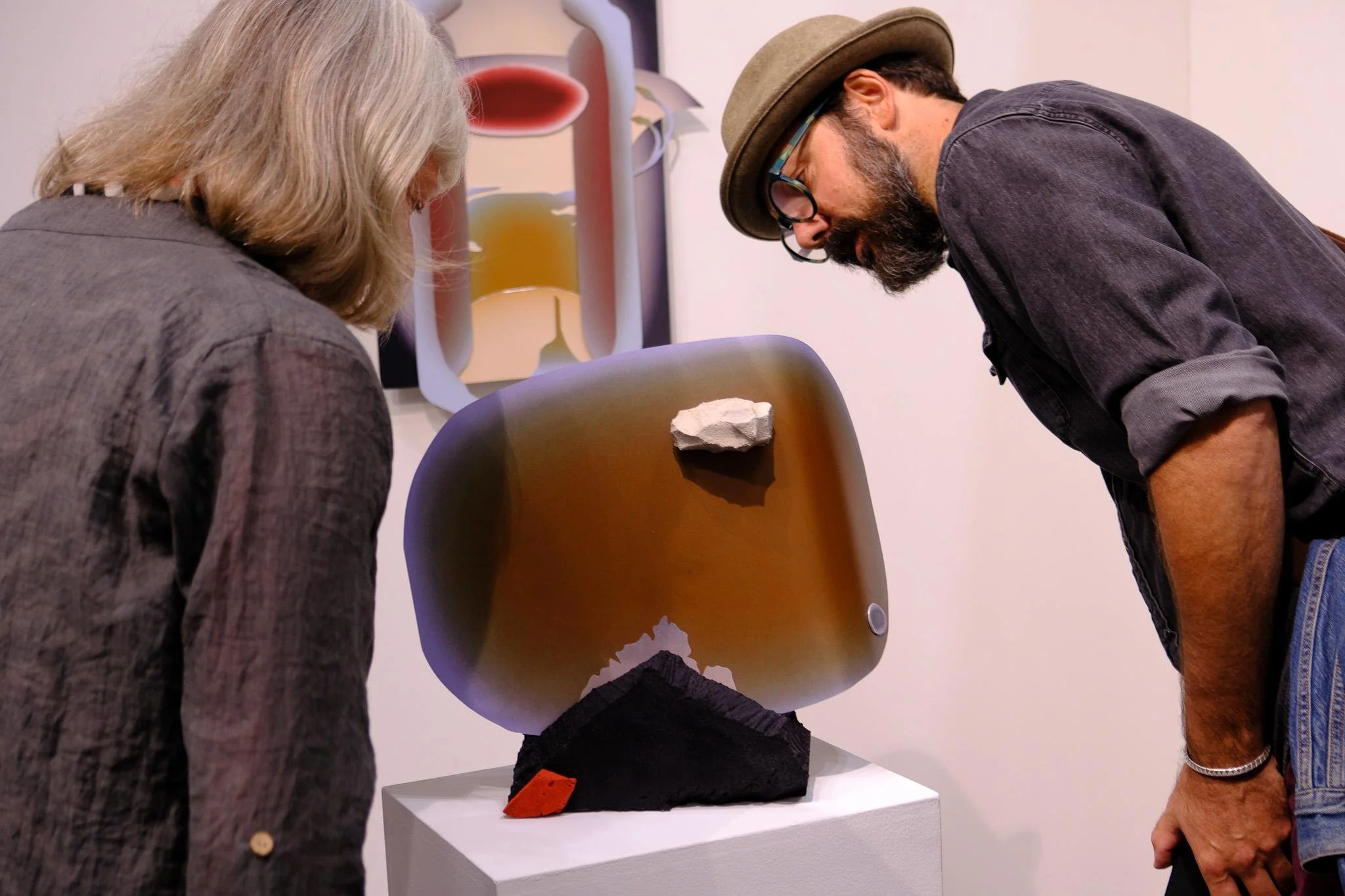
MaryKate Maher. Presented by Kaliner. Photo by Jamie Lubetkin
Massey Klein
Jude Griebel
Griebel’s freestanding sculpture Untitled (essential to all living things) is a Giacometti-esque figure constructed from wood, air-drying clays, bio-resin, glass, and acrylic. The thin, humanoid figure’s torso, arms, and legs appear to be made of dripping water flowing from a water spigot. Another sculpture depicts a dark, toxic rain cloud that creates a river of water and pollutants, merging with natural objects to form the shape of a human figure. Griebel’s sculptures explore our relationship with the natural world and the consequences of consumerism, encouraging us to consider our patterns of consumption and their impact on the environment.
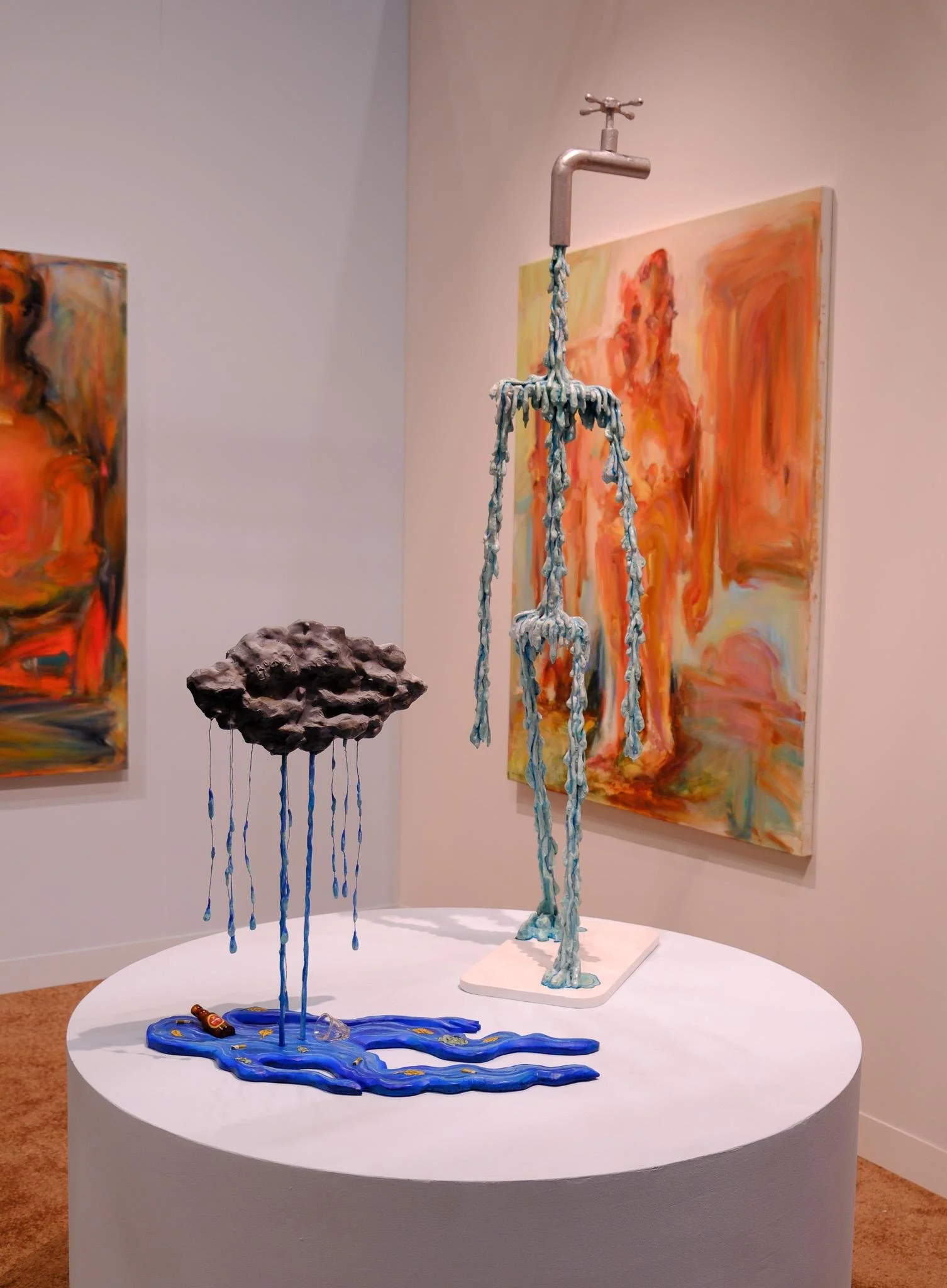
Jude Griebel Untitled (essential to all living things), Gutter Puddle. Presented by Massey Klein. Photo by Jamie Lubetkin
Bruce Silverstein
Brancusi Photos
Although Bruce Silverstein is primarily a photography gallery and did not exhibit any sculptures, I have included its presentation because of its photographs by Constantin Brâncuși (1876–1957). A pioneer of modern sculpture and often considered the father of minimalist sculpture, Brâncuși spent his later years not creating new sculptures but arranging and rearranging his studio and photographing his work. The photographs presented by Bruce Silverstein are the result of this ongoing project, documenting not only the sculptures themselves but also the way Brâncuși chose to present and view them within his studio.
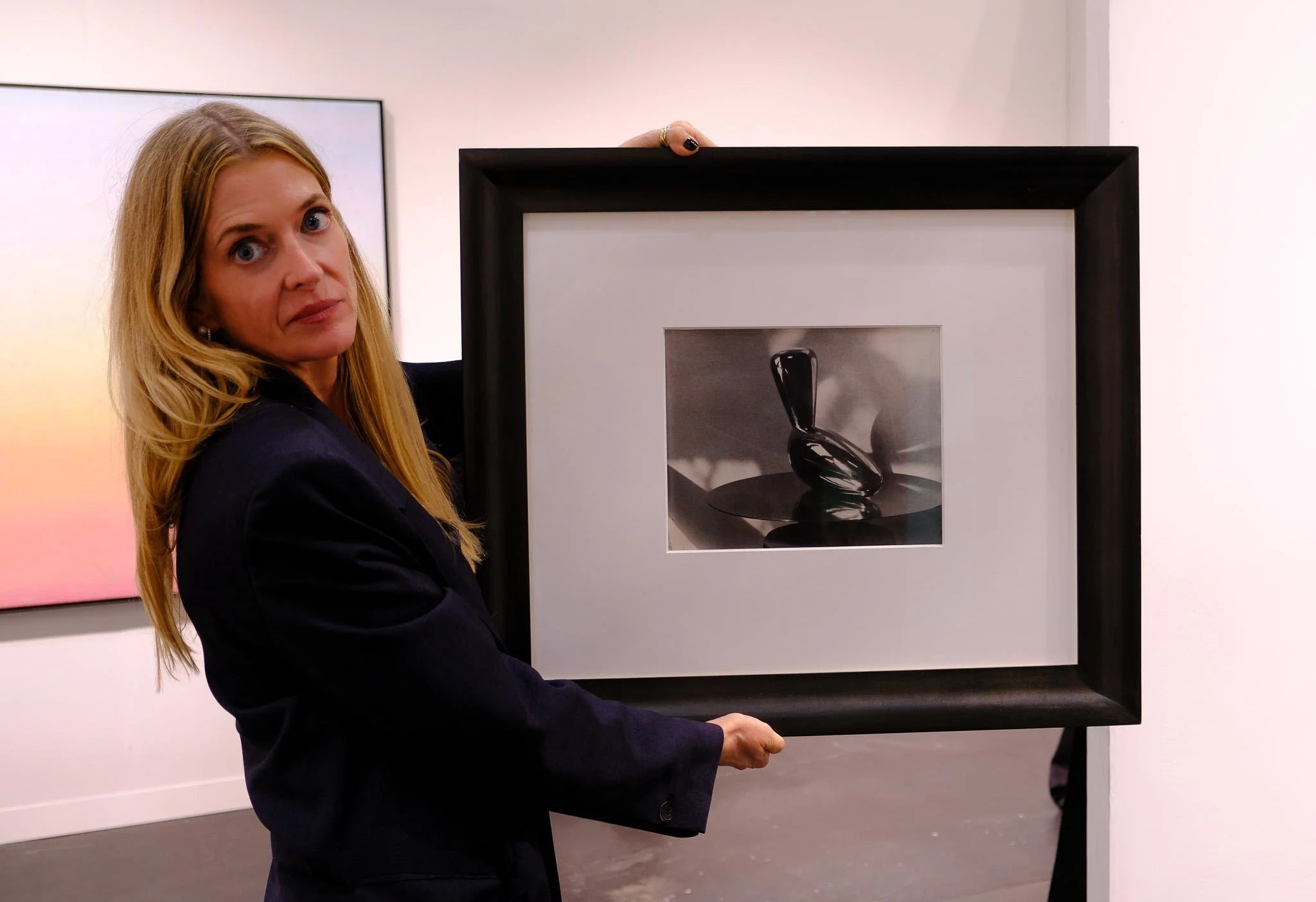
Constantin Brâncuși Léda. Presented by Bruce Silverstein Gallery. Photo by Jamie Lubetkin