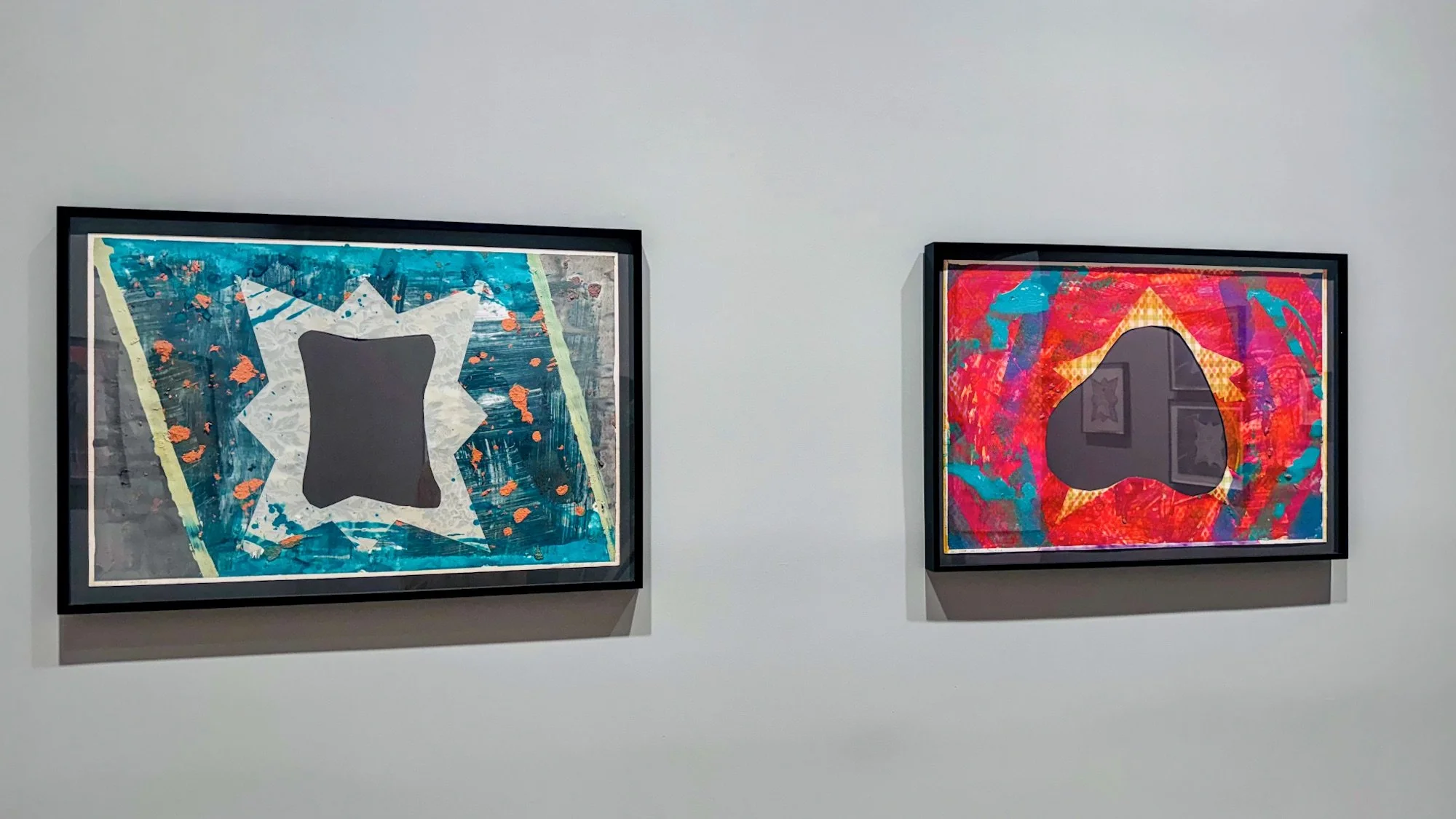
Installation view, Mike Kelley: Jerry Meandering, Hauser & Wirth New York, 2026. Photo: Lauren Ball.
The empty centers of Mike Kelley’s Untitled (Collages 1974–2011) hold something back. Around them, painted plots and chutes of color and patterned paper extend in several directions, describing the essence of objects resisting form: a stone in a field, a picture frame, or absence itself. Their surfaces carry an apparent speed, but looking slows to a dense, hovering idle in the middle, a space that becomes a place to covet. The longer I looked, the more interconnectedness these centers allowed, both pictorially and in my own mind. I was photographing Kelley’s Jerry Meandering works on a wondrous fall day in New York in the first of two rooms of the exhibition. In the adjacent gallery, I found an apt curatorial juxtaposition: Harmony Korine’s paintings in UX LAM depicting luminescent bodies-as-vessels. Korine’s streaming colors felt connected to the dragged acrylic rays jutting from the centers of Kelley’s works. I found my face reflected inside one of the openings along with the bodies and faces of other viewers in the gallery, and I enjoyed the curiosity of it. At first, I felt as if I wasn’t supposed to be looking at the proverbial dead center; however, a closer look at the central blank spaces revealed Kelley to have considered edges, while delicately and imperfectly removed. The Surrealism nibbled at me.
Jerry Meandering, presented in collaboration with the Mike Kelley Foundation for the Arts, places in dialog prints, mixed-media drawings, and collages that originated during Kelley’s undergraduate years at the University of Michigan, Ann Arbor, from 1972 to 1976, alongside early works he later altered. The dimensions encourage various kinds of proximity: an Untitled (Student Drawing) measures 7 by 6¼ inches, while one Untitled (Collages 1974–2011) measures 24 by 36 inches. The encounter moves between the intimacy of a notation and the expansive reach of a painted construction, as Kelley’s brushstrokes and broad washes meet the finest etched lines, giving the works a rhythm as precise as it is powerful. Born near Detroit in 1954 and based in Los Angeles until his death in 2012, Mike Kelley was an artist, musician, and writer whose work took Pop and Conceptual art into a contemporary arena where trauma, repressed memory, and anti-aesthetics commingle. In these collages, returning to an earlier painting becomes a way of troubling its history. The cuts preserve enough to suggest what was there while making something else possible.
The collages have a decoupage quality, assembling visual worlds whose differences remain visible: crude cuts against delicate printed paper, a cut-out, a centralized black anti-form, and fragile geometry throughout the compositions. In another Untitled (Collages 1974–2011), a blue-and-white ornamental border follows the points of an irregular star. Inside, green and turquoise textures resembling stenciled mesh meet orange, staccato horizontal lines and a heavily textured violet triangle extending from the left side of the star-frame. A square opening interrupts the arrangement below and to the right of its apparent center. The star points outward and expands while the square concentrates, as organic gestures turn to a dark empty space.
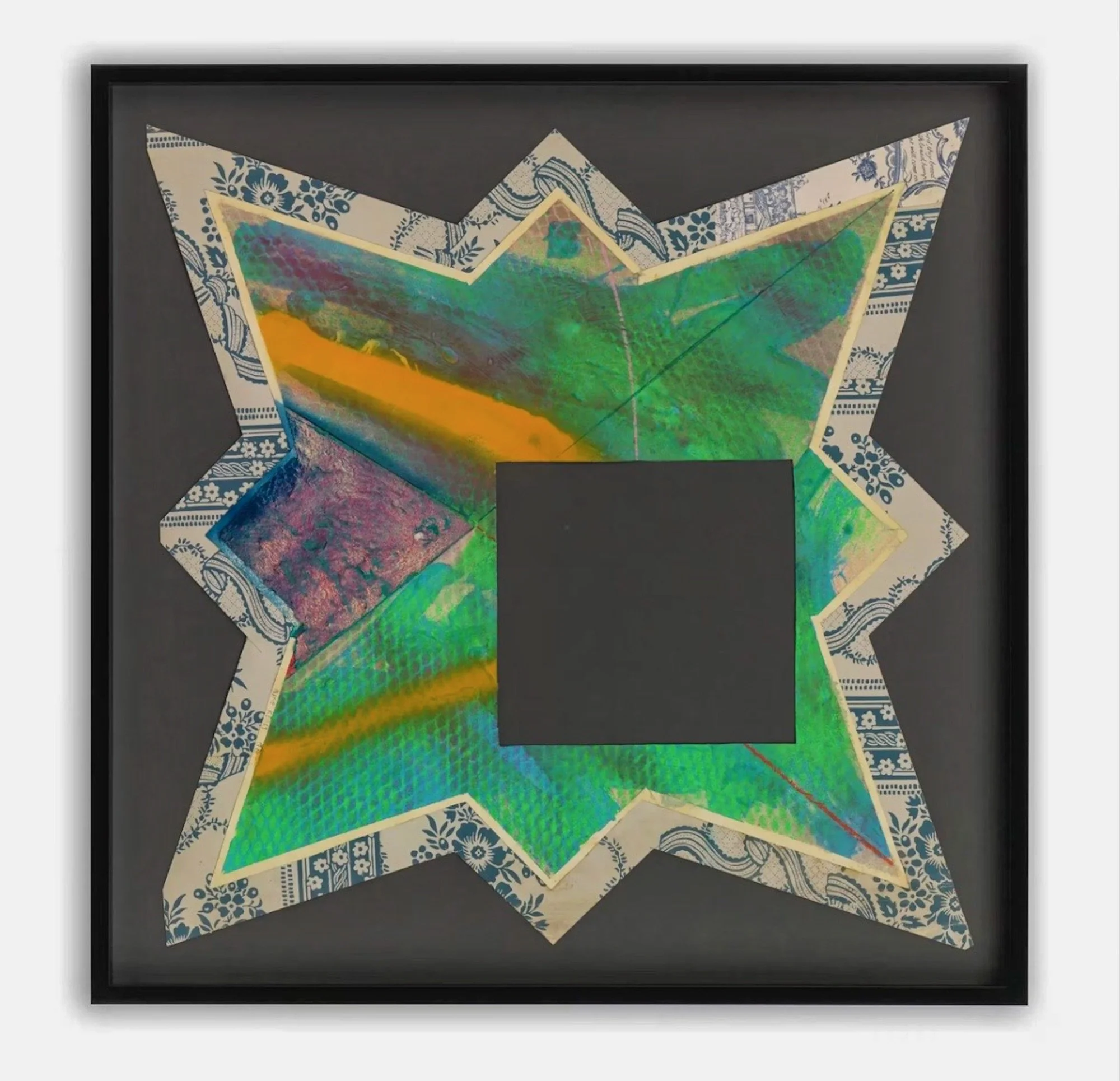
Mike Kelley, Untitled (Collages 1974–2011), 1974–2011. © Mike Kelley Foundation for the Arts. All Rights Reserved/VAGA at ARS, NY. Photo: Stefan Altenburger Photography Zürich
The stars and paper constructions reintroduce my own cultural memory of an elementary public school classroom poster board, divided into sections with fading pieces of construction paper of the same hue, with neighboring students tracing the silhouette of a single object, giving even a small form a sentimental presence. Whether a picture frame, portrait, or mirror, the isolated animate or inanimate object—and these often feel like both in these works—holds meaning. All that’s missing is the corrugated scalloped border, although in several of the works a crudely cut border does appear. Harshness begets touch, while graphic media begets delicate floral imagery. The matte black of the innermost paper layer of Untitled (Collages 1974–2011) sits stoically in the surrounding color, like a protective, darkened shell. Kelley himself described going back to his college paintings as “like going home in shame.” John Welchman, who has written extensively on Kelley, said in a talk with Kelley beside him that Kelley was drawn to the idea, from Freud and from George Boas, whose The Cult of Childhood appeared in 1966, that art is “the recovery of childhood.” That idea carries a paradox. A child who is free of repression would have nothing to recover and nothing to be freed from. The collages don’t look childlike so much as they look like a reach back toward a state that was never free of anything.
The fitting together of Kelley’s painted and patterned fragments brings Miriam Schapiro’s femmages to mind. In Schapiro’s paintings, fabric carries its domestic history into the image. Saving, cutting, and piecing become pictorial decisions, making visible the labor and aesthetic judgment that the dismissal of women’s work had obscured. In a HENI Talks film, Robert Storr says that Kelley fed on feminist art and wanted “a masculine version of what feminism did.” In his account, Schapiro’s “femmage” reversed the connotations of women’s work and raised up what had been dismissed, giving Kelley an affinity for the handcrafts women predominantly make. That affinity appears in his use of crocheted and knitted objects. The originals of these collages were made in Ann Arbor, before Kelley moved to Los Angeles in 1976. Schapiro moved to California in 1967 and co-founded the Feminist Art Program at CalArts with Judy Chicago in 1971. I see a kinship between their reclamation of domestic materials and Kelley’s assembled surfaces.
In “Household Images in Art” (1973), Lucy Lippard exposed a double standard in the reception of Pop art: domestic subjects earned male artists recognition for innovation, while women using the same imagery would, she argued, have been dismissed as producing more genre art. The centered openings recall another part of that history. In their 1973 essay “Female Imagery,” Chicago and Schapiro articulated central-core imagery, connecting recurrent openings and surrounding forms in women’s art to female bodily experience, and their argument gave those forms an affirmative significance within a culture that devalued female sexuality.
Kelley’s compositions suggest tunnels, with sightlines that can draw the eye inward or send it outward. Across the center, the brushwork forms a diagonal chute from the upper left to the lower right, while the void evokes a primal anxiety. Moving through the works recalls the way people move through the memory of a real landscape or space, driven by social and psychological desire. Decorative paper that might belong in a Midwestern kitchen brings a dated, gendered history of domestic life into the work. The liveliness embraces the empty in these works, and the surrounding surface remains exuberant while the stillness of the black space holds back. The eye continues moving through the composition, even as the opening draws its attention. Kelley returned to student paintings and cut away portions, making new shapes and gaps from earlier compositions, and the opening holds a pause within that accumulated activity. Removal becomes a compositional decision with its own sufficiency. There is a sensitivity around solitude in these centralized embryonic fortresses, guiding a surrounding gaze without becoming monumental. Elsewhere, colored blobs begin to articulate something almost Matissean. What might be an uneasy relationship between the wallpaper and the painted forms is made easy by Kelley’s painting over and integrating some of the existing patterns, complementing the pure tactility of the paper and paint.
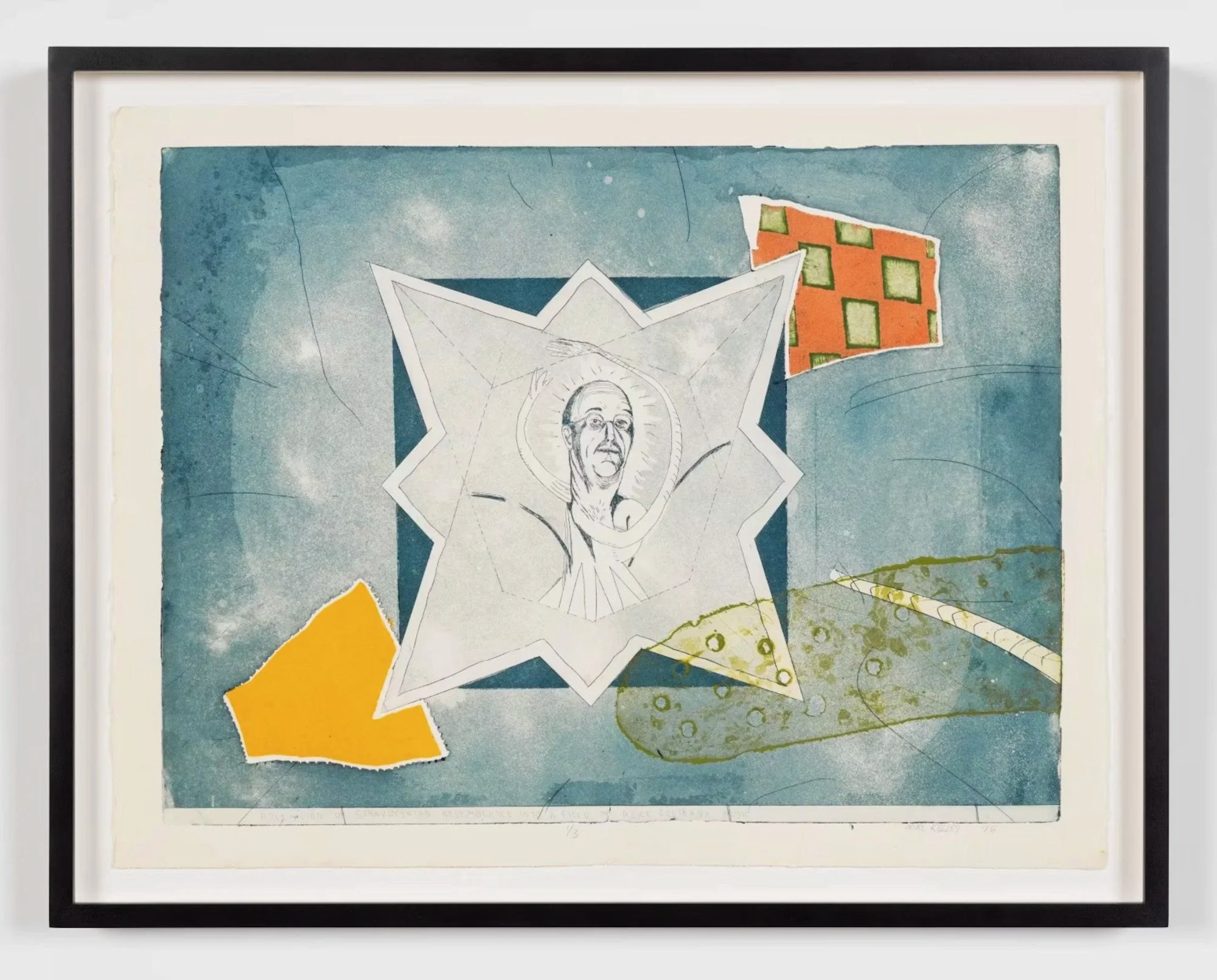
Mike Kelley, Ascension of Stravinskian Resemblance into a Field of Alice Coltrane Music, c. 1976. © Mike Kelley Foundation for the Arts. All Rights Reserved/VAGA at ARS, NY. Photo: Roger Edwards
The prints introduce another rhythm of making. Jerry Meandering / Mr. and Mrs. Ford at Play (1976) is a two-color etching with aquatint, measuring 19 by 12 inches. Aquatint is an etching technique that creates a granular surface on the printing plate to hold ink, producing tones ranging from pale washes to deep, velvety darks. Kelley’s fine etched lines show his utter command of drawing, with close attention to the smallest details alongside these broader fields. In Ascension of Stravinskian Resemblance into a Field of Alice Coltrane Music (c. 1976), a star surrounds a haloed portrait of the composer with his arms raised, recalling a saint within a mandorla. Kelley combines etching with spray paint, giving the devotional pose an informal setting. The star establishes a connection to the collages, where the border becomes part of the image it contains. In A Trip with the Teacher (1975), we gaze upward from a child’s vantage into the countenance of a caregiver or mentor and find a cigarette hanging out of their mouth—a premonition of unidealized adulthood, the moment when the mother, or the Madonna, falls from grace and the child grasps the parent’s humanity and glimpses their own fate.
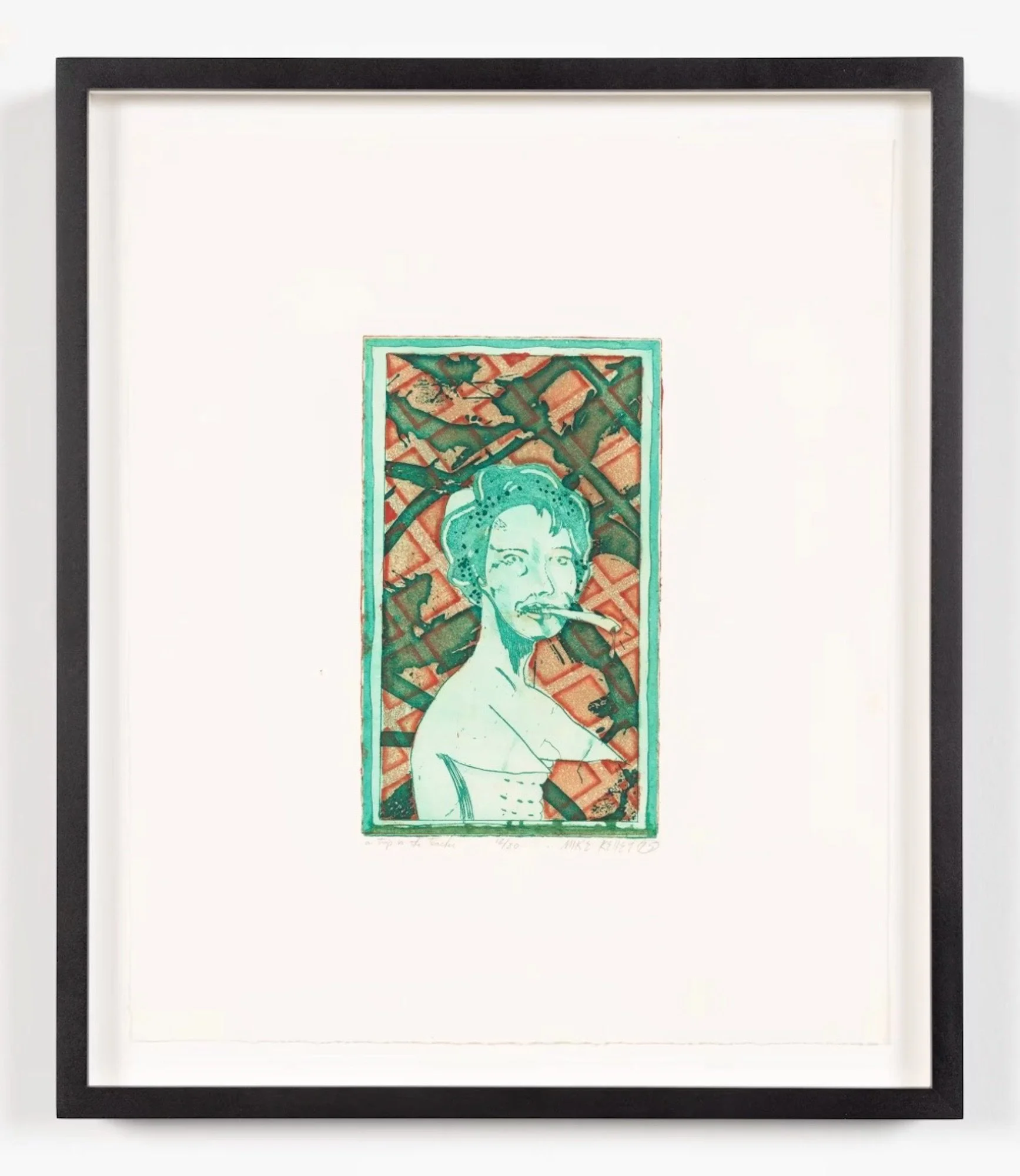
Mike Kelley, A Trip with the Teacher, 1975. © Mike Kelley Foundation for the Arts. All Rights Reserved/VAGA at ARS, NY. Photo: Roger Edwards
Robert Storr, speaking of Kelley’s crocheted squares and a candelabra of craft-store candles, saw in them an “enormous dedication to a futile gesture of love.” Having taken that in, I find these pieces altar-like. That is what the framing devices are doing here. Whether it is a frame, a mirror, or a star, each central shape holds a rooted presence, and its lines retain more meandering humanity than a graphic emblem would. Read as a futile gesture of love, or even of self-love, it becomes a recognition of our own humanity and existence, by way of memory and association, as the viewers of these works. According to the press release, the star motif recurs throughout Kelley’s early work, either framing the picture or forming the frame itself, and in these collages the star is both. One of the early modernist painter’s signature pictorial tools is a frame within a frame—as in Édouard Manet’s Portrait of Émile Zola (1868), where reproductions and a Japanese print surround the sitter.
Mike Kelley’s Jerry Meandering took me in. These compositions matter because they hold something back and still leave a viewer full. Pattern can approach agreement while keeping its unruly parts; an absence can sustain attention without asking to be filled. The radiating body opens outward, and the center holds back. For a moment, looking at the work, I was at its edge, looking in and seeing myself.
Mike Kelley: Jerry Meandering is at Hauser & Wirth, 443 West 18th Street, Chelsea, through January 16.