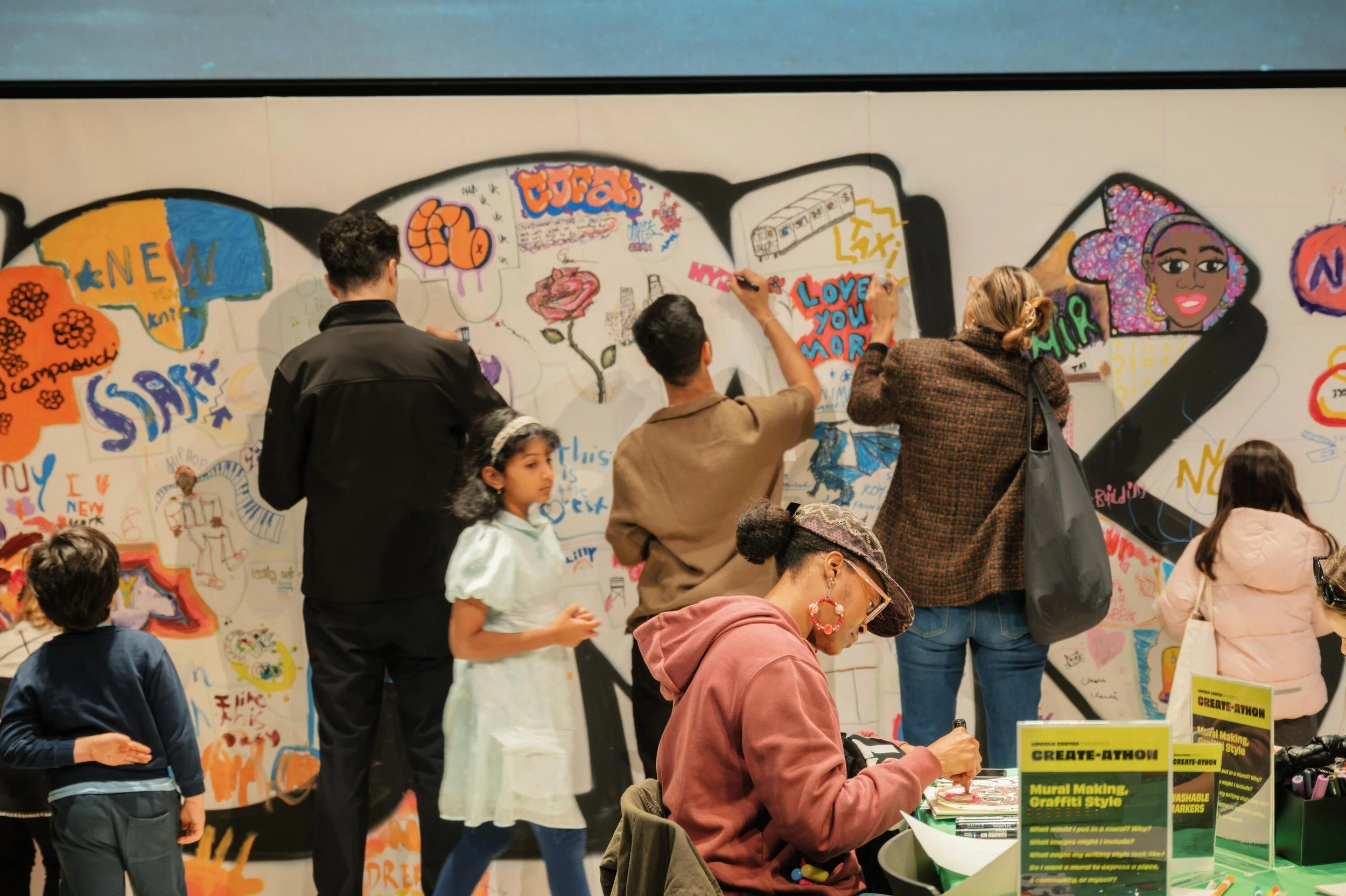
Fifty years ago, Chris "Daze" Ellis painted New York subway cars, illegally, in the dark. On Sunday afternoon, he taught the same art form in daylight, at Lincoln Center, with the institution's blessing.
Daze led Create-athon: Mural Making, Graffiti Style at Lincoln Center’s David Rubenstein Atrium, a free workshop in which participants drafted their own tags and designs onto paper, then integrated them into one large-scale collaborative mural. It’s part of Lincoln Center’s outreach to new audiences and the latest example of a mainstream institution embracing street art and its graffiti roots.
In an interview with UP, Daze said that while he is hardly a novice at teaching art, the setting for this session was new ground for him. “I haven’t really done anything like this with an institution as prestigious as Lincoln Center. So, in that way, it’s a first,” he said. Asked if he could have foreseen such an event decades ago when he was painting illegally in train yards, he chuckled. “No, I could never have imagined that I’d be doing something like that in a place like Lincoln Center. … Forty years ago, something like this would have seemed completely out of my grasp.”
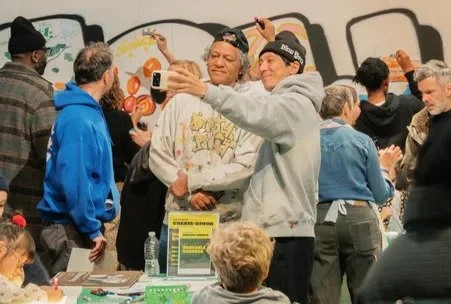
Daze poses for a selfie with a participant of Create-athon at Lincoln Center. Photo: Lawrence Sumulong
John Holyoke, Lincoln Center’s Associate Director, said Daze was chosen on a colleague’s recommendation, for a few reasons: “He’s been at it for such a long time. He is graffiti history. … Not only does he have virtuosic experience creating murals, but he has a lot of experience helping other people make murals,” he said.
Holyoke put the session in the context of a wider shift at Lincoln Center: “So much great art just kind of rises up out of the street. I mean, arguably, most great art ultimately comes from the street at one point or another,” he said.
Daze came to Lincoln Center just two weeks after another venerable Midtown institution closed a major embrace of a street-rooted artist. Kenny Scharf’s Scary and the Dancers!, a center-wide exhibition presented by Art Production Fund and Rockefeller Center, ran October 9 through November 1. Scharf’s largest public installation to date, the exhibition included a 34-foot inflatable creature surrounded by six dancing sculptures. Every Saturday in October, Scharf led free workshops where children painted planters inspired by his Living Sunshine Caverns, and their finished works were displayed at Rockefeller Center.
So what you have here is two of New York’s most respected uptown stages, weeks apart, handing their floors to artists who came up outside the museum system and asking them to teach young people how to do it. These are just the latest examples of the loving embrace being extended to street artists by mainstream public institutions.
Daze’s career tracks graffiti’s march from subway yards to the most elite venues in the world. Born in Brooklyn in 1962, he took up writing at 15 on the 1 and 2 lines. At the High School of Art and Design, he met other writers like DON1 and Lady Pink. He helped found the Crazy Young Artists crew as part of the second-generation writers following Blade, Lee Quiñones, PHASE 2 and many others. He has said his street art carried a single message: ‘Hey I’m here and I exist.’
In 1980, Daze first painted on canvas at the Graffiti 1980 Studio, where Sam Esses gave writers two-month residencies and materials. The next year, Beyond Words at the Mudd Club, put together by Fab Five Freddy and Futura, was his first group show, followed by his first solo show at Fashion Moda. He showed with Crash at Sidney Janis in 1984, and kept showing — most recently Orchid Rain on the Underground at P·P·O·W in spring 2026.
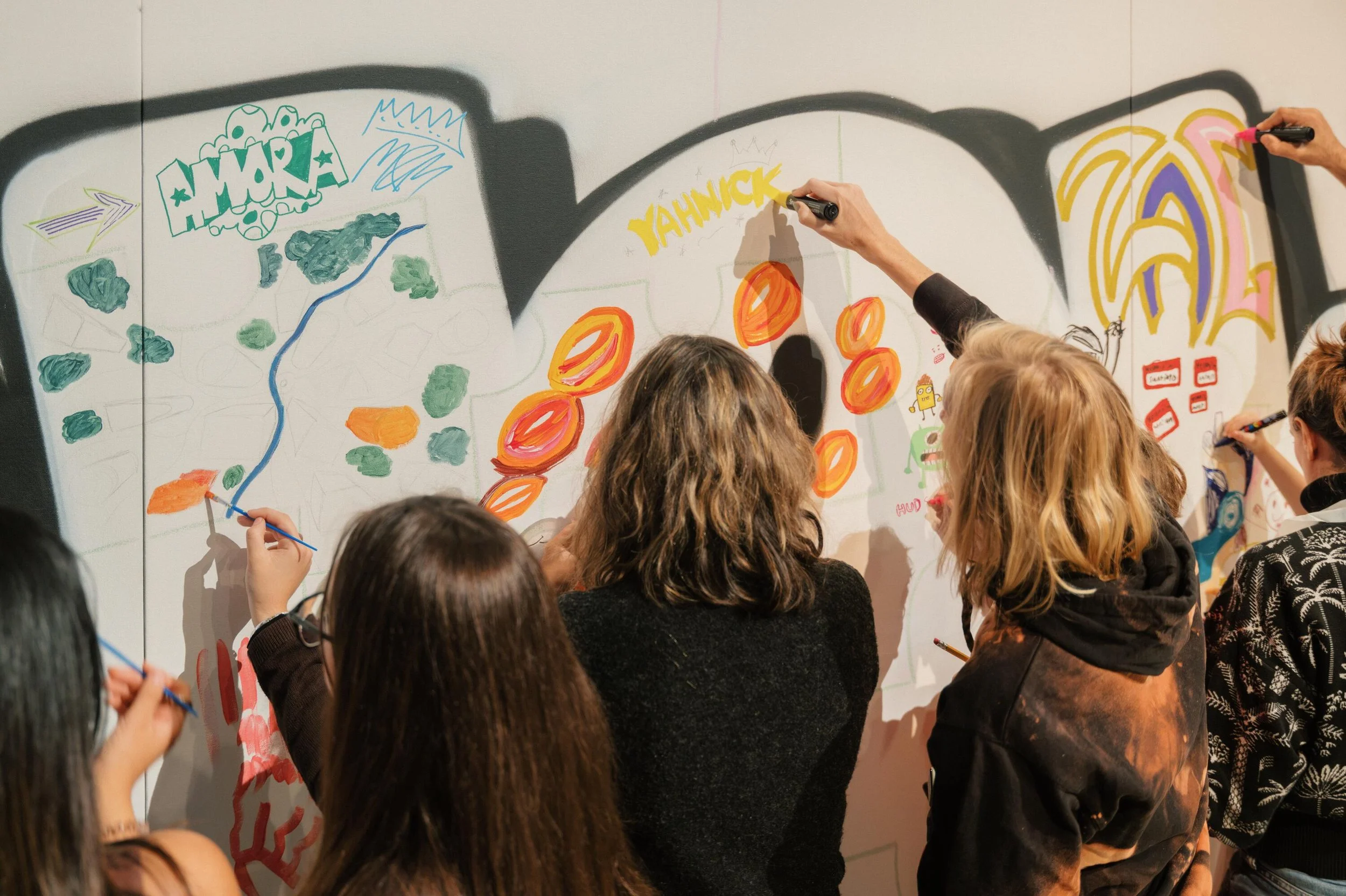
Participants working on the mural at Create-athon: Mural Making, Graffiti Style at Lincoln Center’s David Rubenstein Atrium (Courtesy of Lawrence Sumulong)
In remarks quoted by P·P·O·W in 2022 for its 2022 show Give It All You Got, Daze examined the differences between subway writing and creating art on canvas: “The subways were a perfect venue for painting because when you make a painting in your studio, unless someone buys it right away, you tend to live with it for a long time and it becomes a part of you. But with subway painting, it was much more immediate in that you would go out and do something and then that would be it… It would take on a life of its own and it would travel throughout the city.”
His sanctioned work is in the permanent collections of the Whitney, MoMA, the Museum of the City of New York and the Ludwig Museum. He has created a mural in Hong Kong’s Star Ferry Terminal; in 1995 he designed a train station in Hannover, Germany, with Lee Quiñones and Crash. He has taught students since 1994 in New York, Seoul, Baton Rouge, Rio de Janeiro and many other places.
At Lincoln Center, Daze said he tried to highlight a bit of the graffiti-writing process along with a bit of its zeitgeist. “I don’t look at the participants as assistants in this mural, it’s more like a door that they can walk through and gain experience,” Daze said. “Just look at this as your study. Just make all the mistakes on paper so that when you go up to paint and realize your thing, all the mistakes would be worked out.” The paper studies were the reference, he explained, like the drawings in a writer’s black book that get translated onto a wall.
Only Daze used spray paint, a water-based acrylic spray paint. Everyone else used acrylic paint, tempera paint and Posca markers. “Spray paint is like playing a guitar. You can’t just pick up a can and expect you’re going to get great results, the same way with a guitar,” Daze said.
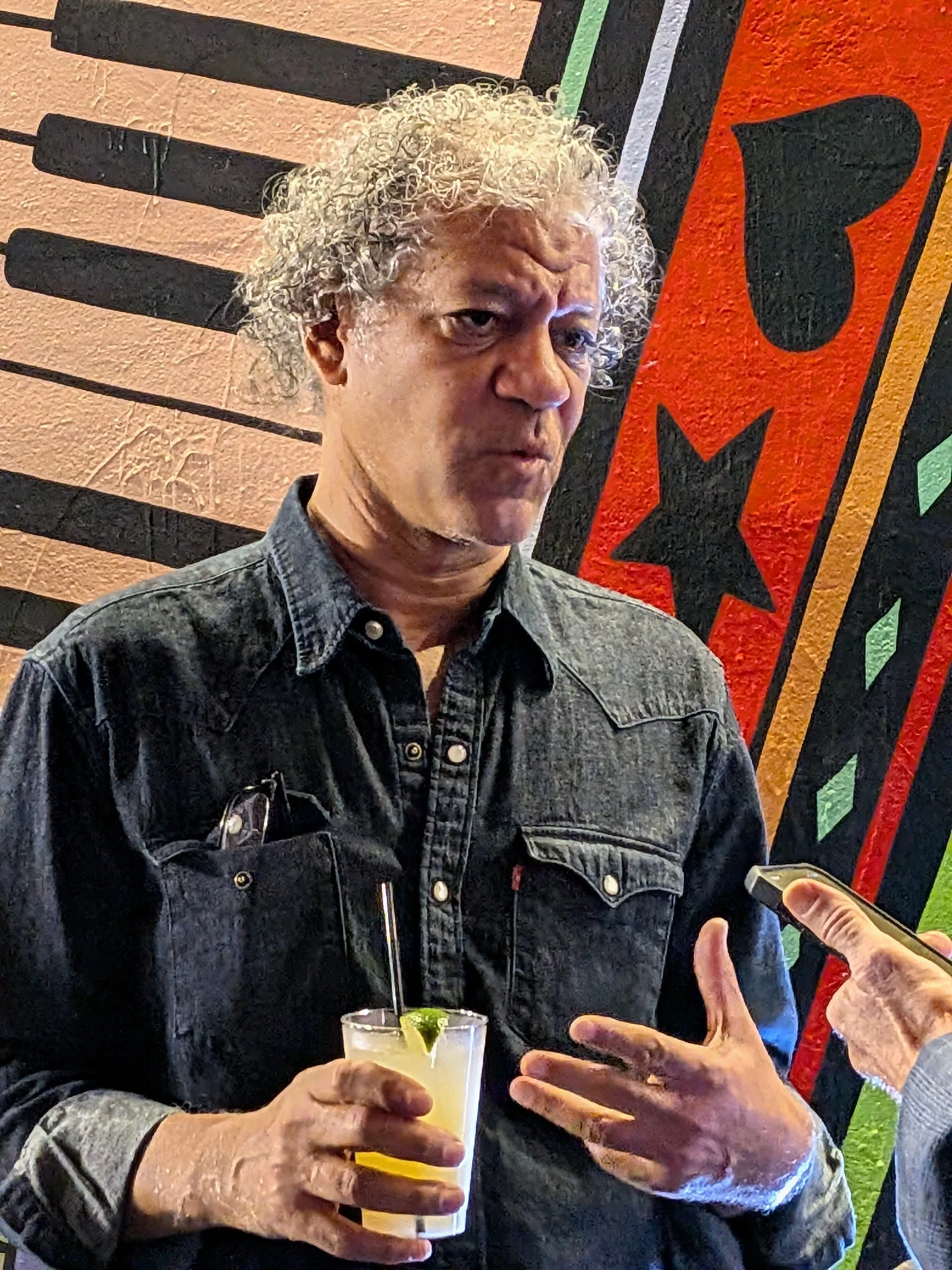
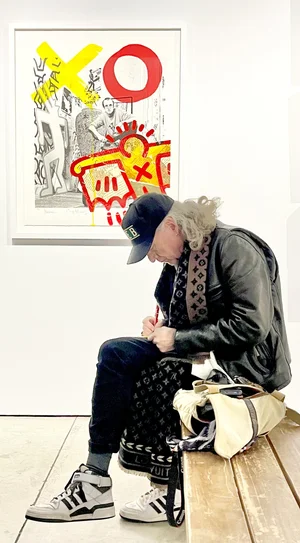
Daze at Wynwood Walls last year. Photo: Lisa Freeman
The mural at Lincoln Center’s David Rubenstein Atrium takes shape. (Courtesy of Lawrence Sumulong)
Holyoke framed the point of the series itself in the same terms: “It’s a chance for people to come with their artist hat on to Lincoln Center, and make things rather than just see things.”
“If we’re for all New Yorkers, then all New Yorkers should be able to see themselves in the work that they see here. It’s a way for Lincoln Center can open up creative resources more widely to the community,” Holyoke said.
Despite being embraced by august institutions like Lincoln Center and Rockefeller Center, Daze said street art still has a way to go before its acceptance as a legitimate art form is complete.
“I don’t think it is completely accepted yet at all. We still have a lot of ropes to jump over and a lot of things that we still have to deal with. The mainstream recognition of what we’ve been doing seems to slowly be appearing and slowly starts to happen more and more. And people are more used to it now a bit.” he said.
On Sunday, Lincoln Center offered the public a free afternoon with a graffiti OG and a street art legend, two weeks after Scharf’s Rockefeller Center run ended. It was the latest statement that graffiti belongs in the room — not just as a guest, but as a teacher.