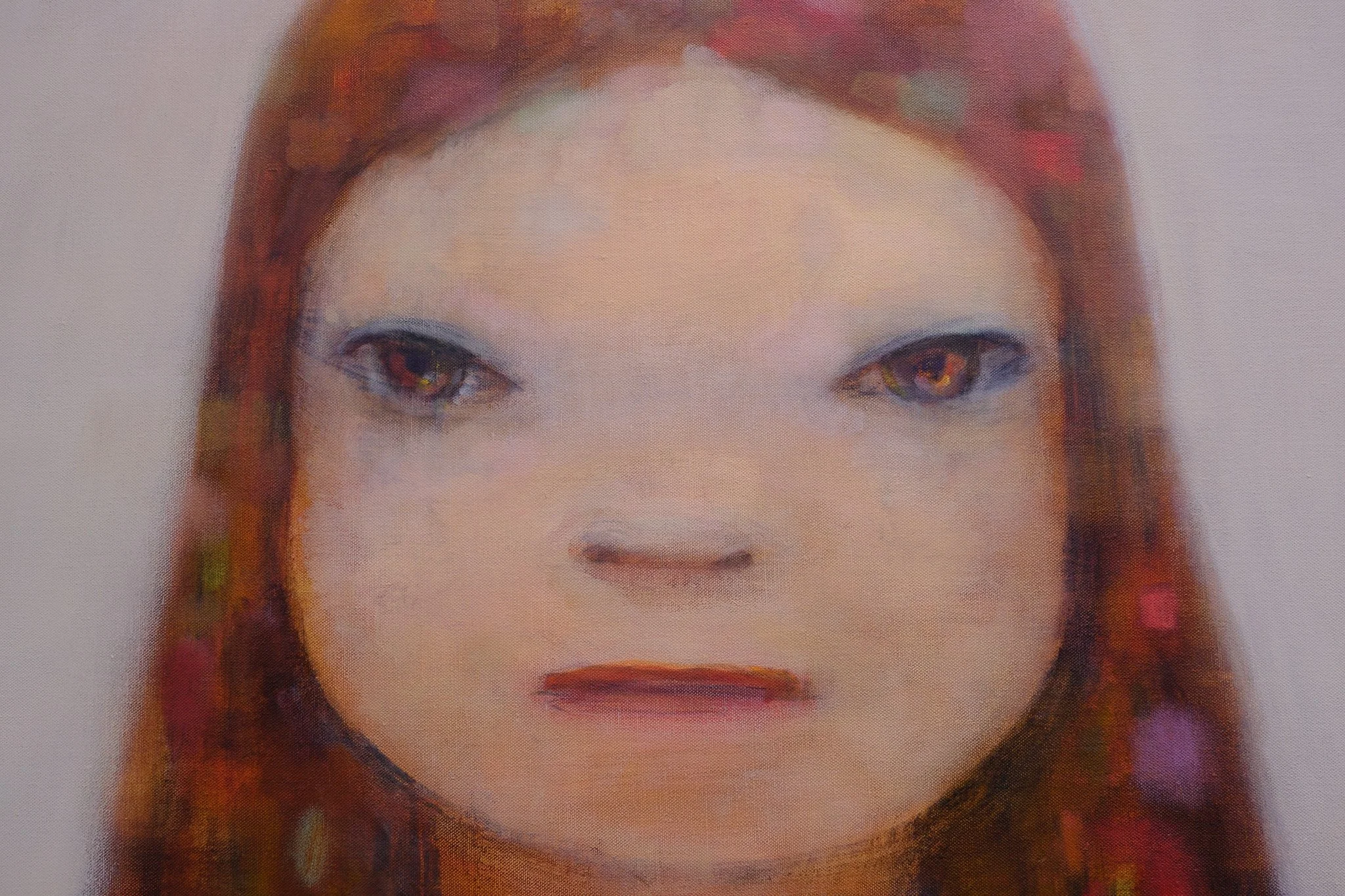
A closeup detail of After the Tears, 2026. Photo: Jamie Lubetkin
BY J. SCOTT ORR, November 5, 2026
David Zwirner has turned over two of his Chelsea galleries to Yoshitomo Nara, and the celebrated Japanese artist is using them to split himself in two.
At Zwirner’s 20th Street gallery, we find Nara the painter offering up a collection of startling new paintings and drawings along with a selection of earlier pieces he selected for the exhibition himself. Then, around the block at the 19th Street gallery, is Nara the sculptor presenting 13 monumental bronze heads, flat white, standing stoically in a white cube.
Yoshitomo Nara is the artist’s first solo exhibition since he left Pace and signed with Zwirner a year ago. It’s also his first major solo show in New York in nearly a decade. The bifurcated exhibition is not a retrospective; that’s coming next fall at the San Francisco Museum of Modern Art, but it is a career-spanning event that offers just enough of Nara’s past to give context to the newer work.
The new paintings, while rendered in Nara’s unmistakable style, are softer, quieter and more nuanced than the earlier work, but they are no less demanding. The subjects, his girls, still have oversized heads and doe eyes that stare you down with a mix of childlike innocence and grown-up determination, but they are presented in a more ethereal way. While the subjects in his early work seemed to appear starkly all at once, they have over the years become less and less eager to show themselves quickly. Today’s Nara girls emerge from layers of muted, washed color like faces recalled from distant memories.
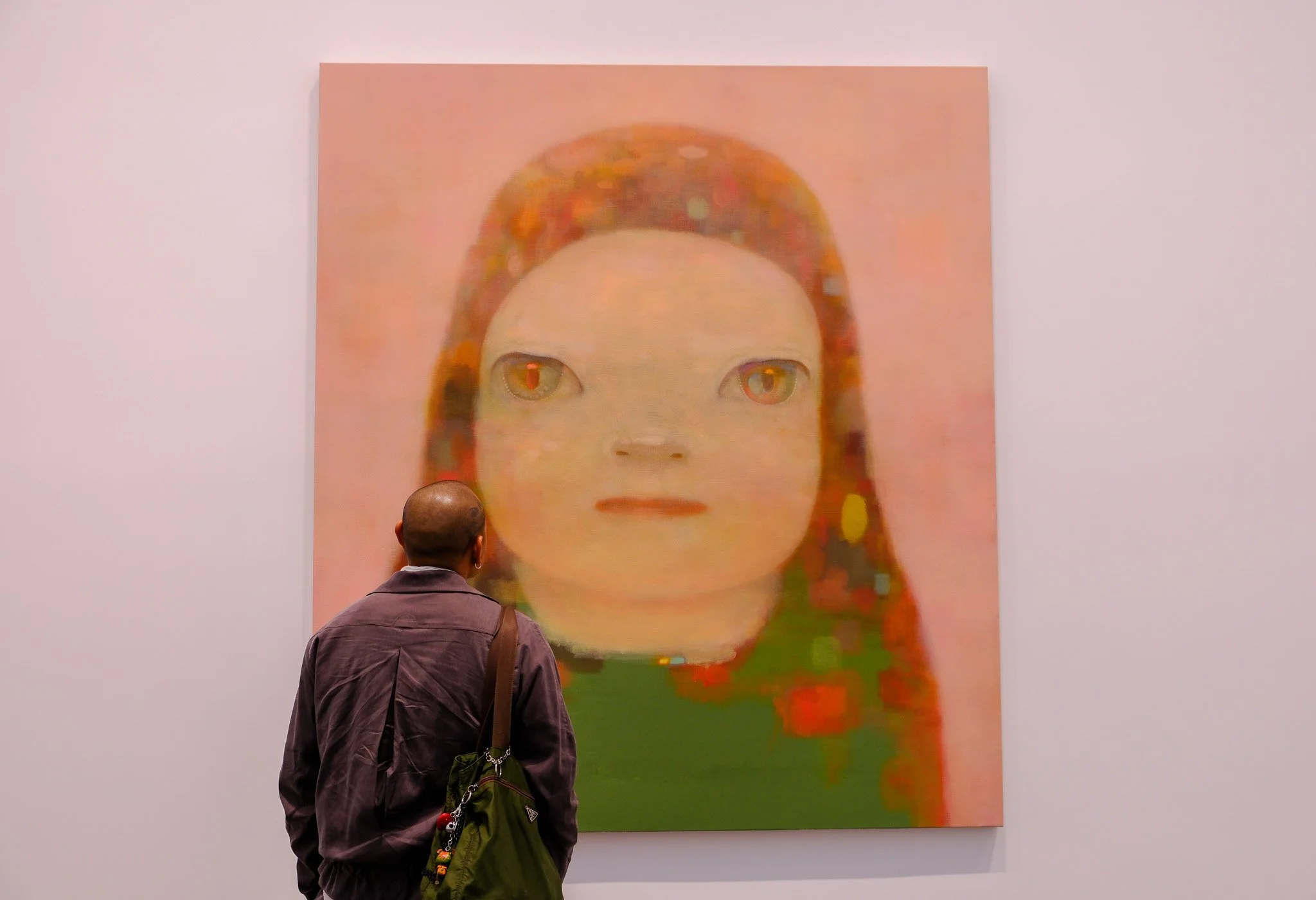
A man contemplates Matryoshka, 2026 Photo: Jamie Lubetkin
Take, for example, the 2026 painting Matryoshka. At first glance, it appears to be a typical Nara girl: long hair, ambiguous eyes, a stern, noncommittal countenance. Her eyes are outsized and staring as always, but now they have more dimension, they are alive with an orange highlight of reflected light and they are looking up, and slightly past the viewer. The girl appears behind a foreground plane dabbed with splotches of color—red, orange, yellow, green—like light refracted through raindrops on a pane of glass. It appears to be the next logical step after, say, 2017’s Midnight Truth or any of the others from that series.
Foggy Tale (2026) is like that too, but less so. The dabs of washed color are less pronounced, presenting mostly as a camouflage-like pattern across the girl’s long hair. But wait: her eyes are closed, a rarity for an artist whose legend is built around the gaze. Her expression is calm, confident, and, as always, ambiguous. She seems resigned, but unafraid, like she might be muttering “ok, whatever” under her breath. Compare this one with 2017’s Midnight Meditation for example, which also features closed eyes, and you see clearly where Nara has been heading, more shading, more dimension, much softer coloring.
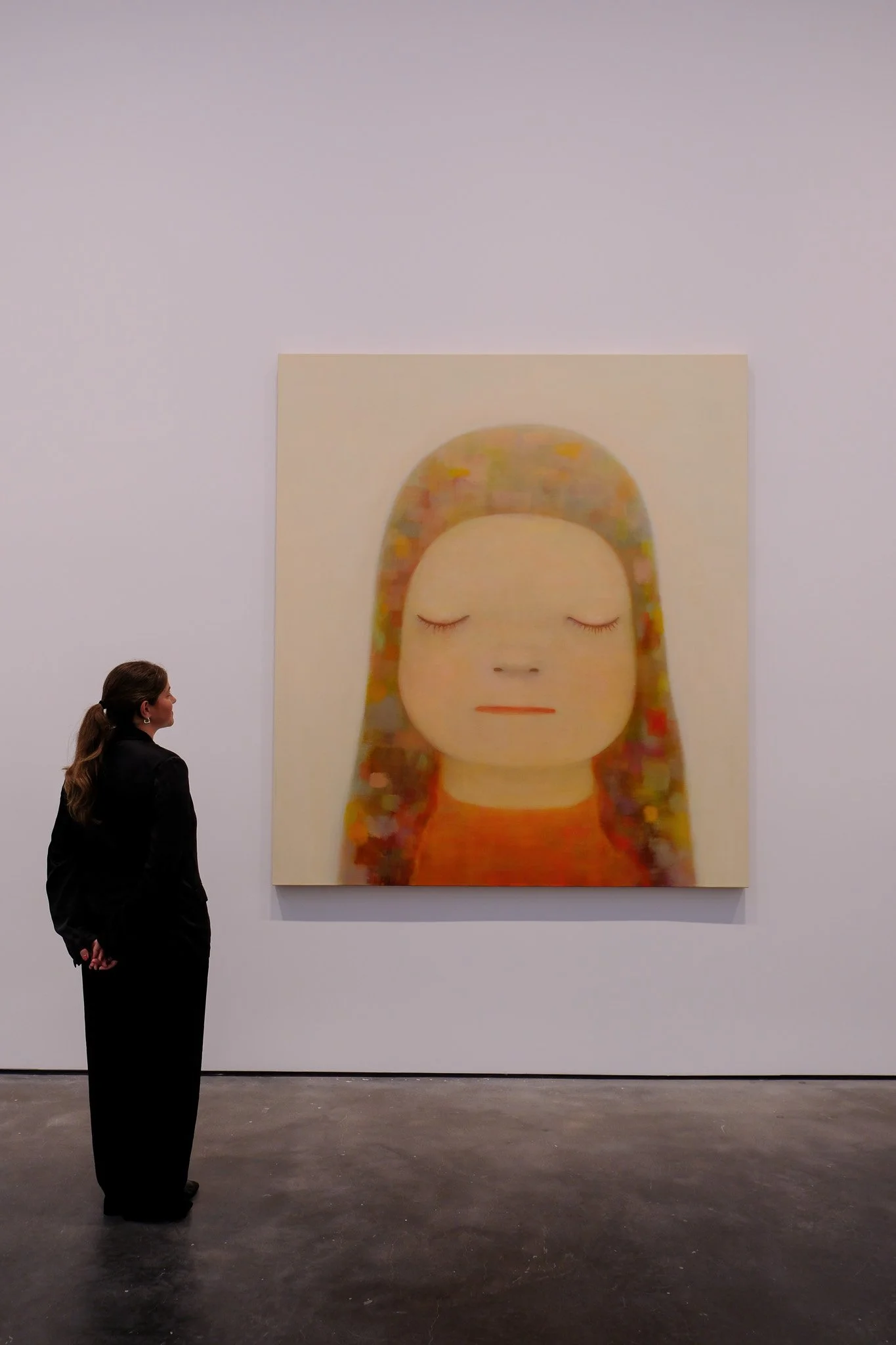
Foggy Tale, 2026, a rare Nara girl with eyes closed. Photo: Jamie Lubetkin
Compare these works with Nara’s 2000 masterpiece, Knife Behind Back, which sold at Sotheby’s in Hong Kong for $25 million in 2019, and you find a painter whose work has evolved, step by step, over 26 years. Where Knife appears in an instant, bold and stark on a pale background, newer Nara girls exist in a soft, fuzzy dreamscape. Where Knife's dress is one flat, saturated block of red, the newer girls wear tops in shades of green or orange that are stained and bled into. Where Knife's eyes accuse, the new eyes drift upward and fill with water, or slide sideways.
In its exhibit documentation, the gallery calls this “a sense of humidity and luminosity” flowing from a muted, low-saturation palette. “His figures on canvas emerge from richly atmospheric layers of soft, earthy colors. Through a process of repeatedly applying paint and reworking it, Nara searches for what is essential.”
Nara’s reliance on drawing as an integral part of his process is made clear via a pair of drawings from 1988, Untitled and Mother Dog produced before Nara arrived at the painting style that would make him one of the most successful artists working today. Studying with A. R. Penck, his professor at the time at the Kunstakademie Düsseldorf, Nara developed a simplified process in which he applied paint with the same freedom he used with pen and pencil in his drawings. This transition was critical to the deployment of Nara’s signature style.
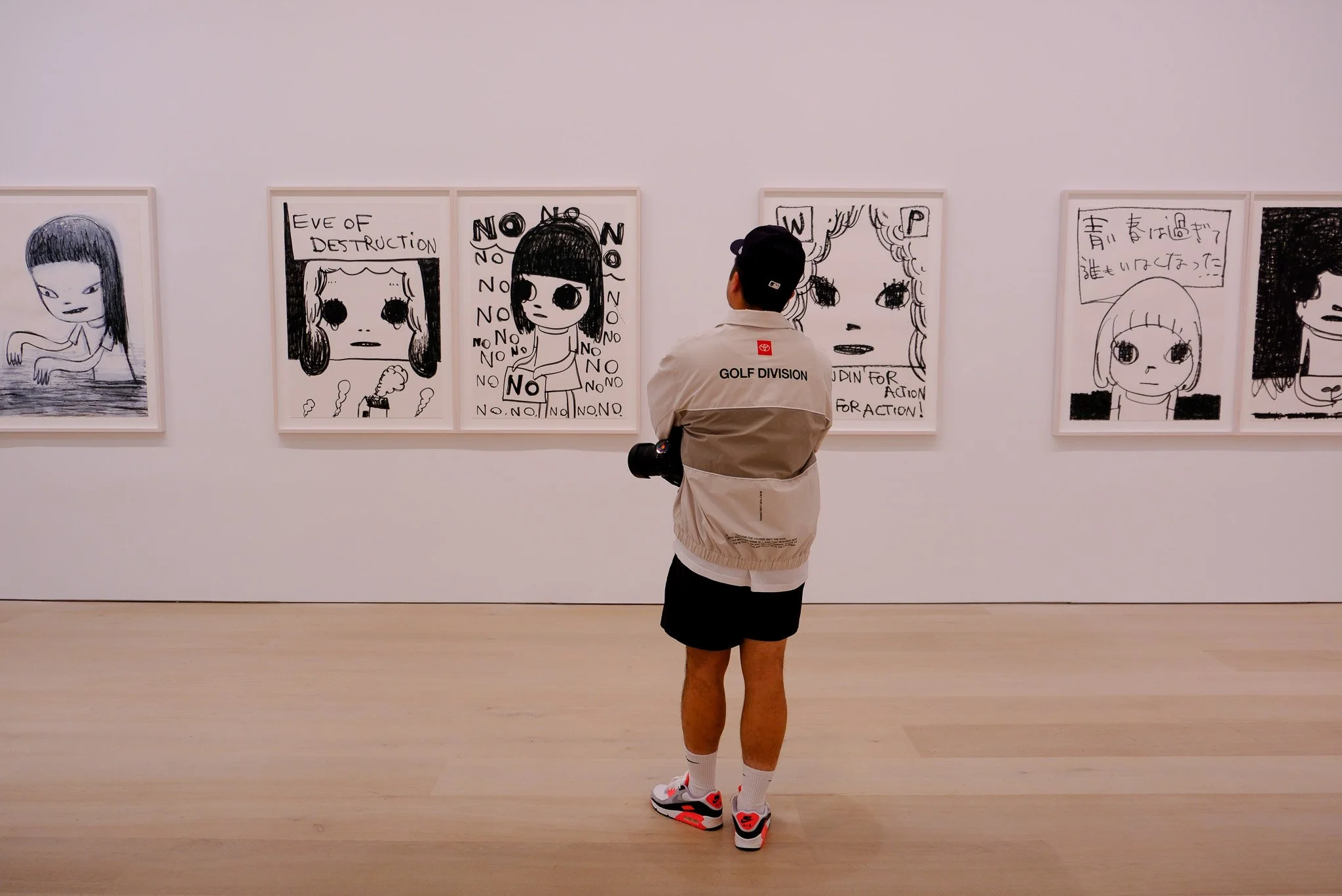
A photograph considers Eve of Destruction and No, No, No both 2026 oil stick works. Photo: Jamie Lubetkin
Also on display is a new group of large-format monochrome drawings, rendered using oil-based paint sticks, that demonstrate an artist who at 66 remains comfortable with lines and symbols. These works, more than the others, show Nara engaging with the very issues that might bring tears to the eyes of real girls: growing up, survival, death. They recall the marker drawings he rendered one night in 2009 on the walls of the East Village bar Niagara. Those drawings are still there, by the way, if you’re interested in experiencing Nara in the wild.
Meanwhile, around the block, the 19th Street gallery holds the sculptural half of the proceedings: 13 bronze heads from 2024, every one 10 times the size of the tiny clay heads Nara molded by hand. The heads recall the snow monsters that Nara knew from his childhood growing up in the shadow of Mount Hakkōda. Even as he shaped them in the palm of his hand, Nara was contemplating how viewers might perceive something so small rendered on a monumental scale.
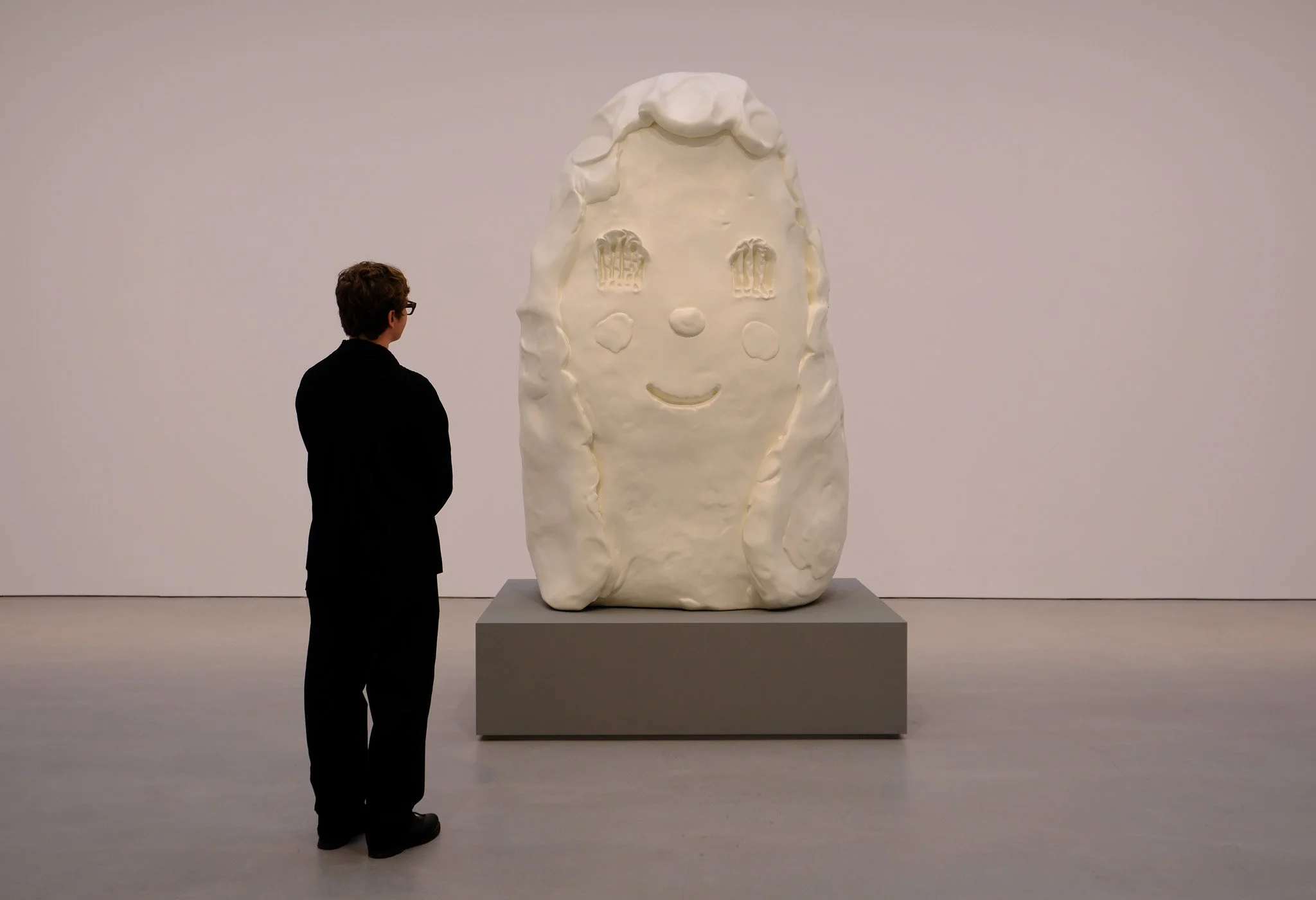
Long Tall Peace sister, a bronze sculpture by Nara. A larger version is on display at the Smithsonian's Hirshhorn Sculpture Garden. Photo: Jamie Lubetkin
The sculptures present as giant faces, each coated in flat white urethane paint that makes them seem soft, like marshmallows. Among them is Long Tall Peace Sister, a monumental Nara girl in three dimensions, her hair pressed clumsily against her head, her smile slight, her eyes a series of vertical lines that look like barred windows.
The heads at Zwirner run concurrently with Sentinels of Stillness, a selection of three heads from the same body of work that make up the inaugural West Lawn series at the newly redesigned Hirshhorn Sculpture Garden at the Smithsonian in Washington. The heads at the Hirshhorn, which include a version of Long Tall Peace Sister, are even larger at 16 times scale and cast in aluminum rather than bronze.
Yoshitomo Nara is on view at David Zwirner, 537 West 20th Street and 533 West 19th Street, New York, November 5 through December 12. Yoshitomo Nara: Sentinels of Stillness is on view at the Hirshhorn Museum and Sculpture Garden, Washington, through November 7, 2027.