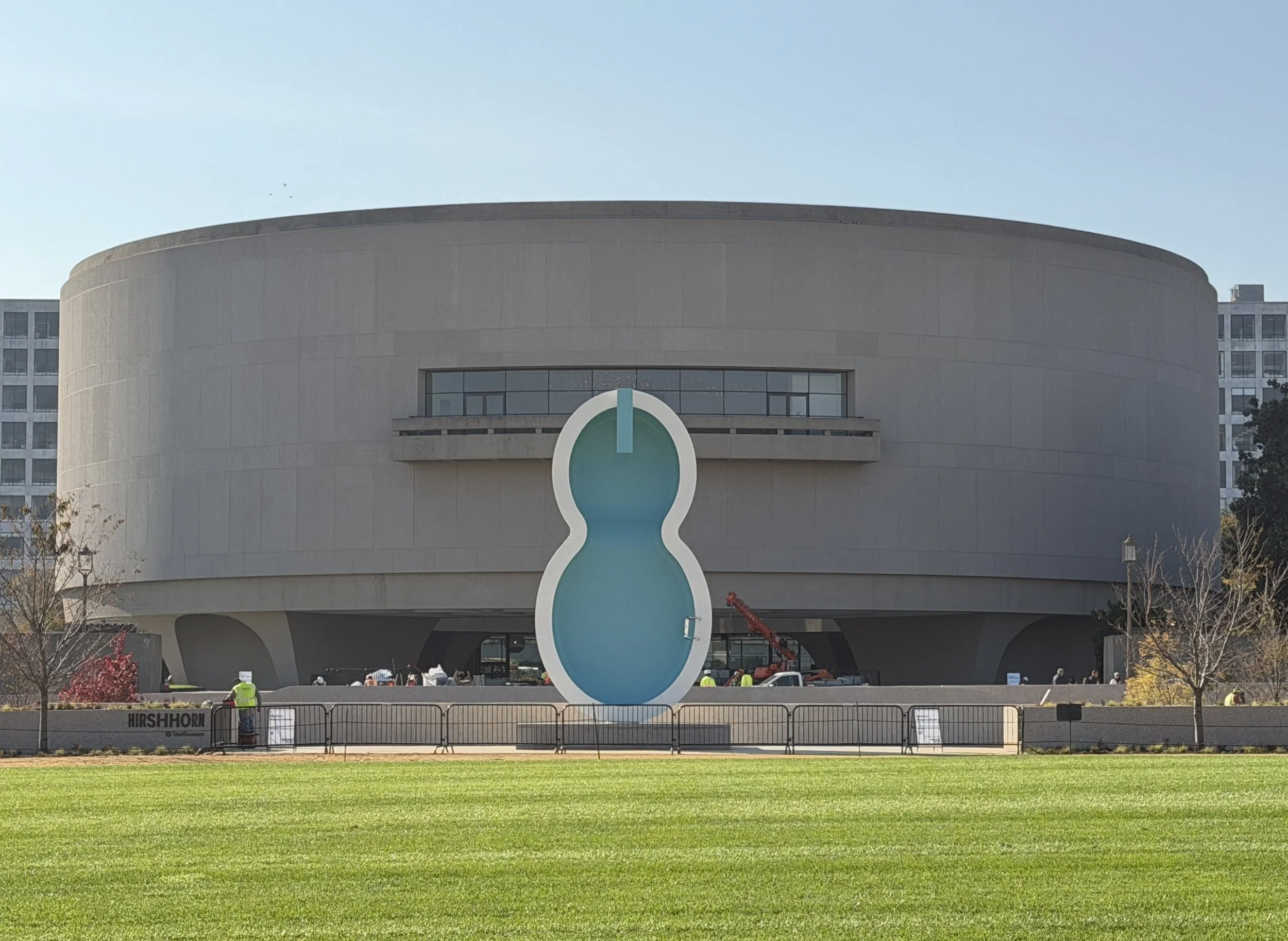
The monumental sculpture Eight, by artist duo Elmgree and Dragset, draws attention to the sculpture garden and the Hirshhorn Museum itself on the National Mall. Photo: J. Scott Orr
WASHINGTON — It’s peaceful on the West Lawn right now, no one here but three Japanese giants that go by the names Long Tall Peace Sister, Smiling, and Tiny Bright Round Eyes. The trio’s faces seem lit up; their eyes glow warmly like lanterns; their smiles are slight, but unforced; overall their demeanor is calm, curious, and contemplative. Could there be some anticipation in the air here on the National Mall? The three ladies are, after all, the stars of this weekend’s reopening of a half-century old national treasure, an event that has been four years and $68 million in the making.
Long Tall Peace Sister, “Smiling, and Tiny Bright Round Eyes are monumental sculptures by celebrated Japanese artist Yoshitomo Nara installed at the west end of the soon-to-reopen Sculpture Garden at the Smithsonian’s Hirshhorn Museum. The three supersized heads, fabricated in aluminum under shimmering coats of white urethane paint, are here to help celebrate the opening of this third iteration of the Hirshhorn Sculpture Garden. The 1.3 acre sunken garden, which made its debut along with the Hirshhorn Museum in 1974 and is the only Smithsonian exhibition space that is actually on the mall, reopens October 31 after a years-long closure.
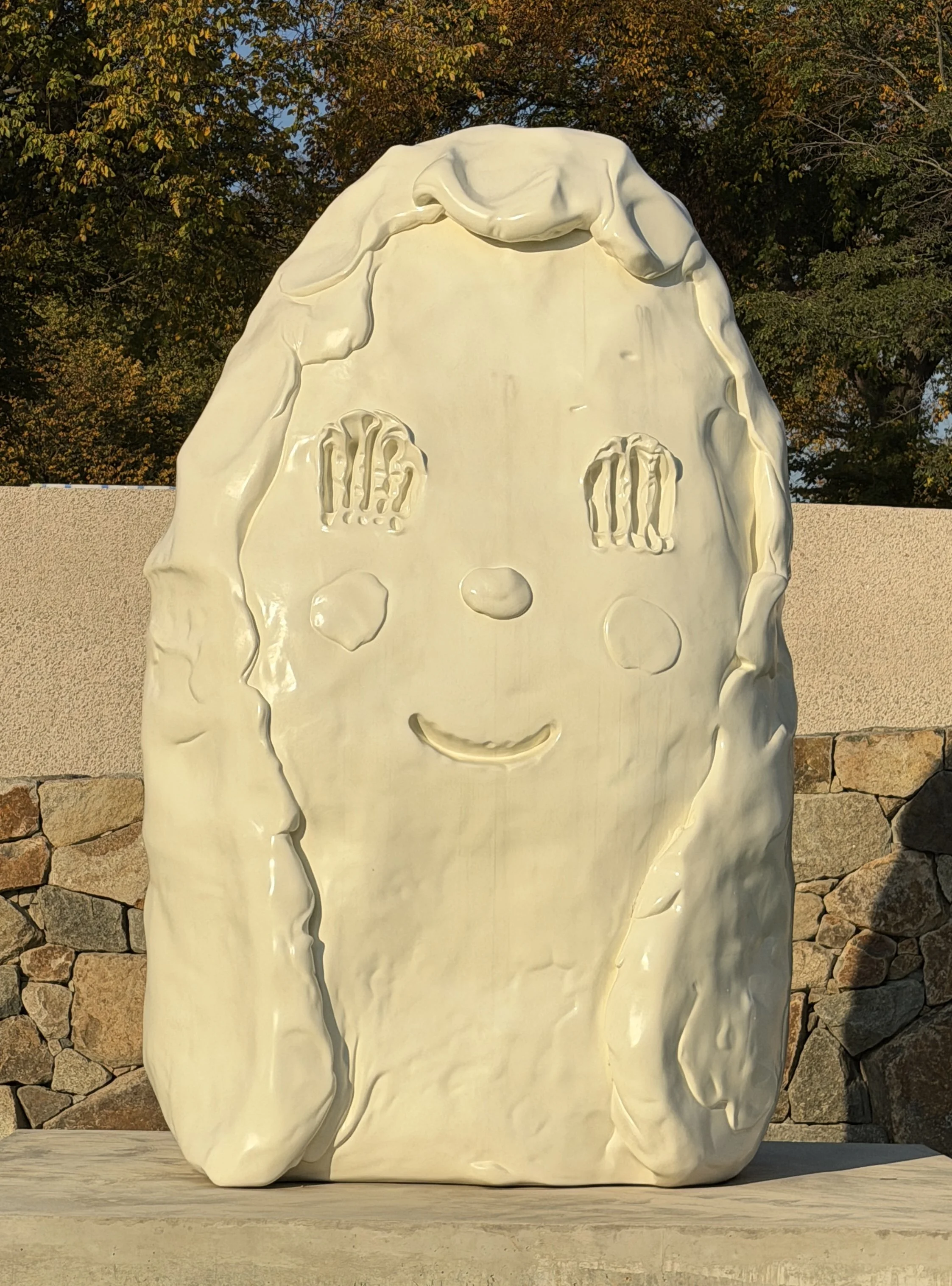
Nara’s Long Tall Peace Sister anchors the garden's West Lawn. Photo: J. Scott Orr
That the work of a Japanese artist should be chosen as the first in a series of annual exhibitions on the garden’s West Lawn is fitting. The garden redesign is by Japanese architect-artist Hiroshi Sugimoto, who said he sought to incorporate aesthetics drawn from medieval Japanese Zen gardens into his plan. That works perfectly in updating the original design by Gordon Bunshaft, who contemplated Japanese gardens in his original layout for the place more than 50 years ago.
At this latest redesign’s groundbreaking in 2022, Sugimoto said Bunshaft, the architect who also designed the cylindrical Hirshhorn Museum, "was strongly influenced by Japanese gardens.” He went on to say that his redesign "incorporates my own Sugimoto-style Japanese aesthetics. It picks up where Bunshaft left off, creating a space for exploration and a place where contemporary can dialogue with the past."
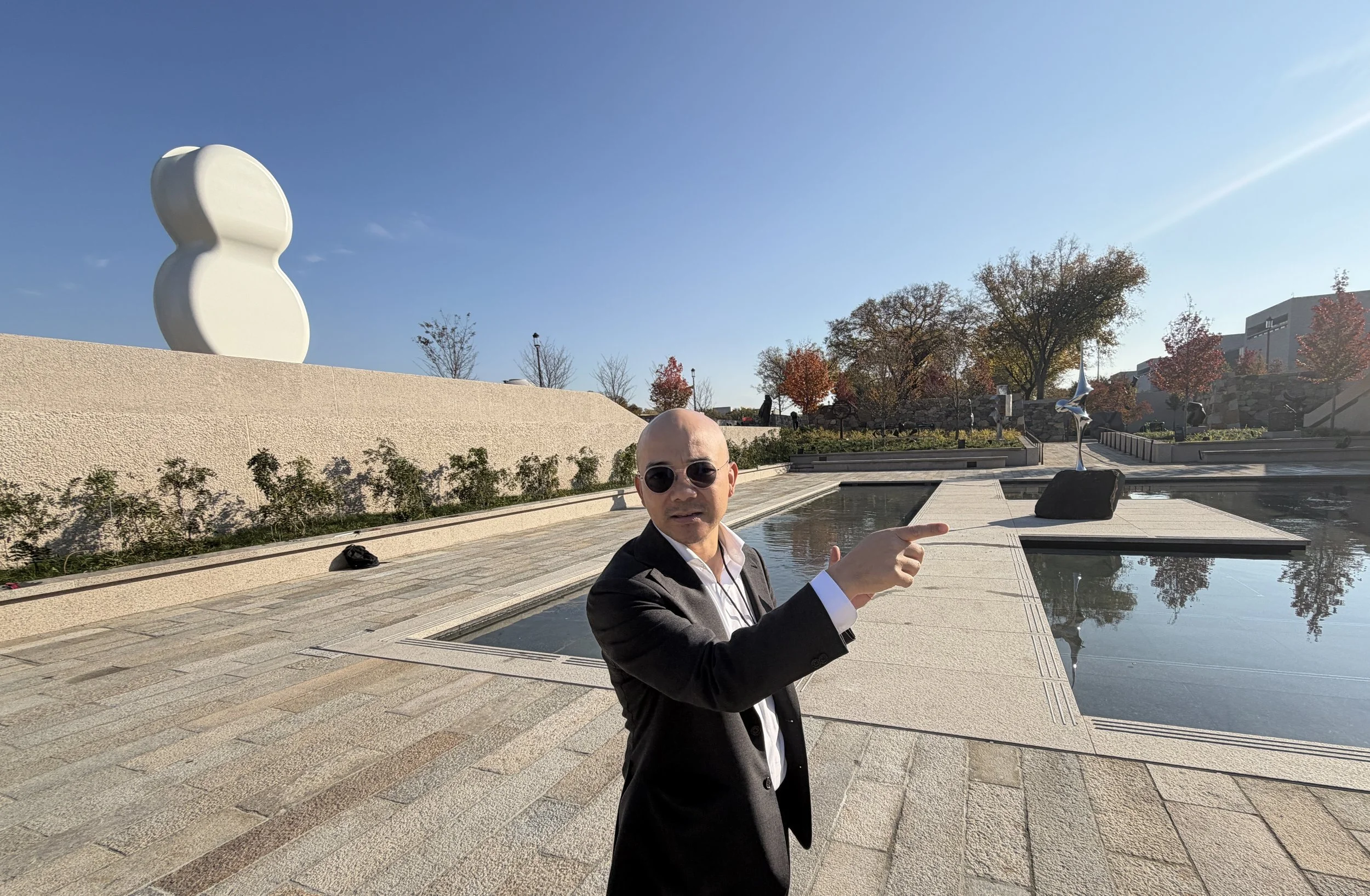
Hirshhorn’s acting director Aaron Seeto discusses the redesign of the sculpture garden on the eve of its reopening. Photo: J. Scott Orr
But if there are Japanese influences, they are only that. There are no lanterns, torii or other clichés, only dry-stacked stone walls, hand-hewn and set by 30 stonemasons brought over from Tokyo. "Clearly, Sugimoto is a Japanese artist and architect so you see the influence, but it is quite unlike a Japanese garden,” the Hirshhorn’s acting director Aaron Seeto said during an interview with Whitehot.
Marina Isgro, a Hirshhorn curator who led a press tour of the garden in advance of its opening, said the stones came from quarries in Massachusetts and Maine, though the pavers came from China.
“These pavers that you’re seeing were sourced by Sugimoto from China from sidewalks and other areas that were being torn up. He then laid the whole floor out in China to create a kind of variation in the patina of the stones. He numbered them, shipped them to the U.S., and then they were installed here,” she said.
In a 2021 essay published by the New York Times, Sugimoto said he felt augmenting the original Brutalist concrete walls of the garden with the natural stone could fit nicely with Bunshaft’s vision. Bunshaft, he wrote, “was deeply influenced by the stone gardens of medieval Japan. Inspired by Bunshaft's dream of a modernist stone garden, I decided that a Japanese dry stone wall could act as a symbolic link between the ancient and the modern, providing the perfect background for the museum's modernist sculptures.”
And that background is, indeed, pretty perfect. “The stone,” Seeto said. “makes you aware of the aggregate nature of the concrete. This concrete is actually made of stones. If you go into the garden these modern bronzes are set off by this material? So there is a complexity of thinking about materials in the garden. It is, I think, truly sympathetic to Bunshaft's ideals.”
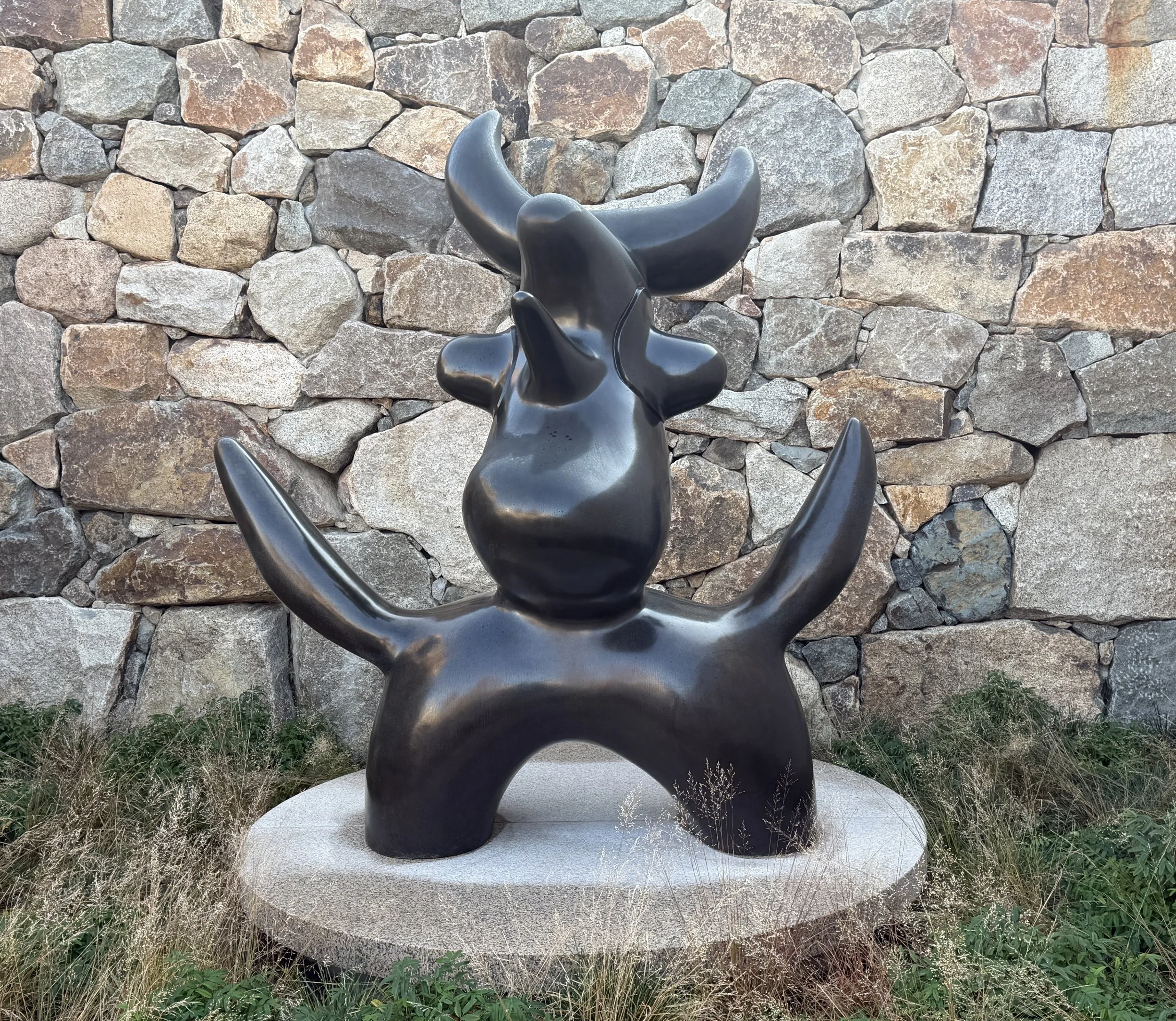
“Lunar Bird” by Joan Miró, a bronze from the Hirshhorn’s permanent collection. Photo: J. Scott Orr
On the east end opposite the Nara installation, the sculpture from Hirshhorn's permanent collection is adjusting nicely to its new surroundings. Joan Miró’s Lunar Bird (1945, cast 1966–67) is tucked cozily into a corner at the intersection of two brown, gray and white stone walls. Monumental Head (1960) by Alberto Giacometti and Grain (1955) by Germaine Richier share a space consisting of one stone wall and one of concrete. The Back I-IV (1909, 1913, 1916-1917, 1930-1931), by Henri Matisse, sit sublimely on a plain concrete wall.
In addition to the 950 tons of stone wall, the redesign called for 30,000 new plants and trees, which is 29,999 more than Bunshaft included in his original design. Not wanting the landscaping to distract from the sculpture, Bunshaft included just a single tree in his design, along with a reflecting pool, lots and lots of gravel and little else. That layout was unappealing to visitors, particularly during Washington’s hot and humid summers, prompting the need for an intervention by landscape architect Lester Collins that opened in 1981.
In all, there are 60 works on display, 25 more than were being shown when the garden was closed for renovation. The garden, once a barren open sprawl, is the same size as before but it is now partitioned by Sugimoto’s walls into three gallery-like sections: the East Garden where the permanent collection resides; the West Lawn where visiting artwork like Nara’s is installed; and the Central Garden with two reflecting pools, a walkway, a stage and tiered seating. The Central Garden also includes the mouth of the Passage of Reflectance, the reopened tunnel that leads into the Hirshhorn Museum.
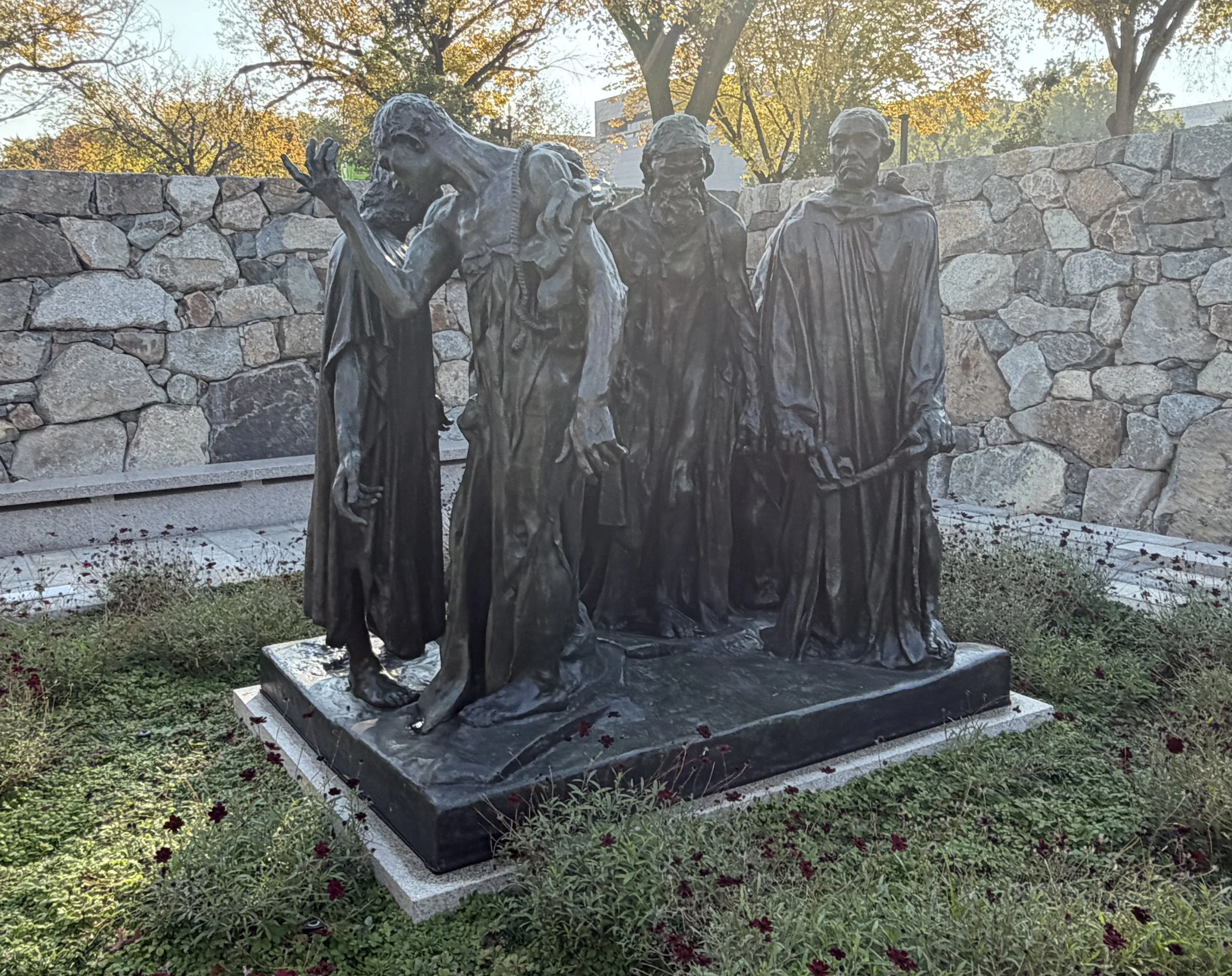
Auguste Rodin's The Burghers of Calai from the Hirshhorn’s permaent collection. Photo: J. Scott Orr
Sugimoto’s design was hardly without its detractors. Some critics suggested the new design disregarded the Brutalist leaning of the original design. The Cultural Landscape Foundation, a nonprofit that seeks to protect America’s cultural landscape, designated the sculpture garden as “threatened” in 2019 because Sugimoto’s new design would wipe out the 1980s work of Collins.
But Seeto said the Sugimoto design respected the garden’s past while at the same time making it more appealing to visitors. "We want people to linger. We want people to feel shaded. We want senses of intimacy and openness and welcome," Seeto said.
If there was a miscalculation in the Smithsonian’s plan for the opening of the new sculpture garden, it’s in its timing. Sure, the fall is nice in the nation’s capital, but the new design features a spectacular row of cherry trees flanking its entrance along the Mall. A spring opening would have coincided with the bloom of the cherry trees, which have been brightening Washington springs since the first batch of Yoshino cherries were donated to the U.S. more than a century ago by Japan.