Arlene Shechet: She Said She Said at Pace Gallery
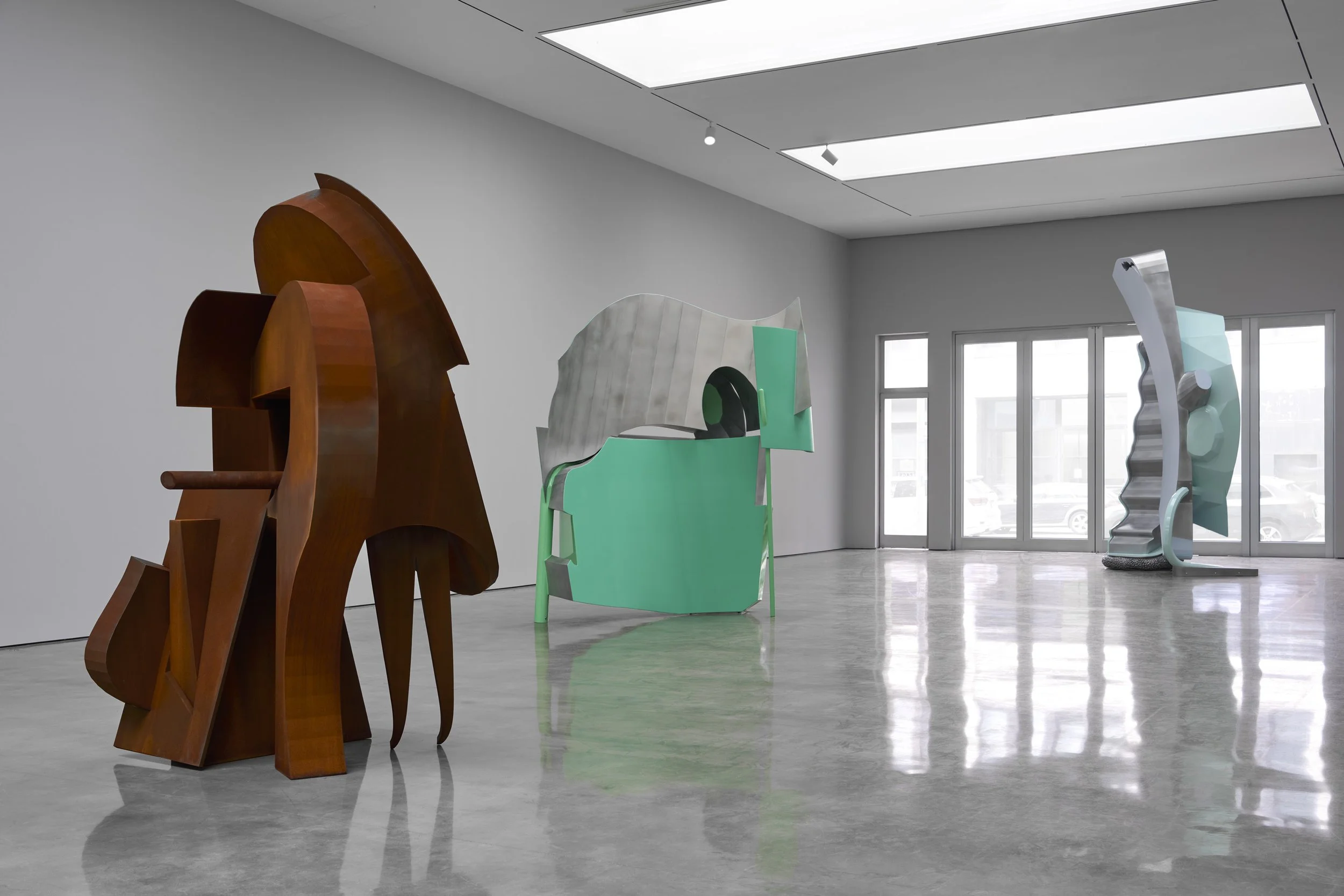
Arlene Shechet: She Said She Said 508 & 510 West 25th Street, New York, NY 10001 September 11- October 24, 2026 Photo courtesy Pace Gallery
Coming off her success at Storm King Art Center, where she exhibited six monumental sculptures in the exhibition Girl Group, Arlene Shechet is presenting a solo exhibition titled She Said She Said at Pace Gallery in Chelsea. The show features three new monumental sculptures alongside a new series of ceramic works. Girl Group at Storm King was a major success for Shechet, with Storm King acquiring Bea Blue, the Hirshhorn Museum acquiring Maiden May, and Crystal Bridges acquiring Midnight. The sculptures are mostly made of bent aluminum and are painted. Part of the aesthetic of the pieces is the construction technique of bending sheets of aluminum in segments, giving the curves a faceted effect. Shechet embraces the marks of the fabrication process, leaving them visible to the viewer and making fabrication an integral part of her aesthetic. For the two largest pieces in She Said She Said, Shechet embraced the same aesthetic and construction process.
Upon entering the gallery at Pace, one is immediately confronted with Eve, the largest piece in the show. It is close to seventeen feet tall and is installed in Pace's large gallery with two other of her sculptures, Jewel and Flo. The artist has stated that she wanted the sculptures to have feminine proper names that also carried a double meaning. Both Eve and Jewel are closely related to her monumental work at Storm King and would have easily fit into the Girl Group exhibition. Both are made of bent and welded aluminum and painted in color palettes that lean toward the pastel. The color scheme may evoke a traditionally feminine aesthetic, but through the scale of the pieces, Shechet asserts her presence in the realm of monumental sculpture, a field historically dominated by male sculptors. With Flo, Shechet makes a clear departure, directly confronting that tradition. Made of Corten steel, Flo invokes a material strongly associated with Richard Serra, one of the most overtly masculine figures in the history of monumental steel sculpture.
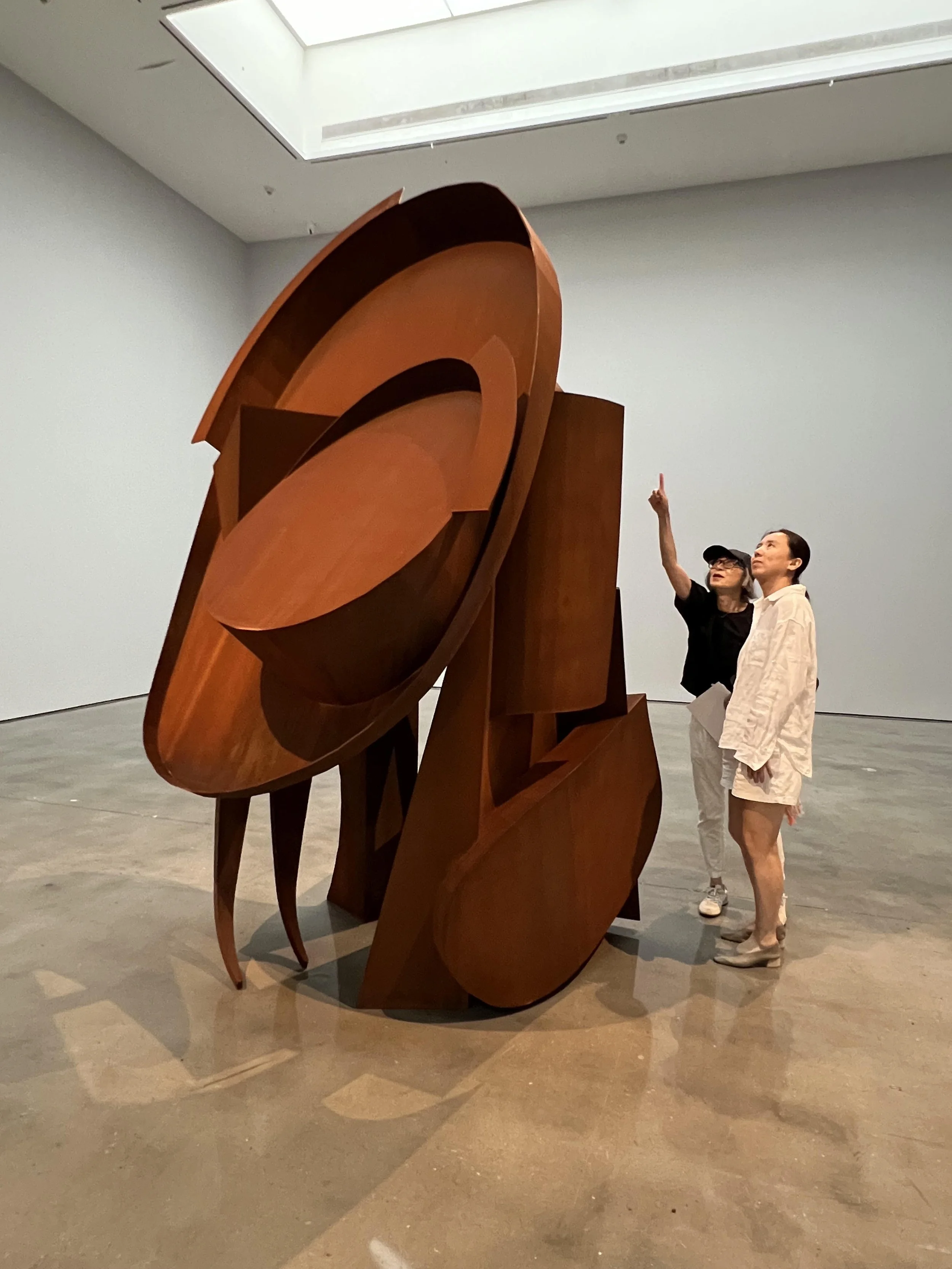
Arlene Shechet: She Said She Said, Flo, 508 & 510 West 25th Street, New York, NY 10001 September 11- October 24, 2026 Photo: Michael Wolf
Flo is a standout in the exhibition. Unlike Eve and Jewel, and the sculptures in Girl Group, it is unpainted, revelling in the natural brown-orange patina of rusted Corten steel. The monochrome surface allows the viewer to fully appreciate Shechet’s mastery of three-dimensional form. Flo is truly a sculpture in the round: there is no front, no back, and no “best side.” The sculpture is engaging from every angle, drawing the viewer in and encouraging them to move around it, observing and appreciating its shifting forms. From the side where you first approach it, concentric, fragmented circles dominate, while an oblong form near the bottom wraps around the sculpture, leading the viewer toward the opposite side. There, the sculpture becomes almost Cubist, with a question-mark-like form, fragmented geometric shapes, and solid volumes creating deep recesses and a variety of intriguing shadows. The sculpture seems to yearn to be outdoors, where the movement of the sun would create continually shifting shadows.
In an adjacent gallery, Shechet is showing a new body of ceramic work, where the smaller scale and malleability of clay allowed her to work more spontaneously and quickly, creating a larger body of work than would have been possible with aluminum and Corten steel. The artist stated that some of the pieces in this body of work draw inspiration from art-historical sources. She explained that the cantilevered pieces reference Donald Judd’s wall-hung “stack” sculptures, while Touching Ground: Statue has a relationship to Auguste Rodin’s standing figurative sculpture Monument to Balzac. Touching Ground: Statue is constructed from slabs of clay formed into a rectangular, open box that appears distorted by the weight of the clay when it was wet. Inside the rectangular form, another slab is bent into an “S” shape, recalling the standing posture of Balzac in Rodin’s nude study for the sculpture. While Shechet discusses her connections to Judd and Rodin, other art-historical relationships go unmentioned. The rectangular, box-like forms that appear throughout the ceramic sculptures recall Louise Nevelson’s work and also the Surrealist boxes of Joseph Cornell. Nevelson used rectangular boxes as modular elements, stacking and combining them, while Shechet uses them as standalone forms. Even so, there is a clear connection between the two artists, particularly in their use of rhythm and shadow. Shechet can be seen as an artistic descendant of Nevelson, not only in her formal approach but also in her willingness to assert herself within a historically male-dominated field of sculpture.
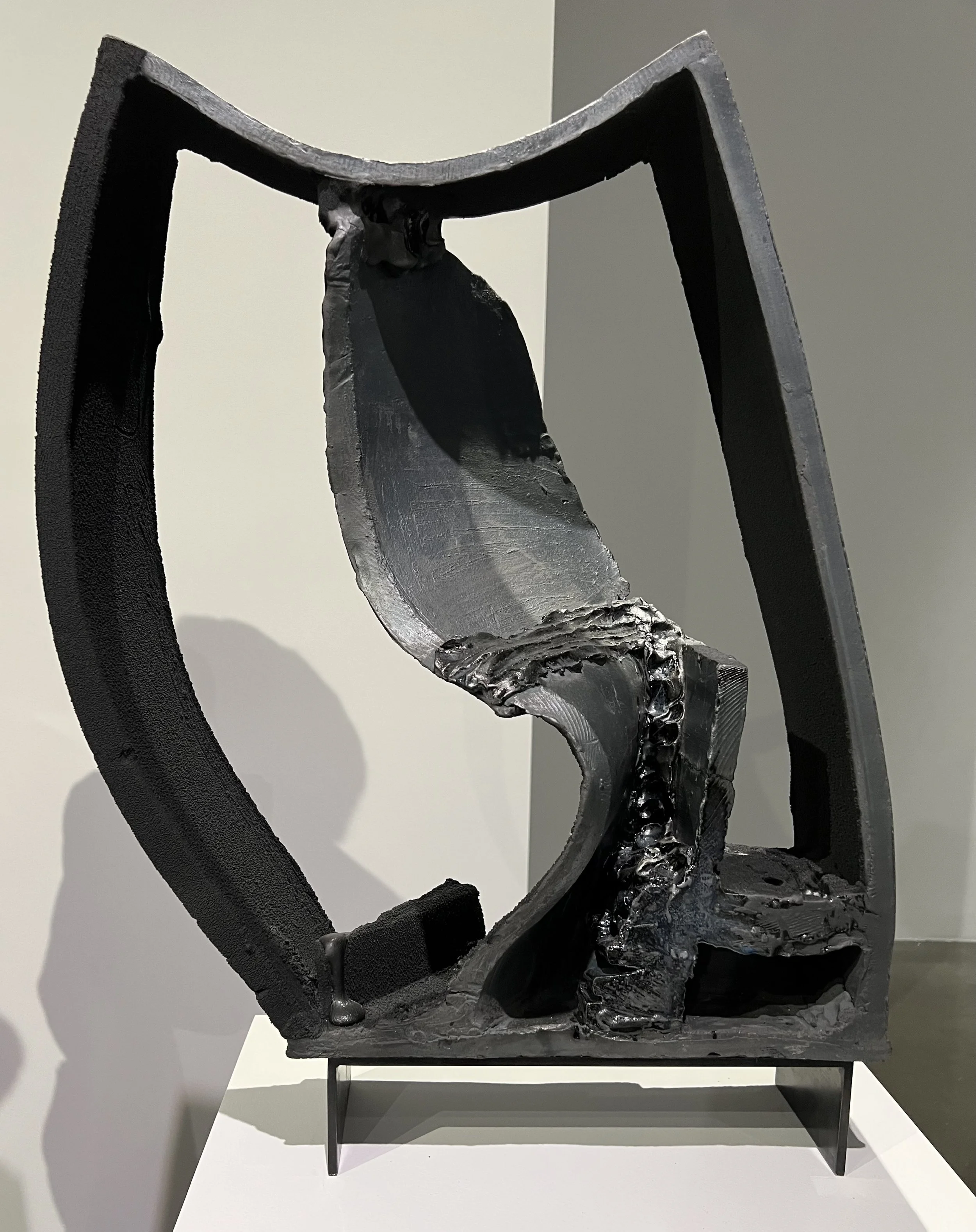
Arlene Shechet, Touching Ground: Statue, 2026 Terra sigillata, glazed ceramic and steel, Sculpture: 59.4 cm × 52.1 cm × 20.3 cm Photo courtesy of the Author, Michael Wolf
The artist ingeniously displays the sculptures in a variety of ways. As mentioned, some are cantilevered from the wall in the manner of Judd, some sit on standard white gallery pedestals of varying heights, some have custom-built bases, while others are built into niches in the walls. This variety of display methods exemplifies Shechet’s playful approach to all facets of her artmaking. In this exhibition, she is most playful in the ceramic series, experimenting with form, shape, and a wide variety of textures. The monumental sculptures are also playful, but their scale and construction command a more serious investigation of the formal aspects of sculpture. In the ceramics, Shechet’s playfulness comes through in her experimentation with form and texture, while in the monumental sculptures it emerges through scale, construction, and the viewer’s movement around the work.
She Said She Said demonstrates Shechet’s ability to move between playfulness and formal rigor. Whether working on a monumental scale in aluminum and Corten steel or experimenting with the more immediate possibilities of clay, she approaches sculpture as both a physical and formal process. Her references to art-historical figures place the new work within a larger history of sculpture, while her affinity with Nevelson suggests a lineage of female artists who have challenged the conventions of a traditionally male-dominated field.
Arlene Shechet: She Said She Said
September 11th - October 24th
Pace Gallery
508 & 510 West 25th St. NY, NY