Roy Lichtenstein, Girl in Window (Study for World's Fair Mural), 1963. Photo courtesy Whitney Museum of American Art
In just a handful of sketches, studies and unfinished works, a new show at the Whitney shows how Roy Lichtenstein worked through ideas during the final year of his life. It’s an interesting way of whetting New York’s appetite for the major retrospective of work by the Pop Art legend coming here in October.
The fall two-parter casts a long-overdue spotlight on an American master whose sweeping career helped redraw the boundaries of contemporary art. Roy Lichtenstein: Like New is the westside gallery’s first comprehensive survey of Lichtenstein’s work in more than two decades.
But before the Benday dots start flying on the Whitney’s fifth floor, Roy Lichtenstein: 1997, on the museum’s third floor, concentrates on the final year of his life, bringing together drawings, collages, prints, photographs and sculptural maquettes, including material for projects he never completed. Lichtenstein died in September 1997 at 73.
A pair of studies for a proposed mural at the Bellagio Hotel in Las Vegas makes Lichtenstein's latter day process unusually visible. In an early drawing for Still Life with Reclining Nude, the room, the nude, portrait, flower pot, chair, trees outside a window are rendered loosely. After being recast with Lichtenstein’s patented precision, diagonal stripes and dots bring the room into graphic focus.
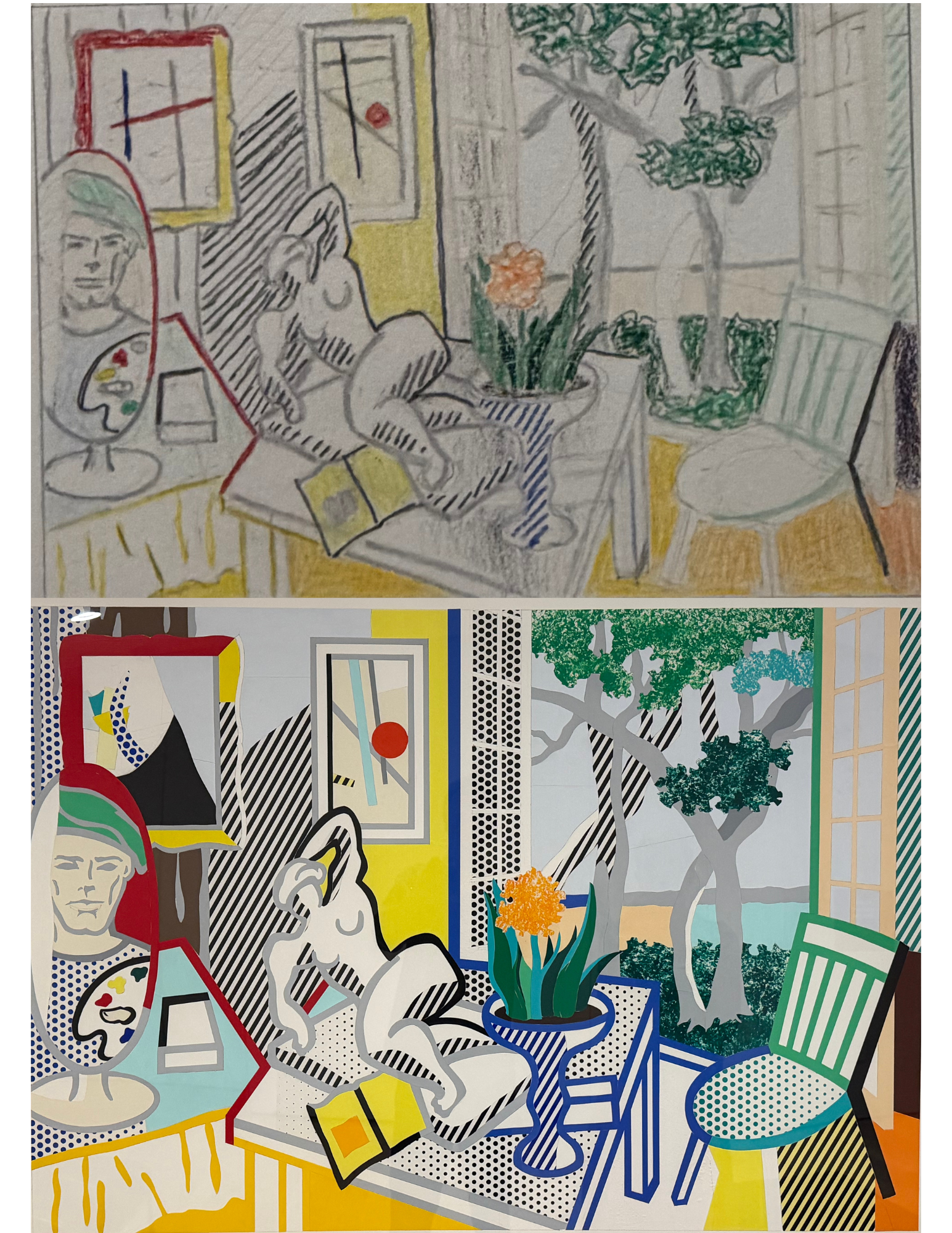
Bellagio Hotel Mural: Still Life with Reclining Nude (Study), 1997.
The transformation helps explain something about Lichtenstein’s process and ultimately his work. In a 1963 interview with Richard Brown Baker for the Smithsonian’s Archives of American Art, he acknowledged how closely his paintings could resemble their source material, but added, “there’s nothing in my work that’s in the same positions really.” The small changes, Baker proposed to him, were precisely where the art resided. Lichtenstein agreed.
The House study demonstrates how a spare graphite drawing of an ordinary pitched-roof house is but a suggestion of the finished work to come. The developed image converts it into blocks of white, yellow and red bounded by heavy black lines. Lichtenstein began developing his House sculptures in 1996, manipulating perspective so that a three-dimensional structure could seem to project or recede as the viewer moved around it.
Roy Lichtenstein: Like New, on the Whitney’s fifth floor, will gather more than 130 works spanning six decades, from the 1940s through the 1990s, including Look Mickey (1961), Drowning Girl (1963) and Happy Tears (1964). The exhibition will also reunite all eight works from his landmark 1962 debut at Leo Castelli Gallery, the show that helped establish him as one of Pop’s central figures.
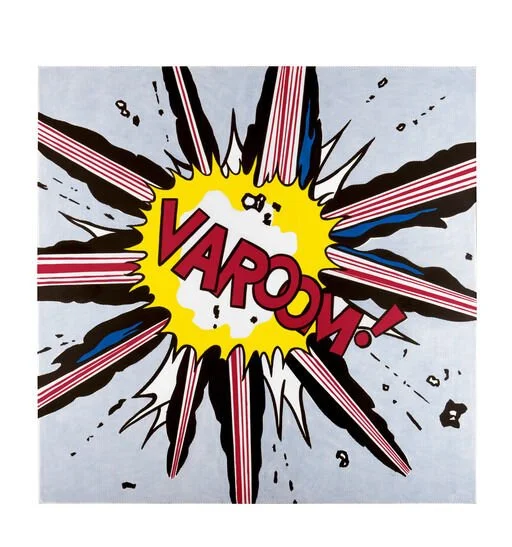
Roy Lichtenstein, Varoom!, 1963. Photo courtesy Whitney Museum of American Art
Regarded today as masterpieces of mid-century contemporary art, these paintings were hardly overnight hits. When Lichtenstein carried several of his new works into Castelli’s gallery in 1961, gallery director Ivan Karp remembered thinking, “You just can’t do this.” He soon reconsidered. Karp recalled that Castelli was receptive to “something dead-center American.”
Lichtenstein had found his subject in the commercial imagery surrounding him. In a 1966 interview, he described contemporary America in terms that make Pop sound less like a style than an act of reportage: “Almost all of the landscape, all of our environment, seems to be made up partially of the desire to sell products.” He wanted not only to portray that landscape, he said, but to work in its style.
Varoom! (1963), Crying Girl (1963) and Ohhh...Alright... (1964), all headed for the October exhibition, come with Lichtenstein signature comic-book melodrama, cheap printing techniques inflated to the scale of serious painting and mass-produced images returned to the viewer as singular art objects.
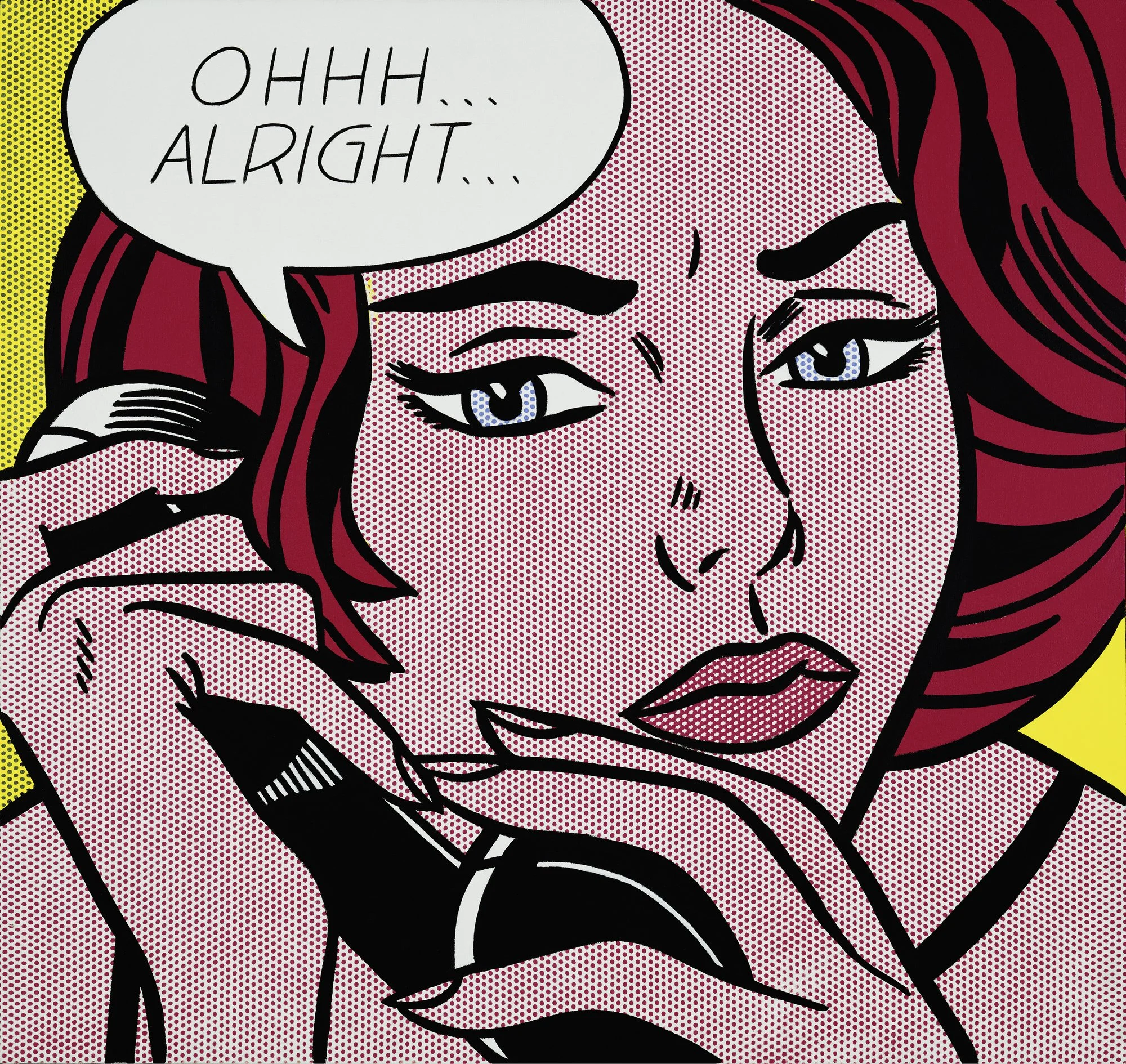
Roy Lichtenstein, Ohhh... Alright..., 1964. Photo courtesy Whitney Museum of American Art
While the dots were seen as disruptive, even disrespectful of contemporary art rules, they were never merely decoration. “What I’m interested in is examining printing processes, ways things are reproduced and disseminated,” Lichtenstein explained in an archival recording presented by the National Gallery of Art. Magnifying the dots gave viewers a look at where the images bombarding them came from.
Sixty-five years later, reproduction and dissemination have swallowed much of visual culture. Images are copied, cropped, filtered, memed and reposted almost instantaneously. Lichtenstein got there first, with crisp black lines and fields of dots.
Open now at the Whitney: Roy Lichtenstein: 1997. Open Oct. 11: Roy Lichtenstein: Like New.